TL;DR:
- Getting freight classification wrong is costly, with up to 25% of shipments requiring reclassification or reweighing, leading to unexpected charges and delays.
- The 2025 NMFC overhaul simplifies classification by relying mainly on precise density measurements, but errors in measurement and coding remain common.
Getting freight classification wrong is one of the most expensive mistakes in LTL shipping, and it happens more often than most logistics professionals expect. Up to 25% of shipments undergo reclassification or reweighing, resulting in unexpected charges and delays that erode margins and strain carrier relationships. This freight classifications guide breaks down the NMFC system, the four core classification factors, the landmark 2025 overhaul, and the practical steps you need to assign the right class, every time.
Table of Contents
- Key takeaways
- The NMFC freight classifications guide: how the system works
- The four factors that determine freight class
- The 2025 NMFC overhaul: what changed and why it matters
- Common mistakes and best practices for accurate classification
- My take on freight classification after years in logistics
- How Worldwideexpress helps you get classification right
- FAQ
Key takeaways
| Point | Details |
|---|---|
| NMFC governs 18 freight classes | Classes range from 50 to 500, with density as the primary pricing driver under the updated 2025 rules. |
| Four factors determine class | Density, stowability, handling, and liability each influence final class assignment, especially for specialty commodities. |
| 2025 overhaul changes the game | A unified 13-tier density scale took effect July 19, 2025, reducing complexity but demanding precise measurements. |
| Errors carry real cost | Misclassification triggers reclassification fees, invoice corrections above quoted rates, and shipment delays. |
| Audits prevent surprises | Pre-tender freight bill audit loops catch classification mismatches before they turn into disputed invoices. |
The NMFC freight classifications guide: how the system works
The National Motor Freight Classification system is maintained by the National Motor Freight Traffic Association (NMFTA), a nonprofit organization that establishes standardized shipping class definitions for LTL carriers across North America. Without this system, every carrier would price freight using its own proprietary criteria, making rate comparison nearly impossible for shippers.
The system defines 18 freight classes, spanning from Class 50 at the low end to Class 500 at the high end. Class 50 represents the densest, most easily handled freight, such as heavy metal parts or flooring materials, and commands the lowest shipping rates. Class 500 represents items that are extremely light relative to the space they occupy, such as ping pong balls or gold dust, and carries the highest rates.
The logic behind the range is straightforward. Class 50 shipments weigh out before cubing out, meaning they fill a trailer’s weight capacity before filling its volume. Class 500 shipments do the opposite, consuming trailer space while contributing almost no weight. Carriers price accordingly because unused trailer space is lost revenue.
The table below gives you a working reference across the full class range.
| Freight class | Density (lbs per cubic ft) | Sample commodities |
|---|---|---|
| 50 | Over 50 | Metal parts, flooring, heavy machinery |
| 55 | 35–50 | Bricks, cement, hardwood flooring |
| 65 | 22.5–35 | Car accessories, bottled beverages |
| 85 | 15–22.5 | Crated machinery, cast iron stoves |
| 100 | 13.5–15 | Boat covers, wine cases |
| 125 | 12–13.5 | Small appliances, auto glass |
| 150 | 10.5–12 | Sheet metal, rolled paper |
| 175 | 9–10.5 | Clothing, couches, stuffed furniture |
| 200 | 8–9 | Auto sheet metal parts, mattresses |
| 250 | 7–8 | Bamboo furniture, plasma TVs |
| 300 | 6–7 | Wood cabinets, tables, bar fixtures |
| 400 | 5–6 | Deer antlers, loose mail bags |
| 500 | Below 1 | Ping pong balls, gold dust |
This table is not exhaustive, but it gives you a clear picture of how density and commodity type intersect within the freight classification system.
The four factors that determine freight class
Most shippers focus exclusively on density and get blindsided when a carrier assigns a different class. Density is the dominant factor, but three others can override or adjust it significantly.
Density
Density is weight per cubic foot. The formula is straightforward: divide the shipment’s weight in pounds by its volume in cubic feet. To convert cubic inches to cubic feet, you divide by 1,728.
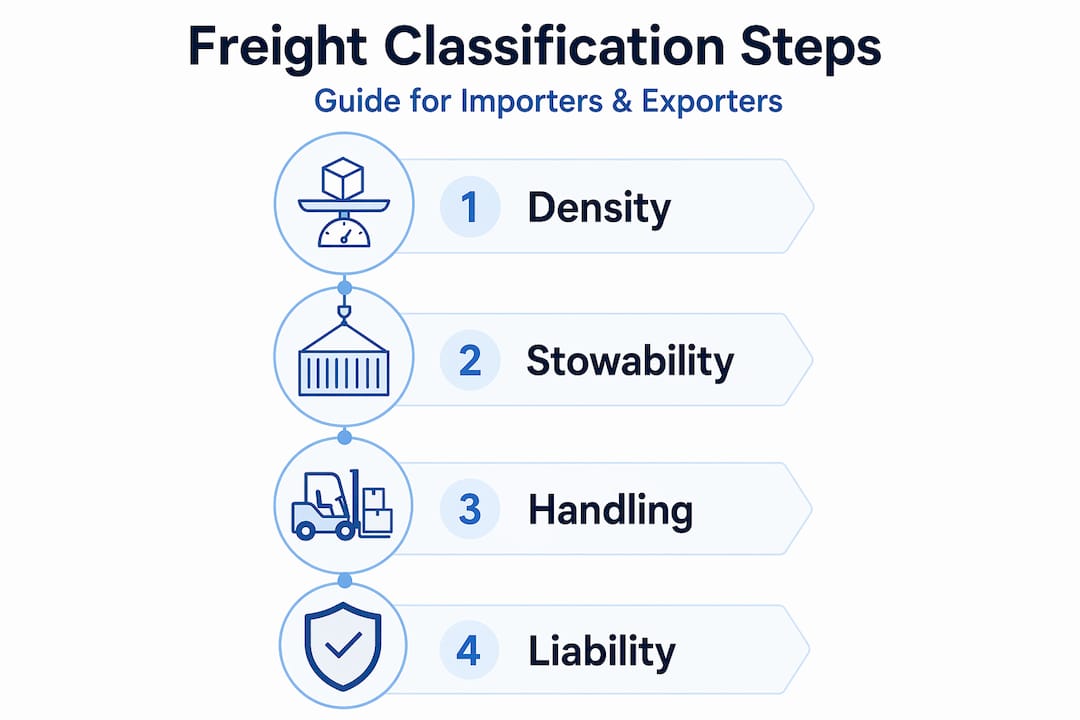
The density calculation looks like this: Density = Weight (lbs) / (Length x Width x Height in inches / 1,728). A 200-pound shipment measuring 40 x 48 x 40 inches occupies 37.04 cubic feet, giving a density of roughly 5.4 lbs per cubic foot and landing in Class 300.
Stowability
Stowability measures how easily freight loads alongside other shipments in a trailer. Oversize items, hazardous materials, and irregularly shaped freight score poorly on stowability, which pushes the class upward. A roll of carpet and a standard pallet have very different stowability profiles, even at similar densities.

Handling
Some freight demands special equipment, extra labor, or unusual care during loading and unloading. Fragile items, live animals, and unusually shaped packages all present handling challenges that increase class. A standard box of steel bolts and a crated piece of sculpture may weigh the same per cubic foot, but the sculpture will cost significantly more to ship.
Liability
Liability accounts for the risk a carrier takes on when moving your freight. High-value items, perishables, and goods with a history of theft or damage carry higher liability and therefore higher freight classes. Jewelry and electronics, for example, sit at a higher class than iron pipe fittings of similar density.
Pro Tip: When you have a commodity that scores high on stowability, handling, or liability, do not assume density alone will set your class. Check whether your product has a specific NMFC item number, because certain commodities carry fixed codes that override the density calculation entirely.
The 2025 NMFC overhaul: what changed and why it matters
The most significant restructuring of the NMFC system in decades took effect on July 19, 2025. The update, known as Docket 2025-1, replaces the previous patchwork of commodity-specific rules with a unified 13-tier density scale that governs the majority of LTL freight. The intent is to reduce reclassifications and make freight pricing more predictable for both shippers and carriers.
For most commodities, the new system means classification comes down almost entirely to measured density. If you know your shipment’s weight and dimensions accurately, you can determine the class with confidence. That is a meaningful improvement over the old framework, where navigating commodity-specific rules required extensive reference checks.
However, the overhaul does not eliminate special-case handling. Freight with unusual liability, stowability, or handling requirements can still receive a designated identifier that overrides the density tier. Think of these as flags in the NMFC tariff that say: “Density alone does not tell the full story here.”
The operational implication is significant. Carriers are using automated dimensioners with increasing frequency to verify shipment dimensions at the dock. If your declared dimensions do not match what the dimensioner captures, you face reclassification fees and surcharges on top of any rate difference.
Preparation steps for shippers included the following:
- Audit your internal commodity database and confirm NMFC codes reflect the new 13-tier structure.
- Update your transportation management system tariffs to align with post-July 19, 2025 classification rules.
- Verify that your tendering process submits accurate weight and dimensions with every shipment.
- Train operations staff on the new density tier thresholds so they can spot obvious mismatches before freight leaves the dock.
- Establish a review process for any commodity your organization ships that previously carried a special commodity-specific NMFC code.
If your TMS workflows have not been updated to reflect these changes, updating container fleet workflows and classification databases in parallel is worth prioritizing.
Common mistakes and best practices for accurate classification
Knowing how to classify freight is only half the battle. The other half is avoiding the errors that send well-intentioned classifications off track. Incorrect freight class declarations often cause invoice corrections materially above quoted costs and can trigger disputes that delay payment and damage carrier relationships.
The most frequent mistakes fall into a recognizable pattern:
- Measuring the product, not the shipment. Density must include all packaging, crating, and pallet dimensions. A machine part that fits in a small box but ships on a full pallet occupies far more cubic space than its bare dimensions suggest.
- Ignoring packaging weight. The pallet, crate, and protective wrapping all count toward the shipment’s total weight. Omitting them understates density and risks assignment to a higher class.
- Using the wrong NMFC code. General commodity descriptions can match multiple NMFC items with different class assignments. Selecting the wrong one because it “sounds right” is a common source of reclassification.
- Underestimating liability. Shippers often focus on density and overlook whether their commodity has a liability modifier that pushes the class up regardless of weight-to-volume ratio.
- Failing to audit bills of lading. Errors compound across multiple shipments when no one reviews whether the class entered on the BOL matches what the carrier ultimately applies.
Consequences go beyond a line-item surcharge. Reclassification disputes create administrative work, slow cash flow, and can surface patterns that carriers flag for future scrutiny.
The best practices that consistently reduce classification errors share a common thread: they treat measurement and documentation as systematic processes, not one-time tasks.
Pro Tip: Build a pre-tender audit loop into your shipping workflow. Compare the class your system calculates internally against the class the carrier applies after delivery. Track mismatches over time. Patterns in those mismatches will tell you exactly where your process is breaking down, whether it is a measurement issue, a code selection error, or a liability oversight.
Accurate bill of lading documentation is the foundation that supports every other best practice. A correctly completed BOL with precise weight, dimensions, and NMFC code is your first line of defense if a carrier challenges your classification.
Understanding the most costly importer mistakes reveals that freight classification errors consistently rank among the most expensive and the most preventable.
My take on freight classification after years in logistics
I’ve worked alongside importers, exporters, and freight professionals long enough to notice something that rarely gets said directly: most classification problems are not knowledge problems. They are process problems.
Shippers learn the NMFC system. They understand density. They know the four factors. And then they rush a shipment out the door on a Friday afternoon, and someone measures the box without the pallet, or grabs the closest NMFC code from a dropdown without confirming it matches the current tariff. The knowledge is there. The discipline is not.
The 2025 overhaul is genuinely positive news for shippers who invest in accurate measurement. A density-dominant system rewards precision. But it also raises the stakes for those who don’t. Automated dimensioners at carrier docks mean there is nowhere to hide a loose measurement anymore.
My honest advice: stop treating classification as a shipping department task and start treating it as a finance function. The reclassification fees and invoice corrections that flow from poor classification directly affect your cost of goods. When your CFO sees a pattern of invoice adjustments tied to freight class disputes, the conversation changes fast.
The pre-tender audit loop is the single most underused tool in freight management. Matching your calculated class against carrier-applied class after delivery creates a feedback loop that surfaces errors before they become entrenched habits. I’ve seen operations cut classification disputes by more than half simply by running this comparison consistently for 90 days.
— Ian
How Worldwideexpress helps you get classification right
Freight classification accuracy is not just about avoiding fees. It is about building a shipping operation that performs predictably across every lane and every commodity. Worldwideexpress brings deep expertise in freight forwarding and customs compliance to help importers and exporters handle classification with confidence, from selecting the correct NMFC codes to verifying documentation before freight moves.
The Worldwideexpress team supports shippers through customs brokerage, import compliance reviews, and hands-on logistics coordination that keeps shipments moving without costly surprises. Whether you’re adjusting workflows to the 2025 NMFC overhaul or building a classification process from scratch, Worldwideexpress has the experience and global reach to support your operation. Connect with the team to learn how tailored logistics solutions can reduce classification errors and improve shipping outcomes across your supply chain.
FAQ
What is freight classification and why does it matter?
Freight classification is a standardized system that assigns one of 18 NMFC classes to a shipment based on density, stowability, handling requirements, and liability. The assigned class directly determines your LTL shipping rate, making accuracy critical to cost control.
How do I calculate the density for freight classification?
Divide the shipment weight in pounds by its volume in cubic feet. To get cubic feet from inches, multiply length by width by height and divide by 1,728. Include all packaging and pallet dimensions in your measurements.
What changed in the 2025 NMFC overhaul?
The 2025 overhaul, effective July 19, 2025, introduced a unified 13-tier density scale that makes density the governing factor for most LTL freight, replacing the older commodity-specific classification rules and reducing the frequency of reclassification disputes.
What happens if my freight gets reclassified?
Reclassification results in invoice corrections above the original quoted cost, potential delays while the dispute is resolved, and possible damage to your carrier relationship. Misclassification affects as many as one in four shipments, making proactive accuracy measures worth the investment.
How do I avoid freight classification errors?
Measure all shipments including packaging and pallets, verify the correct NMFC item number against current tariffs, document accurate weight and dimensions on every bill of lading, and run a post-delivery audit comparing your calculated class against the carrier-applied class to identify recurring gaps.
Recommended
- Complete Guide to International Shipping Basics – Worldwide Express, Inc.
- 8 Key Freight Terms Definitions Every Importer Should Know – Worldwide Express, Inc.
- Freight surcharge explained: essential guide for international trade – Worldwide Express, Inc.
- Freight contract terms: essential guide for shipping managers – Worldwide Express, Inc.