
The U.S. maintains over 14,000 licensed customs brokers, yet many businesses still question whether hiring one is necessary. Navigating customs regulations without expert guidance often leads to shipment delays, costly penalties, and compliance headaches. Understanding how customs brokers add value to your import operations can transform your international trade efficiency and bottom line.
Table of Contents
- Understanding U.S. Customs Brokers: Roles And Licensing
- Core Benefits Of U.S. Customs Brokers
- Efficiency And Speed In Customs Clearance
- Regulatory Compliance And Professional Standards
- Cost Savings And Duty Optimization
- Common Misconceptions About Customs Brokers
- Comparison Of Self-Clearance Vs. Broker-Assisted Clearance
- How To Engage A U.S. Customs Broker: Practical Steps
- Explore Customs Brokerage Solutions With Worldwide Express
- Are Customs Brokers Required For All Imports?
Key takeaways
| Point | Details |
|---|---|
| Compliance assurance | Customs brokers ensure adherence to complex regulations, significantly reducing error risks and penalties. |
| Faster clearance | Electronic submissions and direct CBP liaison expedite customs processing and minimize delays. |
| Cost optimization | Expert tariff classification and trade agreement utilization reduce duty payments and import costs. |
| Professional standards | Continuing education requirements and strict oversight ensure brokers maintain current compliance knowledge. |
| Strategic selection | Evaluating licensing, experience, and transparent fees helps identify the right broker for your needs. |
Understanding U.S. customs brokers: roles and licensing
Customs brokers are licensed, private entities authorized by U.S. Customs and Border Protection to help importers and exporters meet federal customs requirements. These professionals serve as intermediaries between your business and government agencies, managing the intricate process of moving goods across borders while maintaining legal compliance.
The customs broker licensing process requires passing a rigorous CBP exam with strict eligibility criteria. Candidates must be U.S. citizens, at least 21 years old, and demonstrate comprehensive knowledge of customs laws, regulations, and procedures. The exam covers tariff classification, valuation methods, import quotas, and trade agreements.
CBP maintains strict regulatory oversight of all licensed brokers. Key responsibilities include:
- Preparing and filing customs entry documents accurately
- Calculating and arranging payment of duties, taxes, and fees
- Advising clients on tariff classifications and trade regulations
- Maintaining detailed transaction records for compliance audits
- Communicating directly with CBP to resolve clearance issues
Brokers must comply with federal regulations governing their conduct, including ethical standards and client confidentiality. CBP can suspend or revoke licenses for violations, ensuring accountability. This regulatory framework protects importers by requiring brokers to maintain professional competence and integrity throughout their careers.
For businesses new to importing, understanding what a customs broker does helps clarify how these professionals fit into your supply chain strategy.
Core benefits of U.S. customs brokers
Customs brokers handle complex entry procedures including classification, valuation, and payment processing, significantly reducing risks of costly mistakes. The U.S. Harmonized Tariff Schedule contains over 17,000 product classifications, each with different duty rates and regulatory requirements. Misclassification can trigger audits, penalties, and shipment holds.
Professional brokers bring specialized expertise that protects your business. They stay current on tariff changes, trade policy updates, and regulatory modifications that affect your imports. Brokers help reduce shipment delays and avoid penalties by ensuring all documentation meets CBP standards before submission.
Key advantages include:
- Accurate tariff classification preventing overpayments or compliance violations
- Expert valuation ensuring proper duty assessment
- Timely submission of entry documents avoiding storage fees
- Risk assessment identifying potential compliance issues before they escalate
- Regulatory guidance on product-specific requirements like FDA or EPA approvals
Brokers also handle post-clearance issues efficiently. If CBP questions an entry or requires additional documentation, your broker responds quickly to prevent extended delays. Their established relationships with customs officials often expedite resolution of complex situations.
Pro Tip: Choose a broker with experience in your specific product category. Industry specialization ensures familiarity with relevant regulations and common compliance challenges.
Businesses seeking efficient customs brokerage services benefit from streamlined processes that reduce administrative burden. Learning customs brokerage tips helps maximize the value of your broker relationship.
Efficiency and speed in customs clearance
Engaging a customs broker expedites clearance by managing documentation electronically and interfacing directly with CBP systems. Modern brokers use Automated Commercial Environment (ACE) portals to submit entries instantly, eliminating paper-based delays that can add days to clearance times.
Remote filing capabilities allow brokers to clear shipments at any U.S. port regardless of their physical location. This flexibility proves invaluable when goods arrive at multiple entry points or when unexpected routing changes occur. Your broker can file entries from anywhere, ensuring no clearance delays due to geographic constraints.
Electronic submission benefits include:
- Real-time status updates on clearance progress
- Immediate notification of exam selections or document requests
- Faster duty payment processing through electronic funds transfer
- Digital record-keeping accessible for audits or reviews
- Automated compliance checks reducing human error
Brokers maintain direct communication channels with CBP officers to resolve issues quickly. When exams are selected or additional information is needed, brokers can respond within hours rather than days. This responsiveness minimizes demurrage charges and keeps your supply chain moving.
The speed advantage becomes critical during peak shipping seasons when port congestion increases. Brokers familiar with airport customs clearance procedures can navigate busy periods more efficiently than importers attempting self-clearance.
Comparing best customs brokerage providers reveals how technology integration and CBP relationships influence clearance speed.
Regulatory compliance and professional standards
Customs brokers must comply with continuing education requirements and keep records for at least five years to ensure ongoing compliance. CBP requires brokers to maintain current knowledge through annual continuing education programs covering regulatory changes and industry developments.
This mandatory education ensures brokers stay informed about evolving trade policies, new customs procedures, and emerging compliance risks. The requirement protects importers by guaranteeing their representatives possess up-to-date knowledge rather than relying on outdated practices.
CBP’s oversight framework includes:
- Annual renewal of broker licenses with proof of continuing education
- Periodic audits of broker records and client files
- Investigation of complaints filed by importers or government agencies
- Disciplinary actions ranging from warnings to license revocation for violations
- Quality assurance reviews ensuring adherence to professional standards
The five-year record retention policy enables CBP to conduct retrospective reviews of import transactions. Brokers must maintain detailed documentation including entry forms, invoices, payment records, and correspondence. This accountability protects both brokers and their clients during audits.
Professional ethics standards govern broker conduct. Brokers cannot misrepresent facts, provide false information, or engage in fraudulent activities. Violations result in severe penalties including permanent license revocation and potential criminal charges.
Understanding the role of U.S. customs brokers in streamlining trade compliance shows how these professional standards translate into reliable service. Learn more about customs broker professional standards to evaluate potential service providers.
Cost savings and duty optimization
Customs brokers assist importers in optimizing tariff classifications and leveraging trade agreements like USMCA to reduce duties. Proper classification can mean the difference between paying 2% or 25% duty on the same product. These savings quickly exceed broker service fees.

Trade agreements offer preferential duty rates for qualifying goods, but claiming these benefits requires specific documentation and origin certifications. Brokers understand eligibility requirements and guide you through the qualification process. Missing preferential treatment opportunities costs businesses thousands annually in unnecessary duty payments.
Optimization strategies include:
- Analyzing multiple tariff classifications to identify the lowest legal duty rate
- Advising on product modifications that qualify for reduced tariffs
- Implementing first-sale valuation methods when multiple transactions occur
- Utilizing duty drawback programs to recover duties on re-exported goods
- Recommending foreign trade zones for deferred or eliminated duty payments
Brokers also prevent overpayments by ensuring accurate valuation. CBP requires importers to declare transaction value including assists, royalties, and related-party adjustments. Improper valuation leads to either underpayment penalties or unnecessary overpayments. Expert guidance ensures you pay exactly what’s legally required.
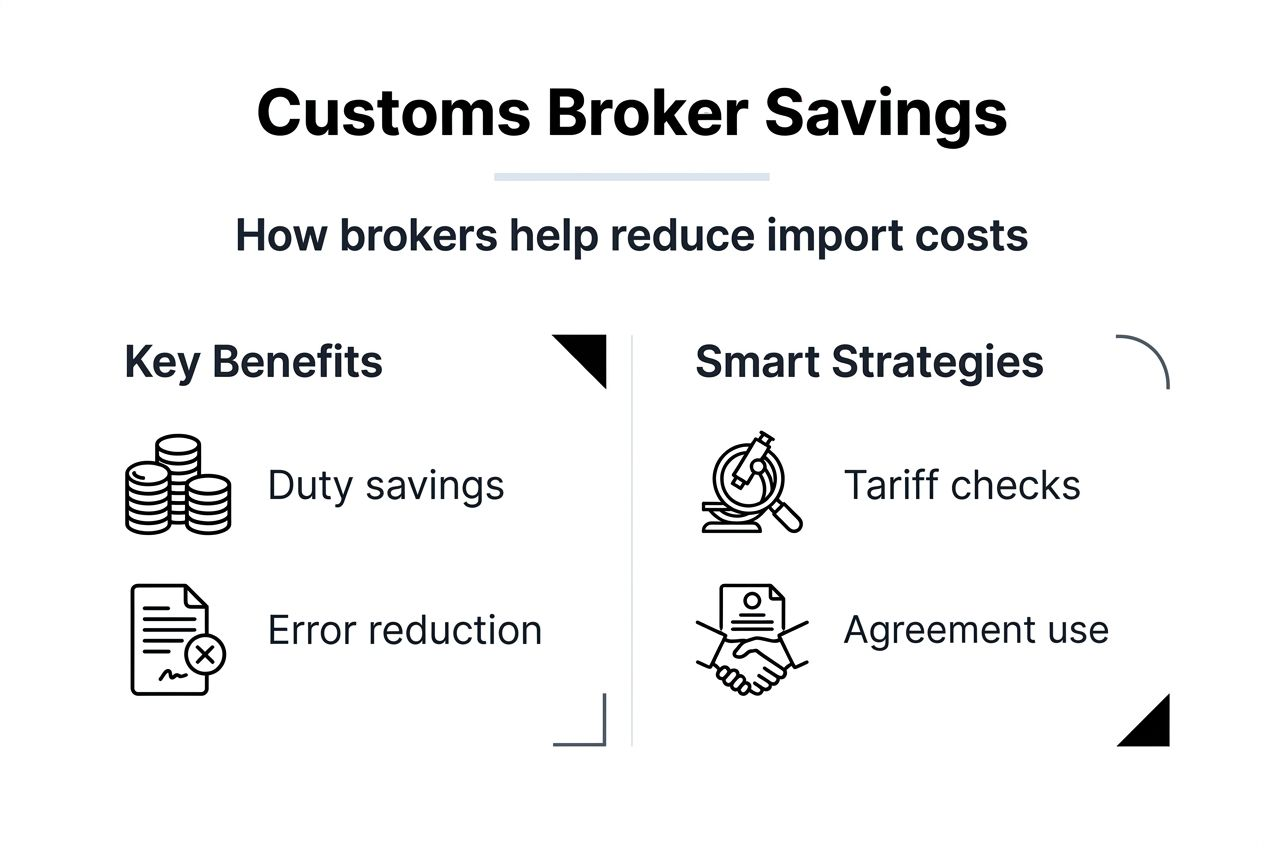
Pro Tip: Request an annual duty analysis from your broker identifying potential savings opportunities across your product portfolio. Small classification optimizations compound into significant savings over time.
Exploring customs broker duty optimization strategies reveals hidden cost reduction opportunities. Discover customs brokerage cost savings available through expert classification and valuation services.
Common misconceptions about customs brokers
Many importers believe customs brokers are optional expenses that merely add cost without value. This misconception ignores the reality that importers retain full legal responsibility for compliance regardless of whether they use a broker. CBP holds importers accountable for classification errors, valuation mistakes, and regulatory violations even when brokers prepare entries.
Another myth suggests brokers guarantee instant clearance every time. Truth is, clearance times depend on multiple factors including shipment characteristics, exam selections, and documentation completeness. Brokers accelerate the process but cannot eliminate CBP’s right to inspect goods or request additional information.
Common misunderstandings include:
- Believing small shipments don’t need broker assistance (complexity matters more than shipment size)
- Assuming all brokers offer identical services (expertise and technology vary significantly)
- Thinking broker fees outweigh benefits (penalties and delays often cost far more)
- Expecting brokers to make compliance decisions (brokers advise, importers decide)
- Presuming self-clearance is always cheaper (time costs and error risks often exceed broker fees)
Self-clearance works for businesses with dedicated customs expertise and simple product lines. However, most companies find the learning curve steep and the consequences of mistakes expensive. A single misclassification penalty can exceed years of broker service fees.
“While importers may handle their own customs entries, the specialized knowledge brokers provide typically outweighs the cost savings of self-clearance, especially for complex or high-volume shipments.”
Understanding the role of a customs import broker clarifies what services brokers actually provide versus common assumptions. Review customs brokerage myths to avoid costly misconceptions.
Comparison of self-clearance vs. broker-assisted clearance
Choosing between handling customs clearance yourself or engaging a broker requires evaluating costs, risks, and operational complexity. Each approach suits different business situations and capabilities.
| Factor | Self-Clearance | Broker-Assisted Clearance |
|---|---|---|
| Upfront Cost | Lower (no broker fees) | Higher (service fees apply) |
| Compliance Risk | Higher (limited expertise) | Lower (professional guidance) |
| Time Investment | Significant (learning and processing) | Minimal (broker handles details) |
| Clearance Speed | Slower (unfamiliarity with systems) | Faster (established processes) |
| Best For | Simple, low-volume imports with in-house expertise | Complex, regular imports requiring efficiency |
Self-clearance makes sense when:
- You import a single, simple product with straightforward classification
- Your staff includes customs compliance experts
- Import volume is extremely low (occasional shipments)
- You have time to invest in learning ACE systems and regulations
Broker-assisted clearance works better when:
- Product lines are diverse requiring multiple classifications
- Import volume justifies professional management
- Compliance complexity involves multiple agencies (FDA, USDA, EPA)
- Speed and reliability directly impact business operations
- Your team lacks specialized customs knowledge
The hidden costs of self-clearance include staff time spent researching regulations, potential penalties for errors, and shipment delays from incorrect submissions. These indirect expenses often exceed broker fees while delivering inferior results.
Learn more about mastering customs brokerage services to maximize value from professional assistance. Explore understanding customs broker options to evaluate available services.
How to engage a U.S. customs broker: practical steps
Selecting and working effectively with a customs broker requires a strategic approach that ensures alignment with your business needs and operational requirements.
-
Assess your shipment complexity and import volume to determine whether broker services add sufficient value. Consider product diversity, regulatory requirements, and internal expertise availability.
-
Research potential brokers by verifying their CBP licensing status through the official broker database. Check credentials, years of experience, and client references in your industry.
-
Evaluate industry-specific knowledge by asking candidates about experience with your product categories and familiarity with applicable regulations. Specialized expertise prevents costly learning curves.
-
Clarify fee structures upfront including per-entry charges, monthly minimums, and additional service costs. Request written fee schedules preventing surprise charges later.
-
Establish communication protocols defining how and when you’ll receive updates on clearance status, exam selections, and duty payments. Clear expectations prevent misunderstandings.
-
Provide complete, accurate documentation promptly including commercial invoices, packing lists, and certificates of origin. Delays in supplying information cause clearance holdups.
-
Review broker reports regularly including entry summaries, duty payments, and compliance recommendations. Active oversight ensures alignment with your business objectives.
Pro Tip: Schedule quarterly reviews with your broker to discuss import trends, regulatory changes, and optimization opportunities. Proactive communication strengthens the partnership and maximizes value.
Compare customs brokerage providers to identify the best fit for your business. Apply customs brokerage service tips to enhance your broker relationship.
Explore customs brokerage solutions with Worldwide Express
Navigating U.S. customs regulations demands expertise, technology, and established CBP relationships. Worldwide Express offers licensed U.S. customs brokerage services designed to streamline your import operations and ensure compliance. Our experienced team handles complex classifications, regulatory requirements, and clearance procedures efficiently.
We provide tailored solutions matching your specific trade needs, whether you’re importing machinery, consumer goods, or specialized products. Our brokers stay current on regulatory changes and trade policy developments affecting your shipments. Discover how understanding the role of U.S. customs brokers can transform your international trade efficiency. Contact us to discuss how our customs brokerage expertise supports your business growth.
Are customs brokers required for all imports?
Customs brokers are not legally required for most imports. U.S. regulations allow importers to clear their own shipments by filing entries directly through CBP systems. However, importers remain fully responsible for compliance accuracy regardless of who prepares the entry.
Broker assistance becomes practically necessary when dealing with complex classifications, multiple regulatory agencies, or high-value shipments where errors carry significant financial consequences. Many businesses find that broker expertise prevents costly mistakes that far exceed service fees.
How do customs brokers help reduce import costs?
Brokers reduce costs through expert tariff classification identifying the lowest legal duty rates for your products. They leverage trade agreements like USMCA to claim preferential duty treatment when goods qualify.
Additional savings come from preventing overpayments through accurate valuation and avoiding penalties from compliance errors. Brokers also advise on duty drawback programs and foreign trade zone opportunities that recover or defer duty payments.
What should I consider when selecting a customs broker?
Verify the broker holds a valid CBP license by checking the official customs broker database. Evaluate their experience with your specific industry and product categories since specialized knowledge prevents compliance issues.
Clarify fee structures including per-entry charges and additional service costs to avoid surprises. Assess their technology capabilities and communication processes ensuring they provide timely updates and responsive support for your shipments.
How quickly can customs brokers clear shipments?
Clearance speed varies based on shipment characteristics, exam selections, and documentation completeness. Brokers typically submit entries electronically within hours of receiving complete information, enabling release as soon as CBP processes the filing.
For routine shipments with no exam requirements, clearance often occurs within 24 hours. Shipments selected for examination take longer depending on CBP inspection schedules. Brokers expedite the process by responding quickly to CBP requests and maintaining direct communication channels with customs officials.
Recommended
- Role of a US customs broker: streamline trade compliance – Worldwide Express, Inc.
- Customs Broker Explained: Ensuring Smooth U.S. Imports – Worldwide Express, Inc.
- Efficient US Customs Brokerage Services for Smooth Imports
- Freight Forwarding vs Broker: Impact on U.S. Trade Efficiency – Worldwide Express, Inc.
- Dubai customs: portale ufficiale, servizi e regole doganali