

A single delivery without the original bill of lading can expose your company to millions in liability, even with letters of indemnity in place. For import/export managers navigating international shipping, bills of lading are far more than administrative paperwork. They carry profound legal weight that determines ownership rights, liability limits, and your ability to recover losses when cargo disputes arise. This guide unpacks the critical legal functions, international conventions, document types, and compliance risks you need to master to protect your shipments and your bottom line in 2026.
Table of Contents
- Understanding The Legal Functions Of A Bill Of Lading
- Navigating International Conventions Governing Bills Of Lading
- Types Of Bills Of Lading And Their Legal Implications
- Risks And Liabilities From Bill Of Lading Errors And Misuse
- Empirical Insights On Cargo Claims Related To Bill Of Lading Issues
- Optimize Your Shipping Compliance With Worldwide Express
Key takeaways
| Point | Details |
|---|---|
| Triple legal function | Bills of lading serve as receipt, contract evidence, and document of title simultaneously |
| International frameworks matter | Hague-Visby, Hamburg, and Rotterdam Rules define carrier duties and liability caps differently |
| Document type drives risk | Negotiable versus non-negotiable and clean versus claused B/L create distinct legal exposures |
| Description accuracy is critical | Incorrect cargo details void liability protections and trigger customs enforcement actions |
| Time bars are strictly enforced | You have only one year under Hague-Visby to file claims or lose recovery rights |
Understanding the legal functions of a bill of lading
A bill of lading serves three primary legal functions: receipt for goods shipped, evidence of the contract of carriage, and document of title enabling transfer of ownership during transit. As a receipt, the carrier acknowledges taking possession of cargo in the condition and quantity described. This creates your first line of defense when proving what was actually shipped.
The second function establishes the contractual relationship between shipper and carrier. While the B/L itself is not the contract, it evidences the terms governing carriage, including liability limits, delivery obligations, and dispute resolution mechanisms. Courts worldwide rely on B/L terms when adjudicating shipping disputes, making precise language essential.
As a document of title, the bill of lading becomes a negotiable instrument when properly endorsed. The lawful holder can claim cargo delivery, sell goods in transit, or pledge the B/L as collateral for financing. This function transforms the B/L into a tradeable asset in international commerce, particularly under letters of credit where banks require clean negotiable bills as payment conditions.
These three roles intersect constantly in practice. Consider a container of electronics shipped from Shanghai to Los Angeles. The B/L receipt function documents 500 units loaded. The contract evidence function incorporates Hague-Visby liability limits. The title function allows your buyer to sell the cargo to a third party while still at sea by endorsing the negotiable B/L. Each function carries distinct legal implications for your risk exposure.
Pro Tip: Always verify cargo descriptions match actual shipment details before signing the B/L. Inaccurate descriptions undermine all three legal functions and can void your liability protections when you need them most. Cross-reference the example bill of lading formats to ensure compliance.
Navigating international conventions governing bills of lading
Multiple international frameworks govern bills of lading, each establishing different carrier obligations and liability structures. Key conventions include Hague Rules (1924), Hague-Visby Rules (1968), Hamburg Rules (1978), and Rotterdam Rules (2008), with Hague-Visby achieving the widest global adoption. These conventions standardize carrier duties like maintaining seaworthiness and exercising due diligence in cargo care.
Liability limits vary dramatically between conventions. Hague-Visby caps carrier liability at 666.67 Special Drawing Rights per package or 2 SDR per kilogram, whichever yields higher compensation. This carrier-favorable framework places the burden of proof on claimants after delivery, making documentation critical for recovery.
The Hamburg Rules shifted toward shipper protection by imposing stricter liability standards on carriers. Under Hamburg, carriers must prove they took all reasonable measures to prevent loss, reversing the Hague-Visby burden of proof. However, adoption remains limited compared to Hague-Visby, creating jurisdictional complexity in international contracts.
Rotterdam Rules represent the most modern framework, addressing electronic documentation, door-to-door transport, and expanded liability for delays. Yet low ratification rates limit practical application, leaving most shipments governed by older conventions. Your choice of jurisdiction and contract terms determines which rules apply.
| Convention | Carrier Obligations | Liability Limit | Burden of Proof | Geographic Adoption |
|---|---|---|---|---|
| Hague-Visby | Seaworthiness, due cargo care | 666.67 SDR/package or 2 SDR/kg | On claimant post-delivery | Widespread (70+ countries) |
| Hamburg | Stricter prevention duties | 835 SDR/package or 2.5 SDR/kg | On carrier to prove diligence | Limited (34 countries) |
| Rotterdam | Door-to-door, e-docs | 875 SDR/package or 3 SDR/kg | Shared, context-dependent | Very limited (5 ratifications) |
Understanding these distinctions matters when negotiating shipping contracts. Specify governing law explicitly to avoid unfavorable default jurisdictions. Review whether your regular trade lanes fall under Hague-Visby or Hamburg territories, as this impacts claim strategy and insurance requirements. The bill of lading letter of credit relationship adds another layer, since banks typically require compliance with specific convention standards for payment release.
Types of bills of lading and their legal implications
Bill of lading variations create distinct legal consequences for transferability and liability. Negotiable bills (order or bearer) allow ownership transfer through endorsement, while non-negotiable (straight) bills name a specific consignee without transfer rights. Choosing negotiable B/L enables selling cargo in transit but requires strict original document control to prevent fraud.
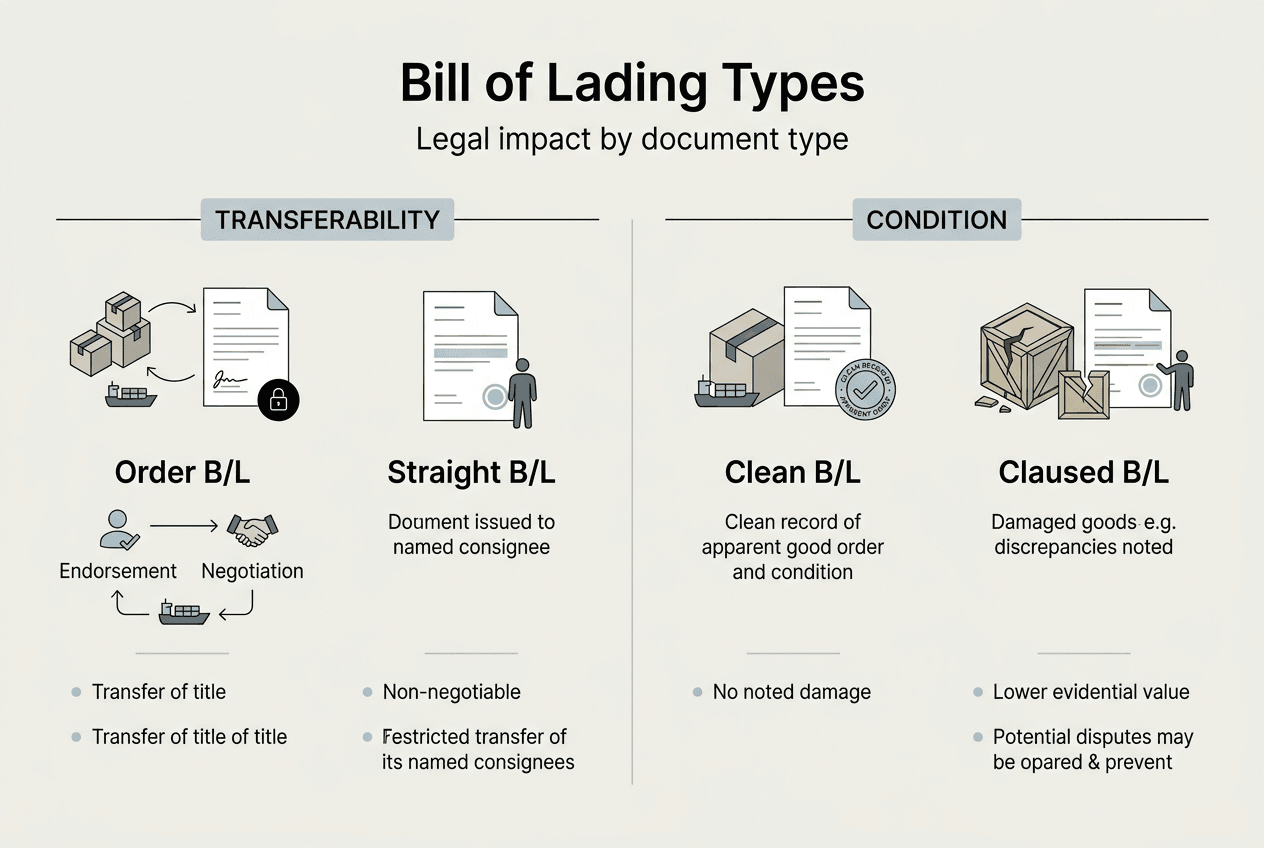
Clean versus claused bills signal cargo condition at loading. A clean B/L confirms goods appeared in good order without visible defects, satisfying letter of credit requirements and preserving full carrier liability. Claused bills note damage, shortages, or packaging issues, which can trigger payment disputes and shift liability to shippers or prior handlers.
Shipped bills confirm cargo is actually loaded on the vessel, while received for shipment bills merely acknowledge the carrier took possession. Banks and buyers strongly prefer shipped bills because they provide certainty about transport commencement. Using received for shipment B/L in letter of credit transactions often causes rejection unless explicitly permitted.
Each type carries specific legal risks. Negotiable bills require physical surrender for cargo release, but carriers sometimes deliver against letters of indemnity when originals are delayed. This exposes carriers to liability claims from rightful B/L holders. Non-negotiable bills reduce fraud risk but eliminate financing flexibility for buyers needing to trade goods in transit.
Consider these scenarios:
- Negotiable B/L allows your buyer to resell to a third party mid-voyage by endorsing the document
- Claused B/L noting water damage shifts liability burden and may void insurance coverage
- Straight B/L to a named consignee prevents unauthorized cargo diversion but blocks secondary sales
- Shipped B/L satisfies strict letter of credit compliance while received for shipment may cause bank rejection
Pro Tip: Match your B/L type to payment terms and shipment characteristics. Letter of credit transactions nearly always require negotiable, clean, shipped bills. For trusted direct buyers under open account terms, straight bills reduce documentation complexity. Verify alignment before cargo moves to avoid costly disputes. Reference bill of lading types for detailed selection guidance.
Risks and liabilities from bill of lading errors and misuse
Delivering cargo without the original negotiable bill of lading creates severe legal exposure for carriers. Such delivery triggers both contractual and tortious liability to the lawful B/L holder, regardless of letters of indemnity from shippers. Courts consistently rule that guarantees and LOIs provide insufficient legal defense when the rightful holder demands cargo or damages.

Inaccurate cargo descriptions carry equally serious consequences. Incorrect descriptions void carrier liability limits, trigger customs seizure, and cause insurance claim denials. When your B/L states 100 cartons but actually contains 95, you lose the protection of convention liability caps. Customs authorities may seize shipments when descriptions fail to match physical cargo or required regulatory classifications.
Time limitations compound these risks. The one-year time bar under Hague-Visby Rules is strictly enforced, meaning claims filed after 12 months from delivery are legally barred regardless of merit. Banks, traders, and cargo interests must act immediately when damage or shortage appears, as delays forfeit recovery rights entirely.
Common documentation mistakes that trigger legal issues include:
- Vague cargo descriptions using generic terms instead of specific product details
- Omitting container seal numbers or failing to note seal integrity at loading
- Accepting bills with clauses added after signing without shipper agreement
- Releasing cargo against email or fax copies rather than original documents
- Missing notification party details that delay delivery and extend carrier liability periods
To avoid these legal pitfalls, implement these protective steps:
- Conduct physical cargo inspections before issuing or accepting bills of lading to verify quantities and condition
- Photograph container loading, seal placement, and any visible damage as contemporaneous evidence
- Issue claused bills immediately when defects appear rather than accepting shipper pressure for clean documents
- Establish strict protocols requiring original B/L surrender before cargo release, with no exceptions
- Maintain comprehensive documentation of all cargo handling, inspection results, and communication with parties
- File notice of claims within required timeframes, typically 3 days for visible damage and before or at delivery for concealed loss
Understanding and respecting the one-year time bar is critical for preserving legal rights. The clock starts at delivery, not when damage is discovered, making immediate action essential for any cargo discrepancy.
These risks directly impact your ability to recover losses and maintain customer relationships. Familiarize your team with the freight claim process guide to ensure timely, properly documented claims that survive legal scrutiny.
Empirical insights on cargo claims related to bill of lading issues
Recent industry data reveals patterns in cargo claims that highlight bill of lading documentation’s role in dispute outcomes. Analysis of bulk carrier claims from 2021-2024 shows approximately 50% involve cargo shortages, with many ultimately deemed meritless due to measurement methodology disputes. Africa and China emerge as high-risk regions for shortage claims, often stemming from draft survey disagreements rather than actual losses.
Physical damage claims concentrate heavily in steel cargoes, where improper stowage, inadequate securing, and moisture exposure cause significant losses. Contamination accounts for 68% of claims originating from shore-side operations rather than vessel conditions, yet bill of lading descriptions often fail to document pre-existing contamination at loading. This documentation gap shifts liability unfairly to carriers.
The connection between claim success and B/L accuracy is striking. Claims supported by detailed, photographically documented bills noting specific cargo conditions at loading achieve substantially higher settlement rates. Conversely, generic descriptions like “bulk grain” without moisture content, temperature readings, or hold cleanliness notes face challenge from carriers citing inadequate evidence.
| Claim Type | Frequency | Primary Cause | B/L Documentation Impact |
|---|---|---|---|
| Shortage | 50% | Draft survey disputes, measurement methods | Detailed quantity recording critical for defense |
| Physical damage | 30% | Stowage failures, moisture, securing issues | Pre-loading condition notes determine liability |
| Contamination | 15% | Shore operations, prior cargo residue | Hold cleanliness certificates essential |
| Other | 5% | Various | Case-specific documentation needs |
These patterns suggest actionable risk mitigation strategies:
- Implement mandatory photographic documentation of cargo and hold conditions before loading
- Require independent surveyor confirmation for high-value or dispute-prone cargoes
- Specify exact measurement methodologies in B/L terms to prevent later disagreements
- Note all visible defects, moisture levels, and temperature readings on bills at issuance
- Maintain chain of custody documentation from shore facility through vessel loading
- Review historical claim patterns for your specific trade routes and cargo types to identify vulnerabilities
Regional risk factors also emerge from the data. Shipments involving African and Chinese ports show elevated shortage claim rates, suggesting enhanced documentation protocols for these lanes. Steel and grain cargoes warrant particular attention to moisture and contamination notation given their damage susceptibility.
Pro Tip: Use empirical claim data to inform your insurance coverage levels and B/L description practices. Cargoes with high historical claim rates justify more detailed documentation and potentially higher liability limits. Invest in precise, photographically supported bills for routes and commodities showing elevated dispute frequency. Consider comprehensive cargo insurance basics to supplement convention liability limits.
Optimize your shipping compliance with Worldwide Express
Navigating the legal complexities of bills of lading requires expert support and proven systems. Managing international shipments while ensuring full regulatory compliance demands specialized knowledge of documentation requirements, convention applications, and customs regulations that vary across jurisdictions. Worldwide Express brings decades of freight forwarding experience to help you avoid the costly legal pitfalls discussed throughout this guide.
Our comprehensive freight forwarding services manage every aspect of your international shipments, from proper bill of lading preparation through final delivery. We ensure your documentation meets legal standards under applicable conventions, reducing liability exposure and claim disputes. Our customs brokerage team navigates import regulations, verifies cargo descriptions match customs requirements, and prevents the seizures that result from B/L inaccuracies. When you need reliable logistics solutions that protect your legal interests while maintaining supply chain efficiency, Worldwide Express delivers the expertise and global reach your business requires. Explore our understanding freight forwarding 2026 guide, review our U.S. customs brokerage services, or discover our full range of logistics services tailored for import/export professionals.
FAQ
What is the primary legal function of a bill of lading?
A bill of lading serves three simultaneous legal functions: receipt confirming the carrier received cargo in stated condition and quantity, evidence of the contract of carriage establishing terms between shipper and carrier, and document of title enabling ownership transfer during transit. These functions work together to create enforceable rights for cargo interests. The title function particularly matters in trade finance, allowing goods to be sold or pledged while still at sea.
How do international conventions affect carrier liability under a bill of lading?
Conventions like Hague-Visby, Hamburg, and Rotterdam establish carrier duties, liability caps, and burden of proof standards that vary significantly. Hague-Visby limits carrier liability to 666.67 SDR per package and places proof burdens on claimants, while Hamburg imposes stricter carrier obligations and higher limits. Your choice of governing law and jurisdiction in shipping contracts determines which convention applies, directly impacting claim outcomes and available remedies. Most global trade operates under Hague-Visby due to widespread adoption.
What risks arise from incorrect bill of lading descriptions?
Inaccurate cargo descriptions void carrier liability protections under international conventions, exposing all parties to unlimited loss exposure. Customs authorities may seize shipments when descriptions fail to match physical cargo or regulatory classifications, causing significant delays and penalties. Insurance companies routinely deny claims when B/L descriptions contradict actual cargo, leaving shippers without recovery options. Even minor discrepancies between stated and actual quantities can trigger these consequences, making precision essential.
Why is timely action important under the Hague-Visby Rules?
The Hague-Visby Rules impose a strict one-year time bar from delivery date for filing cargo claims, with no exceptions for late discovery of damage. Courts uniformly reject claims filed after this deadline regardless of merit or circumstances. The clock starts at delivery, not when you discover the loss, requiring immediate investigation of any cargo discrepancies. Delays in filing notices or formal claims jeopardize your entire recovery, potentially leaving you with total financial loss despite valid underlying claims.
Recommended
- Example of Bill of Lading – Key Elements and Legal Impact – Worldwide Express, Inc.
- How to Read a Bill of Lading: A Step-by-Step Guide – Worldwide Express, Inc.
- Bill of Lading Letter of Credit – Ensuring Secure Trade – Worldwide Express, Inc.
- Bill of Lading Types: Cut Shipping Errors by 30% in 2026 – Worldwide Express, Inc.
- Customs, Excise Duty & VAT Charges | Omnia Radiation Balancer