

Every American logistics manager knows the frustration of waiting for payment or delivery with cargo stuck in limbo. The complexity of customs paperwork involving the Bill of Lading and Letter of Credit can quickly turn routine shipments into confusing puzzles. Understanding secure shipping and payment documentation arms your company against delays, disputes, and financial risk, helping you move goods efficiently between United States ports and global buyers.
Table of Contents
- Bill of Lading And Letter Of Credit Basics
- Key Differences Between These Documents
- How Each Facilitates International Shipping
- Legal And Compliance Requirements In U.S. Trade
- Common Pitfalls And Security Risks To Avoid
Key Takeaways
| Point | Details |
|---|---|
| Importance of Bill of Lading and Letter of Credit | These documents provide essential frameworks for secure international trade, protecting both exporters and importers. |
| Distinct Functions | The Bill of Lading handles shipping logistics, while the Letter of Credit guarantees payment, each mitigating different risks in transactions. |
| Compliance and Legal Requirements | Adhering to U.S. regulatory standards is crucial, as it ensures smooth trade operations and legal protection. |
| Common Pitfalls | Key errors in documentation can lead to severe transaction issues; diligent verification is necessary to avoid complications. |
Bill of Lading and Letter of Credit Basics
International trade requires sophisticated financial and logistical documentation to ensure smooth transactions between exporters and importers. Two critical documents that form the backbone of secure global commerce are the Bill of Lading and the Letter of Credit. These instruments protect both parties by establishing clear ownership, transportation, and payment terms.
A Letter of Credit serves as a contractual guarantee from a buyer’s bank, promising payment once specific shipping conditions are met. When an exporter ships goods and presents the required documentation to their bank, the foreign buyer’s bank commits to complete the financial transaction. This mechanism provides critical protection for both trading parties by mitigating risks associated with international transactions.
The Bill of Lading complements this process as a crucial shipping document. It functions simultaneously as a contract between the cargo owner and carrier, a receipt for transported goods, and potentially a title of ownership. There are two primary types of bills of lading:
- Straight Bill of Lading: Non-negotiable document that does not transfer ownership
- Negotiable (Shipper’s Order) Bill of Lading: Can be traded while goods are in transit
These documents work together to create a comprehensive framework for international trade transactions. The Letter of Credit ensures financial security, while the Bill of Lading confirms the physical transportation and potential ownership transfer of goods.
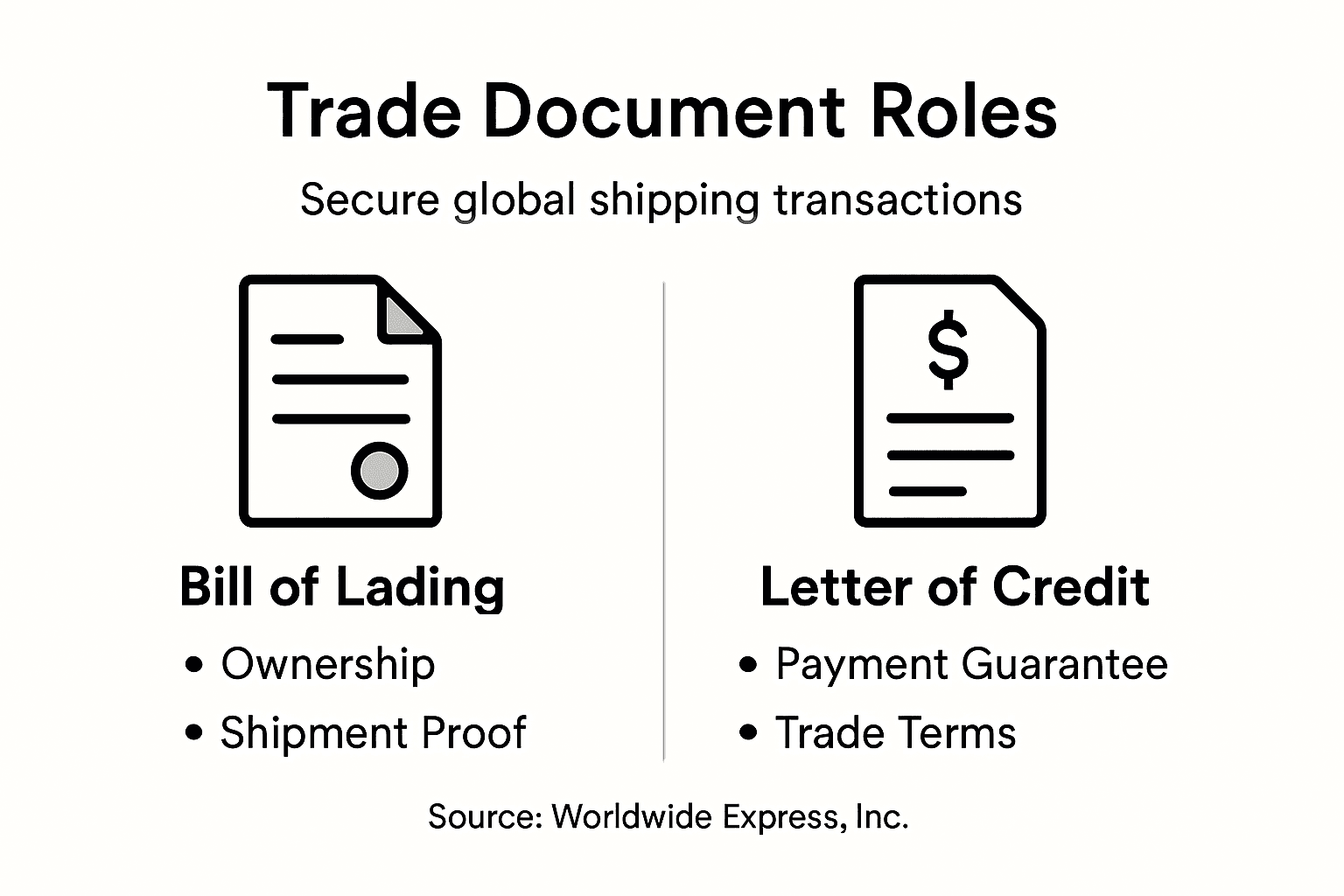
Here’s how Bills of Lading and Letters of Credit impact exporters and importers:
| Aspect | Exporter Benefits | Importer Benefits |
|---|---|---|
| Bill of Lading | Ensures goods are shipped as agreed | Facilitates cargo claim at destination |
| Letter of Credit | Guarantees secure payment | Reduces risk of non-delivery |
| Compliance | Meets shipping and regulatory needs | Eases customs and legal verification |
| Risk Reduction | Minimizes delivery and payment disputes | Enhances transaction transparency |
Pro tip: Always verify the specific requirements and type of Bill of Lading and Letter of Credit needed for your particular international trade transaction to minimize potential complications.
Key Differences Between These Documents
While Bills of Lading and Letters of Credit are both essential in international trade, they serve distinctly different purposes. Trade finance documents play unique roles in managing the complex landscape of global transactions.
The primary distinction lies in their core functions. A Bill of Lading is fundamentally a shipping document that provides critical information about cargo transportation. It serves three primary purposes:
- Confirms the contract of carriage between shipper and carrier
- Acts as a receipt for goods being transported
- Can potentially serve as a title document for ownership transfer
In contrast, a Letter of Credit is a financial instrument focused exclusively on payment guarantees. It represents a bank’s commitment to ensure the seller receives payment after meeting specific shipping and documentation requirements.

To illustrate the key differences, consider the following comparison:
| Document Type | Primary Purpose | Issued By | Key Function |
|---|---|---|---|
| Bill of Lading | Transportation Documentation | Shipping Carrier | Cargo Tracking & Ownership |
| Letter of Credit | Financial Payment Guarantee | Bank | Risk Mitigation & Payment |
These documents work in tandem to provide comprehensive protection. Specific trade documentation ensures that both the physical movement of goods and financial transaction are securely managed.
Pro tip: Always consult with international trade experts to ensure you’re using the correct documents for your specific shipping and payment requirements.
How Each Facilitates International Shipping
Letters of Credit and Bills of Lading play critical yet complementary roles in enabling smooth international shipping transactions. Export transaction regulations directly link these documents to ensure comprehensive trade protection.
Letters of Credit serve as a financial safety net, providing crucial payment assurance for exporters. They function by establishing a bank-backed commitment that guarantees payment upon meeting specific documentation requirements. This mechanism allows businesses to:
- Reduce financial risks in international transactions
- Establish trust between unfamiliar trading partners
- Ensure secure payment after goods are shipped
- Provide a standardized payment protection framework
Bills of Lading complement this process by managing the physical logistics of cargo transportation. These documents are essential for:
- Confirming goods have been loaded and shipped
- Providing legal proof of cargo ownership
- Facilitating customs clearance procedures
- Enabling transfer of cargo ownership during transit
The seamless interaction between Letters of Credit and Bills of Lading creates a robust system that protects both financial and logistical aspects of international trade.
International shipping mechanisms work together to minimize risks and streamline complex global commerce processes. By requiring specific documentation and establishing clear guidelines, these instruments help businesses navigate the intricate landscape of cross-border transactions.
Pro tip: Always ensure your Letter of Credit explicitly specifies the required Bill of Lading documentation to prevent potential shipping and payment complications.
Legal and Compliance Requirements in U.S. Trade
Navigating the legal landscape of international trade requires a comprehensive understanding of U.S. regulatory requirements for shipping documentation. Export credit regulations establish strict documentation guidelines that businesses must meticulously follow to ensure compliance.
The Federal Acquisition Regulation (FAR) provides a comprehensive framework for documentation requirements in international trade transactions. Key compliance elements include:
- Detailed invoice documentation
- Precise Bill of Lading numbering
- Accurate shipment detail reporting
- Comprehensive cargo ownership verification
U.S. regulations mandate specific protocols for Letters of Credit in export transactions. These protocols typically require:
- Original clean onboard Bills of Lading
- Verification of shipper credentials
- Comprehensive documentation of cargo transfer
- Explicit payment terms and conditions
Compliance is not optional – it is the fundamental foundation of legal international trade transactions.
Trade documentation processes play a critical role in ensuring smooth government procurement and payment mechanisms. Businesses must understand that these requirements are designed to protect all parties involved in international trade, providing a structured approach to cross-border transactions.
Pro tip: Maintain a comprehensive compliance checklist and consult with international trade legal experts to ensure all documentation meets current U.S. regulatory standards.
Common Pitfalls and Security Risks to Avoid
International trade documentation demands meticulous attention to detail. Trade documentation processes require rigorous verification to prevent potentially costly errors that can derail entire shipping transactions.
The most common pitfalls in Bills of Lading and Letters of Credit transactions include:
- Typographical errors in shipment details
- Inconsistent cargo descriptions
- Missing or incorrect shipper/receiver information
- Misalignment between document specifications
Security risks emerge from several critical vulnerability points:
- Document Forgery
- Incomplete Documentation
- Misrepresentation of Cargo Details
- Unauthorized Document Modifications
Diligence in documentation is not just a bureaucratic requirement – it’s your primary defense against financial and legal complications.
Payment documentation guidelines emphasize the importance of comprehensive verification. Businesses must implement robust internal review processes to minimize risks, including:
Common documentation pitfalls and effective prevention strategies:
| Pitfall Type | Impact on Trade | Prevention Strategy |
|---|---|---|
| Typographical Errors | Delays shipment and payment | Implement double-check reviews |
| Incomplete Documents | Causes transaction rejection | Use checklist for completion |
| Forged Papers | Leads to legal complications | Use authentication technology |
| Misaligned Details | Risk of non-payment or disputes | Regular staff training required |
- Multiple-layer document verification
- Professional legal and logistics consultations
- Regular compliance training for staff
- Advanced document authentication technologies
Pro tip: Develop a standardized internal checklist for document verification and invest in professional training to recognize potential documentation red flags.
Secure Your International Trade with Expert Logistics Support
Navigating the complexities of Bills of Lading and Letters of Credit can be challenging for businesses engaged in global commerce. These critical documents require precise handling to avoid costly delays, payment disputes, or compliance issues. If you want to confidently manage shipping documentation while ensuring your goods move smoothly across borders, partnering with experienced logistics providers is essential.
Unlock peace of mind with Worldwide Express, Inc. Our industry expertise in customs brokerage, freight forwarding, and global tracking simplifies compliance and documentation management so you can focus on growing your business. Explore tailored solutions in our Uncategorized – Worldwide Express, Inc. section and start protecting your international shipments today. Visit Worldwide Express now for efficient, customized logistics strategies that align perfectly with your trade finance needs.
Frequently Asked Questions
What is the purpose of a Letter of Credit in international trade?
A Letter of Credit serves as a financial guarantee from a buyer’s bank that they will make payment to the seller once specific conditions are met. It helps reduce financial risks in international transactions.
How does a Bill of Lading function in the shipping process?
A Bill of Lading acts as a contract between the shipper and the carrier, providing evidence of the cargo’s shipment. It can also serve as a receipt and transfer of ownership document.
What are the key differences between a Straight Bill of Lading and a Negotiable Bill of Lading?
A Straight Bill of Lading is non-negotiable, meaning it does not transfer ownership, while a Negotiable Bill of Lading can be traded and ownership can be transferred while the goods are still in transit.
What are common pitfalls to avoid when dealing with Bills of Lading and Letters of Credit?
Common pitfalls include typographical errors, incomplete documentation, and misalignment between document specifics. Implementing thorough verification processes can help mitigate these risks.
Recommended
- Understanding Letter of Credit Shipping for International Trade – Worldwide Express, Inc.
- 7 Key Types of Bill of Lading Explained for Exporters – Worldwide Express, Inc.
- Example of Bill of Lading – Key Elements and Legal Impact – Worldwide Express, Inc.
- How to Read a Bill of Lading: A Step-by-Step Guide – Worldwide Express, Inc.