Many logistics professionals incorrectly assume all bills of lading transfer ownership. This confusion causes costly shipment disputes and compliance delays. Non-negotiable straight bills designate a fixed consignee and cannot transfer ownership, unlike negotiable order bills. This guide clarifies types of bills of lading and their correct usage for U.S. international shipping.
Table of Contents
- Introduction To Bills Of Lading
- Types Of Bills Of Lading And Their Uses
- Legal And Compliance Considerations
- Comparison Of Bill Of Lading Types
- Common Misconceptions About Bills Of Lading
- Practical Guidance For Bill Of Lading Selection
- Conclusion And Further Resources
- Optimize Your Shipping With Worldwide Express
Key Takeaways
| Point | Details |
|---|---|
| Negotiable vs Non-Negotiable | Straight and seaway bills are non-negotiable; order and bearer bills allow ownership transfer. |
| Mode Specific Selection | Ocean bills suit sea freight, air waybills for air cargo, seaway bills for trusted parties. |
| Electronic Acceptance | Electronic bills of lading are legally accepted across all U.S. states with compliance standards. |
| Error Reduction Impact | Proper document selection reduces shipping errors by up to 30%. |
| Ownership Transfer | Only negotiable bills permit ownership transfer during transit for financing or resale. |
Introduction to Bills of Lading
Having summarized key concepts, now we explain the foundational definitions and core purpose of bills of lading. A bill of lading is a legal document between shipper and carrier detailing goods and terms. Bills of lading serve as contracts of carriage, receipts for goods, and documents of title in shipping.
These documents perform three critical functions. First, they provide evidence of the contract between shipper and carrier. Second, they act as receipts confirming the carrier received the goods. Third, certain types serve as documents of title, enabling ownership transfer.
Bills of lading are vital in international trade to ensure shipment compliance and risk management. They facilitate customs clearance by providing essential cargo details. You need them for tracking shipments, establishing legal ownership, and resolving disputes. Without proper bills of lading, your international shipments face regulatory holds, liability issues, and financial losses.
Core functions include:
- Evidence of contract of carriage between parties
- Receipt confirming goods handed to carrier
- Document of title for negotiable types
- Foundation for cargo insurance claims
- Required documentation for customs clearance
Types of Bills of Lading and Their Uses
After understanding what bills of lading are, explore the specific types and their distinct roles in shipping. Straight bills are non-negotiable; order and bearer bills are negotiable, allowing ownership transfer. Each type serves distinct purposes based on shipment needs and ownership requirements.
A straight bill of lading is non-negotiable with a fixed consignee. It cannot transfer ownership during transit. Use this when selling directly to a known buyer without financing needs. The carrier delivers only to the named consignee.
An order bill of lading is negotiable and can be endorsed to transfer ownership. Banks commonly require these for letters of credit. The consignee can be changed by endorsement, making them ideal for trade financing. They protect sellers until payment clears.
A bearer bill of lading is negotiable and transferable by delivery alone. Whoever physically holds the document owns the cargo. These are rare due to theft risks but offer maximum flexibility. Handle them with extreme caution.
A seaway bill is non-negotiable and facilitates fast cargo delivery without physical documents. The carrier releases cargo to the named consignee without requiring the original bill. This speeds up delivery for trusted trading partners. Electronic transmission is straightforward.
An air waybill is non-negotiable and serves as a contract of carriage only for air shipments. It is never a document of title. The airline delivers to the named consignee upon arrival. No original document needs to be presented.
| Bill Type | Negotiable | Ownership Transfer | Typical Mode | Document Required at Delivery |
|---|---|---|---|---|
| Straight Bill | No | No | Ocean/Land | No |
| Order Bill | Yes | Yes | Ocean | Yes |
| Bearer Bill | Yes | Yes | Ocean | Yes |
| Seaway Bill | No | No | Ocean | No |
| Air Waybill | No | No | Air | No |
Pro Tip: Choose order bills when you need payment security through banking channels. Their negotiability protects your financial interests until the buyer fulfills payment terms.
Legal and Compliance Considerations
Understanding bill types leads naturally into their legal and regulatory implications for U.S. operations. The distinction between clean and claused bills affects claim and liability risks. A clean bill indicates goods were received in apparent good condition. A claused bill notes damage or discrepancies, which can complicate insurance claims.
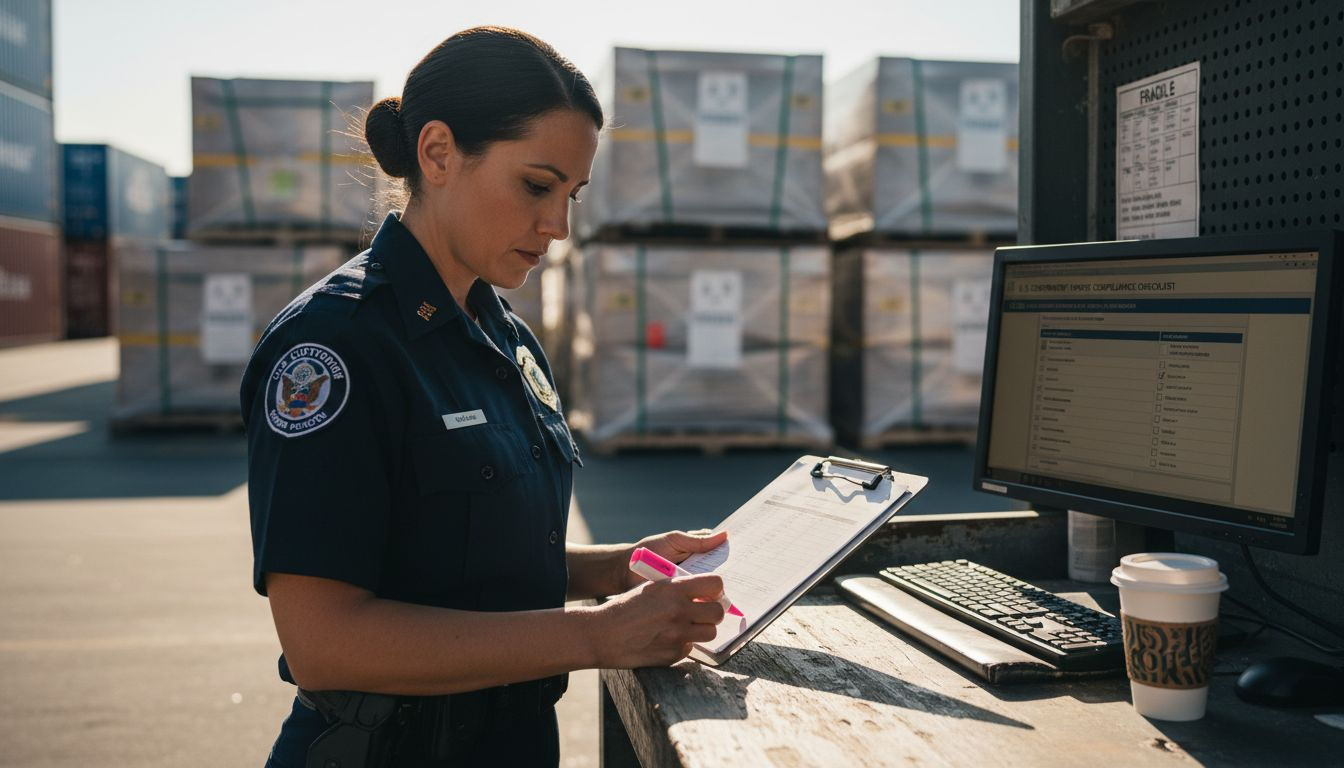
U.S. statutes regulate bill issuance, especially for ocean transport under the Carriage of Goods by Sea Act (COGSA). COGSA defines carrier liability limits and shipper obligations. Violations can result in substantial financial penalties. Your documentation must comply with federal maritime regulations.
Electronic bills of lading are legally recognized across all U.S. states with compliance standards for authenticity. They must meet integrity and security requirements. Digital signatures and blockchain technologies increasingly support e-bill authentication. Adopting electronic bills reduces processing time and paper handling costs.
Incorrect documentation can trigger customs fines, shipment holds, or legal disputes. Customs and Border Protection scrutinizes bill accuracy during clearance. Errors in cargo descriptions or consignee details cause delays. You must ensure all information matches commercial invoices and packing lists.
Compliance linkage with customs and cargo insurance documentation is essential. Your bill of lading serves as primary evidence for insurance claims. Discrepancies between bills and insurance policies can void coverage. Maintain consistency across all shipping documents.
Key compliance points:
- Ensure bill type matches shipment ownership needs
- Verify all consignee and cargo details for accuracy
- Use electronic bills only with proper authentication systems
- Align bills with customs and insurance documentation
- Keep records for audit and dispute resolution
Pro Tip: Conduct quarterly audits of your bill of lading processes. Regular reviews catch errors before they become costly compliance issues or shipment delays.
Comparison of Bill of Lading Types
Building upon legal context, this section crystallizes differences with a comparison table aiding bill choice. The negotiability and transferability of order, straight, and bearer bills impact cargo claims and ownership rights. Understanding these distinctions prevents costly documentation mistakes.
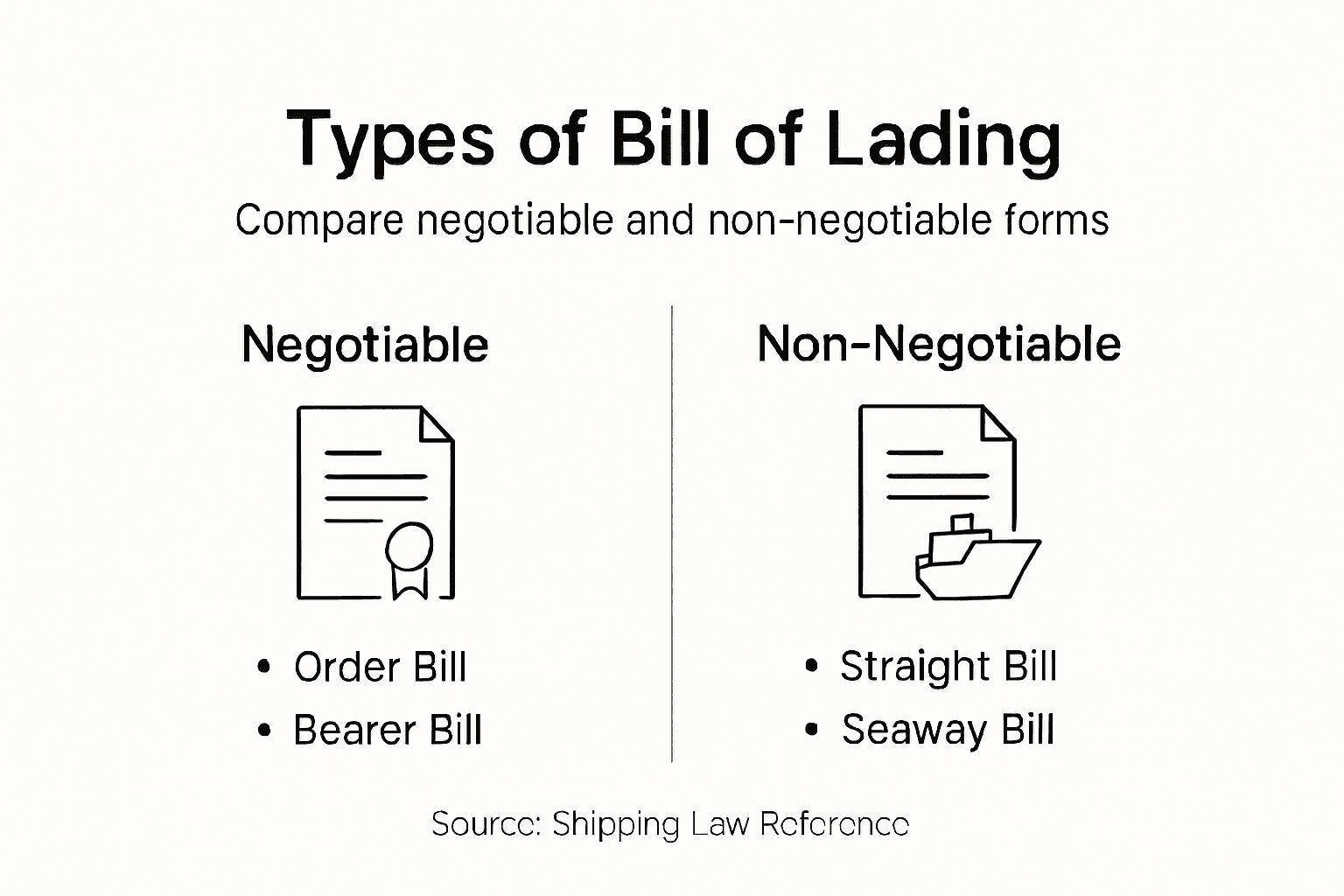
Negotiability determines whether ownership can transfer during transit. Straight bills and seaway bills are non-negotiable, locking in the original consignee. Order and bearer bills are negotiable, allowing endorsed transfers. This flexibility matters for trade financing and resale scenarios.
Ownership transfer is allowed only with negotiable bills, impacting financing and claims. Banks require negotiable bills for letters of credit because they can hold the document as security. Without negotiability, sellers cannot control cargo release after shipping. This affects payment risk management.
Suitable shipping modes vary by bill type. Ocean freight typically uses ocean bills of lading in straight, order, or bearer forms. Air cargo always uses air waybills, which are never negotiable. Seaway bills work for ocean shipments between trusted parties who prioritize speed over ownership control.
Impact on cargo claims and litigation depends on bill type and its status. Clean negotiable bills offer the strongest legal position for claims. Claused bills indicate pre-existing damage, weakening your claim leverage. Non-negotiable bills simplify delivery but limit your control if disputes arise.
| Feature | Straight Bill | Order Bill | Bearer Bill | Seaway Bill | Air Waybill |
|---|---|---|---|---|---|
| Negotiability | Non-negotiable | Negotiable | Negotiable | Non-negotiable | Non-negotiable |
| Ownership Transfer | No | Yes | Yes | No | No |
| Document of Title | No | Yes | Yes | No | No |
| Primary Mode | Ocean/Land | Ocean | Ocean | Ocean | Air |
| Trade Financing | Limited | Ideal | Possible | Not Suitable | Not Applicable |
| Delivery Speed | Standard | Standard | Standard | Fast | Fastest |
| Security Level | Medium | High | Low | Medium | Medium |
Key selection factors:
- Payment terms: Use order bills for letters of credit
- Trust level: Seaway bills work with established partners
- Speed priority: Air waybills and seaway bills accelerate delivery
- Ownership control: Negotiable bills maintain seller leverage
Common Misconceptions About Bills of Lading
With a clear comparison established, now dispel myths to reinforce accurate understanding. Many logistics professionals hold incorrect beliefs that lead to operational errors and compliance violations.
-
Myth: All bills of lading transfer ownership. Actually, only negotiable bills (order and bearer types) enable ownership transfer. Straight and seaway bills are non-negotiable and do not permit ownership transfer during transit. Using a straight bill when you need ownership control creates unrecoverable payment risk. Choose bill types based on your financing and control requirements.
-
Myth: Air waybills are documents of title. Air waybills are non-negotiable and serve only as contracts of carriage, not documents of title. You cannot use them to control cargo release or secure bank financing. Airlines deliver based on the named consignee, regardless of payment status. For air shipments requiring payment security, arrange alternative financial instruments.
-
Myth: Electronic bills are not legally valid in U.S. shipments. Electronic bills of lading are legally accepted in all U.S. states when they meet authenticity and integrity standards. Major carriers and ports support e-bill systems. Adoption grows annually due to efficiency gains and cost savings. Resistance to electronic bills stems from outdated assumptions, not legal barriers.
-
Myth: Seaway bills and straight bills are identical. While both are non-negotiable, seaway bills allow cargo release without presenting the original document. Straight bills typically require document presentation. This distinction affects delivery speed and document handling procedures.
-
Myth: A clean bill of lading guarantees cargo condition. A clean bill only means no apparent damage was visible at loading. Hidden damage or concealed defects may exist. Always inspect cargo upon arrival and note any discrepancies immediately.
Misconceptions lead to shipment holds, fines, and ownership disputes. Understanding these differences streamlines your international trade operations. Clarifying bill types with your freight forwarder reduces risk and prevents costly mistakes.
Practical Guidance for Bill of Lading Selection
Having corrected myths, now apply that knowledge into actionable bill selection guidance. Proper bill selection reduces shipment documentation errors by up to 30%. Follow this systematic approach to choose the right bill type every time.
-
Identify shipment mode to select appropriate bill form. Ocean freight requires ocean bills of lading (straight, order, or seaway). Air cargo uses air waybills exclusively. Land transport within North America may use straight bills or through bills of lading. Match your document type to your transportation mode.
-
Determine if ownership transfer during transit is needed. If you require payment before releasing cargo, choose an order bill of lading. For letter of credit transactions, banks mandate negotiable bills. Direct sales to trusted buyers can use straight bills. Assess your payment risk before selecting bill type.
-
Confirm consignee information accuracy to avoid customs delays. Verify legal business names, addresses, and tax identification numbers. Errors in consignee details trigger customs holds and clearance delays. Cross-check information against commercial invoices and purchase orders. Small mistakes cause disproportionate problems.
-
Ensure compliance with electronic document requirements if e-bills are used. Verify your carrier and destination port support electronic bills of lading. Confirm your trading partner accepts digital documentation. Implement secure authentication systems meeting legal standards. Electronic bills save time but require proper technological infrastructure.
-
Review all cargo descriptions for precision and compliance. Use Harmonized System codes correctly for customs classification. Provide accurate weight, dimensions, and packaging details. Vague descriptions invite customs scrutiny and potential penalties. Detailed, accurate cargo information expedites clearance.
Best practices include staff training on bill of lading fundamentals and verifying documentation before shipment. Implement checklist systems to catch errors at multiple review stages. Partner with experienced freight forwarders who understand documentation nuances. Regular training updates keep your team current on regulatory changes.
Pro Tip: Create internal templates for each bill type you commonly use. Standardized templates reduce data entry errors and ensure you include all required information every time.
Conclusion and Further Resources
End the core content by wrapping key points and pointing to practical next steps and resources. Proper bill of lading selection is key to compliant and efficient shipping. Understanding negotiability, ownership transfer, and mode-specific requirements protects your business from costly errors.
Resources like official PDFs and templates streamline documentation processes. Many carriers provide standardized forms meeting regulatory requirements. Government agencies publish guidelines clarifying legal obligations. Use these resources to build robust documentation systems.
Consult experts for complex shipments and compliance assurance. International shipping regulations evolve frequently. Professional freight forwarders and logistics providers stay current on changes. Their expertise prevents compliance violations and optimizes your supply chain.
Continued education reduces disputes and errors in international trade. Key resources:
- Federal Maritime Commission guidelines on ocean bills
- Carrier-specific electronic bill of lading platforms
- Trade association webinars on documentation best practices
- Legal counsel specializing in transportation law
Optimize Your Shipping with Worldwide Express
Having empowered you with knowledge and resources, consider how professional solutions streamline your shipping operations. Navigating bill of lading requirements and international freight regulations demands expertise and experience.
Worldwide Express offers tailored logistics services to help you comply with U.S. shipping regulations. Our team simplifies bill of lading selection and international freight management. We handle documentation complexities so you can focus on growing your business.
Partner with us to reduce shipping errors and optimize global freight operations. Our comprehensive services include customs brokerage, freight forwarding, and supply chain management. We master international freight shipping challenges daily. Let our decades of experience work for you. When you choose a freight forwarder, choose proven reliability and expertise.
Frequently Asked Questions
What is a straight bill of lading and when should it be used?
A straight bill of lading is non-negotiable and names a fixed consignee. It is ideal for shipments where ownership transfer during transit is not needed. Use straight bills for direct sales to trusted buyers or when payment is secured before shipping. The carrier delivers only to the named consignee, providing delivery certainty without ownership transfer flexibility.
How do electronic bills of lading work in U.S. international shipping?
Electronic bills of lading are legally recognized in all U.S. states if they meet standards for authenticity and integrity. They use digital signatures, encryption, and sometimes blockchain technology to ensure document security. E-bills streamline documentation, reduce paper handling, and facilitate faster shipment processing. Both shipper and consignee must use compatible electronic platforms.
What risks can arise from using the wrong type of bill of lading?
Using the wrong bill type can cause shipment delays, customs fines, disputes over ownership, and increased liability risks. Payment disputes arise when non-negotiable bills are used for transactions requiring ownership control. Incorrect bills may result in cargo claims denial and lost business credibility. Documentation mismatches trigger customs holds and potential penalties, disrupting your supply chain and damaging client relationships.
Recommended
- How to Reduce Shipping Costs: Effective Strategies for 2025 – Worldwide Express, Inc.
- Global Shipping 2026: 72% Face Tariff Volatility – Worldwide Express, Inc.
- Bill of Lading Letter of Credit – Ensuring Secure Trade – Worldwide Express, Inc.
- Carrier vs Freight Forwarder: Cut 20% Shipping Costs 2026 – Worldwide Express, Inc.