

Selecting the right customs broker can mean the difference between smooth international operations and costly delays that disrupt your entire supply chain. Many businesses struggle with this decision, unsure what credentials matter most or how to evaluate broker capabilities against their specific trade requirements. This guide walks you through the essential criteria, preparation steps, and evaluation framework needed to choose a customs broker who will protect your compliance standing, minimize clearance times, and support your growth in global markets. You’ll learn how to assess broker qualifications, compare service models, and establish ongoing performance standards that keep your international trade running efficiently.
Table of Contents
- Understanding The Role And Importance Of A Customs Broker
- Preparing To Select The Right Customs Broker
- Step-By-Step Process To Evaluate And Choose A Customs Broker
- Verifying Broker Performance And Maintaining Compliance After Selection
- Discover Expert Customs Brokerage And Logistics Solutions
- Frequently Asked Questions
Key takeaways
| Point | Details |
|---|---|
| Evaluation criteria | Assess brokers based on licensing, compliance history, technology capabilities, and pricing transparency |
| Preparation requirements | Document your shipment volumes, compliance challenges, and service expectations before contacting brokers |
| Selection process | Follow systematic steps including credential verification, performance analysis, and reference checks |
| Ongoing monitoring | Establish KPIs and review schedules to ensure continued broker performance and regulatory compliance |
Understanding the role and importance of a customs broker
Customs brokers serve as critical intermediaries between your business and government customs authorities, managing the complex documentation and regulatory requirements that govern international trade. They handle tariff classification, duty calculations, and submission of entry documents to ensure your shipments clear customs legally and efficiently. Without expert broker support, businesses face increased risk of shipment delays, incorrect duty payments, and potential penalties for compliance violations.
The value brokers provide extends beyond basic paperwork processing. Customs brokers streamline global trade by staying current on constantly evolving import and export regulations, helping you navigate changes in trade agreements, tariff schedules, and security requirements. They also advise on duty optimization strategies, proper product classification, and documentation best practices that can significantly reduce your total landed costs. When shipments encounter holds or examinations, experienced brokers communicate directly with customs officials to resolve issues quickly and minimize disruption to your supply chain.
Choosing the right broker directly impacts your operational efficiency and financial performance. A skilled customs broker reduces clearance times, prevents costly errors, and provides the regulatory expertise needed to maintain compliance as your business scales. They become strategic partners who understand your products, shipping patterns, and business objectives, offering proactive guidance rather than just reactive problem solving.
Key broker responsibilities include:
- Preparing and filing customs entry documentation
- Calculating and arranging payment of duties and taxes
- Classifying goods under the correct tariff codes
- Ensuring compliance with all applicable regulations
- Communicating with customs authorities on your behalf
- Advising on regulatory changes affecting your imports
Pro Tip: Look for brokers who specialize in your industry or product categories, as they’ll have deeper knowledge of relevant regulations and common compliance challenges specific to your trade.
Understanding the customs import broker role helps you recognize what capabilities matter most when evaluating potential partners. Brokers with strong track records prevent the seizures, fines, and delays that result from classification errors or incomplete documentation. Their expertise becomes especially valuable when dealing with regulated commodities, complex free trade agreements, or shipments requiring special permits or licenses.
Preparing to select the right customs broker
Successful broker selection starts with thorough internal preparation that clarifies your specific requirements and service expectations. Begin by analyzing your current and projected shipment volumes, including the types of products you import, countries of origin, and frequency of shipments. This information helps brokers assess whether they have the capacity and expertise to handle your business effectively. Document any compliance challenges you’ve experienced, such as classification disputes, valuation issues, or regulatory violations, so potential brokers understand your risk profile and can demonstrate relevant experience.

Next, define your service level requirements beyond basic customs clearance. Consider whether you need integrated logistics support, real-time shipment tracking, automated reporting, or 24/7 availability for time-sensitive shipments. Proper preparation ensures more efficient customs brokerage selection and helps you communicate expectations clearly during broker evaluations. Some businesses require brokers who can handle specialized services like duty drawback programs, foreign trade zone entries, or temporary import bonds.
Research the regulatory landscape affecting your imports to understand what expertise your broker must possess. Different product categories face varying levels of scrutiny and documentation requirements from agencies like the FDA, USDA, or EPA. Identify which partner government agencies regulate your goods and ensure potential brokers have experience navigating those specific compliance requirements. This knowledge allows you to ask informed questions during broker interviews and assess whether candidates truly understand your regulatory environment.
Create a structured comparison framework to evaluate brokers consistently. A simple table helps you track how different candidates stack up across key criteria:
| Evaluation Criteria | Broker A | Broker B | Broker C |
|---|---|---|---|
| Years of experience | |||
| Industry specialization | |||
| Technology platform | |||
| Pricing structure | |||
| References provided | |||
| Compliance record |
Pro Tip: Involve stakeholders from logistics, finance, and legal departments early in the preparation process to capture all organizational requirements and ensure the selected broker meets cross-functional needs.
Gather input from teams that will interact with your customs broker regularly. Your logistics team can specify needs around shipment coordination and delivery timing. Finance needs clarity on invoicing, duty payment terms, and cost predictability. Legal or compliance teams may have specific requirements around documentation retention, audit support, or regulatory reporting. Consolidating these requirements upfront prevents misalignment later and ensures your chosen broker can support all aspects of your operation.
Review how customs brokers streamlining trade integrate with your existing systems and processes. Consider whether you need electronic data interchange capabilities, integration with your enterprise resource planning system, or compatibility with your freight forwarders and carriers. Technology integration can dramatically improve efficiency and visibility, but only if the broker’s systems align with your infrastructure and workflow requirements.
Step-by-step process to evaluate and choose a customs broker
Once you’ve completed your preparation, follow this systematic evaluation process to identify the best customs broker for your business:
-
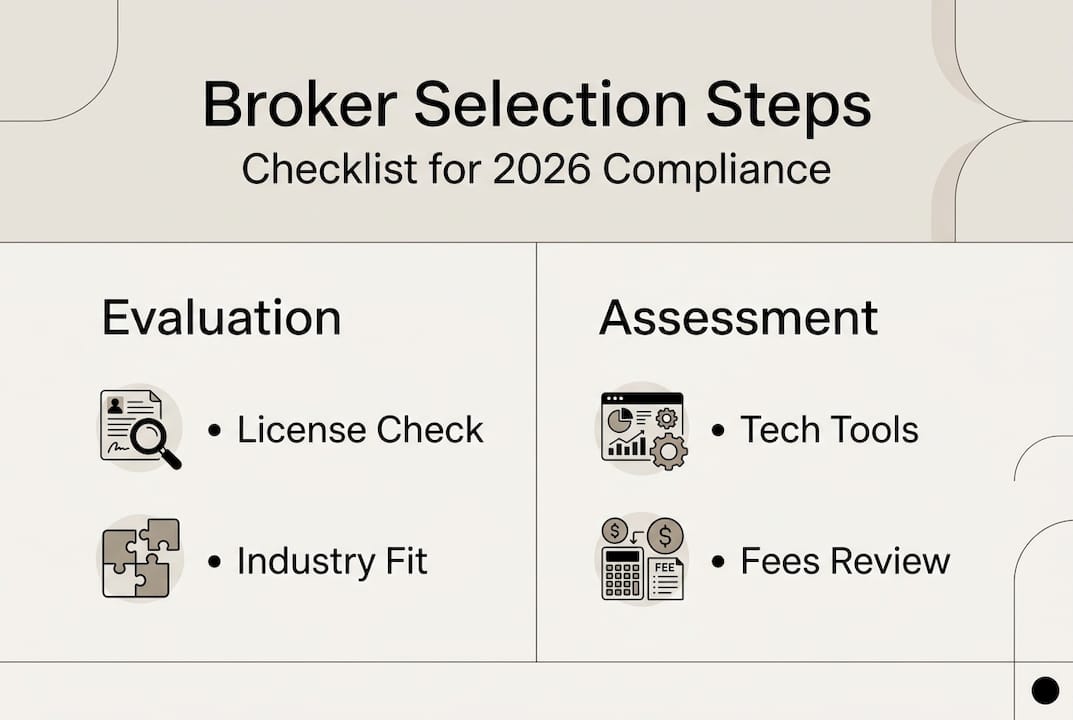
Verify credentials and licensing: Confirm that each candidate holds a valid customs broker license issued by U.S. Customs and Border Protection. Check the CBP website to verify license status and ensure no disciplinary actions or suspensions appear on their record. Review how long they’ve been licensed and whether they maintain the continuing education required to stay current on regulatory changes.
-
Analyze compliance and performance history: Request information about the broker’s error rates, penalty history, and track record with customs examinations. Ask how they handle compliance issues when they arise and what systems they use to prevent common mistakes. Strong brokers willingly share performance metrics and can provide examples of how they’ve resolved complex compliance situations.
-
Assess technology capabilities: Evaluate the broker’s technology platform for features like online document submission, real-time status tracking, automated alerts, and comprehensive reporting. Test their user interface if possible and confirm they can integrate with your existing systems. Technology directly impacts your visibility into the clearance process and your ability to manage shipments proactively.
-
Compare pricing models and fee structures: Understand exactly how each broker charges for services, including per-entry fees, monthly minimums, and any additional charges for specialized services. Request detailed fee schedules and ask about circumstances that might trigger extra charges. Transparent pricing prevents surprises and allows accurate cost comparison across candidates.
-
Conduct interviews and check references: Meet with broker representatives to assess their knowledge, responsiveness, and customer service approach. Ask detailed questions about how they would handle scenarios specific to your business. Contact provided references to learn about their actual experience, focusing on responsiveness during issues, accuracy of work, and overall satisfaction.
Evaluating customs brokers based on compliance history, customer service, technology, and cost ensures you select a partner who can deliver reliable, efficient service aligned with your business requirements. Use your comparison table to score candidates objectively across all criteria rather than making decisions based on price alone.
Create a side-by-side comparison that weights factors according to your priorities:
| Criteria | Weight | Broker A Score | Broker B Score | Broker C Score |
|---|---|---|---|---|
| Compliance record | 25% | |||
| Technology platform | 20% | |||
| Industry expertise | 20% | |||
| Pricing | 15% | |||
| Customer service | 10% | |||
| Geographic coverage | 10% |
Pro Tip: During interviews, present specific scenarios from your shipping history and ask how the broker would handle them, paying attention to their problem-solving approach and regulatory knowledge.
Consider cultural fit and communication style alongside technical qualifications. Your customs broker becomes an extension of your team, so compatibility in working style, responsiveness expectations, and communication preferences matters significantly. Assess whether the broker assigns dedicated account representatives and how accessible they are when urgent issues arise. Understanding what a customs broker explained in practical terms helps you evaluate whether candidates can truly meet your operational needs.
Review contract terms carefully before making your final decision. Pay attention to termination clauses, liability limitations, service level commitments, and dispute resolution procedures. Ensure the agreement clearly defines responsibilities, performance standards, and remedies if the broker fails to meet expectations. A well-structured contract protects both parties and establishes the foundation for a successful long-term partnership.
Verifying broker performance and maintaining compliance after selection
Selecting a customs broker marks the beginning, not the end, of your quality assurance responsibilities. Establish clear performance metrics from the start to track how effectively your broker handles clearances and maintains compliance. Key performance indicators should include clearance processing times, documentation accuracy rates, duty calculation precision, and responsiveness to inquiries. Set specific targets for each metric and review performance against these benchmarks regularly.
Schedule structured review meetings quarterly or biannually to assess broker performance comprehensively. These sessions provide opportunities to discuss trends in clearance times, address any recurring issues, and align on upcoming changes to your shipping patterns or product mix. Use data from your broker’s reporting systems to identify areas for improvement and recognize strong performance. Regular dialogue ensures small problems get resolved before they become significant compliance risks.
Leverage technology tools to monitor shipment status and customs clearance progress in real time. Most modern brokers provide online portals or automated notifications that keep you informed throughout the clearance process. Active monitoring allows you to spot delays early and intervene when necessary rather than discovering problems only when shipments miss delivery windows. Ongoing performance monitoring and clear communication prevent issues from escalating and maintain the efficiency that drove your broker selection.
Stay informed about regulatory changes that affect your imports, even though your broker should proactively advise you of relevant updates. Subscribe to CBP bulletins, join industry associations, and participate in trade compliance webinars to maintain your own knowledge base. This awareness allows you to ask informed questions and verify that your broker is implementing necessary changes to maintain compliance. When regulations shift, confirm your broker has updated procedures and trained staff accordingly.
Document compliance issues immediately when they occur and work collaboratively with your broker to implement corrective actions. Whether facing classification disputes, valuation challenges, or documentation errors, prompt attention prevents patterns of non-compliance that could trigger penalties or increased scrutiny. Maintain records of how issues were resolved and what preventive measures were put in place, creating an audit trail that demonstrates your commitment to compliance.
Critical monitoring activities include:
- Tracking clearance times against established benchmarks
- Reviewing duty calculations for accuracy and optimization opportunities
- Verifying proper tariff classification of new products
- Confirming timely filing of all required documentation
- Assessing communication quality and responsiveness
- Monitoring for any CBP penalties or compliance violations
Develop contingency plans for scenarios where broker performance declines or compliance risks emerge. Identify warning signs that might indicate problems, such as increasing clearance times, rising error rates, or deteriorating communication. Know what steps you’ll take if performance falls below acceptable levels, including escalation procedures within the brokerage firm or criteria that would trigger a broker change. Having these plans ready allows swift action if issues arise.
Consider how to avoid customs penalties guide principles apply to your broker relationship. Your broker should actively help you prevent violations through proper classification, accurate valuation, and complete documentation. If penalties occur despite working with a broker, investigate whether they resulted from broker error, miscommunication, or factors outside the broker’s control. This analysis informs whether the relationship needs adjustment or termination.
Maintain open communication channels with your broker’s team at multiple levels. Know who to contact for routine questions, urgent issues, and escalations when normal channels don’t resolve problems quickly enough. Strong broker relationships include regular touchpoints beyond just transactional interactions, building the trust and understanding that enable smooth operations even when challenges arise. Invest in this relationship as you would with any critical business partner.
Discover expert customs brokerage and logistics solutions
Applying the selection framework outlined in this guide positions you to find a customs broker who truly supports your international trade objectives. Worldwide Express brings decades of customs brokerage expertise combined with comprehensive logistics capabilities that address every aspect of your global supply chain. Our licensed customs brokers handle clearances efficiently while our integrated services manage freight forwarding, warehousing, and transportation to create seamless end-to-end solutions.
We combine regulatory knowledge with advanced technology platforms that provide real-time visibility into your shipments and customs status. Our team stays current on changing trade regulations and proactively advises clients on compliance requirements, duty optimization strategies, and documentation best practices. Whether you’re importing specialized equipment, consumer goods, or regulated commodities, our industry-focused expertise ensures accurate classification and efficient clearance.
Explore our comprehensive logistics services that extend beyond customs brokerage to support your entire international shipping operation. Our U.S. customs brokerage services deliver the compliance expertise and operational efficiency you need to compete in global markets. Learn how to master international freight shipping with a partner who understands the complexities of cross-border trade and provides tailored solutions that reduce costs while improving reliability.
Frequently asked questions
How do I verify if a customs broker is licensed and reputable?
Visit the U.S. Customs and Border Protection website and use their broker lookup tool to confirm current license status and check for any disciplinary actions or suspensions. Request client references and testimonials from businesses similar to yours, then contact those references to ask about their actual experience with the broker’s accuracy, responsiveness, and compliance track record.
What are the common hidden fees to watch for when choosing a customs broker?
Watch for storage fees charged when clearance delays prevent timely cargo pickup, as these can accumulate quickly. Some brokers pass through penalties or fines resulting from their own errors rather than absorbing those costs. Request detailed fee schedules that specify charges for specialized documentation, after-hours service, amendments to entries, and any other services beyond standard clearance processing.
How often should I review my customs broker’s performance?
Conduct formal performance reviews quarterly or biannually, depending on your shipment volume and complexity. Use established KPIs like clearance times, accuracy rates, and communication responsiveness to evaluate performance objectively. Schedule these reviews as structured meetings where you discuss metrics, address concerns, and align on any changes to your business needs or shipping patterns.
What technology features should I prioritize in a customs broker’s platform?
Prioritize real-time shipment tracking that shows exactly where your goods are in the clearance process and alerts you to any holds or examinations. Look for online document submission and retrieval capabilities that eliminate manual paperwork and improve efficiency. Comprehensive reporting features that provide visibility into duty costs, clearance times, and compliance metrics help you manage your trade program strategically.
Can I switch customs brokers if performance doesn’t meet expectations?
You can switch brokers, but review your contract terms for any notice requirements or termination procedures you must follow. Plan the transition carefully to avoid clearance disruptions, including transferring necessary documentation and ensuring your new broker has all product information and compliance history. Most businesses maintain relationships with backup brokers to ensure continuity if their primary broker relationship ends.
Recommended
- How customs brokers streamline global trade in 2026 – Worldwide Express, Inc.
- Best Customs Brokerage Providers – Expert Comparison 2025 – Worldwide Express, Inc.
- Why use a customs broker: cut costs by 15% in 2026 – Worldwide Express, Inc.
- Best 7 Customs Brokerage Solutions 2025 – Expert Comparison – Worldwide Express, Inc.