

Faced with the ever-changing demands of global trade, many American logistics managers must juggle complex rules to guarantee Country of Origin Labeling (COOL) accuracy for every shipment. Rising consumer expectations for product transparency and growing regulatory pressure make COOL compliance a priority that goes beyond standard paperwork. This overview demystifies the core labeling standards, reveals relevant legal distinctions, and outlines the best practices needed to protect your supply chain and reputation.
Table of Contents
- Country Of Origin Labeling Explained
- Key U.S. Requirements And Regulations
- Labeling Types Across Products And Industries
- Compliance Responsibilities For U.S. Importers
- Risks And Penalties For Labeling Errors
Key Takeaways
| Point | Details |
|---|---|
| Understanding COOL Requirements | Country of Origin Labeling (COOL) mandates accurate labeling of the geographic source of products to ensure compliance and transparency. |
| Regulatory Oversight | Different U.S. agencies like USDA and FDA oversee specific product categories, necessitating tailored compliance strategies. |
| Importance of Documentation | Comprehensive tracking and detailed production documentation are essential for meeting labeling requirements and avoiding penalties. |
| Consequences of Noncompliance | Labeling errors can lead to shipment delays, financial penalties, and serious reputational damage, highlighting the need for meticulous adherence to regulations. |
Country Of Origin Labeling Explained
Country of Origin Labeling (COOL) is a critical compliance mechanism designed to provide transparency about the geographic source of products entering the United States marketplace. This regulatory requirement mandates that imported goods display clear information about where they were manufactured, processed, or grown, giving U.S. importers and consumers unprecedented insight into product provenance.
The labeling process serves multiple strategic purposes beyond simple identification. Comprehensive origin tracking helps consumers make informed purchasing decisions, supports domestic economic interests, and enables more precise supply chain management. For logistics managers, understanding COOL requirements means navigating complex regulatory frameworks that differ across product categories and industries.
Specifically, COOL regulations vary significantly depending on product type. USDA and FDA oversight means that meat, poultry, and agricultural products follow different labeling protocols compared to manufactured goods. Importers must meticulously track production processes, transformation stages, and documentation to ensure accurate country of origin declarations. Key information typically includes:
- Complete manufacturing location
- Processing country
- Primary raw material origins
- Substantial transformation details
Pro tip: Always maintain detailed production documentation and consult with customs brokers to verify complex origin labeling requirements across different product categories.
Key U.S. Requirements And Regulations
The United States has established comprehensive Country of Origin Labeling (COOL) requirements that reflect intricate legal frameworks governing product import and transparency. Mandatory labeling regulations) emerged from the 2002 Farm Bill, creating a complex system that requires retailers and importers to provide detailed origin information for specific product categories.
Under current U.S. regulations, different federal agencies oversee varying product classifications. The United States Department of Agriculture (USDA) primarily manages labeling for meat, poultry, and certain agricultural products, while the Food and Drug Administration (FDA) handles regulations for other imported goods. Federal regulations mandate that importers provide clear, conspicuous labeling that indicates the complete geographic origin of products, including intricate details about manufacturing and processing locations.
The regulatory landscape for COOL involves several critical compliance requirements:
- Identification of primary manufacturing country
- Documentation of substantial product transformation
- Clear packaging and container labeling
- Specific exemptions for processed foods
- Detailed tracking of raw material origins
Key legislative acts driving these requirements include the Agricultural Marketing Act and subsequent amendments, which establish precise definitions and enforcement mechanisms for origin declarations. Importers must navigate these complex rules, understanding that the ultimate purchaser’s right to know product origin supersedes many traditional marketing considerations.
Here’s how regulatory oversight and labeling specifics compare by U.S. agency and product type:
| Federal Agency | Main Products Overseen | Key Labeling Focus |
|---|---|---|
| USDA | Meat, Poultry, Produce | Origin, processing country, packing location |
| FDA | Processed foods, Manufactured goods | Complete manufacturing origin, packaging info |
| Customs and Border Protection | All imports | Accurate country of origin marking |
Pro tip: Develop a comprehensive internal tracking system that documents each stage of product production to ensure seamless compliance with COOL requirements across different product categories.
Labeling Types Across Products And Industries
Country of Origin Labeling (COOL) encompasses diverse requirements that vary dramatically across different product categories, reflecting the complex nature of international trade regulations. Labeling requirements differ substantially depending on the specific industry, with unique specifications for apparel, agricultural products, manufactured goods, and specialized industrial materials.
In the food sector, labeling goes beyond simple origin identification. Global labeling standards mandate comprehensive information including nutritional content, safety details, and precise geographical origins. The Codex Alimentarius Commission establishes international guidelines that help standardize these requirements, ensuring consumers receive transparent and accurate product information across different markets.
Specific labeling types vary by industry and product classification:
-
Textile and Apparel
- Permanent country of origin tags
- Fiber composition details
- Manufacturing location
-
Food Products
- Nutritional information
- Geographical origin
- Processing details
- Allergen warnings
-
Industrial Goods
- Detailed manufacturing location
- Material sourcing information
- Substantial transformation documentation
Each product category demands unique labeling strategies, with regulations that balance consumer transparency, trade compliance, and practical manufacturing constraints. Importers must develop nuanced approaches that address these multifaceted requirements while maintaining accurate and legible documentation.
Pro tip: Invest in a comprehensive digital tracking system that can automatically generate compliant labels across multiple product categories, reducing manual processing time and minimizing potential errors.
Compliance Responsibilities For U.S. Importers
U.S. importers face a complex web of regulatory obligations when bringing products into the country, with Country of Origin Labeling (COOL) representing a critical compliance requirement. Importer compliance duties stem from longstanding legislation like the Tariff Act of 1930, which mandates precise and transparent product origin identification across various import categories.

The legal framework requires importers to take proactive steps in ensuring comprehensive documentation and accurate labeling. Regulatory responsibilities encompass multiple critical areas, including verifying origin declarations, maintaining detailed records, and adhering to specific packaging and labeling requirements for different product types. Importers must work closely with agencies like the United States Department of Agriculture (USDA), Food and Drug Administration (FDA), and Customs and Border Protection to navigate these intricate compliance landscapes.
Key compliance responsibilities include:
- Verifying product origin documentation
- Ensuring legible and permanent origin markings
- Maintaining detailed import records
- Preparing accurate customs declarations
- Understanding product-specific labeling regulations
Noncompliance can result in significant penalties, including potential shipment delays, financial sanctions, and legal complications. Successful importers develop robust internal processes that anticipate regulatory requirements, leveraging technology and expert guidance to streamline their compliance strategies.
Pro tip: Develop a comprehensive compliance checklist that includes specific requirements for each product category and schedule regular internal audits to ensure ongoing regulatory adherence.
Risks And Penalties For Labeling Errors
Country of Origin Labeling (COOL) errors can expose U.S. importers to substantial legal and financial risks that extend far beyond simple regulatory noncompliance. Enforcement actions can be severe, potentially resulting in significant operational disruptions and substantial financial penalties that can critically impact a company’s bottom line and international trade capabilities.
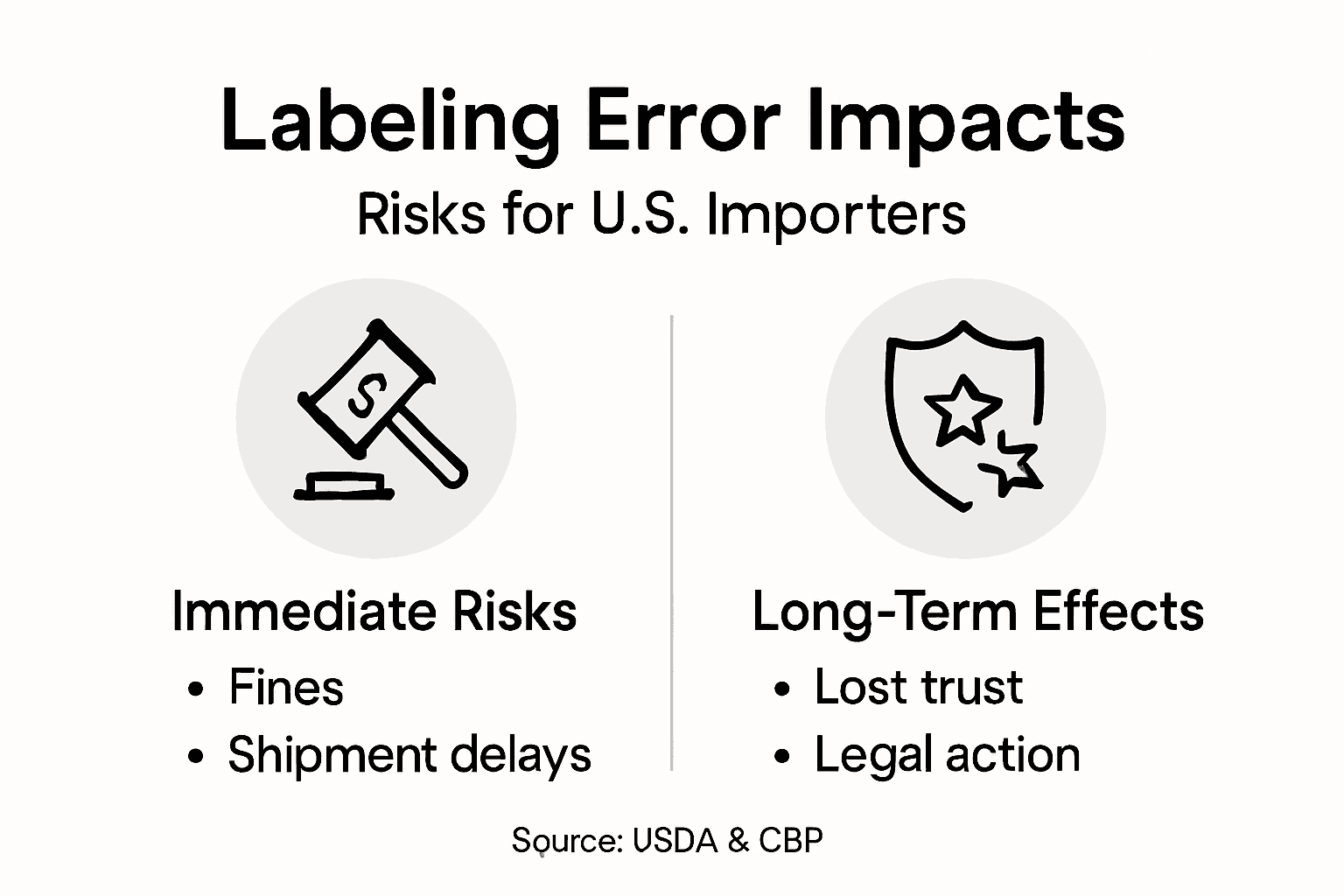
U.S. customs regulations mandate strict requirements for product origin marking, with Customs and Border Protection empowered to take immediate and punitive actions against importers who fail to meet these standards. Potential consequences range from shipment delays and product seizures to substantial monetary fines and potential legal proceedings that can damage a company’s reputation and future import privileges.
The spectrum of potential risks includes:
- Immediate shipment detention
- Monetary penalties ranging from hundreds to thousands of dollars
- Mandatory product relabeling at importer’s expense
- Potential import license restrictions
- Long-term reputational damage with regulatory agencies
- Increased scrutiny on future import shipments
- Potential exclusion from specific trade programs
Beyond immediate financial implications, labeling errors can trigger complex trade disputes, trigger international regulatory investigations, and create significant supply chain disruptions that extend well beyond the initial noncompliance incident. Successful importers recognize that meticulous attention to labeling requirements is not just a regulatory obligation but a critical business strategy.
Below is a summary of business impacts resulting from noncompliance with COOL requirements:
| Consequence Type | Immediate Impact | Long-Term Effect |
|---|---|---|
| Shipment Detention | Delivery delays and costs | Disrupted supply chain |
| Monetary Fines | Increased expenses | Reduced profit margins |
| Reputational Damage | Trouble with agencies | Loss of trade partners |
| Relabeling Expenses | Additional operational costs | Higher compliance spending |
Pro tip: Implement a multi-stage verification process that includes independent third-party label compliance reviews before shipping to minimize the risk of costly labeling errors.
Streamline Your Compliance with Expert Logistics Support
Navigating the complexities of Country of Origin Labeling can be overwhelming for U.S. importers facing stringent documentation, origin verification, and labeling regulations. Mistakes in COOL compliance lead to costly shipment delays, fines, and reputational risks. At Worldwide Express, we recognize these challenges and provide tailored logistics solutions that simplify customs brokerage, ensure accurate documentation, and support thorough compliance management throughout your supply chain.
Don’t let labeling errors disrupt your import operations. Partner with Worldwide Express to leverage our global freight forwarding expertise, customs clearance precision, and compliance-focused services. Visit Worldwide Express today and take control of your international shipping with confidence. Explore how our customs brokerage and freight forwarding solutions can protect your business from costly penalties and streamline your Country of Origin labeling requirements now.
Frequently Asked Questions
What is Country of Origin Labeling (COOL)?
Country of Origin Labeling (COOL) is a regulatory requirement that mandates the clear labeling of a product’s geographic source, providing transparency to consumers and importers about where a product was manufactured or grown.
Why is compliance with COOL important for U.S. importers?
Compliance with COOL is critical because it ensures accurate product origin identification, helps in maintaining consumer trust, and avoids significant legal and financial penalties associated with labeling errors.
What are the key responsibilities of U.S. importers regarding COOL?
U.S. importers must verify product origin documentation, ensure legible and permanent markings, maintain detailed import records, prepare accurate customs declarations, and understand product-specific labeling regulations to comply with COOL requirements.
What are the consequences of noncompliance with COOL regulations?
Noncompliance with COOL can lead to various consequences, including shipment detention, monetary penalties, mandatory product relabeling, reputational damage, and increased scrutiny on future shipments.
Recommended
- Import License Requirements: Ensuring U.S. Trade Compliance – Worldwide Express, Inc.
- Importer of Record Explained: Roles, Risks, and Compliance – Worldwide Express, Inc.
- Harmonized Tariff Schedule: Impact on U.S. Importers – Worldwide Express, Inc.
- Master Importing Food Products: Step-by-Step US Guide – Worldwide Express, Inc.