
Many import/export businesses mistakenly believe customs agents can handle full clearance when only licensed brokers possess legal authority to represent importers before U.S. Customs and Border Protection. This confusion leads to costly delays, compliance penalties, and operational inefficiencies. Understanding the distinct roles of customs brokers and agents empowers you to choose the right service, reduce clearance risks, and streamline your international trade operations.
Table of Contents
- What Is A Customs Broker?
- What Is A Customs Agent?
- Legal, Compliance, And Operational Differences
- Common Misconceptions About Customs Brokers And Agents
- Choosing The Right Service For Your Business
- Conclusion And Next Steps For Import/Export Businesses
- Streamline Your Imports With Expert Customs Brokerage
Key takeaways
| Point | Details |
|---|---|
| Customs brokers hold CBP licenses | Licensed professionals legally represent importers during customs clearance and assume compliance responsibility. |
| Customs agents lack legal authority | Agents provide administrative support without licenses, legal representation, or liability for compliance failures. |
| Brokers reduce clearance delays | Using licensed brokers minimizes shipment holds, duty classification errors, and regulatory penalties. |
| Service choice depends on complexity | High-risk or complex shipments require brokers; simple support tasks may suit agents. |
| Misalignment increases costs | Choosing agents when brokers are needed exposes businesses to fines, delays, and non-compliance risks. |
What is a customs broker?
A customs broker is a licensed professional authorized by U.S. Customs and Border Protection to act on behalf of importers and exporters during the customs clearance process. Customs brokers must be licensed by U.S. CBP and have legal authority to represent clients in interactions with customs officials. This licensing requirement ensures brokers possess deep knowledge of tariff classifications, duty calculations, and trade regulations.
Brokers assume significant legal responsibilities when they represent your business. They manage the entire customs clearance workflow, from classifying goods under the Harmonized Tariff Schedule to calculating duties and taxes. If classification errors or compliance violations occur, brokers face penalties and potential license suspension. This accountability drives their commitment to accuracy and regulatory adherence.
The role of a US customs broker extends beyond paperwork processing. Key duties include:
- Submitting entry documents and required certifications to CBP
- Paying duties, taxes, and fees on behalf of importers
- Communicating directly with customs officials to resolve holds or inquiries
- Advising clients on regulatory changes affecting their shipments
- Maintaining detailed records for audits and compliance verification
Brokers also provide strategic guidance to minimize duty costs through preferential trade agreements and tariff engineering. Their expertise helps you navigate complex regulations like antidumping orders, quota restrictions, and product-specific admissibility requirements. The benefits of U.S. customs brokers become especially apparent when handling regulated goods such as pharmaceuticals, food products, or controlled substances that require additional permits and agency approvals.
Unlike professionals in fields such as real estate brokerage, customs brokers face strict federal oversight and must maintain continuing education to keep their licenses current. This regulatory framework ensures brokers stay informed about evolving trade policies and enforcement priorities.
What is a customs agent?
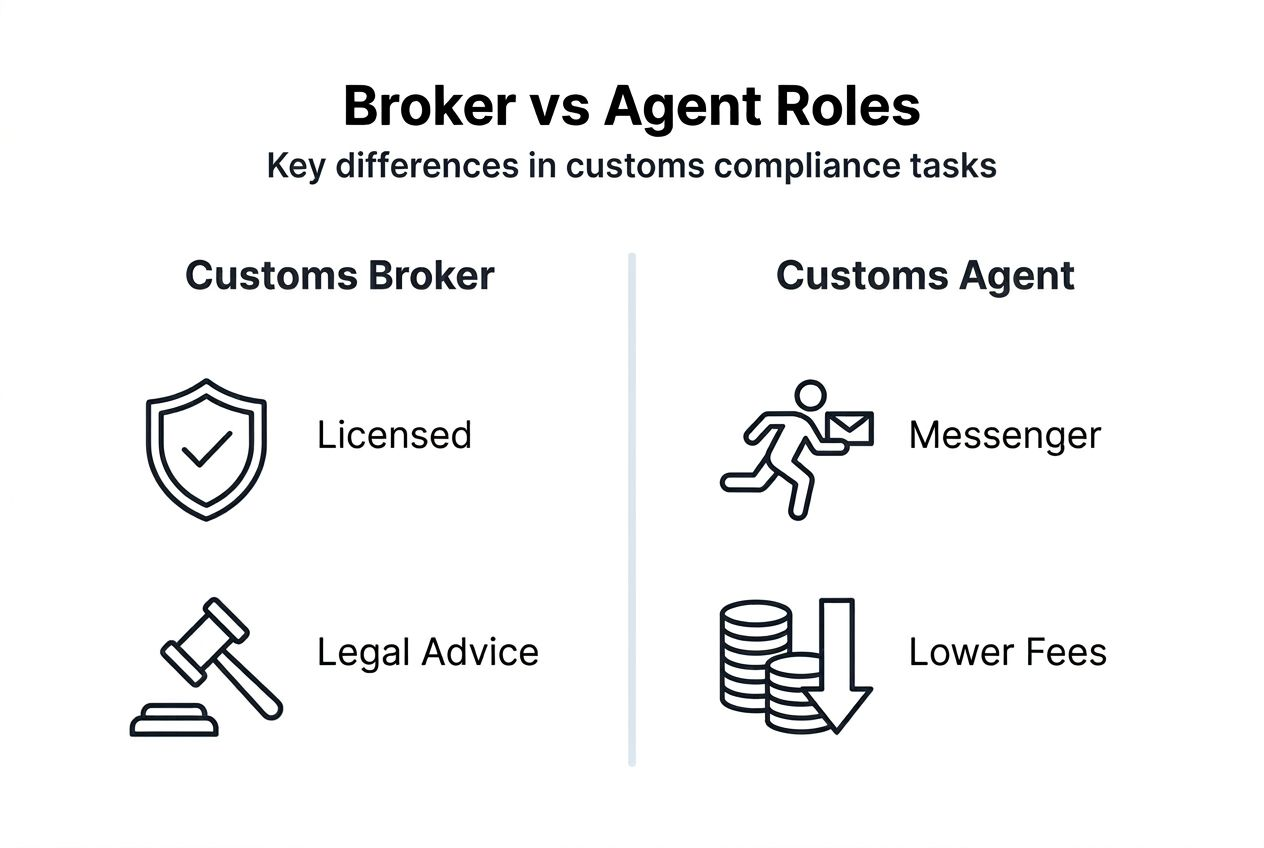
A customs agent operates without a U.S. Customs and Border Protection license and cannot legally represent importers during customs clearance. Agents provide administrative support services that help facilitate trade operations but lack the authority to act as your legal representative before CBP. This fundamental difference creates distinct limitations on what agents can accomplish for your business.
Customs agents typically handle routine support tasks that do not require legal representation. These services include gathering documentation, submitting forms prepared by others, and coordinating communication between parties. However, agents cannot make legal declarations on your behalf, sign official customs documents as your representative, or assume liability for compliance failures.
The scope of customs agent services generally includes:
- Collecting and organizing shipping documents and commercial invoices
- Delivering prepared paperwork to customs offices or freight forwarders
- Tracking shipment status and communicating updates to clients
- Coordinating pickup and delivery logistics for cleared goods
- Providing basic information about documentation requirements
Agents often charge lower fees than licensed brokers because they provide limited services and carry no legal responsibility for clearance outcomes. This cost advantage appeals to businesses handling simple, low-risk shipments with minimal compliance requirements. However, the reduced expense comes with increased operational risk.

When agents submit documents, they do so as messengers rather than legal representatives. If errors occur in tariff classification, valuation, or required certifications, you bear full responsibility for corrections, penalties, and delays. Agents cannot pay duties on your behalf, negotiate with customs officials about holds, or provide authoritative guidance on regulatory compliance.
The distinction between agents and freight broker agent duties often confuses businesses new to international trade. Freight broker agents arrange transportation services, while customs agents assist with clearance-related paperwork. Neither role includes the legal authority and compliance responsibility that define licensed customs brokers.
Legal, compliance, and operational differences
The regulatory framework governing customs brokers creates clear legal distinctions from agents that directly impact your business operations and risk exposure. Customs brokers face regulatory penalties and manage compliance risks, while agents lack legal accountability for clearance outcomes. Understanding these differences helps you align service selection with your operational needs and risk tolerance.
| Aspect | Customs Broker | Customs Agent |
|---|---|---|
| CBP License | Required, with federal oversight | Not required or regulated |
| Legal Authority | Can represent importers before CBP | Cannot legally represent clients |
| Duty Payment | Authorized to pay on importer’s behalf | Not authorized to handle payments |
| Compliance Liability | Assumes responsibility for accurate clearance | No liability for errors or violations |
| Penalty Exposure | Subject to fines and license suspension | No regulatory penalties |
| Document Signing | Can sign official entry documents | Cannot sign as legal representative |
| Clearance Management | Manages entire process end-to-end | Provides support tasks only |
Brokers operate under strict CBP regulations that mandate continuing education, ethical standards, and quality controls. This oversight ensures brokers maintain current knowledge of tariff changes, trade agreements, and enforcement priorities. When you engage a customs broker explained here, you gain access to this expertise and the legal protections it provides.
The operational workflow differs significantly between brokers and agents. Brokers lead the clearance process from initial document review through final release of goods. They identify potential compliance issues before submission, correct errors proactively, and resolve CBP inquiries with authority. Agents simply transmit documents prepared by others and cannot address compliance questions or negotiate clearance terms.
Risk exposure escalates when businesses use agents for complex shipments requiring broker-level expertise. Incorrect tariff classifications can trigger audits, penalty assessments, and shipment seizures. Agents cannot prevent these outcomes because they lack the knowledge and authority to verify classification accuracy or challenge CBP determinations.
Pro Tip: Evaluate your annual import volume and shipment complexity to determine if broker services provide better long-term value than agent support. High-volume importers often save money by preventing penalties and delays rather than minimizing service fees.
Payment processing authority represents another critical distinction. Brokers can pay duties and fees from funds you provide, streamlining the clearance timeline. Agents cannot handle payments, requiring you to manage financial transactions separately and potentially delaying release of your goods.
Common misconceptions about customs brokers and agents
Importers frequently misunderstand the capabilities and limitations of customs service providers, leading to poor decisions that increase costs and compliance risks. Addressing these misconceptions helps you make informed choices about who should handle your customs clearance needs.
Many businesses incorrectly assume customs agents can fully represent them before U.S. Customs and Border Protection. In reality, agents lack the legal authority to act as your representative in any official capacity. They cannot sign entry documents on your behalf, make legal declarations about your goods, or negotiate with CBP officials about clearance issues. Only licensed customs brokers possess this authority.
Another common belief holds that customs brokers simply process paperwork and forward it to customs officials. This view dramatically understates broker responsibilities and expertise. Brokers analyze your shipments for compliance risks, classify goods under complex tariff schedules, calculate duty obligations, and provide strategic advice to minimize costs. They actively manage the clearance process rather than passively transmitting documents.
Some importers think using agents instead of brokers saves money without increasing risk. While agents charge lower fees, this apparent savings disappears quickly when clearance problems arise. Without broker expertise, you face higher likelihood of:
- Incorrect tariff classifications triggering audits and penalties
- Missing required certifications causing shipment holds
- Valuation errors resulting in duty underpayments and interest charges
- Compliance violations leading to fines and increased CBP scrutiny
Businesses also confuse customs brokers with freight brokers or assume freight broker agent duties include customs clearance authority. Freight brokers arrange transportation services between shippers and carriers but have no role in customs compliance. Customs brokers specialize exclusively in regulatory clearance and cannot arrange transportation. These are separate, complementary services serving different needs.
Pro Tip: Request credentials and license verification from any service provider claiming to offer customs representation. Legitimate brokers readily provide their CBP license numbers, which you can verify through CBP’s online broker database.
Some importers believe they only need brokers for their first few shipments until they learn the process themselves. This misconception underestimates the complexity and constant evolution of customs regulations. Tariff classifications change, trade agreements update, and enforcement priorities shift regularly. Brokers maintain current expertise through mandatory continuing education, ensuring your clearances reflect the latest requirements.
The assumption that all customs service providers offer equivalent expertise creates another pitfall. Agents may describe their services using language that suggests broker-level capabilities without clearly stating their unlicensed status. Always verify licensing credentials and understand exactly what legal authority your service provider possesses before entrusting them with clearance responsibilities.
Choosing the right service for your business
Selecting between customs brokers and agents requires careful assessment of your operational needs, risk tolerance, and shipment characteristics. The right choice balances service costs against potential compliance expenses and clearance delays. Follow this systematic approach to determine which service type best supports your import operations.
- Assess your shipment complexity and compliance risk profile
- Evaluate your internal customs expertise and resource availability
- Calculate the financial impact of potential delays and penalties
- Compare service provider credentials and track records
- Review your decision periodically as your business evolves
Start by analyzing your typical shipments for factors that increase clearance complexity. High-risk characteristics include regulated products requiring permits, goods subject to antidumping orders or quotas, shipments with unclear country of origin documentation, and items with ambiguous tariff classifications. Any of these factors strongly favor using a licensed US customs broker rather than an agent.
Your internal capabilities significantly influence this decision. Companies with experienced customs compliance staff may successfully handle routine shipments using agent support for administrative tasks. However, most importers lack the specialized knowledge to manage classification disputes, regulatory inquiries, or changing enforcement priorities. Honest assessment of your team’s expertise prevents costly overconfidence.
Consider these factors when evaluating service options:
- Annual import volume and frequency affecting compliance oversight needs
- Product diversity requiring multiple tariff classifications and regulatory knowledge
- Existing compliance violations or audit history indicating elevated CBP scrutiny
- Budget constraints balanced against potential penalty costs and delay impacts
- Strategic importance of reliable clearance timelines to your operations
The cost-benefit analysis often surprises importers who focus solely on service fees. A broker charging higher rates may save significant money by preventing a single misclassification penalty that exceeds a year of service fees. Calculate your potential exposure by multiplying your average shipment value by typical penalty percentages for common violations, then compare this risk cost to broker fees.
Businesses importing consumer goods, electronics, automotive parts, or industrial equipment generally benefit from broker services due to classification complexity and strict regulatory requirements. Companies handling simple, repetitive shipments of well-documented commodities may find agent support adequate for their limited needs.
Regularly review your customs clearance strategy as your business grows. Expanding product lines, entering new markets, or increasing import volumes often justify upgrading from agent support to full broker services. Schedule annual assessments to ensure your service selection continues meeting your evolving needs and risk profile.
Conclusion and next steps for import/export businesses
Understanding the fundamental differences between customs brokers and agents directly impacts your ability to maintain compliance, control costs, and ensure reliable clearance timelines. Licensed customs brokers provide legal representation and assume responsibility for accurate clearance, while agents offer administrative support without authority or liability. This distinction determines whether you receive comprehensive compliance protection or basic document handling assistance.
Your service selection should align with shipment complexity, regulatory requirements, and risk tolerance. Brokers deliver essential expertise for complex imports requiring tariff classification judgment, regulatory navigation, and legal representation before CBP. Agents may suffice for simple support tasks when you possess internal compliance expertise and handle low-risk shipments.
Take these practical next steps to optimize your customs clearance approach:
- Audit your current service provider’s credentials and verify their CBP license status if they claim broker authority
- Review recent shipments for compliance issues that indicate need for enhanced broker support
- Develop internal training programs to help staff understand when broker expertise is essential
- Create written guidelines specifying which shipment types require licensed broker handling
- Consult with customs compliance experts to identify gaps in your current approach
Proactive management of your customs clearance strategy reduces operational disruptions and protects your business from preventable compliance failures. Clear understanding of broker and agent roles empowers you to make informed decisions that balance service costs against business risks effectively.
Streamline your imports with expert customs brokerage
Navigating customs compliance becomes significantly simpler when you partner with experienced professionals who understand the complexities of international trade regulations.
Worldwide Express provides comprehensive U.S. customs brokerage services backed by licensed brokers who reduce delays and minimize compliance risks. Our team manages every aspect of customs clearance, from tariff classification to duty payment and regulatory coordination. We combine brokerage expertise with full-service logistics services including freight forwarding, warehousing, and supply chain management to support your complete import operation. Whether you’re expanding into new markets or optimizing existing trade lanes, our international freight shipping guide and personalized consultation help you develop efficient, compliant strategies. Contact Worldwide Express today to discover how our customs expertise and integrated logistics solutions can streamline your imports and protect your business from costly compliance failures.
FAQ
What is the main legal difference between a customs broker and a customs agent?
Customs brokers hold licenses issued by U.S. Customs and Border Protection that grant legal authority to represent importers during clearance. Customs agents operate without licenses and cannot legally represent clients or assume compliance responsibility. This licensing distinction determines who can sign official documents and make legal declarations on your behalf.
Can a customs agent submit documents on behalf of an importer?
Customs agents can physically deliver documents to customs offices or freight forwarders as a courier service. However, they cannot sign entry documents as your legal representative, make compliance certifications, or assume liability for accuracy. Their role remains limited to administrative support without legal authority.
When should a business choose a customs broker over an agent?
Businesses should use licensed customs brokers for shipments involving complex tariff classifications, regulated products, high values, or unclear documentation. Brokers are essential when you need legal representation, compliance expertise, or protection from penalties. Their authority and knowledge justify higher fees by preventing costly clearance problems.
What risks exist if a company uses a customs agent instead of a broker?
Using agents when brokers are needed exposes your business to misclassification penalties, shipment seizures, customs audits, and extended delays. You bear full responsibility for all compliance failures since agents cannot verify accuracy or represent you in disputes. The financial impact of a single violation often exceeds years of broker service fees.
Recommended
- Benefits of U.S. customs brokers for efficient trade – Worldwide Express, Inc.
- Role of a US customs broker: streamline trade compliance – Worldwide Express, Inc.
- Customs Broker Explained: Ensuring Smooth U.S. Imports – Worldwide Express, Inc.
- Understanding the Role of a Customs Import Broker – Worldwide Express, Inc.
- Dubai customs: portale ufficiale, servizi e regole doganali