A customs clearance certificate is the official record confirming that a shipment has satisfied a country’s customs requirements and is authorized for release into the domestic market or onward transit. A national customs authority issues it, usually through an electronic system rather than a paper stamp, once duties are assessed and any inspection requirements are cleared. If you’re staring at a shipment stuck at a port, here’s what to look for first:
- The transaction or Cargo Control Number (CCN) tied to your entry
- Confirmation of an electronic release message from customs
- Any stamped or digital document your customs broker forwards as proof
Key Takeaways
A valid customs clearance certificate is really an electronic release message or stamped proof of release, and its name, format, and verification method depend entirely on which country’s customs authority issued it.
| Point | Details |
|---|---|
| No universal certificate exists | Confirm the local term (RNS, SAD release, certificate of clearance) before requesting documents. |
| Proof of origin has thresholds | Invoice declarations self-issued up to €6,000; higher values often need approved exporter status. |
| Verify, don’t trust paper | Query the transaction or CCN directly with customs instead of accepting a stamped copy. |
| Mode-specific transport docs matter | AWB, bill of lading, CMR, or CIM each apply depending on how the shipment moved. |
| Brokers accelerate verification | Worldwide Express manages electronic filing, PGA coordination, and release confirmation for importers. |
Table of Contents
- Customs Clearance Certificate vs. Declarations and Transport Documents
- Core Documents You Need Before Filing a Customs Declaration
- How the Customs Clearance Process Actually Unfolds
- How Canada, the EU, and New Zealand Handle Proof of Release
- How to Obtain and Verify a Customs Clearance Certificate
- Why Working With a Customs Broker Changes the Timeline
- Sources
Customs Clearance Certificate vs. Declarations and Transport Documents
The phrase gets used loosely, and that looseness causes real delays at warehouses and ports. A customs clearance certificate, or proof of release, is not the same thing as a commercial invoice, a bill of lading, or a proof of origin. Each of those feeds into the clearance decision, but the release record is the output, the document (or message) confirming customs has finished its review and the goods can move.
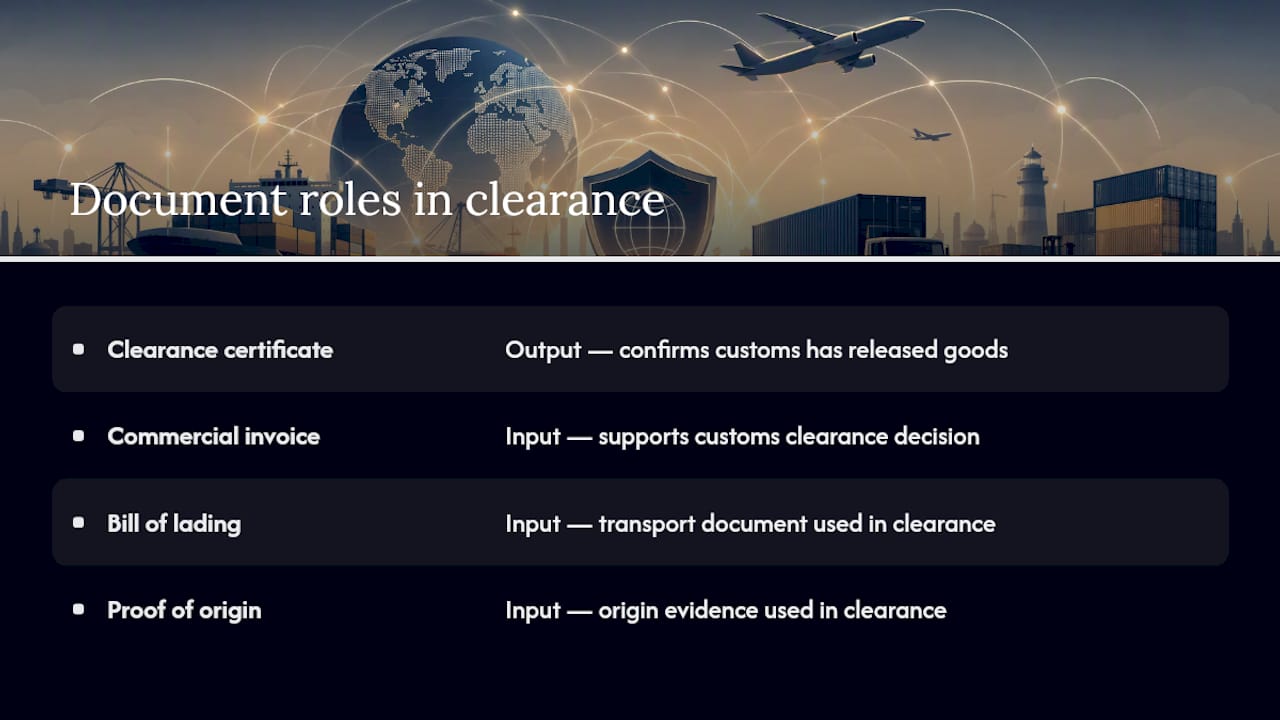
Different customs authorities give this output different names. Some issue an electronic assessment notice. Others generate a release notification tied to a specific reference number. New Zealand publishes prescribed forms under its own certificates of clearance rules, while Canadian shipments rely on electronic release messages rather than a single universal certificate. There is no single global customs clearance certificate, and industry professionals often use the term colloquially. That matters operationally: if you request “the certificate” without naming the local equivalent, you can end up waiting on the wrong document entirely.
Core Documents You Need Before Filing a Customs Declaration
Before you lodge a customs declaration form, gather these in order of how often customs actually asks for them as detailed in the shipping documentation process:
- Commercial invoice. List the buyer, seller, HS classification, unit values, currency, and Incoterms. Undervaluation and missing HS codes are the two most common triggers for a documentary hold.
- Transport documents. The specific paper depends on the mode: an air waybill for air freight, a bill of lading or FIATA B/L for ocean, a CMR for European road freight, or a CIM for rail. These, along with packing lists and carnets, confirm what physically moved and how.
- Proof of origin. This determines whether your goods qualify for reduced or duty-free treatment under a trade agreement. Invoice declarations up to €6,000 can typically be self-issued by the exporter, but higher-value shipments often require approved exporter status or a formal EUR.1 certificate.
- Packing lists, licenses, and permits. Health certificates, veterinary certificates, and other permits apply to regulated goods, food, pharmaceuticals, chemicals, and any category that draws in another government agency.
- ATA or TIR carnets. These cover temporary admission or transit, not standard import clearance, and they’re essential for trade show equipment or goods crossing multiple borders without a sale.
Pro Tip: Keep a standing template of your commercial invoice with HS codes pre-filled for repeat SKUs. Mismatched or missing codes are the single fastest way to trigger a Participating Government Agency (PGA) review you didn’t expect.
How the Customs Clearance Process Actually Unfolds
Clearance follows a fairly predictable sequence, even though the paperwork names change by country. Understanding where the release document appears in that sequence tells you when to start chasing it.
- Advance cargo information. Carriers submit an Entry Summary Declaration (ENS) before arrival so customs can run risk analysis. In the EU, this gets lodged at the first port of entry, with deadlines that shift depending on transport mode.
- Declaration submission. The declarant, often a licensed broker, files the customs declaration form, which in the EU is the Single Administrative Document (SAD) or a national equivalent elsewhere.
- Risk assessment and checks. Customs flags a percentage of entries for documentary review or physical inspection based on risk scoring, commodity type, and origin.
- Duty and tax assessment. Once cleared, duties and taxes get calculated and either paid upfront or deferred through a bonded account.
- Release issuance. This is where your proof of release appears, an electronic assessment message, a stamped certificate, or a release notification, depending on the country’s system.
Most electronic filings clear within hours when documentation is complete; physical inspections or PGA holds can add days.
How Canada, the EU, and New Zealand Handle Proof of Release
The paperwork name and format shift meaningfully once you cross a border, and knowing the local term saves real time.
- Canada. The Canada Border Services Agency treats electronic Release Notification System (RNS) messages, tied to an Import Information Data (IID) submission, as official proof of release. An IID can be filed up to 90 days before arrival, and one IID can link up to many related cargo control documents. Without an electronic message, a stamped Cargo Control Document (CCD) serves as the fallback.
- European Union. Clearance runs through the SAD, supported by proof-of-origin documents like the EUR.1 certificate or invoice declaration, and gated by ENS filing deadlines that vary by transport mode.
- New Zealand. The Customs (Certificates of Clearance) Rules 2024 prescribe specific forms and required fields for sea craft, aircraft, and small craft clearance, with approved electronic submission through the Trade Single Window.
If you receive a stamped or foreign-language document you can’t verify, don’t take it at face value. Confirm it against the issuing country’s own reference number system before releasing goods.
How to Obtain and Verify a Customs Clearance Certificate
Getting a valid release record, and confirming it’s real, comes down to a short sequence most experienced import teams run every time.
- Contact your broker or the customs helpdesk first, and have your HS codes, invoice, EORI or importer number, and any existing transaction or CCN ready before you call.
- Submit missing supporting documents electronically. Many customs systems now accept image uploads of licenses, permits, and certificates through Document Image Functionality, which moves faster than mailing paper originals.
- Verify the release, don’t just trust a printed copy. Query the transaction number directly with the customs system rather than accepting an unsigned or stamped copy at face value, since forged or outdated copies are a known risk at busy ports.
- Escalate if nothing moves within the expected window. Documentary reviews typically resolve within a few business days; if you’re past that with no update, request a status check by CCN rather than resubmitting the entire filing.
Pro Tip: Never release goods to a downstream buyer or warehouse based solely on a stamped paper copy. Ask your broker for the electronic confirmation number and check it yourself, forged clearance documents are more common than most importers assume.
Why Working With a Customs Broker Changes the Timeline
A licensed broker handles the parts of this process that eat the most internal hours: electronic filing, coordinating with Participating Government Agencies, uploading supporting documents, calculating duties and taxes, and confirming release status once it posts.
- Brokers file electronically through systems most importers don’t have direct access to.
- They know which commodity codes routinely draw PGA scrutiny before you find out the hard way.
- They can verify a release message the same day it posts instead of waiting on a status callback.
Self-filing can work for simple, repeat shipments with clean HS classifications. Once you’re dealing with regulated goods, multiple PGAs, or unfamiliar trade lanes, a broker’s compliance experience usually pays for itself in avoided delay costs alone.
An Operations Lead’s Take on Cutting Clearance Delays
Three fixes solve most delays before they start: verify HS codes against the actual commodity, not last year’s shipment; submit proof-of-origin documents before arrival instead of scrambling after a hold; and standardize on bar-coded transaction numbers so paper submissions don’t get lost in queue. None of this is glamorous. It’s just the difference between a two-hour clearance and a three-day one.
— Ian
Getting Clearance Documentation Right the First Time
Worldwide Express handles the filing work that turns a customs clearance certificate from a guessing game into a predictable step in your shipment timeline. As a licensed U.S. customs broker, the team manages electronic filing, PGA coordination, and duty calculation directly, so you’re not chasing a transaction number through a call center while cargo sits at the port.
Before reaching out, have your commercial invoice, HS codes, and transport documents ready, whether that’s an air waybill, bill of lading, or CMR. That’s typically all it takes to get a filing started. If you’re comparing how brokerage fits against handling filings in house, the logistics services overview walks through where brokerage sits inside a full freight forwarding engagement. Request a quote through Worldwide Express and get your next shipment’s clearance documentation moving before it becomes a bottleneck.
Sources
- Proof of origin (European Commission – Taxation and Customs Union)
- Memorandum D17-1-4 (CBSA)
- Additional customs clearance documents (Access2Markets / European Commission)
- Customs (Certificates of Clearance) Rules 2024 (New Zealand Customs Service)
Recommended
- Customs Clearance Is in Progress – What It Means for U.S. Importers – Worldwide Express, Inc.
- Customs clearance for businesses: compliance and smooth trade – Worldwide Express, Inc.
- The Initiated Customs Clearance Process: A U.S. Guide – Worldwide Express, Inc.
- Import Customs Clearance Completed: What It Means for U.S. Importers – Worldwide Express, Inc.