

Nearly every American manufacturer handling international shipments runs into barriers with customs paperwork. Precision and accuracy in customs documentation are non-negotiable, but even small mistakes can lead to costly delays or compliance headaches. Leveraging a well-prepared customs power of attorney PDF empowers your team with documented authority that matches federal expectations and keeps your export and import processes moving. This guide breaks down the key steps for compliance officers who want to simplify global shipping while avoiding common pitfalls.
Table of Contents
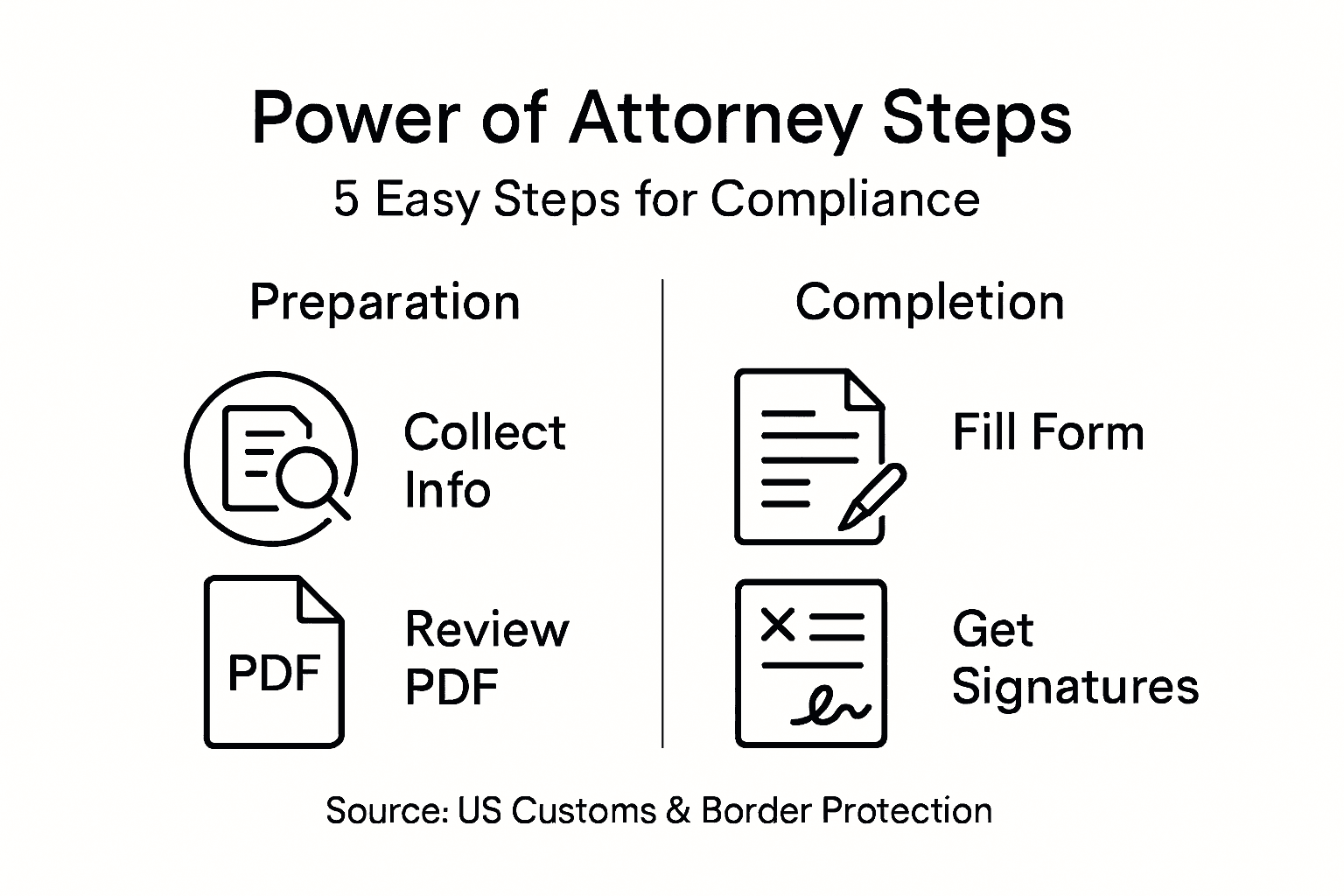
- Step 1: Gather Required Company and Officer Information
- Step 2: Download and Review a Valid Customs Power of Attorney PDF
- Step 3: Complete Key Details and Designate Authority
- Step 4: Sign and Authenticate the Customs Power of Attorney
- Step 5: Verify Legal Compliance and Document Retention
Quick Summary
| Key Point | Explanation |
|---|---|
| 1. Gather Complete Company Documents | Collect business registration documents, Federal Tax Identification Number, and official records for accurate customs processing. |
| 2. Download Official Power of Attorney PDF | Obtain the most recent Customs Form 5291 from a secure government site to ensure compliance with regulations. |
| 3. Specify Authority Clearly | Define the scope and limitations of the authority you grant your designated representative in the Power of Attorney form. |
| 4. Authenticate Signatures Properly | Ensure authorized corporate officers sign the document accurately, following required protocols for legal binding. |
| 5. Implement Document Retention Strategies | Establish storage protocols for both digital and physical copies to maintain compliance and prepare for audits. |
Step 1: Gather Required Company and Officer Information
Gathering the right company and officer information is your critical first step in preparing a valid Customs Power of Attorney. This process requires precise documentation and verification to ensure smooth customs processing and legal compliance.
Start by collecting key company documents that will help you establish your business’s legal identity and authority. You’ll need to have your original business registration documents from your state, Federal Tax Identification Number (EIN), and official company records. When validating power of attorney details, US Customs requires exact matches between your documents and submitted information.
For officer identification, prepare unexpired government issued photo identification for each authorized company representative who will sign the Power of Attorney. This typically means gathering current drivers licenses, passports, or other official government ID for corporate officers with signing authority. Verify that the names on these identification documents precisely match the names registered with your state and federal business records. Double check addresses ensure they match your official business registration and are not using PO box locations.
Collect your company’s primary contact information including official business phone numbers, corporate headquarters address, and contact details for the specific officers authorized to execute customs documentation. US Customs will potentially verify these contact points during their review process.
Pro tip: Create a dedicated folder with all required documents organized chronologically to streamline your Power of Attorney preparation and reduce potential processing delays.
Step 2: Download and Review a Valid Customs Power of Attorney PDF
Downloading and carefully reviewing a valid Customs Power of Attorney PDF is a crucial step in establishing your company’s legal authorization for customs transactions. This process ensures you have the correct documentation that meets all regulatory requirements.

Begin by obtaining the official Customs Form 5291 PDF directly from the US Customs and Border Protection website or through an authorized government portal. Verify that you are accessing the most recent version of the form to ensure compliance with current regulations. When downloading, use a secure government website to prevent any potential document tampering or fraudulent versions.
Carefully review every section of the PDF, paying close attention to the specific fields that require precise company and officer information. Check that all details match your company’s official records exactly. This includes verifying business name, Federal Tax Identification Number, complete physical address, and the names of authorized representatives who will be signing the document. Ensure no fields are left blank and that all information is typed clearly and legibly.
Read through the entire document to understand the scope of authorization you are granting. Some Power of Attorney forms have specific checkboxes or sections that define the exact customs transactions and activities your designated representative can perform. Make sure these align perfectly with your business needs and compliance requirements.
Pro tip: Create a digital backup of the downloaded PDF and store it in a secure cloud storage system with restricted access to ensure you always have a clean copy for future reference.
Step 3: Complete Key Details and Designate Authority
Completing the Customs Power of Attorney form requires meticulous attention to detail and a clear understanding of the specific authority you are granting to your designated representative. This step is critical for ensuring precise and legally compliant customs transactions.
Critically examine the details of authority delegation by carefully specifying the exact scope of transactions your agent can perform. Begin by entering the complete legal business name exactly as it appears on your official registration documents. Include your Federal Tax Identification Number, complete physical business address, and contact information. When designating an agent, provide their full legal name, title, and specific permissions they will have for conducting customs related business.
Each section of the Power of Attorney form demands precision. Clearly define the date range for the authorization period and specify any limitations on the agent’s actions. This might include restricting certain types of transactions or setting geographic boundaries for their authority. Be extraordinarily specific about what actions the designated representative can take on your company’s behalf to prevent potential misunderstandings or unauthorized activities.
Review every line of the document to confirm that all information is accurate and complete. Double check that signatures are placed in the correct locations and that all required fields are filled out with clear and legible information. Incomplete or unclear forms can result in significant delays in your customs processing.
Pro tip: Consider having a legal professional review the completed Power of Attorney form before submission to ensure absolute accuracy and compliance with current customs regulations.
Step 4: Sign and Authenticate the Customs Power of Attorney
Signing and authenticating your Customs Power of Attorney is a critical legal process that formally establishes your company’s authorization for customs transactions. This step transforms your carefully prepared document into a legally binding instrument that grants specific powers to your designated representative.
Ensure that the signing process follows strict protocols by having the appropriate company officers complete the authentication. Typically, this means the signatures must come from individuals with documented authority to bind the company legally such as presidents, chief executive officers, or other senior executives specifically empowered to execute such documents. Each authorized signatory should sign using their full legal name exactly as it appears in the company’s official registration documents.
Carefully verify the authentication requirements before signing. This might include having signatures notarized or witnessed by an official who can confirm the identity of the signatories. Some customs jurisdictions require additional documentation proving the signatory’s corporate authority. Include any supplemental corporate resolution or board meeting minutes that explicitly authorize the specific individuals to execute the Power of Attorney on behalf of the company.
Pay careful attention to the placement and completeness of signatures. Each signature should be accompanied by the printed name, title, and date to ensure absolute clarity. Use blue or black ink and ensure the signatures are original signatures not photocopied or digitally reproduced. Make multiple copies of the fully executed document for your internal records and potential future customs interactions.
Compare key authentication requirements for Customs Power of Attorney:
| Authentication Method | Documentation Required | Legal Reliability | Typical Use Cases |
|---|---|---|---|
| Officer Signature | Unexpired government ID | Essential | All companies |
| Notary Witnessing | Notarized certificate | Very high | Large transactions |
| Board Resolutions | Meeting minutes | Critical for oversight | Corporate appointments |
Pro tip: Maintain a centralized corporate signature log that tracks who has been authorized to sign official documents to streamline future authentication processes.
Step 5: Verify Legal Compliance and Document Retention
Verifying legal compliance and establishing a robust document retention strategy are critical final steps in the Customs Power of Attorney process. These actions protect your company from potential legal complications and ensure you maintain proper records for future reference and potential audits.
Carefully review all completed documentation to confirm full compliance with current US Customs and Border Protection regulations. This means double checking that every section of the Power of Attorney form has been completed accurately, all signatures are properly executed, and the document meets all current legal requirements. Verify that the authorization scope precisely matches your company’s intended customs transactions and that no unauthorized activities could potentially occur under this documentation.
Establish a comprehensive document retention protocol that goes beyond simply filing the Power of Attorney. Create both digital and physical backup copies stored in secure locations. Your digital copies should be saved in encrypted formats with restricted access, while physical copies should be kept in fireproof and locked storage areas. Maintain a detailed log tracking when the document was created, who authorized it, and its expected period of validity. Consider implementing a systematic review process to ensure the Power of Attorney remains current and relevant to your business operations.
Here’s a summary of common Power of Attorney document retention practices:
| Retention Strategy | Security Level | Update Frequency | Business Benefit |
|---|---|---|---|
| Physical fireproof storage | High | Annual audit | Protects from physical threats |
| Encrypted digital backup | Very High | Quarterly review | Safeguards against cyber risks |
| Centralized authorization log | Moderate | Upon signatory change | Prevents unauthorized signatures |
| Reminder system for renewals | High | Six months pre-expiry | Ensures continuous compliance |
Periodically reassess the authorization levels granted in your Customs Power of Attorney. Business needs change rapidly, and what was appropriate six months ago might no longer serve your current operational requirements. Schedule regular reviews of the document to confirm that the designated representatives still have the appropriate level of authority and that no organizational changes necessitate updates to the Power of Attorney.
Pro tip: Create a digital reminder system that alerts your compliance team six months before the Power of Attorney expires to ensure timely renewal and continuous customs transaction capabilities.
Streamline Your Customs Power of Attorney Process with Expert Logistics Support
Navigating the complexities of Customs Power of Attorney requires precision and full compliance to avoid costly delays and legal risks. This article highlights key challenges like gathering exact company and officer information, completing detailed authorization scopes, and maintaining rigorous document retention standards. If you are looking to simplify customs brokerage and ensure flawless execution of your customs documentation, our expertise can make the difference.
Discover tailored international shipping solutions designed to handle everything from customs clearance to freight forwarding with care and efficiency. Visit our Uncategorized Services page to explore how Worldwide Express, Inc. can support your global trade needs. Take the next step in protecting your business by partnering with a logistics provider that understands the critical nature of your Customs Power of Attorney and compliance requirements. Get started now at Worldwide Express to experience seamless customs transactions backed by trusted industry knowledge.
Frequently Asked Questions
What is a Customs Power of Attorney PDF, and why is it important?
A Customs Power of Attorney PDF is a legal document that grants a designated representative the authority to act on behalf of a company in customs transactions. It is important because it ensures compliance with customs regulations and facilitates smooth processing of imports and exports.
How do I download the official Customs Power of Attorney PDF form?
To download the official Customs Power of Attorney PDF form, visit the US Customs and Border Protection website or an authorized government portal. Make sure to obtain the most recent version to ensure it meets current regulatory requirements.
What information do I need to include in the Customs Power of Attorney form?
You need to include your company’s legal name, Federal Tax Identification Number, physical business address, and the names and titles of the authorized representatives. Ensure that all provided details match your company’s official records exactly to avoid processing delays.
How should I sign and authenticate my Customs Power of Attorney?
Sign and authenticate your Customs Power of Attorney by having authorized company officers sign the document with their full legal names. Additionally, consider having signatures notarized or witnessed to increase legal reliability and compliance with customs requirements.
How can I verify legal compliance for my Customs Power of Attorney document?
Verify legal compliance by reviewing your completed Customs Power of Attorney document for accuracy in all sections, including signatures and authorization scope. Keep a detailed log of when the document was created and consider implementing an annual audit for best practices.
What are the best practices for document retention of the Customs Power of Attorney?
Best practices for document retention include creating both digital and physical backups stored securely. Maintain a log of document creation details and set up a reminder system to review and update the Power of Attorney regularly to remain compliant with any changes in business operations.
Recommended
- Complete Guide to Customs Power of Attorney Form PDF – Worldwide Express, Inc.
- Complete Guide to the Customs Inspection Process – Worldwide Express, Inc.
- How to Avoid Customs Penalties: A Step-by-Step Guide – Worldwide Express, Inc.
- How to Handle Customs Audits for Smooth Compliance – Worldwide Express, Inc.