

TL;DR:
- The digital freight forwarding market is projected to nearly triple in size by 2031 due to increasing demand for real-time visibility and automation. Key technologies like automation, AI, and IoT are reshaping logistics by reducing processing times and enhancing supply chain transparency. Despite growth, barriers such as skill gaps and resistance remain, and human expertise remains essential for handling complex logistics scenarios.
The digital freight forwarding market is projected to nearly triple in size, growing from USD 41.46 billion in 2025 to USD 119.12 billion by 2031 at a 19% CAGR. That kind of acceleration does not happen by accident. Businesses moving goods across borders are under mounting pressure to cut costs, improve visibility, and deliver faster than ever before. Traditional freight processes, built on phone calls, paper trails, and manual data entry, are simply not keeping pace. Understanding where digital freight forwarding is heading, and how to act on it, is now a strategic priority for any company serious about international trade.
Table of Contents
- Why digital freight forwarding is surging
- Technology pillars powering transformation
- Opportunities and challenges in adoption
- How to leverage digital trends for your supply chain
- The human factor: Why digital still needs people
- Streamline your logistics with expert freight forwarding support
- Frequently asked questions
Key Takeaways
| Point | Details |
|---|---|
| Market growth is accelerating | Digital freight forwarding solutions are expanding rapidly, transforming global supply chains. |
| Automation and AI drive gains | Technologies like automation, AI, and IoT are making freight processes faster and more reliable. |
| Adoption requires overcoming barriers | Skill gaps and organizational resistance must be addressed to fully benefit from digital trends. |
| Success blends tech with expertise | The most resilient supply chains combine powerful digital tools with human problem-solving. |
Why digital freight forwarding is surging
With this growth established, it is important to understand why the industry is shifting at this pace. The numbers alone tell a compelling story, but the real drivers run deeper than market projections.
Competitive advantage and rising customer expectations are the primary forces pushing freight forwarders toward digital platforms. Shippers now expect real-time tracking, instant quotes, and seamless documentation. Forwarders that cannot deliver these experiences are losing business to platforms that can.
The freight marketplace trends shaping logistics in 2025 also reflect a broader shift: buyers of freight services are increasingly comparing providers online, demanding price transparency, and favoring platforms that reduce friction at every step.
Key drivers accelerating digital adoption:
- Real-time shipment visibility demanded by importers and exporters
- Pressure to reduce operational costs through automation
- Growing complexity of global trade regulations requiring smarter compliance tools
- Customer expectations for instant quotes and digital documentation
- Competitive pressure from digitally native freight platforms
The impact of digital freight forwarding on traditional operators is already visible. Legacy forwarders that have not invested in technology are losing market share to platforms offering end-to-end digital workflows.
| Market indicator | 2025 value | 2031 projection |
|---|---|---|
| Market size | USD 41.46 billion | USD 119.12 billion |
| Annual growth rate | 19% CAGR | Sustained through 2031 |
| Primary driver | Platform adoption | AI and automation integration |
Common barriers remain real, however. Many firms cite a shortage of in-house expertise, outdated IT infrastructure, and cultural resistance as the main reasons they have not moved faster. The freight forwarding 2026 guide outlines how businesses can begin addressing these gaps systematically. Businesses that delay adaptation risk more than inefficiency. They risk irrelevance in a market moving at 19% annual growth.
Technology pillars powering transformation
Understanding the ‘why’ sets the stage for examining the ‘how,’ specifically, the tech transforming operations on the ground. Three technologies stand out as the foundation of modern digital freight forwarding.
Per industry data, automation reduces documentation time by 68%, while 65% of freight forwarding operations now use AI route optimization, and IoT devices are active in 45% of containers globally. These are not pilot programs. They are operational realities reshaping how cargo moves.
How the three core technologies work in practice:
- Automation handles repetitive documentation tasks, including bills of lading, customs declarations, and invoicing, cutting processing time dramatically and reducing human error.
- Artificial intelligence analyzes thousands of route variables in real time, selecting optimal paths based on cost, transit time, carrier reliability, and current disruptions.
- IoT sensors embedded in containers transmit live location, temperature, humidity, and shock data, giving shippers and receivers unprecedented supply chain visibility.
AI in logistics is not just about speed. It is about smarter decisions. When AI optimizes international shipping, it can reroute shipments mid-journey to avoid port congestion, weather events, or customs delays, saving both time and money.

| Workflow element | Traditional process | Digitalized process |
|---|---|---|
| Documentation | Manual entry, 2-3 days | Automated, under 8 hours |
| Route selection | Experience-based | AI-driven, real-time |
| Cargo tracking | Periodic check-ins | Continuous IoT monitoring |
| Quote generation | Hours to days | Instant, platform-based |
Pro Tip: Combining all three technologies amplifies efficiency gains far beyond what any single tool delivers alone. A business using automation for documentation, AI for routing, and IoT for tracking creates a feedback loop where each system informs and improves the others.
The compounding effect of these technologies is what makes digital freight forwarding so powerful. Each layer of technology reduces a different category of friction, and together they create a logistics operation that is faster, cheaper, and more resilient.
Opportunities and challenges in adoption
Now that the technology is clear, let us explore both the potential and the hurdles businesses experience on their digital transformation journey.
The opportunities are substantial. Efficiency gains from automation free up skilled staff to focus on complex shipments and client relationships. Improved customer experience through real-time tracking and transparent pricing builds loyalty. And the competitive differentiation that comes from being a digitally capable forwarder is increasingly decisive in winning new contracts.
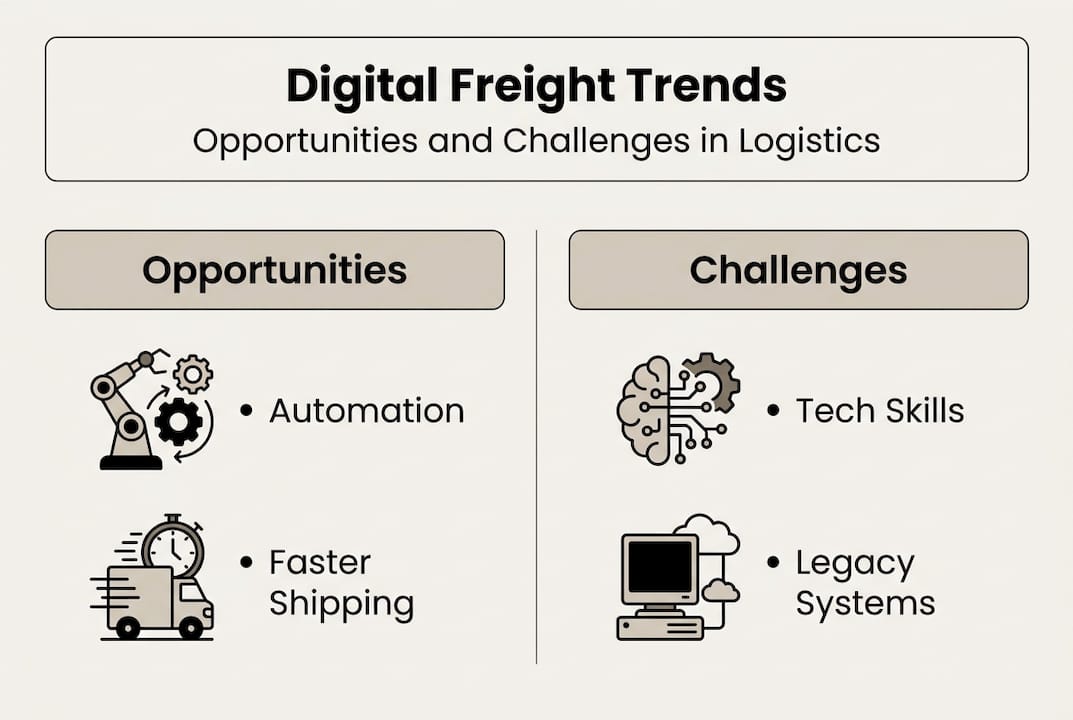
Supply chain digitalization also opens new revenue opportunities. Businesses that digitalize their freight operations gain access to richer data, enabling better forecasting, smarter inventory management, and faster response to market disruptions.
The challenges, however, are equally real. Research on platform-driven digital transformation in B2B freight forwarding identified 30 distinct technology, organization, and environment adoption factors. Sellers often fear market transparency and the price pressure it creates, while buyers actively favor it. This tension is one of the most underappreciated dynamics in freight digitalization.
“Barriers include lack of expertise, IT infrastructure, and cultural resistance; drivers include competitive advantage and customer expectations.” The Impacts of Digitisation on Freight Forwarders
Top challenges businesses face when adopting digital freight solutions:
- Skill gaps in understanding and operating new platforms
- High upfront investment in IT infrastructure and integration
- Cultural resistance from teams accustomed to manual workflows
- Transparency pressure creating pricing anxiety for service providers
- Data security concerns around sharing shipment information on third-party platforms
Pro Tip: Overcome internal resistance by starting with incremental wins. Automate one documentation process first, demonstrate the time savings clearly, and use that success to build organizational buy-in for broader digital adoption.
Logistics growth strategies built around digital tools consistently show that businesses which phase their digital transformation rather than attempting a full overhaul at once achieve better adoption rates and faster returns on investment.
How to leverage digital trends for your supply chain
With opportunities and roadblocks in view, businesses need to know how to act. Here is how to move from awareness to strategy.
The path to digital freight forwarding does not require replacing everything at once. A structured, phased approach reduces risk and builds momentum.
- Audit your current workflows. Map every step in your freight process, from quote request to final delivery, and identify the highest-friction points where time or money is being lost.
- Prioritize automation for documentation. Start with the tasks that consume the most manual hours, such as customs declarations, invoicing, and shipment status updates.
- Select technology partners with proven integration capabilities. Look for platforms that connect with your existing ERP or TMS systems without requiring a complete rebuild.
- Introduce AI-driven route optimization gradually. Begin with your highest-volume trade lanes where the data is richest and the ROI is easiest to measure.
- Train your team alongside the technology rollout. Digital tools only deliver value when the people using them understand both the mechanics and the strategic intent.
The freight forwarding 2026 guide provides a practical framework for evaluating platforms and building a digitalization roadmap suited to different business sizes and trade volumes.
Balancing automation with human judgment is critical. As noted in research on human and machine collaboration, edge cases in logistics require continued human oversight alongside automated platforms. Not every shipment fits a standard template, and the ability to intervene intelligently when things go wrong remains a core competency.
Pro Tip: When evaluating digital freight platforms, require vendors to demonstrate clear ROI metrics from existing clients and confirm that the platform supports flexible integration paths. Rigid systems that cannot adapt to your trade lanes or compliance requirements will create more problems than they solve.
The goal is not to automate everything. The goal is to automate the right things, freeing your team to focus on the decisions that genuinely require expertise.
The human factor: Why digital still needs people
Before closing, it is worth addressing one persistent myth about digital transformation in logistics: that technology will eventually replace the need for experienced freight professionals.
Technology handles routine tasks exceptionally well. Automated platforms process standard shipments faster and more accurately than any manual system. But logistics is not a world of standard shipments. Regulatory changes, port strikes, customs disputes, and damaged cargo are daily realities, not edge cases. Per research on logistics and human judgment, platforms excel in routine tasks but human oversight remains essential when complexity spikes.
Businesses that blend AI and logistics expertise with skilled human teams consistently outperform those relying solely on automation or manual processes. The most resilient supply chains are built by organizations that treat technology as a tool for their people, not a substitute for them. Success in digital freight forwarding belongs to teams that leverage innovation confidently, not those that fear it.
Streamline your logistics with expert freight forwarding support
If you are ready to future-proof your shipping and supply chain strategy, here is where to start.
Worldwide Express brings together deep industry expertise and digital logistics capabilities to help businesses navigate international trade with confidence. Whether you are just beginning to explore the freight forwarding basics or ready to optimize an established supply chain, the right partner makes the difference. Explore the full range of logistics services built for businesses moving goods across borders, or get guidance on choosing a freight forwarder that aligns with your specific trade lanes, compliance needs, and growth goals. The digital shift is already underway. Now is the time to move with it.
Frequently asked questions
What is digital freight forwarding?
Digital freight forwarding uses online platforms and automation to manage shipping and documentation, improving speed and transparency compared to traditional methods. Per market analysis, digital freight forwarding improves supply chain efficiency through automation and transparent platforms.
How much faster is automated documentation processing?
Automation in digital freight forwarding reduces documentation time by as much as 68%, freeing logistics teams to focus on higher-value tasks.
What are the biggest barriers to adopting digital freight solutions?
The most common obstacles include lack of expertise, IT infrastructure upgrades, and staff resistance to new technology. Research confirms that cultural resistance and skill gaps are among the top barriers slowing adoption.
Can digital freight forwarding completely replace humans?
No. While platforms handle routine tasks efficiently, human judgment remains essential for complex logistics challenges, exceptions, and situations requiring real-time decision-making.
Recommended
- Freight marketplace trends shaping logistics in 2025 – Worldwide Express, Inc.
- Understanding freight forwarding: a 2026 guide – Worldwide Express, Inc.
- Unlock cargo tracking benefits for efficient logistics – Worldwide Express, Inc.
- 6 Key Trends in International Logistics for U.S. Managers – Worldwide Express, Inc.