

More than ninety percent of American imports flow through strict U.S. Customs checkpoints, making accurate Entry Summary Form 7501 filings a non-negotiable part of international trade. For logistics managers, even one simple mistake can mean costly shipment delays or stiff penalties. Knowing exactly what American customs officials expect on this form helps safeguard your supply chain and keeps your goods moving with fewer complications.
Table of Contents
- Entry Summary 7501 Defined and Its Vital Role
- Key Components and Data Fields Explained
- Filing Process and Customs Requirements
- Penalties, Corrections, and Compliance Risks
- Common Mistakes and How to Avoid Them
Key Takeaways
| Point | Details |
|---|---|
| Importance of Entry Summary Form 7501 | This form is essential for compliance with U.S. customs regulations, capturing detailed information about imported goods to avoid penalties and shipping delays. |
| Critical Data Fields | Key information such as HTS codes, origin, and merchandise value must be accurately documented to ensure legal clearance through customs. |
| Filing Requirements | Importers must submit the Entry Summary Form within 10 working days post-release, necessitating a thorough and timely preparation process. |
| Common Errors to Avoid | Frequent mistakes include incorrect HTS classifications and undervaluation of goods, which can lead to significant compliance risks and audits. |
Entry Summary 7501 Defined and Its Vital Role
The Entry Summary Form 7501 represents a critical documentation mechanism for international trade professionals navigating U.S. customs regulations. U.S. Customs and Border Protection uses this form to meticulously track and validate imported merchandise across multiple dimensions including classification, valuation, and duty assessment.
At its core, the Entry Summary Form serves as an official government record that captures comprehensive details about imported goods. Logistics managers must complete this document with extreme precision, documenting critical information such as product descriptions, country of origin, harmonized tariff codes, declared value, and applicable duty rates. Inaccurate or incomplete submissions can trigger significant complications, including potential shipment delays, financial penalties, or even legal enforcement actions.
The Entry Summary Form 7501 operates as more than a mere bureaucratic requirement – it functions as a crucial compliance instrument within the international shipping ecosystem. Importers rely on this document to ensure legal clearance of their merchandise through U.S. customs checkpoints. Each line item represents a potential point of scrutiny, where customs officials will cross-reference declared information against established trade regulations, tariff schedules, and potential restricted goods protocols.
Key components that logistics professionals must carefully address on the Entry Summary Form include:
- Precise product classification codes
- Exact merchandise value declarations
- Complete origin country identification
- Accurate duty and tax calculations
- Detailed shipment weight and measurement specifications
Pro Tip: Invest in robust customs management software that can automatically validate Entry Summary 7501 form data against current U.S. customs regulations to minimize potential compliance risks.
Key Components and Data Fields Explained
The Entry Summary Form 7501 encompasses a complex array of data fields that demand meticulous attention from logistics professionals. U.S. Customs and Border Protection requires comprehensive documentation that goes far beyond simple merchandise identification, creating a detailed landscape of import transaction specifics.
Fundamental data fields on the Entry Summary Form include critical elements that collectively construct a comprehensive import profile. These essential components encompass the entry number, which serves as a unique identifier for the specific shipment, and the entry type that categorizes the nature of the import transaction. The port code indicates the specific customs entry point, while the importer number provides traceable identification for the importing entity.

Merchandise-specific details represent another crucial segment of the form. Logistics managers must provide exhaustive descriptions including product classifications using the Harmonized Tariff Schedule of the United States (HTSUS) codes, precise country of origin information, and detailed valuation metrics. These fields are not merely bureaucratic requirements but serve as critical instruments for determining appropriate duty calculations, potential trade restrictions, and comprehensive compliance verification.
Key data fields that demand strategic attention include:
- Entry Number (unique shipment identifier)
- Entry Type (transaction classification)
- Port of Entry Code
- Importer Identification Number
- Detailed Merchandise Description
- HTSUS Classification Codes
- Country of Origin
- Merchandise Value
- Quantity and Weight Specifications
- Applicable Duty Rates
Pro Tip: Maintain a standardized internal documentation workflow that cross-references Entry Summary 7501 data against your company’s master import records to minimize potential transcription errors and ensure consistent compliance.
Here’s a quick reference highlighting the functions of major Entry Summary 7501 data fields and their business impact:
| Data Field | Primary Function | Business Impact |
|---|---|---|
| Entry Number | Unique shipment identification | Enables precise tracking |
| HTSUS Code | Merchandise classification | Determines duty rates |
| Importer Number | Identifies responsible party | Drives legal accountability |
| Merchandise Value | Sets goods valuation | Influences total duty owed |
| Origin Country | Specifies product origin | Affects trade restrictions |
Filing Process and Customs Requirements
The Entry Summary Form 7501 filing process represents a critical compliance mechanism that demands precise execution by import professionals. Importers must submit their documentation within 10 working days after merchandise release, creating a narrow window for comprehensive data compilation and submission.
The submission process primarily occurs through the Automated Commercial Environment (ACE) system, which requires electronic filing of all critical import documentation. Logistics managers must meticulously prepare detailed information including accurate Harmonized Tariff Schedule (HTS) classifications, precise merchandise valuations, complete origin details, and comprehensive shipping specifications. Each data point represents a potential compliance checkpoint where errors can trigger significant regulatory scrutiny.
Complex customs requirements demand that importers demonstrate extraordinary attention to detail throughout the filing process. Accurate documentation serves multiple purposes beyond mere administrative compliance – it facilitates smooth goods clearance, enables proper duty calculation, and mitigates potential audit risks. Compliance teams must verify every data element, understanding that incomplete or inaccurate submissions can result in substantial financial penalties, shipment delays, or potential legal complications.
Key steps in the Entry Summary 7501 filing process include:
- Gather comprehensive merchandise documentation
- Verify HTS classification accuracy
- Calculate precise merchandise valuation
- Confirm country of origin details
- Prepare electronic submission through ACE system
- Deposit estimated duties within prescribed timelines
- Maintain thorough record-keeping documentation
Pro Tip: Develop a standardized internal checklist that cross-references Entry Summary 7501 requirements against your specific import documentation to minimize potential compliance gaps and streamline the submission process.
Penalties, Corrections, and Compliance Risks
Navigating the complex landscape of Entry Summary 7501 requires an understanding of potential penalties and compliance risks that can significantly impact import operations. Customs regulations impose stringent consequences for inaccurate or late filing, with penalties ranging from monetary fines to potential legal enforcement actions under statutes like 19 U.S.C. 1592 and the False Claims Act.
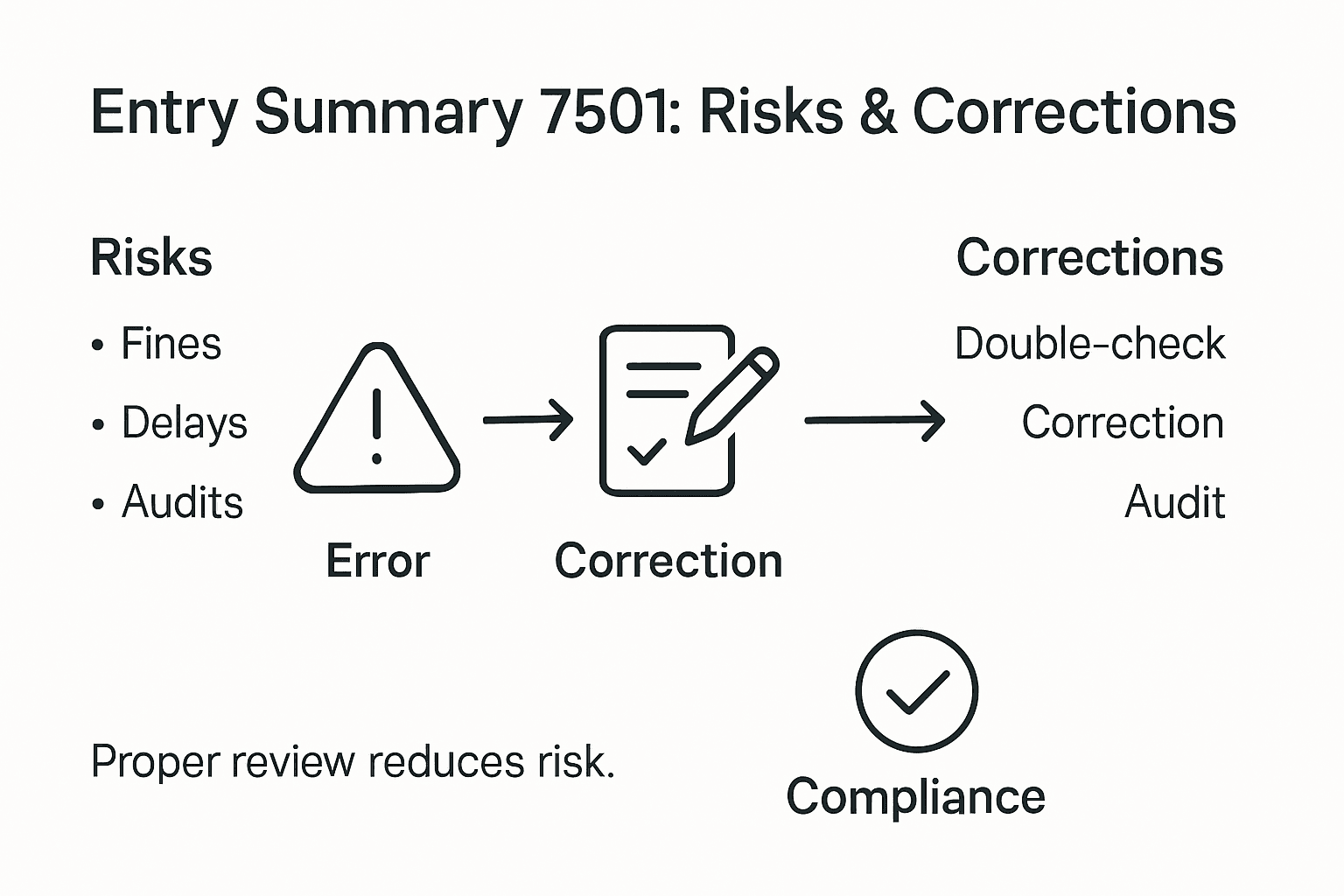
The Post Summary Correction (PSC) mechanism provides importers a critical pathway to address documentation errors, but this process is not without its complexities. Deliberate misclassification or undervaluation can trigger severe scrutiny, with potential financial penalties that can escalate quickly. Compliance teams must recognize that voluntary disclosure before government investigation may mitigate some risks, but does not guarantee complete immunity from potential legal consequences.
Risk mitigation demands a proactive approach to documentation and compliance. Importers must maintain meticulous records, understand the nuanced requirements of Entry Summary 7501, and develop robust internal control mechanisms to prevent recurring errors. The financial and operational risks extend beyond immediate penalties, potentially impacting a company’s reputation, future import privileges, and overall supply chain efficiency.
Key compliance risks and potential consequences include:
- Monetary penalties for misclassification
- Shipment delays and customs holds
- Increased audit frequency
- Potential legal action under False Claims Act
- Revocation of import privileges
- Substantial financial settlements
- Reputational damage to the importing organization
Pro Tip: Implement a comprehensive internal audit process that conducts quarterly reviews of Entry Summary 7501 submissions, cross-referencing historical data to identify and proactively address potential compliance vulnerabilities.
Common Mistakes and How to Avoid Them
Logistics professionals navigating Entry Summary 7501 documentation must remain vigilant about potential pitfalls that can compromise import compliance. Common errors on customs forms can trigger significant operational disruptions and financial penalties, ranging from minor administrative challenges to substantial legal complications.
The most frequent mistakes stem from technical documentation errors that appear deceptively simple but carry significant consequences. Incorrect Harmonized Tariff Schedule (HTS) classification codes represent a critical vulnerability, where even minor misinterpretations can result in incorrect duty calculations, potential audits, and unexpected financial liabilities. Importers frequently struggle with precise product categorization, especially when dealing with complex or technologically advanced merchandise that may not fit neatly into standard classification frameworks.
Comprehensive risk mitigation requires a multifaceted approach to documentation and internal processes. Successful import professionals develop robust verification mechanisms that include multiple layers of review, leveraging both technological solutions and human expertise. Automated filing systems can reduce human error, but cannot completely eliminate the need for meticulous manual verification by experienced compliance specialists who understand the nuanced requirements of customs documentation.
Key mistakes to avoid on Entry Summary 7501 include:
- Incorrect HTS classification codes
- Undervaluation of imported goods
- Incomplete origin documentation
- Late or missed filing deadlines
- Insufficient supporting documentation
- Inaccurate shipment weight and measurement declarations
- Failure to update historical compliance records
Pro Tip: Establish a mandatory two-person review protocol for all Entry Summary 7501 submissions, with one team member performing the initial documentation and a second conducting an independent verification to minimize potential errors.
For better error prevention, compare manual vs. automated Entry Summary 7501 review methods:
| Method | Strengths | Limitations |
|---|---|---|
| Manual Review | Detailed human oversight | Susceptible to fatigue |
| Automated System | Rapid error detection | May miss nuanced discrepancies |
| Combined Approach | Maximizes accuracy | Requires resource commitment |
Simplify Your Entry Summary 7501 Compliance with Expert Logistics Support
Handling Entry Summary 7501 filings can feel overwhelming with its detailed requirements around HTS codes, accurate valuations, and strict customs deadlines. Missing a classification or misfiling duty information risks costly penalties, shipment delays, and increased audit scrutiny. Understanding these critical pain points is the first step toward seamless import compliance.
At Worldwide Express, we specialize in customs brokerage and import freight forwarding services designed to reduce errors and streamline your customs clearance process. Our global team navigates complex U.S. Customs guidelines so you can focus on growing your business with confidence. From expert documentation management to supply chain solutions, we provide tailored support that ensures accurate Entry Summary 7501 submissions and timely filings.
Ready to eliminate compliance risks and accelerate your U.S. imports? Discover how our customs and international shipping expertise can help you meet detailed regulatory needs. Visit Worldwide Express now for a custom logistics plan that protects your shipments and improves operational efficiency.
Frequently Asked Questions
What is the Entry Summary Form 7501?
The Entry Summary Form 7501 is a crucial document used by U.S. Customs and Border Protection to track and validate imported merchandise, ensuring compliance with customs regulations.
What information is required on the Entry Summary Form 7501?
The form requires detailed information including product descriptions, country of origin, harmonized tariff codes, declared value, and applicable duty rates to facilitate accurate duty calculations and compliance.
How can errors in the Entry Summary Form 7501 impact my imports?
Errors may lead to significant complications, such as shipment delays, financial penalties, and legal enforcement actions, making accurate and complete submissions essential.
What steps should I take if I make a mistake on the Entry Summary Form 7501?
If an error occurs, you may utilize the Post Summary Correction (PSC) process to amend documentation, but proactive voluntary disclosure can help mitigate risks even before an investigation starts.
Recommended
- Import License Requirements: Ensuring U.S. Trade Compliance – Worldwide Express, Inc.
- How to Avoid Customs Penalties: A Step-by-Step Guide – Worldwide Express, Inc.
- Complete Guide to the Customs Inspection Process – Worldwide Express, Inc.
- Importer of Record Explained: Roles, Risks, and Compliance – Worldwide Express, Inc.