

TL;DR:
- Export compliance is crucial to avoid shipment delays, penalties, and relationship damage.
- Building a comprehensive export compliance program enhances operational speed and market access.
- Automation and integrated processes turn compliance into a strategic growth advantage.
Export compliance is widely misunderstood as a back-office paperwork exercise. In reality, a single misclassified product, one overlooked sanctions check, or a missing Automated Export System filing can freeze a shipment, trigger six-figure penalties, and damage relationships with trading partners that took years to build. The stakes are genuinely high. Businesses that treat compliance as a strategic priority rather than an afterthought move goods faster, access new markets with confidence, and avoid the costly disruptions that derail competitors. This article walks through the essential regulations, the Bureau of Industry and Security framework, and the daily practices that turn compliance from a burden into a genuine operational advantage.
Table of Contents
- Understanding key export compliance regulations
- The BIS export compliance framework: 8 essential elements
- Export authorization, screening, and recordkeeping best practices
- Training, audits, and handling violations: Building resilient teams
- Why export compliance is a strategic advantage, not just a regulatory hurdle
- Next steps: Streamline your export compliance and logistics
- Frequently asked questions
Key Takeaways
| Point | Details |
|---|---|
| Know your regulations | Identify whether EAR, ITAR, OFAC, or FTR applies to each shipment to avoid missteps. |
| Build a robust program | Apply the BIS 8-element framework to structure effective compliance systems from management to training. |
| Screen every transaction | Screen all parties and products—even EAR99 items—to prevent overlooked risks and ensure control requirements are met. |
| Leverage automation | Use software tools to automate classification, screening, and recordkeeping as your export volume grows. |
| Invest in training | Empower teams with regular compliance training and audits to build resilience and quickly address potential violations. |
Understanding key export compliance regulations
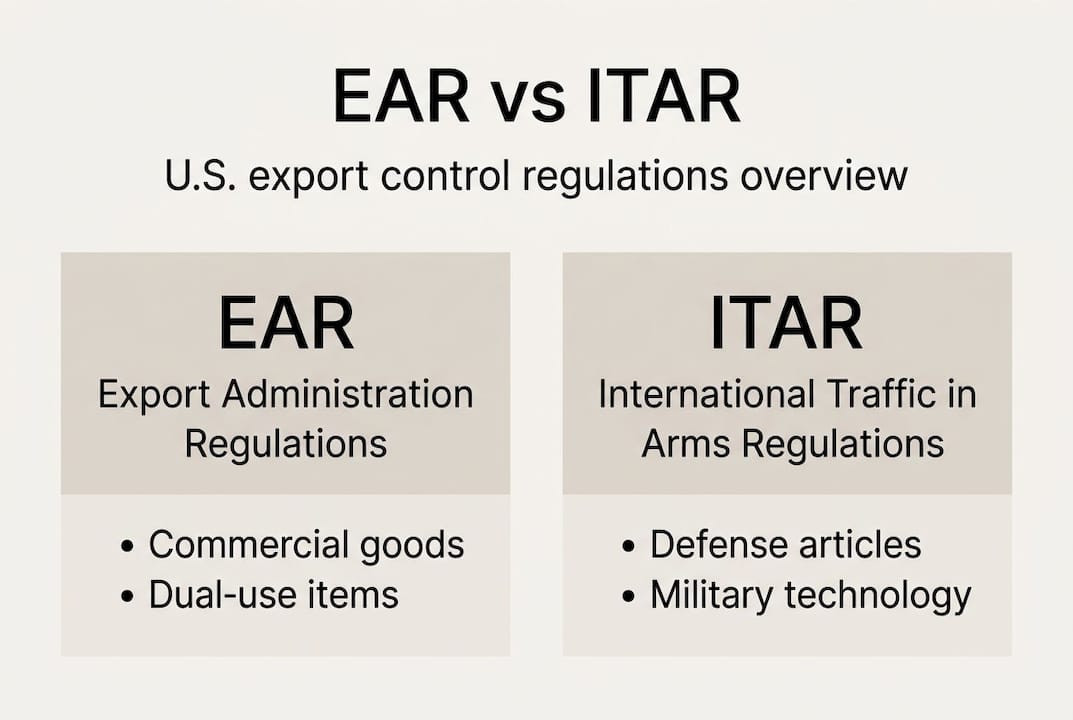
The U.S. export control landscape is built on four foundational pillars, and knowing which one governs your transaction is the first critical step. The Export Administration Regulations, administered by the Bureau of Industry and Security (BIS), cover dual-use and commercial goods. The International Traffic in Arms Regulations (ITAR), managed by the Directorate of Defense Trade Controls (DDTC), govern defense articles and services. The Office of Foreign Assets Control (OFAC) enforces sanctions programs that restrict or prohibit transactions with certain countries, entities, and individuals. The Foreign Trade Regulations (FTR) require Electronic Export Information (EEI) filings through the Automated Export System (AES) for shipments above certain value thresholds. Understanding export controls basics is essential before your first international shipment leaves the dock.
One of the most consequential distinctions in trade compliance basics is the difference between EAR and ITAR. The EAR vs ITAR comparison shows that EAR applies broadly to dual-use items and assumes a product is EAR99 (no specific Export Control Classification Number) if no ECCN applies. ITAR is far stricter, covering items on the U.S. Munitions List (USML), and violations carry criminal penalties that can include imprisonment.
Common pitfalls trip up even experienced exporters. Misclassification is the most frequent. A company assumes a product is EAR99 without checking the USML, only to discover it qualifies as a defense article under ITAR. Overlooked sanctions are another danger. A buyer in an approved country may still be on OFAC’s Specially Designated Nationals (SDN) list, making the transaction prohibited regardless of the product’s classification.
Key regulations at a glance:
| Regulation | Governing body | Scope | Key requirement |
|---|---|---|---|
| EAR | BIS | Dual-use and commercial goods | ECCN classification, license determination |
| ITAR | DDTC | Defense articles and services | USML check, registration, license |
| OFAC | Treasury | Sanctions programs | Screen all parties against SDN and other lists |
| FTR | Census Bureau | Export reporting | AES/EEI filing for qualifying shipments |
Pro Tip: Always check the USML before assuming EAR applies. If a product has any defense application, ITAR may govern it, and the penalties for getting this wrong are far more severe than an EAR violation.
The BIS export compliance framework: 8 essential elements
With regulatory basics established, let’s see how BIS recommends businesses build robust export compliance systems. BIS outlines 8 elements of an effective Export Compliance Program (ECP), and these elements function as a practical blueprint regardless of a company’s size or export volume.
The eight elements are:
- Management commitment: Leadership must formally endorse and resource the compliance program.
- Risk assessment: Identify which products, destinations, and end users pose the greatest compliance risk.
- Export authorization: Determine the correct license or license exception for every transaction.
- Recordkeeping: Maintain all export-related documents for a minimum of five years.
- Training: Provide initial and ongoing education to all employees involved in export activities.
- Audits: Conduct regular internal reviews to catch gaps before regulators do.
- Violation handling: Establish clear procedures for reporting, investigating, and correcting violations.
- Ongoing maintenance: Update the program continuously as regulations and business activities evolve.
For new exporters, implementation does not need to happen all at once. Starting with a solid risk assessment and clear authorization procedures creates a foundation that the other elements can build on over time. Companies that integrate efficient logistics planning with their ECP from the beginning avoid the bottlenecks that arise when compliance is bolted on as an afterthought.
| ECP element | Practical action |
|---|---|
| Management commitment | Assign a dedicated compliance officer |
| Risk assessment | Map products to ECCNs and flag high-risk destinations |
| Export authorization | Build a license determination checklist |
| Recordkeeping | Use cloud-based document management with access controls |
| Training | Schedule quarterly training sessions with role-specific modules |
| Audits | Conduct semi-annual internal audits with written findings |
| Violation handling | Draft a written response protocol before a violation occurs |
| Ongoing maintenance | Subscribe to BIS regulatory updates and review annually |
Pro Tip: Integrate compliance checkpoints directly into your logistics planning workflow. When compliance is a step in the shipping process rather than a separate review, delays drop significantly and errors are caught earlier.
Export authorization, screening, and recordkeeping best practices
Once your compliance framework is set, attention turns to the everyday processes that determine your success or failure. Classification is the starting point. Every product must be evaluated against the USML first, then assigned an ECCN under the EAR, or confirmed as EAR99 with no license required. EAR99 sounds like a free pass, but it is not. These items still require thorough party screening before every shipment.

Party screening means checking every entity in the transaction, including the buyer, end user, freight forwarder, and financial intermediaries, against government watchlists. Red flags include unusual payment terms, requests to ship to a freight forwarder without a disclosed end user, and reluctance to provide end-use certifications. The BIS Entity List, OFAC SDN List, and the Denied Persons List are the minimum checks for every transaction.
A significant regulatory development in 2025 reshaped how exporters evaluate corporate ownership structures. The BIS Affiliates Rule established that entities with 50% or more ownership by a party on the Entity List, Military End User (MEU) list, or SDN list automatically trigger the strictest export controls. Even minority ownership by such parties requires enhanced due diligence. This rule has real consequences for companies with complex international supply chains or joint ventures.
Automation is increasingly essential for scaling compliance checks without proportionally scaling headcount. Compliance software can screen parties in seconds, flag classification mismatches, and generate audit trails automatically.
Recordkeeping essentials:
- Export licenses and license determinations
- Commercial invoices, packing lists, and bills of lading
- End-use certificates and destination control statements
- AES/EEI filing confirmations
- Party screening records and results
- Internal communications related to export decisions
All records must be retained for five years from the date of export or the expiration of the applicable license, whichever is later. The export license application process and Automated Export System filings are particularly important to document thoroughly.
Pro Tip: Screen all parties even for EAR99 items. A shipment of ordinary office supplies to a sanctioned individual is still a violation. The product’s classification does not override the party check.
Training, audits, and handling violations: Building resilient teams
With your authorization and recordkeeping in place, let’s focus on building resilient teams that make compliance second nature. Training and audits are core BIS ECP elements, and handling violations correctly is what separates companies that recover quickly from those that face escalating penalties.
Effective compliance training operates on three levels:
- Initial training: Every new employee with any role in export activities completes a foundational course covering applicable regulations, the company’s ECP, and how to escalate concerns.
- Ongoing training: Annual refreshers keep staff current on regulatory changes, new watchlists, and updated classification guidance.
- Job-specific training: Sales teams learn to recognize red flags in customer requests. Logistics staff learn proper documentation and AES filing procedures. Finance teams understand payment screening obligations.
Regular audits are the mechanism that keeps the entire program honest. A useful audit checklist includes:
- Verify that all shipments in the review period had documented classification determinations
- Confirm party screening was completed and recorded for every transaction
- Check that AES filings were submitted accurately and on time
- Review recordkeeping completeness against the five-year retention requirement
- Assess whether training records are current for all relevant staff
Violations happen even in well-run programs. The response matters enormously. Immediate steps include halting the affected transaction, notifying legal counsel, and conducting an internal investigation to determine scope. Export documentation process gaps are among the most common audit findings, so reviewing shipping documentation practices is a smart first corrective action.
Companies that self-disclose violations to BIS typically receive significantly reduced penalties compared to those where violations are discovered through enforcement actions. Proactive disclosure is not an admission of wrongdoing; it is a demonstration of good faith that regulators reward.
Building a culture where employees feel empowered to raise concerns without fear of retaliation is the foundation of a resilient compliance program. When a warehouse worker flags a suspicious shipment request, that is the system working exactly as intended. Proper packing goods for export procedures and documentation habits reinforce this culture at every level of the operation.
Compliance training resources from industry specialists can supplement internal programs, particularly for smaller teams that lack dedicated compliance staff.
Why export compliance is a strategic advantage, not just a regulatory hurdle
The conventional view treats export compliance as a cost center, a necessary expense to avoid fines. That framing is limiting and, frankly, inaccurate for businesses serious about global growth. Strong compliance programs create something far more valuable than penalty avoidance. They create trust.
Customs authorities, foreign buyers, and logistics partners all prefer working with companies that demonstrate consistent, documented compliance practices. That trust translates into faster clearance times, smoother license approvals, and access to markets that less compliant competitors simply cannot enter. Well-executed programs also future-proof operations against regulatory shifts. When a new rule like the BIS Affiliates Rule takes effect, companies with mature ECPs adapt quickly because the infrastructure for due diligence already exists.
Automation and diligent screening are not just efficiency tools. They are competitive differentiators. Treating logistics optimization and compliance as integrated functions rather than separate departments is the mindset that separates market leaders from reactive operators. Involve every department, from sales to finance to operations, and compliance becomes a growth enabler rather than a bottleneck.
Next steps: Streamline your export compliance and logistics
Navigating export regulations is genuinely complex, but the right partners make it manageable and even efficient.
Worldwide Express offers customs brokerage services designed to handle classification, screening, and documentation with precision, reducing the compliance burden on your internal teams. For businesses expanding their international footprint, understanding freight forwarding essentials is a smart next step toward smoother, faster cross-border shipments. Experienced customs brokers in global trade bring regulatory expertise that keeps your shipments moving and your business protected. Reach out to Worldwide Express to explore tailored solutions that align compliance rigor with operational efficiency.
Frequently asked questions
What is export compliance and why is it important?
Export compliance means following all applicable laws and regulations governing international shipments, including EAR, ITAR, OFAC, and FTR requirements, to avoid penalties and ensure uninterrupted cross-border trade. Without it, businesses risk shipment holds, fines, and loss of export privileges.
How do I determine if my product is controlled under EAR or ITAR?
Check the USML first for any defense-related application under ITAR; if the product is not listed, evaluate it for an ECCN under the EAR broader dual-use framework and treat it as EAR99 if no specific classification code applies.
Do I need an export license for EAR99 items?
Generally, no license is required for EAR99 items, but exporters must still screen all parties in the transaction against government watchlists before every shipment.
What does the BIS Affiliates Rule mean for exporters?
Under the BIS Affiliates Rule, entities with majority ownership by parties on the Entity List, MEU list, or SDN list face the strictest export controls, and even minority ownership by such parties triggers enhanced due diligence obligations.
How can automation improve export compliance?
Automation tools streamline party screening, goods classification, and AES filing, making it far easier to maintain consistent compliance standards as export volumes grow without adding proportional administrative overhead.
Recommended
- Master customs compliance tips for smoother shipping – Worldwide Express, Inc.
- Master the Export Documentation Process in 2025 – Worldwide Express, Inc.
- Entry Summary 7501 in U.S. Imports: Ensuring Compliance – Worldwide Express, Inc.
- USPS International Shipping: Compliance Essentials for 2026 – Worldwide Express, Inc.
- 7 Essentiële stappen internationale verzending checklist