
Trade agreements shape how every American import and export business moves goods across international borders. With over $5 trillion in U.S. trade conducted annually, logistics managers face constant challenges in balancing compliance with cost efficiency. Understanding how free trade agreements work can transform your supply chain strategy and uncover hidden savings, giving you a competitive edge in complex global markets.
Table of Contents
- What Are Free Trade Agreements?
- Types Of Free Trade Agreements And Coverage
- How FTAs Affect Customs And Compliance
- Cost Savings And Supply Chain Efficiency
- Risks, Limitations, And Common Pitfalls
Key Takeaways
| Point | Details |
|---|---|
| Understanding Free Trade Agreements | Free trade agreements facilitate international trade by reducing tariffs and simplifying regulations, creating predictable environments for businesses. |
| Types of Agreements | Familiarity with bilateral and multilateral agreements is essential, as they vary in complexity and scope, influencing trade strategies. |
| Customs Compliance Importance | Robust customs compliance under free trade agreements is crucial to avoid penalties, necessitating meticulous documentation and tracking systems. |
| Cost Efficiency Benefits | Leveraging free trade agreements can lead to significant cost savings and enhanced supply chain resilience, making them vital for competitive advantage. |
What Are Free Trade Agreements?
Free trade agreements represent strategic international frameworks designed to streamline economic interactions between countries, establishing clear pathways for simplified global commerce. These formal arrangements serve as critical tools for reducing trade barriers, promoting cross-border economic cooperation, and creating predictable environments for businesses engaged in international markets.
At their core, trade agreements function like comprehensive commercial rulebooks that govern interactions between nations. They systematically address multiple dimensions of international trade, including tariff reductions, regulatory standardization, intellectual property protections, and fair competition guidelines. By establishing foundational rules for economic interaction, these agreements help eliminate complex bureaucratic obstacles that traditionally hindered smooth international business transactions.
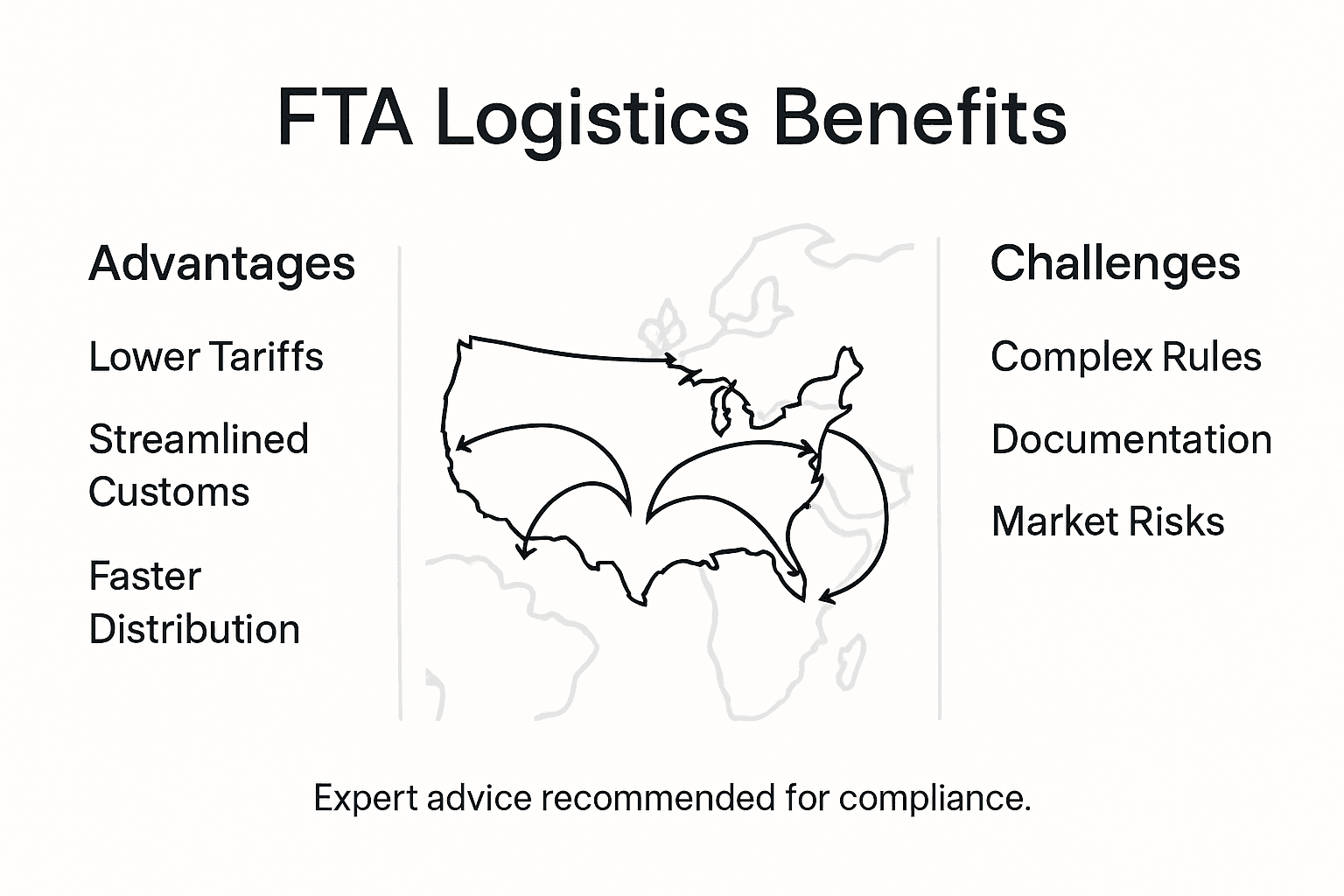
For logistics managers and import/export professionals, free trade agreements offer substantial strategic advantages. These agreements typically provide several key benefits:
- Reduced or eliminated import/export tariffs
- Simplified customs clearance processes
- Standardized product and safety regulations
- Enhanced legal protections for intellectual property
- More predictable international business environments
The United States has been particularly active in developing trade agreements that create favorable conditions for American businesses. By negotiating strategic frameworks with key trading partners, these agreements help U.S. companies access global markets more efficiently while simultaneously protecting their economic interests.
Pro tip: Before engaging with a new international market, carefully review the specific free trade agreement provisions to understand precise tariff rates and regulatory requirements for your industry.
Types of Free Trade Agreements and Coverage
Free trade agreements demonstrate remarkable complexity and diversity in their structural design and comprehensive coverage. The World Bank’s research highlights that these agreements range from simple bilateral arrangements to intricate multilateral frameworks that address far more than traditional tariff reductions, encompassing sophisticated economic interactions across multiple domains.
Understanding the primary categories of free trade agreements is crucial for logistics professionals. Bilateral agreements involve two countries directly negotiating trade terms, creating targeted economic partnerships. Multilateral agreements engage three or more nations, establishing broader regional or global trading frameworks. Modern U.S. trade agreements have evolved to cover extensive areas beyond basic goods exchange, including:
- Digital trade regulations
- Intellectual property protections
- Environmental and labor standards
- Investment protocols
- Government procurement guidelines
The United States has been particularly strategic in developing comprehensive trade agreements that protect national economic interests while facilitating smoother international commerce. These agreements increasingly function as sophisticated economic governance tools, addressing complex modern business challenges that extend far beyond traditional tariff negotiations. By creating predictable regulatory environments, they help American businesses navigate increasingly complex global markets.
Here is a comparison of bilateral and multilateral free trade agreements for logistics professionals:
| Aspect | Bilateral Agreements | Multilateral Agreements |
|---|---|---|
| Number of Countries | Two | Three or more |
| Negotiation Complexity | Lower, more targeted | Higher, involves diverse interests |
| Regulatory Scope | Focused on specific issues | Broader, covers many economic areas |
| Impact on Trade Flow | Limited to participants | May influence entire regions |
Advanced trade agreements now represent intricate diplomatic instruments that balance economic opportunity with strategic national priorities. They provide frameworks for resolving potential disputes, establishing clear performance expectations, and creating transparent mechanisms for ongoing economic cooperation between participating nations.
Pro tip: Always consult specialized trade experts to understand the specific nuances of each free trade agreement that might impact your particular industry or supply chain.
How FTAs Affect Customs and Compliance
Free trade agreements fundamentally transform the landscape of international shipping and logistics by introducing complex yet strategic customs requirements that demand precise navigation. Customs authorities use these agreements as critical tools for trade facilitation, creating intricate frameworks that balance efficiency with rigorous regulatory oversight. This delicate balance requires logistics professionals to develop sophisticated compliance strategies that go far beyond traditional import/export practices.
Customs compliance under free trade agreements involves multiple critical dimensions. U.S. Customs and Border Protection plays a pivotal role in implementing these agreements by:
- Reviewing claims for preferential treatment
- Verifying complex rules of origin
- Preventing fraudulent trade documentation
- Conducting regular compliance audits
- Enforcing precise documentation standards
U.S. Customs and Border Protection actively monitors and enforces FTA compliance, recognizing that non-compliance can result in significant penalties. These penalties might include shipment delays, financial assessments, or complete forfeiture of trade benefits. Logistics managers must therefore develop comprehensive internal systems that can accurately track, document, and validate every aspect of international shipments.
The documentation requirements for free trade agreements are substantially more complex than traditional import/export processes. Companies must maintain meticulous records demonstrating product origin, manufacturing processes, and value chain details. Sophisticated logistics operations now require dedicated compliance teams capable of interpreting nuanced regulatory frameworks and implementing robust tracking mechanisms that can withstand potential customs audits.

Pro tip: Invest in specialized trade compliance software that can automatically validate documentation and track changing regulatory requirements across different free trade agreements.
Cost Savings and Supply Chain Efficiency
Free trade agreements offer transformative opportunities for U.S. logistics professionals seeking to optimize supply chain performance and reduce operational costs. These strategic frameworks fundamentally reshape international trade dynamics by eliminating tariff barriers, enabling more competitive pricing, and creating smoother cross-border transaction pathways that directly impact bottom-line efficiency.
The financial benefits of free trade agreements extend across multiple dimensions of logistics operations. Cost reduction strategies emerge through several key mechanisms:
- Elimination or significant reduction of import/export tariffs
- Streamlined customs clearance processes
- Reduced administrative and documentation expenses
- Enhanced ability to source materials from multiple international markets
- More predictable and transparent trade regulations
Digital transformation initiatives enabled by free trade agreements are particularly powerful in driving supply chain resilience. These agreements facilitate faster information exchange, reduce border delays, and create more flexible sourcing environments that allow logistics managers to rapidly adapt to changing market conditions. By harmonizing regulatory standards and creating more transparent trade mechanisms, FTAs help companies develop more agile and responsive supply chain networks.
The strategic value of free trade agreements goes beyond immediate cost savings. They represent sophisticated tools for risk management, enabling companies to diversify supplier bases, minimize potential disruptions, and create more robust international trade ecosystems. Logistics professionals who effectively leverage these agreements can transform their supply chains from traditional cost centers into strategic competitive advantages.
Pro tip: Develop a comprehensive internal tracking system that monitors tariff changes and preferential treatment opportunities across different free trade agreements to maximize potential cost savings.
Risks, Limitations, and Common Pitfalls
Free trade agreements present complex challenges that extend far beyond their potential economic benefits. While these frameworks offer significant opportunities for logistics professionals, they simultaneously introduce nuanced operational risks that demand strategic navigation and comprehensive understanding. Successful implementation requires a sophisticated approach that anticipates potential complications and develops robust mitigation strategies.
The primary compliance risks in free trade agreements encompass multiple critical dimensions:
- Intricate rules of origin calculations
- Inconsistent or incomplete documentation requirements
- Rapidly changing regulatory landscapes
- Potential for significant financial penalties
- Complex verification processes
Businesses frequently underutilize FTA benefits due to manual compliance processes that create substantial operational friction. The fear of non-compliance penalties often paralyzes organizations, preventing them from fully leveraging the potential cost savings and strategic advantages these agreements provide. Many logistics managers find themselves trapped in a reactive mode, struggling to interpret complex regulatory requirements rather than proactively managing their international trade strategies.
Beyond compliance challenges, free trade agreements can introduce broader economic and operational risks. They may create unexpected competitive pressures, potentially displacing domestic industries, and expose companies to greater market volatility. Logistics professionals must develop sophisticated risk management frameworks that go beyond traditional compliance checking, incorporating dynamic analysis of trade policy shifts, geopolitical developments, and emerging regulatory trends.
The following table summarizes key risk management actions when using free trade agreements:
| Risk Area | Recommended Action | Business Outcome |
|---|---|---|
| Rules of Origin Audits | Automate product traceability | Reduces compliance errors |
| Regulatory Shifts | Monitor policy updates regularly | Minimizes disruption risk |
| Documentation Gaps | Centralize trade documentation | Smoothens customs processing |
| Market Volatility | Diversify supplier base | Improves supply chain resilience |
Pro tip: Invest in specialized trade compliance software and develop a dedicated team focused on continuous FTA regulation monitoring to transform potential risks into strategic opportunities.
Unlock Greater Savings and Compliance Confidence with Expert Logistics Support
Navigating the complex landscape of free trade agreements requires more than just knowledge of tariff reductions and customs regulations. The challenges of strict compliance, detailed documentation, and evolving trade policies can create costly delays and penalties for businesses. If your goal is to fully leverage these agreements to reduce costs and improve supply chain efficiency while avoiding common pitfalls, expert logistics and freight forwarding support is essential.
Worldwide Express, Inc. specializes in simplifying global trade through tailored customs brokerage, comprehensive freight forwarding, and reliable shipment tracking solutions that reduce operational risks. Our experienced team helps you manage intricate rules of origin and documentation challenges so you can confidently access preferential trade benefits for U.S. imports and exports. Get specialized insights and services designed to enhance your international shipping efficiency by visiting our Uncategorized category page to learn more.
Take control of your global supply chain today with Worldwide Express. Don’t let compliance complexities or costly delays hold back your growth. Visit Worldwide Express now to request a freight quote or connect with our experts who will design a logistics plan tailored to your business needs and help you maximize the advantages of free trade agreements.
Frequently Asked Questions
What are the primary benefits of free trade agreements for U.S. logistics?
Free trade agreements provide substantial advantages such as reduced or eliminated tariffs, streamlined customs processes, and enhanced regulatory standards, all which lead to cost savings and increased efficiency in international trade.
How do free trade agreements impact customs compliance?
Free trade agreements introduce complex customs requirements, necessitating precise compliance strategies. U.S. Customs and Border Protection ensures adherence by reviewing claims and verifying documentation, which is crucial to avoid penalties that can disrupt logistics operations.
What types of trade agreements are most relevant for U.S. logistics professionals?
The most relevant types include bilateral agreements, which involve two countries, and multilateral agreements that engage three or more nations. Both types can cover a wide array of trade aspects, from tariff reduction to regulatory alignment.
What risks should logistics managers consider when utilizing free trade agreements?
Logistics managers should be aware of compliance risks such as intricate rules of origin, documentation gaps, and the potential for penalties due to non-compliance. Additionally, market volatility can pose challenges that require dynamic risk management strategies.
Recommended
- Top Trading Partners USA: Complete Guide for 2025 – Worldwide Express, Inc.
- Business Networking Strategies for Logistics Managers – Worldwide Express, Inc.
- Understanding Sustainability in Logistics: Key Insights – Worldwide Express, Inc.
- Understanding Logistic Providers: Key Concepts Explained – Worldwide Express, Inc.