

AI in international shipping is no longer a future promise. It is a present-day competitive advantage, and the numbers back that up. Companies deploying AI across their supply chains are seeing 15-20% lower shipping costs and deliveries that arrive 25-35% faster, with manual auditing workloads shrinking by as much as 87%. Yet many logistics managers still treat AI as an emerging technology to evaluate later rather than a tool to deploy now. This article breaks down exactly what AI is doing in international shipping today, which technologies are driving the gains, where compliance boundaries still require human judgment, and how to build a practical adoption roadmap.
Table of Contents
- Understanding the impact of AI on international shipping
- Key AI technologies transforming global shipping
- Navigating compliance: AI, audits, and regulatory limits
- Best practices for adopting AI in your shipping workflow
- Our perspective: Why successful AI in shipping means putting people and compliance first
- Accelerate your global shipping with trusted AI-driven solutions
- Frequently asked questions
Key Takeaways
| Point | Details |
|---|---|
| AI delivers real ROI | Shipping companies experience up to 20% cost reduction and 25% faster deliveries using AI-powered logistics. |
| Compliance needs oversight | AI cannot fully replace licensed customs procedures or audit transparency—human involvement remains essential. |
| Hybrid approach wins | The best results come from combining AI analytics with experienced logistics professionals for both speed and regulatory assurance. |
| Start with pilot projects | Piloting AI in high-impact areas and clear success metrics accelerates adoption and minimizes risk. |
Understanding the impact of AI on international shipping
AI in shipping is not a single product. It is a collection of capabilities, including predictive analytics, machine learning, and natural language processing, that work together to reduce friction across the entire logistics chain. In plain terms, artificial intelligence in logistics means systems that learn from historical data, identify patterns humans would miss, and make or recommend decisions faster than any manual process.
The measurable impact is striking. Flexport, one of the most data-forward freight forwarders in the market, reported 20% lower shipping costs and 25% faster deliveries after deploying AI across its operations. Broader industry benchmarks confirm this is not an outlier. Empirical studies show 3.5x ROI on AI investments in supply chain contexts, with error rates in documentation falling dramatically when automation replaces manual data entry.
| Metric | Without AI | With AI |
|---|---|---|
| Shipping cost reduction | Baseline | 15-20% lower |
| Delivery speed improvement | Baseline | 25-35% faster |
| Manual auditing workload | 100% | 13% (87% reduction) |
| ROI on AI investment | 1x | 3.5x |
The core functions most changed by AI include:
- Predictive ETA modeling: Real-time rerouting based on weather, port congestion, and carrier data
- Smart routing: Dynamic lane selection that balances cost, speed, and reliability
- Inventory forecasting: Demand signals that reduce overstock and stockout events
- Automated documentation: Extraction and validation of shipping documents without manual keying
- AI-driven trade compliance: Flagging regulatory mismatches before shipments clear customs
Pro Tip: The best ROI from AI pilots comes when you define clear KPIs before launch. Track cost per transaction, error rates, and SLA adherence from day one. Without a baseline, it is nearly impossible to prove the value that justifies scaling.
For logistics managers looking to optimize global shipping, the entry point is usually one high-frequency, data-rich process, such as carrier selection or document validation, where improvement is easy to measure.
Key AI technologies transforming global shipping
Understanding the impact of AI leads naturally to the technologies that make these gains possible. Not all AI is created equal, and the distinction between rule-based automation and genuine machine learning matters enormously in practice.
One of the most fascinating breakthroughs in recent years is the application of deep reinforcement learning (DRL) to master stowage planning. A system called AI2STOW uses DRL to solve stowage planning under real-world demand uncertainty, optimizing how containers are loaded across large vessels to reduce port turnaround time and fuel consumption. This is a problem that traditional rule-based systems simply cannot handle at scale.
“Deep reinforcement learning models like AI2STOW demonstrate that AI can now tackle combinatorially complex maritime planning problems that were previously considered unsolvable by automated systems, delivering measurable gains in vessel utilization and operational efficiency.”
Here is how the evolution of shipping technology looks across three generations:
- Manual workflows: Human planners using spreadsheets and experience, prone to error and slow to adapt
- Rule-based automation: Systems that follow fixed logic trees, fast but brittle when conditions change
- AI-driven systems: Models that learn from data, adapt to new conditions, and optimize across multiple variables simultaneously
| Workflow type | Speed | Adaptability | Error rate | Cost |
|---|---|---|---|---|
| Manual | Slow | Low | High | High |
| Rule-based | Medium | Medium | Medium | Medium |
| AI-driven | Fast | High | Low | Lower over time |
Beyond stowage, AI in transportation is reshaping freight modes selection, carrier negotiation, and last-mile routing. AI-powered transportation management systems (TMS) now integrate demand forecasting with carrier capacity data, automatically selecting the optimal mode and lane. Automated document processing tools extract data from commercial invoices, bills of lading, and certificates of origin with accuracy rates that rival experienced specialists.
For teams monitoring AI-enabled cargo tracking, these systems provide real-time visibility across ocean, air, and ground shipments from a single dashboard. Staying current with freight marketplace trends is essential, as new AI-native platforms are entering the market rapidly. Teams evaluating freight modes optimization will find that AI dramatically simplifies multi-modal decisions that once required days of manual analysis.

Navigating compliance: AI, audits, and regulatory limits
With optimization explained, it is critical to address compliance, the area where AI is powerful but not invincible. The enthusiasm around automation sometimes obscures a hard legal reality: AI has firm boundaries in customs and trade compliance work.
As of 2026, the U.S. Customs and Border Protection (CBP) has made clear that unlicensed AI cannot perform customs business such as classifying HTSUS codes beyond 6 digits or transmitting customs entries. That work legally requires a licensed customs broker. AI tools that cross this line expose importers and exporters to serious regulatory liability.
Beyond legal limits, there are operational risks that compliance managers must take seriously:
- Black box decisions: Many AI models cannot explain their outputs in a way that satisfies customs auditors, creating transparency problems
- Model drift: AI trained on historical trade data becomes less accurate as regulations, tariffs, and trade lanes change
- Data integration debt: Poor data quality upstream causes AI to make flawed recommendations downstream
- Sanctions evasion exposure: AI systems that fail to flag obfuscated routing or shell entities can inadvertently facilitate sanctions violations
- EU AI Act requirements: As of 2026, high-risk AI systems used in regulated environments require human-in-the-loop oversight under EU law
The EU AI Act, now in full effect, classifies certain logistics AI applications as high-risk, requiring documented human oversight for decisions with significant legal or financial consequences. This is not bureaucratic red tape. It is a recognition that AI models make mistakes, and the cost of those mistakes in international trade can be severe.
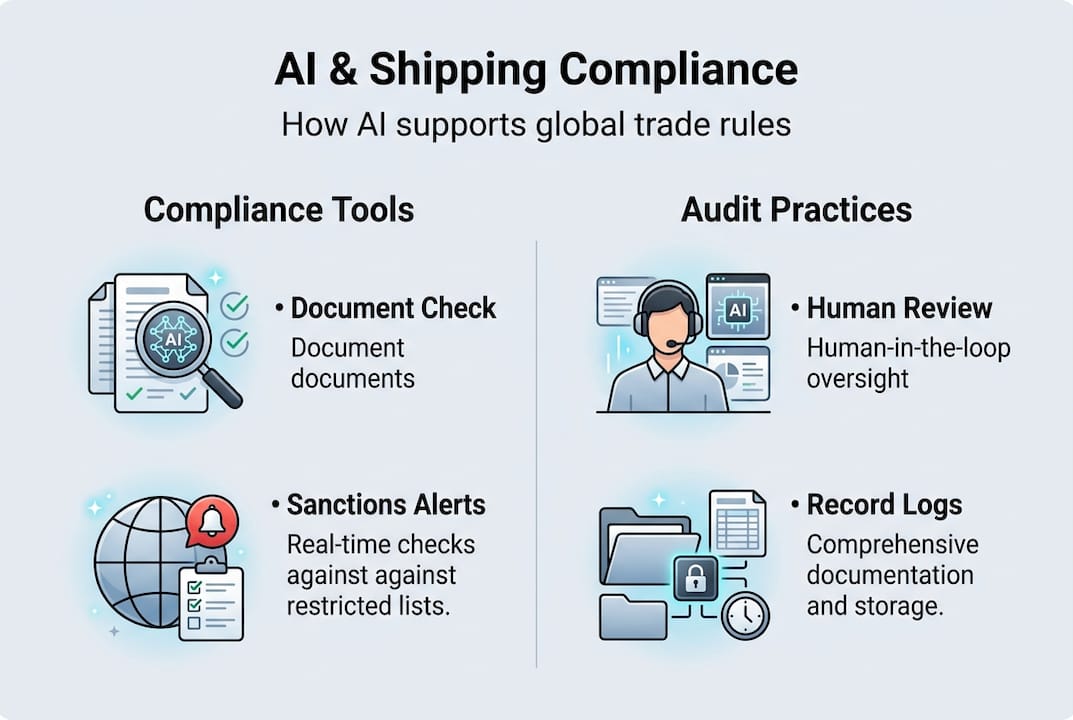
Pro Tip: When implementing AI for customs compliance best practices, always pair your AI tools with a licensed customs broker. Review your automated export system workflows regularly to confirm AI is assisting, not replacing, licensed professionals. Prepare for handling customs audits by maintaining clear records of every AI-assisted decision and the human review that accompanied it.
Best practices for adopting AI in your shipping workflow
So, how can you actually put AI to work in your operations while managing risk and maximizing return? The answer is structured, incremental adoption with rigorous validation at every stage.
Here is a proven sequence for piloting and scaling AI in international logistics:
- Identify one high-frequency process with clear inputs and measurable outputs, such as carrier selection, document extraction, or predictive ETA
- Establish a baseline by measuring current cost per transaction, error rates, and SLA adherence before the pilot begins
- Run a controlled pilot for 60 to 90 days, comparing AI-assisted outcomes against the baseline
- Validate ROI by confirming that the pilot delivers a credible path to a 6-12 month payback before committing to broader rollout
- Scale with oversight by expanding to adjacent processes while maintaining human review for compliance-sensitive decisions
- Retrain models regularly as trade lanes, regulations, and carrier data evolve
The metrics that matter most for pilot validation include:
- Cost per transaction (before and after AI assistance)
- Document error rate and rework frequency
- SLA adherence percentage across lanes
- Time to customs clearance
- Exception rate requiring human escalation
Pro Tip: Use hybrid human-AI workflows for any process that touches optimizing logistics process decisions with regulatory consequences. AI handles the volume and pattern recognition. Humans handle the judgment calls and audit accountability. This division of labor is not a limitation. It is the architecture that top performers use.
For teams following AI integration best practices, the most common failure mode is deploying AI too broadly, too fast, without the data infrastructure to support it. Prioritize clean, integrated data before expanding AI scope. The technology is only as good as what you feed it.
Our perspective: Why successful AI in shipping means putting people and compliance first
The uncomfortable truth about AI in international shipping is that full automation is a myth, at least for any operation that touches regulated trade. The companies achieving the most impressive results are not the ones that have removed humans from the loop. They are the ones that have strategically positioned humans and AI to do what each does best.
AI excels at processing thousands of data points simultaneously, flagging anomalies, and optimizing across complex variables. Humans excel at contextual judgment, regulatory accountability, and managing the unexpected. The best-performing logistics teams treat this as a feature, not a workaround. Monitoring tariff volatility insights is a perfect example: AI can surface the signals, but a seasoned trade professional decides how to respond.
The “human-in-the-loop” requirement is not just regulatory compliance. It is a competitive advantage. Teams that build robust oversight processes develop institutional knowledge that makes their AI systems smarter over time. Update your processes frequently and invest in training both your staff and your models. The organizations that will lead in AI-powered logistics are those that treat continuous learning as a core operational discipline.
Accelerate your global shipping with trusted AI-driven solutions
As you look to maximize the benefits of AI while avoiding regulatory headaches, the right logistics partner makes all the difference. Worldwide Express combines advanced technology with licensed customs expertise to help import/export businesses move freight efficiently and compliantly.
Our US customs brokerage services ensure that AI-assisted workflows stay within legal boundaries, with licensed professionals overseeing every critical compliance decision. Whether you are new to AI-powered freight or looking to scale what you have already started, our freight forwarding guide offers a practical foundation. Learn how customs brokers in 2026 are integrating technology and human expertise to streamline global trade without compliance risk. Reach out to our team to explore solutions tailored to your lanes and cargo.
Frequently asked questions
How much can AI actually reduce international shipping costs?
Most companies see 15-20% lower shipping costs and 25% faster deliveries when AI is fully deployed across carrier selection, routing, and documentation workflows.
Can AI completely automate customs compliance?
No. Current regulations require licensed brokers for key customs work, and unlicensed AI cannot transmit entries or classify HTSUS codes beyond 6 digits, making human oversight legally required.
What are the biggest risks with AI in international logistics?
The key risks are data integration failures, model drift over time, unexplained AI decisions that fail customs audits, and exceeding legal customs boundaries that require licensed broker involvement.
How should import/export businesses start using AI?
Start with a focused pilot on predictive routing or document automation, and track cost, error rates, and SLA adherence to confirm ROI before scaling to broader operations.
Recommended
- Understanding Artificial Intelligence in Logistics – Worldwide Express, Inc.
- How to Optimize Logistics for Efficient Global Shipping – Worldwide Express, Inc.
- Master customs compliance tips for smoother shipping – Worldwide Express, Inc.
- How to Reduce Shipping Costs: Effective Strategies for 2025 – Worldwide Express, Inc.
- Transportation | Artificial Intelligence