
Managing international shipments can overwhelm even seasoned compliance officers when customs documentation piles up and schedules are tight. A thoughtfully executed Import Power of Attorney gives your trusted agents the legal right to handle U.S. Customs tasks, reducing your workload and closing compliance gaps. For U.S. manufacturers, understanding how to structure and control agent authority is crucial for smooth, secure import operations while maintaining oversight and meeting all Customs and Border Protection requirements.
Table of Contents
- Import Power of Attorney Explained
- Types And Scope In U.S. Customs
- Legal Requirements And Key Parties Involved
- How Import Power of Attorney Works In Practice
- Risks, Liabilities, And Common Mistakes
- Revocation, Updates, And Compliance Tips
Key Takeaways
| Point | Details |
|---|---|
| Power of Attorney (POA) Importance | An Import Power of Attorney allows authorized representatives to act on behalf of importers to facilitate customs clearance. |
| Types of POA | There are several types of Customs Powers of Attorney, including General, Limited, Specific Transaction, and Continuing, each suitable for different business needs. |
| Key Compliance Steps | Importers must regularly review documentation, notify changes promptly, and maintain accurate records to ensure compliance with customs regulations. |
| Risks and Liabilities | Importers face significant legal risks if POAs are improperly constructed or managed, highlighting the need for careful agent selection and oversight. |
Import Power of Attorney Explained
A Power of Attorney (POA) enables authorized representatives to act legally on behalf of an importer during U.S. Customs transactions. This critical legal document grants specific permissions for customs clearance and import processes, allowing designated agents to manage complex international shipping requirements.
In the context of U.S. Customs, an Import Power of Attorney serves several essential functions:
- Authorizes a licensed customs broker to file documentation
- Permits electronic submission of import declarations
- Enables representation during customs inspections
- Facilitates faster cargo clearance processes
- Reduces administrative burdens for importers
Customs Power of Attorney documents can be structured with varying levels of authority. Companies typically choose between general and specific POAs depending on their operational needs. A general POA provides broad permissions across multiple transactions, while a specific POA limits an agent’s actions to predefined scenarios.
A Power of Attorney represents a legal agreement where the principal grants an agent explicit authority to act on their behalf during customs transactions.
Key Components of a valid Import Power of Attorney typically include:
- Principal’s complete legal name and business information
- Designated agent or broker’s detailed credentials
- Explicit scope of authorized actions
- Signature of the principal
- Date of execution
- Notarization (in some jurisdictions)
Importers must carefully draft these documents to ensure compliance with U.S. Customs and Border Protection regulations. Complex legal requirements demand precision in defining agent permissions and maintaining proper documentation.

Pro tip: Always consult a licensed customs broker or international trade attorney when preparing your Import Power of Attorney to ensure complete legal compliance and minimize potential customs clearance complications.
Types And Scope In U.S. Customs
In U.S. Customs regulations, Powers of Attorney (POAs) are classified into distinct categories that define their operational scope and legal authority. Customs regulations recognize multiple POA classifications that enable importers to strategically delegate customs-related responsibilities.
The primary types of Customs Power of Attorney include:
- General Power of Attorney: Provides comprehensive authorization across all customs transactions
- Limited Power of Attorney: Restricts agent actions to specific, predefined tasks
- Specific Transaction POA: Authorizes representation for a single, precise import event
- Continuing Power of Attorney: Allows ongoing representation with defined parameters
Each POA type carries unique implications for import operations. A general POA grants broad permissions, enabling agents to handle multiple aspects of customs clearance, while limited POAs provide targeted, controlled authorization for precise business needs.
Here’s a comparison of the main types of Import Power of Attorney and their optimal business use cases:
| POA Type | Authority Scope | Best For |
|---|---|---|
| General | Broad, multiple actions | High-volume, ongoing importers |
| Limited | Defined, specific actions | Occasional or one-off transactions |
| Specific Transaction | Single transaction only | Rare import events, unique products |
| Continuing | Ongoing, with limits | Regular needs with changing shipments |
U.S. Customs requires explicit documentation defining the exact scope of an agent’s authorized actions during import processes.
Key Considerations for selecting the appropriate POA type involve:
- Evaluating the complexity of import transactions
- Assessing the frequency of customs interactions
- Determining the level of administrative delegation required
- Understanding compliance requirements
- Matching POA scope with organizational objectives
Customs and Border Protection enforces strict guidelines regarding POA documentation, ensuring that only authorized agents can represent importers in official transactions. This regulatory oversight protects both importers and the broader international trade ecosystem.
Pro tip: Consult with a licensed customs broker to precisely match your Power of Attorney type with your specific import operational requirements and compliance needs.
Legal Requirements And Key Parties Involved
Powers of Attorney (POAs) in U.S. Customs involve complex legal frameworks with specific requirements for documentation and representation. Customs regulations mandate precise documentation standards to ensure transparent and legally compliant import transactions.
The key parties involved in a Customs Power of Attorney typically include:
- Principal: The original entity granting authorization
- Customs Broker: Licensed professional acting on behalf of the principal
- Designated Agent: Specific individual authorized to conduct customs business
- Customs and Border Protection (CBP): Regulatory oversight agency
- Surety Bond Issuer: Provides financial guarantee for potential liabilities
Legal requirements for executing a valid Power of Attorney are stringent and multifaceted. The documentation must be written, signed by an authorized representative, and explicitly define the scope of actions permitted. Nonresident principals face additional compliance challenges, including specific surety bond requirements and comprehensive verification processes.
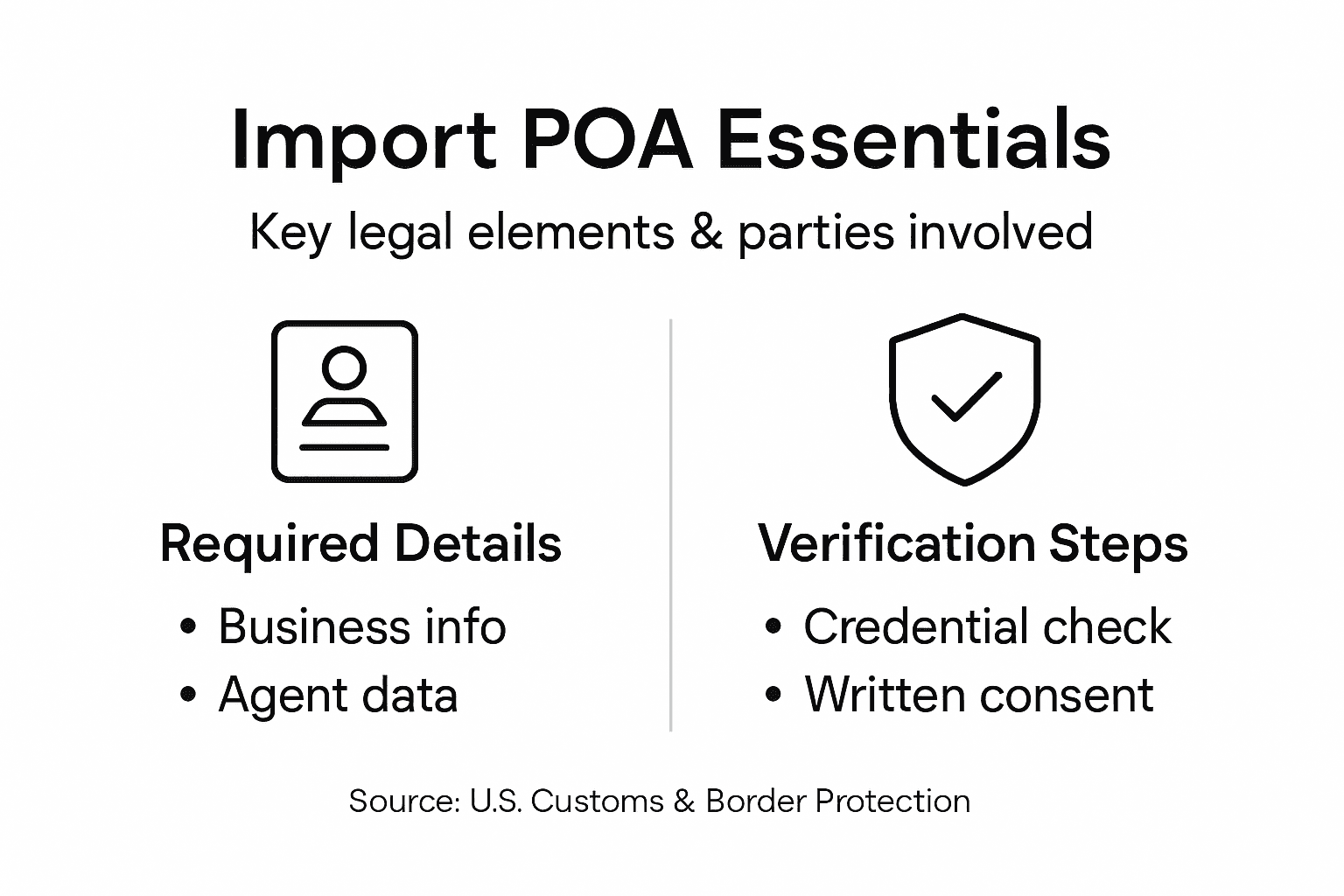
Below is a summary of the key parties in a customs POA and their primary responsibilities:
| Party | Role in POA | Main Responsibility |
|---|---|---|
| Principal | Grants authority | Ensures compliance, selects agent |
| Customs Broker | Act as agent | Executes customs transactions |
| Designated Agent | Individual representative | Manages day-to-day customs entries |
| Customs and Border Protection | Regulatory oversight | Monitors legal compliance |
| Surety Bond Issuer | Provides financial guarantee | Covers customs-related liabilities |
Customs brokers must meticulously validate Powers of Attorney to prevent fraudulent transactions and ensure legal compliance.
Verification Requirements for a legally valid POA include:
- Confirming principal’s legal authority
- Matching importer registration details
- Verifying business licenses
- Checking official government registrations
- Ensuring comprehensive documentation
Customs brokers must validate POA details carefully through multiple verification methods, including checking business credentials, contact information, and official registrations. This rigorous process protects both importers and the broader customs ecosystem from potential legal and financial risks.
Pro tip: Work closely with a licensed customs broker who understands the intricate legal requirements and can guide you through the complex POA validation process.
How Import Power of Attorney Works In Practice
In the complex world of international trade, an Import Power of Attorney (POA) serves as a critical mechanism for streamlining customs processes. Customs brokers use POAs to facilitate import transactions by acting on behalf of importers with comprehensive legal authorization.
The practical implementation of an Import Power of Attorney involves several key operational steps:
- Executing a formal written authorization
- Defining specific transaction permissions
- Designating authorized customs representatives
- Establishing clear communication protocols
- Maintaining comprehensive documentation
When an importer grants a Power of Attorney, they effectively delegate critical customs-related responsibilities. This delegation allows customs brokers to perform essential functions such as submitting import declarations, paying required duties, and resolving potential compliance issues on the principal’s behalf.
A Power of Attorney transforms complex import procedures into a streamlined, manageable process by enabling trusted professionals to navigate regulatory requirements.
Typical Actions Performed under a Power of Attorney include:
- Preparing and submitting import entry documentation
- Calculating and paying applicable customs duties
- Resolving customs clearance challenges
- Representing the importer during regulatory inspections
- Ensuring compliance with U.S. Customs regulations
Importing guidelines emphasize that the importer remains ultimately responsible for all import-related activities, even when a designated agent manages the process. This approach ensures accountability while providing operational flexibility.
Pro tip: Select a customs broker with proven expertise and a comprehensive understanding of your specific import requirements to maximize the effectiveness of your Power of Attorney.
Risks, Liabilities, And Common Mistakes
Navigating the complexities of Import Power of Attorney (POA) requires a thorough understanding of potential risks and legal vulnerabilities. Importers face significant legal consequences for improper delegation and oversight of customs representation.
Common risks associated with Import Powers of Attorney include:
- Unauthorized financial transactions
- Misrepresentation of import documentation
- Inadequate agent verification
- Poorly defined scope of authority
- Insufficient ongoing monitoring
Legal liabilities can emerge from various operational missteps. An improperly constructed or managed Power of Attorney can expose importers to substantial financial and legal risks, potentially resulting in customs penalties, shipment delays, or even criminal investigations.
Careful agent selection and continuous oversight are critical to mitigating potential risks in customs power of attorney arrangements.
Major Potential Legal Vulnerabilities encompass:
- Criminal charges for fraudulent documentation
- Financial penalties for non-compliance
- Potential customs seizure of goods
- Revocation of import privileges
- Personal liability for agent misconduct
U.S. law imposes strict penalties for fraudulent customs transactions, including potential fines and imprisonment. Importers must maintain rigorous documentation standards and exercise extensive due diligence when granting power of attorney.
Pro tip: Conduct comprehensive background checks on potential customs agents and establish clear, written protocols for monitoring and reporting to minimize potential legal and financial risks.
Revocation, Updates, And Compliance Tips
Managing an Import Power of Attorney (POA) requires proactive oversight and strategic documentation management. Principals can revoke POAs at any time through formal written communication with U.S. Customs and Border Protection.
Key compliance strategies for maintaining POA effectiveness include:
- Regular documentation review
- Prompt notification of agent changes
- Maintaining accurate record-keeping
- Implementing internal verification processes
- Establishing clear revocation protocols
The revocation process demands precise execution. Importers must provide written notice directly to Customs and Border Protection, ensuring the communication is received and processed to immediately terminate an agent’s authorization.
Effective POA management requires continuous monitoring and immediate action when agent relationships change or become inappropriate.
Critical Steps for POA Revocation involve:
- Drafting a formal written revocation letter
- Sending notification to CBP
- Communicating changes to current customs broker
- Updating internal compliance records
- Confirming receipt of revocation
Customs brokers recommend periodic POA reviews to ensure ongoing compliance and minimize potential legal risks associated with outdated authorizations.
Pro tip: Develop a standardized internal workflow for tracking, updating, and revoking Powers of Attorney to maintain seamless customs compliance.
Simplify Your Import Power of Attorney and Customs Clearance Today
Handling an Import Power of Attorney involves navigating complex legal requirements, strict compliance, and detailed documentation. Many importers face challenges like ensuring precise agent authorization, avoiding costly mistakes, and managing revocation or updates efficiently. Worldwide Express understands these pain points and offers expert customs brokerage services designed to streamline your customs transactions with accuracy and peace of mind.
With Worldwide Express, you gain access to:
- Licensed customs brokers who specialize in handling Powers of Attorney with precision
- Tailored import solutions that match your specific operational needs
- Comprehensive compliance support to minimize risks and delays
Ready to reduce administrative burdens and accelerate your import clearance process with trusted experts by your side Visit Worldwide Express now to explore how our customs brokerage solutions can transform your international shipping operations. Don’t let legalities slow down your business Connect with us today and make your Import Power of Attorney work for you effectively and securely.
Frequently Asked Questions
What is an Import Power of Attorney?
An Import Power of Attorney (POA) is a legal document that allows authorized representatives, such as licensed customs brokers, to act on behalf of an importer during U.S. Customs transactions, facilitating the customs clearance and import processes.
What types of Powers of Attorney are used in U.S. Customs?
U.S. Customs recognizes several types of Powers of Attorney, including General, Limited, Specific Transaction, and Continuing POA, each catering to different operational needs and scopes of authority for import transactions.
What are the key components required in a valid Import Power of Attorney?
A valid Import Power of Attorney typically requires the principal’s legal name and business information, agent credentials, explicit scope of authority, principal’s signature, execution date, and possibly notarization depending on jurisdiction.
What are the risks of improperly managing an Import Power of Attorney?
Improper management of an Import Power of Attorney can lead to unauthorized transactions, legal liabilities, penalties for non-compliance, and even criminal charges for fraud, making careful selection and oversight of agents essential.
Recommended
- How to Use CBP Power of Attorney for Customs Clearance – Worldwide Express, Inc.
- How to Complete a Customs POA Form for U.S. Imports – Worldwide Express, Inc.
- Complete Guide to Customs Power of Attorney Form PDF – Worldwide Express, Inc.
- Power of Attorney for Customs Clearance: Streamline US Imports – Worldwide Express, Inc.
- Merch Shipping Process Guide for Custom Apparel Success
- 7 Essential Types of Business Automation for SMB Success – BizDev Strategy