

Every year, importers lose millions to avoidable ISF filing penalties. A single late or inaccurate filing can trigger $5,000 fines plus demurrage fees that quickly exceed the original shipment value. The Importer Security Filing (ISF) is a U.S. CBP requirement mandating advance shipment data to assess security risks before ocean cargo loading, yet many importers still struggle with timing, data accuracy, and responsibility allocation. This guide breaks down ISF filing essentials, from the 10+2 data elements to deadlines, penalties, and proven best practices that keep your cargo moving and your costs under control.
Table of Contents
- Key takeaways
- What is the ISF filing and why does it matter?
- ISF filing requirements: data, timing, and responsibilities
- Common pitfalls and penalties for non-compliance
- Practical steps to ensure smooth and compliant ISF filing
- Streamline your ISF filing with expert freight forwarding services
- Frequently asked questions
Key Takeaways
| Point | Details |
|---|---|
| Advance data submission | ISF requires submitting all twelve data elements before cargo loading to CBP, with penalties of up to five thousand dollars for each violation. |
| Importer liability | The importer of record must ensure accuracy and timing even if a customs broker files on their behalf. |
| Timing buffer | Create a 48 to 72 hour buffer to account for supplier delays, data verification issues, and time zone differences to avoid late filings and fines. |
| ISF forms differences | ISF 10 requires twelve data elements including two carrier items whereas ISF 5 covers five elements for certain in transit or deferred entry scenarios. |
What is the ISF filing and why does it matter?
The Importer Security Filing, commonly called the 10+2 rule, is a U.S. Customs and Border Protection regulation introduced in 2009 to strengthen cargo security. It requires importers to submit detailed shipment data electronically before ocean cargo loads onto vessels bound for U.S. ports. This advance notice allows CBP to assess potential security threats and prevent dangerous goods from entering American supply chains.
ISF applies exclusively to ocean cargo imports entering U.S. commerce. Air freight, NAFTA/USMCA shipments, and certain postal items follow different protocols. Unlike standard customs entry filings that occur when goods arrive, ISF import compliance demands proactive data submission well before departure.
The regulation serves three primary purposes:
- Security screening: CBP analyzes shipment data against terrorist watch lists and risk profiles to identify high-risk cargo requiring inspection
- Supply chain visibility: Early data submission enables port authorities to allocate inspection resources efficiently and reduce congestion
- Trade compliance: Accurate advance information helps CBP verify that importers follow customs regulations and pay appropriate duties
Many importers confuse ISF with general customs entry documentation. The key difference lies in timing and purpose. Customs entry filings declare goods for duty assessment after arrival. ISF focuses on security risk assessment before departure. Both are mandatory, but ISF penalties hit faster because they disrupt cargo flow at the loading stage.
ISF filing requirements: data, timing, and responsibilities
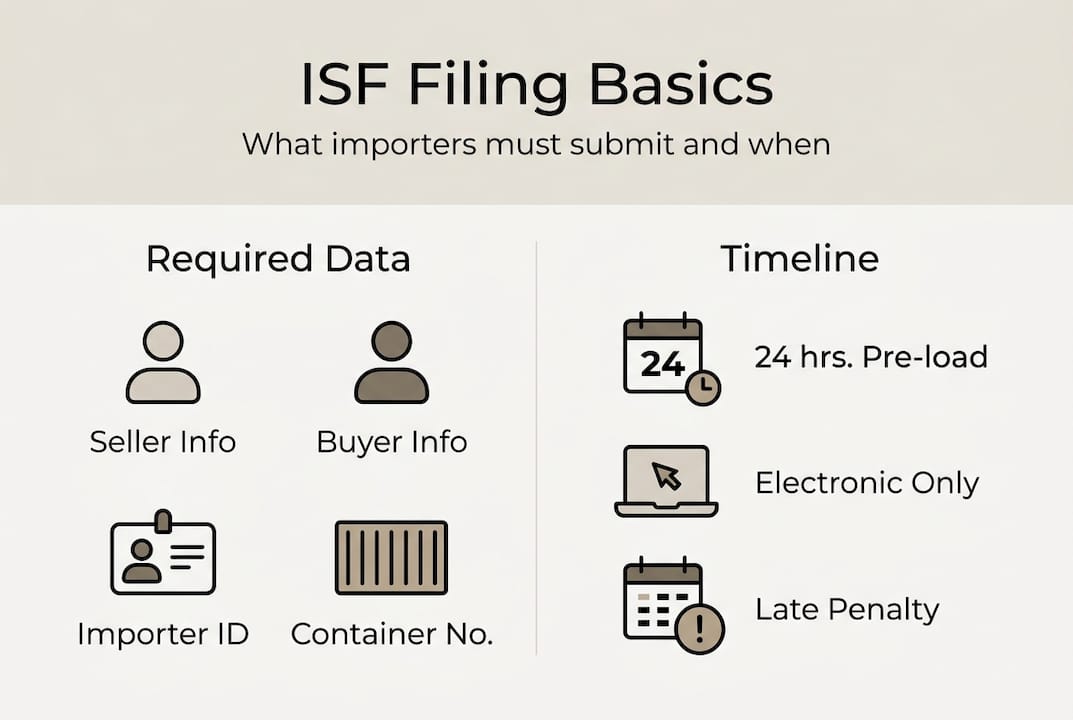
Understanding exactly what data you must submit and when prevents costly delays. The ISF-10 form requires ten data elements from the importer plus two carrier elements. Each piece of information serves a specific security or compliance function.
| ISF-10 Data Element | Description |
|---|---|
| Seller name and address | Legal entity selling goods to the importer |
| Buyer name and address | Legal entity purchasing goods (importer of record) |
| Importer of record number | IRS/EIN or SSN of the party responsible for customs compliance |
| Consignee number | IRS/EIN or SSN of the party receiving goods |
| Manufacturer name and address | Factory or facility where goods were produced |
| Ship to name and address | Physical delivery location in the U.S. |
| Country of origin | Nation where goods were grown, mined, or manufactured |
| Commodity HTS code | Six-digit Harmonized Tariff Schedule classification |
| Container stuffing location | Address where cargo was loaded into containers |
| Consolidator name and address | Party arranging container consolidation if applicable |
The two carrier elements include vessel stow plan details and container status messages. Ocean carriers submit these separately, but importers must coordinate to ensure all 12 elements reach CBP on time.
ISF must be filed electronically at least 24 hours before cargo loading; late filings trigger penalties. However, smart importers build in a 48 to 72 hour buffer. Supplier delays, data verification issues, and time zone differences can erode that 24 hour window quickly. Filing early also allows time to correct errors before CBP flags your shipment.

The importer of record is responsible for ISF compliance; customs brokers or freight forwarders can file under Power of Attorney; a customs bond is required. Even if your broker handles the filing, you remain legally liable for accuracy and timeliness. A continuous customs bond covering ISF obligations is mandatory for regular importers. Single entry bonds work for occasional shipments but cost more per transaction.
ISF-5 applies to specific scenarios:
- Cargo moving in-transit through the U.S. to foreign destinations
- Goods entering under in-bond procedures for transport to another U.S. port
- Shipments destined for Foreign Trade Zones where formal entry is deferred
ISF-5 requires only five data elements: booking party, ship to party, commodity HTS, container stuffing location, and consolidator. The reduced requirement reflects lower security risk for goods not immediately entering U.S. commerce. Importers must understand which form applies to avoid filing the wrong version and triggering compliance issues.
Pro Tip: Start collecting ISF data as soon as you issue a purchase order. Waiting until shipment confirmation leaves no margin for supplier delays or data discrepancies. Early collection also helps you spot potential compliance issues before they become expensive problems.
ISF bond requirements vary based on import volume and value. Work with a licensed customs broker to determine the right bond type and amount for your business. Insufficient bond coverage can halt shipments even if your ISF filing is perfect.
Common pitfalls and penalties for non-compliance
Penalties for late, inaccurate, or missing ISF filings can reach $5,000 per violation plus demurrage fees and cargo holds. The real cost often exceeds the fine itself. Demurrage charges of $200 to $500 per container per day accumulate while your cargo sits in port awaiting clearance. A three day delay on a single container can cost more than the ISF penalty.
CBP issues liquidated damages claims for ISF violations. Unlike civil penalties that require court proceedings, liquidated damages allow CBP to collect directly from your customs bond. This means faster enforcement and immediate financial impact. Repeated violations trigger bond increases, making future imports more expensive even after you fix the underlying issue.
Common errors include late data from suppliers (40%), HTS mismatches, and incorrect addresses. Many importers underestimate how long it takes to extract accurate information from overseas suppliers. Language barriers, time zones, and incomplete documentation compound the challenge. A manufacturer address that lists a corporate headquarters instead of the actual production facility violates ISF requirements even if everything else is correct.
Typical pitfalls that trigger penalties:
- Submitting ISF after the 24 hour deadline because suppliers provided data late
- Using generic HTS codes instead of verifying the correct six-digit classification
- Listing consolidator information when goods shipped as full container loads
- Failing to update ISF when shipment details change after initial filing
- Omitting container stuffing location or providing vague descriptions
CBP conducts periodic audits of importers with compliance red flags. Multiple ISF violations put you on the audit list, leading to increased scrutiny of all your imports. Audits consume time and resources, and any additional violations discovered during the review process result in more penalties.
“The hidden cost of ISF non-compliance is not the $5,000 fine. It is the cargo hold that stops your production line, the demurrage fees that erase your profit margin, and the customer relationships damaged by late deliveries. One penalty teaches an expensive lesson; systematic compliance prevents the lesson from repeating.”
Pro Tip: Implement a pre-filing verification checklist that compares ISF data against commercial invoices, packing lists, and bills of lading. This three-way match catches discrepancies before CBP does. Assign one team member to own ISF compliance across all shipments rather than distributing responsibility across multiple people.
Automating data collection through supply chain management software reduces human error. Systems that pull information directly from purchase orders and supplier databases eliminate manual data entry mistakes. Integration with your customs broker’s filing system creates a seamless workflow from order placement to ISF submission. Importer security filing tips include leveraging technology to standardize and accelerate the filing process.
Practical steps to ensure smooth and compliant ISF filing
Building a reliable ISF filing process requires clear procedures and accountability. Follow this workflow to minimize risk:
- Collect supplier data immediately after purchase order confirmation: Request manufacturer address, country of origin, and HTS code from your supplier within 24 hours of order placement, not when goods are ready to ship.
- Verify HTS classification accuracy: Cross-reference supplier-provided codes against CBP’s Harmonized Tariff Schedule to confirm proper classification; misclassification causes both ISF penalties and duty assessment errors.
- Confirm container stuffing location details: Obtain the specific warehouse or factory address where cargo was loaded into containers, including city and postal code; generic descriptions trigger CBP rejections.
- Submit ISF 48 to 72 hours before loading deadline: File as early as possible to allow time for CBP system processing and potential corrections; waiting until the 24 hour minimum eliminates your safety margin.
- Monitor shipment changes and update ISF accordingly: If vessel schedules change, cargo gets transferred to different containers, or any data element shifts, file an ISF amendment immediately to maintain compliance.
- Maintain detailed documentation for audit defense: Keep copies of all supplier communications, commercial invoices, packing lists, and bills of lading that support your ISF data; organized records protect you during CBP reviews.
| Filing Method | Pros | Cons |
|---|---|---|
| Self-filing through CBP portal | Lower per-shipment cost; direct control over submission timing | Requires customs expertise; higher error risk; no professional liability protection |
| Customs broker filing | Professional accuracy; compliance expertise; liability insurance coverage | Service fees per filing; requires Power of Attorney setup; less direct control |
| Freight forwarder integrated filing | Seamless coordination with shipping logistics; single point of contact | May cost more than standalone broker; forwarder expertise varies by company |
Collect data early from suppliers and file 48-72 hours before deadline for buffer; verify carefully against bills of lading to avoid mismatches. The verification step separates compliant importers from those who accumulate penalties. A simple spreadsheet comparing ISF data to shipping documents catches 90% of errors before filing.
Self-filing is risky for non-experts; partnering with customs brokers or freight forwarders improves accuracy and mitigates risks. Licensed brokers carry professional liability insurance that protects you if filing errors occur despite reasonable care. They also stay current on CBP policy changes that might affect your filings.
Automation tools range from basic spreadsheet templates to enterprise supply chain platforms. Mid-sized importers benefit most from cloud-based compliance software that integrates with their ERP systems. These platforms automatically populate ISF fields from purchase order data, flag missing information, and submit filings through direct CBP connections. The upfront investment pays for itself by eliminating manual data entry and reducing penalty risk.
Pro Tip: Create a master supplier database that includes all ISF-required information for each vendor. Update it annually and whenever suppliers change facilities. This reference library accelerates future filings and ensures consistency across shipments. ISF shipping compliance depends on having accurate supplier information readily available.
Working with a role of US customs broker provides additional benefits beyond ISF filing. Brokers handle customs entry documentation, duty calculations, and regulatory compliance across your entire import program. This integrated approach reduces administrative burden and ensures all aspects of your imports align with current regulations.
Streamline your ISF filing with expert freight forwarding services
Navigating ISF compliance becomes significantly easier when you partner with experienced freight forwarding and customs brokerage professionals. Expert providers handle the entire filing process, from data collection to submission and amendment tracking, ensuring your shipments clear customs without delays or penalties.
Professional freight forwarders bring regulatory expertise, established supplier networks, and technology platforms that automate compliance workflows. They monitor CBP policy changes, update filing procedures accordingly, and maintain the documentation trails that protect you during audits. Their liability insurance coverage adds an extra layer of financial protection if filing errors occur despite reasonable care. When you work with specialists who file thousands of ISFs annually, you benefit from their experience across diverse commodity types, origin countries, and shipping scenarios. Understanding freight forwarding 2026 guide explains how integrated logistics services coordinate ISF filing with broader supply chain management. Connecting with a role of US customs broker ensures your compliance strategy covers all regulatory requirements, not just ISF. Compare best freight forwarding services comparison to find providers with proven ISF compliance track records and technology platforms that fit your business needs.
Frequently asked questions
What is the difference between ISF-10 and ISF-5 filings?
ISF-10 applies to standard ocean cargo imports entering U.S. commerce and requires ten importer data elements plus two carrier elements. ISF-5 covers in-transit shipments, in-bond cargo, and Foreign Trade Zone entries with only five required data elements. The reduced ISF-5 requirement reflects lower security risk for goods not immediately entering domestic commerce. Importers must determine which form applies based on the shipment’s customs status and destination.
Who holds legal responsibility for ISF filing accuracy?
The importer of record bears full legal responsibility for ISF compliance regardless of who physically submits the filing. Customs brokers and freight forwarders can file on your behalf under Power of Attorney, but you remain liable for penalties if data proves inaccurate or late. This responsibility structure means you must verify that your service providers have correct information and file on time. Choosing experienced partners with strong compliance records reduces your risk but does not eliminate your legal obligation.
How does CBP enforce ISF penalties and what triggers an audit?
Penalties for late, inaccurate, or missing ISF filings can reach $5,000 per violation plus demurrage fees and cargo holds. CBP collects through liquidated damages claims against your customs bond, allowing faster enforcement than court proceedings. Repeated violations, significant data discrepancies, and shipments flagged during security screening trigger compliance audits. Audits examine your entire import history and can uncover additional violations beyond the initial penalty. Maintaining detailed documentation and implementing systematic verification procedures provides the best audit defense.
When must I submit the ISF filing before cargo loads?
ISF must be filed electronically at least 24 hours before cargo loading; late filings trigger penalties. However, compliance experts recommend filing 48 to 72 hours early to accommodate supplier delays, data verification needs, and potential system issues. The earlier timeline also allows you to correct errors before CBP processes your filing. If shipment details change after initial submission, file an ISF amendment immediately to maintain compliance. ISF 10+2 form completion requires accurate data and proper timing to avoid disrupting your cargo flow.
Are there exemptions to ISF filing requirements?
Personal effects, food shipments, and in-transit cargo have special ISF filing rules; low-value exemptions do not apply to ISF. Section 321 de minimis exemptions that waive duties on shipments under $800 do not eliminate ISF obligations. Food imports require FDA prior notice in addition to ISF filing, creating dual compliance requirements. In-transit and Foreign Trade Zone shipments use the simplified ISF-5 form rather than full exemption. Household goods and personal effects moving internationally have modified filing procedures but still require advance data submission. Always verify your shipment’s specific requirements rather than assuming exemptions apply.
Recommended
- What is ISF 10+2? A 2026 Guide for US Importers – Worldwide Express, Inc.
- What Is ISF and Its Role in U.S. Import Compliance – Worldwide Express, Inc.
- Complete isf 10 2 form for compliant U.S. imports – Worldwide Express, Inc.
- ISF Bond Requirements – Safeguarding U.S. Imports – Worldwide Express, Inc.
- IOSS (Import One Stop Shop) All You Need to Know About