For U.S. businesses moving commercial cargo overseas, the single most important action is to hire a licensed freight forwarder with in-house customs brokerage and file all required CBP and EEI documents before each shipment milestone. Miss those deadlines and you face cargo holds, fines, and potential export-control violations under CBP and the Bureau of Industry and Security (BIS). The industry term for this process is international freight forwarding, and it covers far more than booking a container: it includes export classification, Electronic Export Information (EEI) filing, import entry, duty deposits, and cargo insurance.
Immediate must-dos before any international shipment:
- Assign a U.S. Principal Party in Interest (USPPI) contact and a licensed customs broker
- Confirm your commodity’s Schedule B number and Export Control Classification Number (ECCN)
- Determine whether EEI filing is required (value exceeds the applicable threshold per Schedule B line or a validated license applies)
- Secure a customs bond covering estimated duties and charges
- Confirm carrier booking, estimated time of arrival (ETA), and Importer Security Filing (ISF) deadline for ocean shipments
These five steps prevent the most common causes of customs holds and BIS compliance failures.
Key Takeaways
Successful moving overseas shipping for U.S. businesses requires assigning a licensed customs broker, filing EEI before export, securing a bond, and depositing duties within 10 working days after CBP release.
| Point | Details |
|---|---|
| File EEI before export | EEI is required when any Schedule B line value exceeds $2,500 or a validated license applies. |
| Meet CBP entry deadlines | Entry documents are due within 15 calendar days of arrival; duty deposit within 10 working days after release. |
| Secure a customs bond | A continuous bond covers all formal entries over 12 months; required for all commercial import entries. |
| Insure at full commercial value | Carrier liability caps are far below cargo value; a separate policy covers the full invoice amount plus freight. |
| Worldwideexpress | Provides in-house customs brokerage, freight forwarding, cargo insurance, and tracking for U.S. commercial shipments. |
Table of Contents
- Pre-shipment checklist: what to prepare before you book
- End-to-end steps for moving commercial cargo overseas
- Filing rules, forms, and deadlines you cannot afford to miss
- How to select and manage a freight forwarder and customs broker
- Primary cost drivers and realistic lead times by mode
- Cargo insurance, claims handling, and bond management
- Worldwideexpress supports U.S. businesses shipping commercial cargo overseas
- Authoritative resources for compliance and next steps
- The compliance gap most U.S. exporters ignore until it costs them
- Worldwideexpress: a direct path from compliance planning to cleared cargo
- Sources
Pre-shipment checklist: what to prepare before you book
Getting documents and filings organized before booking saves days of delay at the port. The table below maps each document or filing to the responsible party and the applicable deadline.
| Document / Filing | Responsible Party | Deadline |
|---|---|---|
| Commercial invoice | Exporter/seller | Ready before export |
| Packing list | Exporter/shipper | Ready before export |
| Bill of lading or air waybill | Carrier / forwarder | Issued at origin |
| Proof of right to make entry | Importer / broker | Before CBP entry filing |
| Schedule B / ECCN classification | USPPI / exporter | Before EEI filing |
| EEI via AES/AESDirect | USPPI or authorized agent | Before export for most shipments |
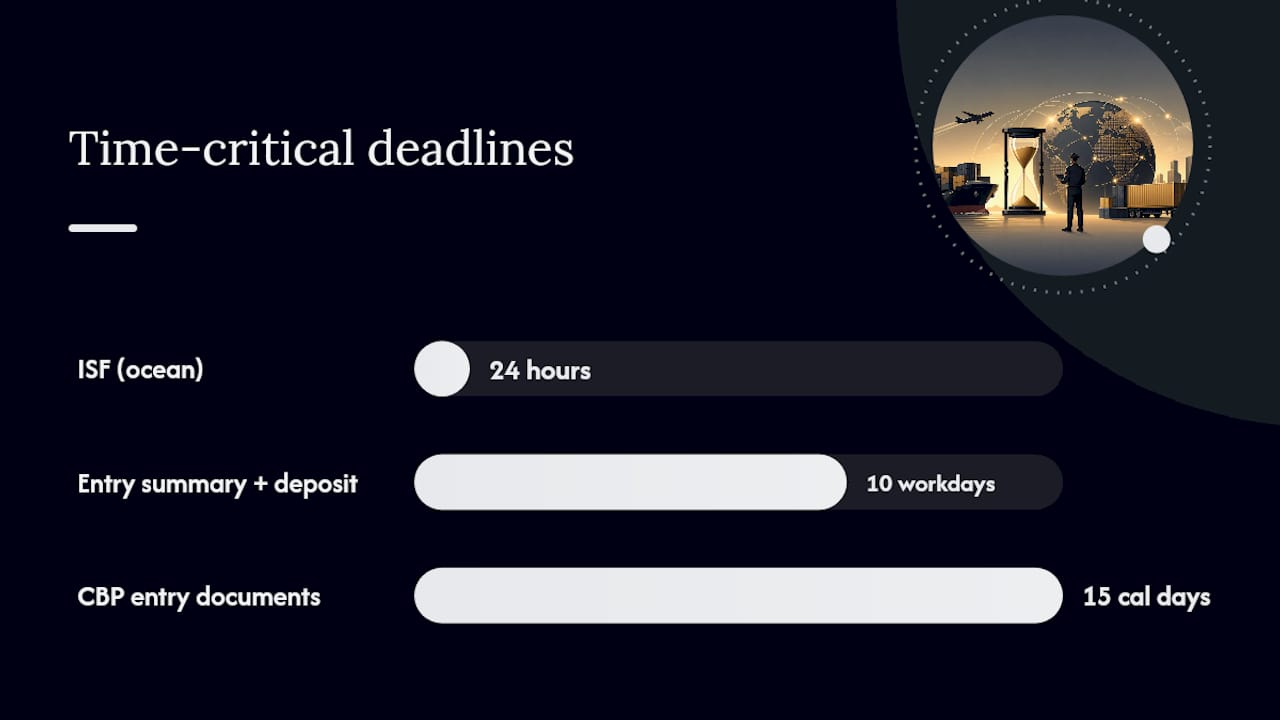
| ISF (ocean imports only) | Importer or forwarder | 24 hours before vessel departure |
| CBP entry documents | Licensed customs broker | Within 15 calendar days of arrival |
| Entry summary + duty deposit | Licensed customs broker | Within 10 working days after release |
Per DHS guidance, CBP Form 3461 covers immediate-delivery procedures, while the entry summary and estimated duty deposit must follow within 10 working days after cargo release. Missing that window triggers penalty exposure.
EEI threshold to calendar now: EEI filing is required when any single Schedule B commodity value exceeds $2,500, or whenever a validated export license applies, regardless of value. The USPPI bears primary responsibility for filing accuracy in AES.
End-to-end steps for moving commercial cargo overseas
Moving commercial cargo internationally follows a predictable sequence. Knowing who owns each handoff prevents gaps that cause delays.
- Classify your commodity. Determine the Schedule B number for export and the Harmonized Tariff Schedule (HTS) code for import. Assign ECCN if the goods are subject to the Export Administration Regulations (EAR).
- Engage a forwarder and customs broker. A freight forwarder coordinates space booking, document preparation, ISF filing, insurance, and customs clearance. Only a licensed customs broker can legally file entries with CBP. Confirm whether your forwarder has in-house brokerage or a partnered broker.
- Execute a Power of Attorney (POA). Both the forwarder and the customs broker need written authorization before they can act on your behalf. This is non-negotiable under BIS guidance for routed export transactions.
- Book carrier space and confirm mode. Ocean FCL (full container load) typically requires booking 3–6 weeks ahead; LCL (less than container load) consolidation windows add 5–10 days. Air freight can move in 2–7 days but at significantly higher cost per kilogram.
- File EEI in AES. The USPPI or authorized agent files Electronic Export Information before export. For ocean, ISF must reach CBP 24 hours before the vessel departs the foreign port.
- Arrange cargo insurance. Carrier liability under standard bills of lading is limited. A separate cargo insurance policy covers the full commercial value.
- Manage in-transit tracking. Use your forwarder’s visibility platform to monitor milestones and flag exceptions early.
- File CBP entry at destination. Your licensed broker files entry documents within 15 calendar days of arrival. CBP Form 3461 can trigger immediate release for qualifying cargo under ACE Cargo Release, provided the carrier participates in the Automated Manifest System.
- Deposit duties and file entry summary. Within 10 working days after release, the broker files the entry summary and deposits estimated duties with CBP.
- Arrange drayage and final delivery. Coordinate inland trucking from the port or air cargo facility to the final destination. At major gateways like Los Angeles/Long Beach, local forwarders assist with port-specific procedures and inland moves, per Port of Los Angeles guidance.
Pro Tip: Book ocean space at least four weeks before your target departure date. Consolidation windows for LCL close earlier than most shippers expect, and a missed window can add 10 or more days to your transit time.
Filing rules, forms, and deadlines you cannot afford to miss
Compliance failures in this area generate the largest fines and the longest delays. Three areas demand the most attention.
CBP entry timing. Entry documents must be filed within 15 calendar days of the cargo’s arrival at a U.S. port. After CBP releases the cargo, the entry summary and estimated duty deposit are due within 10 working days. Immediate-release procedures via CBP Form 3461 can accelerate release, but only when the carrier is enrolled in the Automated Manifest System and pre-arrival data is complete. Errors in pre-arrival data trigger follow-on penalties.
EEI and AES. The $2,500-per-Schedule-B-line threshold is the trigger most teams miss on multi-line shipments. Each line is evaluated independently. When a validated export license is required, EEI is mandatory regardless of value. In a routed export transaction, the foreign buyer’s agent may file EEI, but the USPPI must still provide accurate ECCN and license data in writing. BIS is explicit: forwarders depend on exporters for correct classification, and a missing or wrong ECCN is one of the most common causes of export-control violations.
Customs bonds. A continuous bond covers all entries over a 12-month period and is standard for regular importers. A single-entry bond covers one transaction. Your licensed broker can arrange either type. Bonds are required for all formal entries and for certain in-bond movements.
| Filing | Threshold / Trigger | Who Files | Penalty for Non-Compliance |
|---|---|---|---|
| EEI via AES | Value >$2,500 per Schedule B line, or validated license required | USPPI or authorized agent | Civil and criminal penalties under EAR |
| ISF (ocean) | All ocean imports | Importer or forwarder | Potential fines per violation |
| CBP entry documents | All formal entries | Licensed customs broker | Cargo hold; liquidated damages |
| Entry summary + duties | Within 10 working days post-release | Licensed customs broker | Interest and penalties |
Pro tip on packaging and labeling: Correct country-of-origin marking, HS/HTS codes on commercial invoices, and weight/quantity accuracy on packing lists directly reduce the probability of a CBP exam. Errors on these documents are among the top triggers for intensive inspections. See Worldwideexpress’s export packing guidance for commodity-specific standards.
How to select and manage a freight forwarder and customs broker
The right forwarder reduces compliance risk and transit time. The wrong one creates both.
Selection criteria to evaluate:
- Licensed customs broker on staff or a named affiliated broker (not just a referral)
- Demonstrated experience with your commodity type and destination trade lane
- Capacity and carrier relationships for your preferred mode (ocean, air, or intermodal)
- Digital visibility tools for real-time tracking and exception alerts
- Clear cargo insurance and claims-handling process
- Written SOP covering POA scope, EEI responsibilities, ECCN reporting, and escalation contacts
Red flags to watch for:
- Forwarder files EEI but will not share the AES Internal Transaction Number (ITN) with you
- No POA request before acting on your behalf
- Vague answers about who holds the customs bond
- No written confirmation of ECCN or license determination
- Missing communication SLAs in the service agreement
FIATA describes forwarders as the architects of transport: their core value is managing complexity across multi-leg shipments, consolidations, and customs strategy, not owning transport assets. That distinction matters when evaluating a provider’s actual capabilities versus their marketing claims.
For packing workflows and securing goods before handoff to a forwarder, the step-by-step packing guide from Aleks Moving offers practical sequencing that complements commercial export packing standards.
Primary cost drivers and realistic lead times by mode
Budget planning for international freight forwarding requires understanding which cost components are fixed and which fluctuate with market conditions.
Typical cost components:
- Ocean or air freight rate (market-driven, varies by lane and season)
- ISF filing fee and CBP entry filing fee
- Customs broker fee and duty/tax deposits
- Terminal handling charges (THC) at origin and destination
- Drayage (inland trucking) at both ends
- Cargo insurance premium (typically calculated on commercial invoice value plus freight)
- Forwarder documentation and handling fees
Lead times by mode:
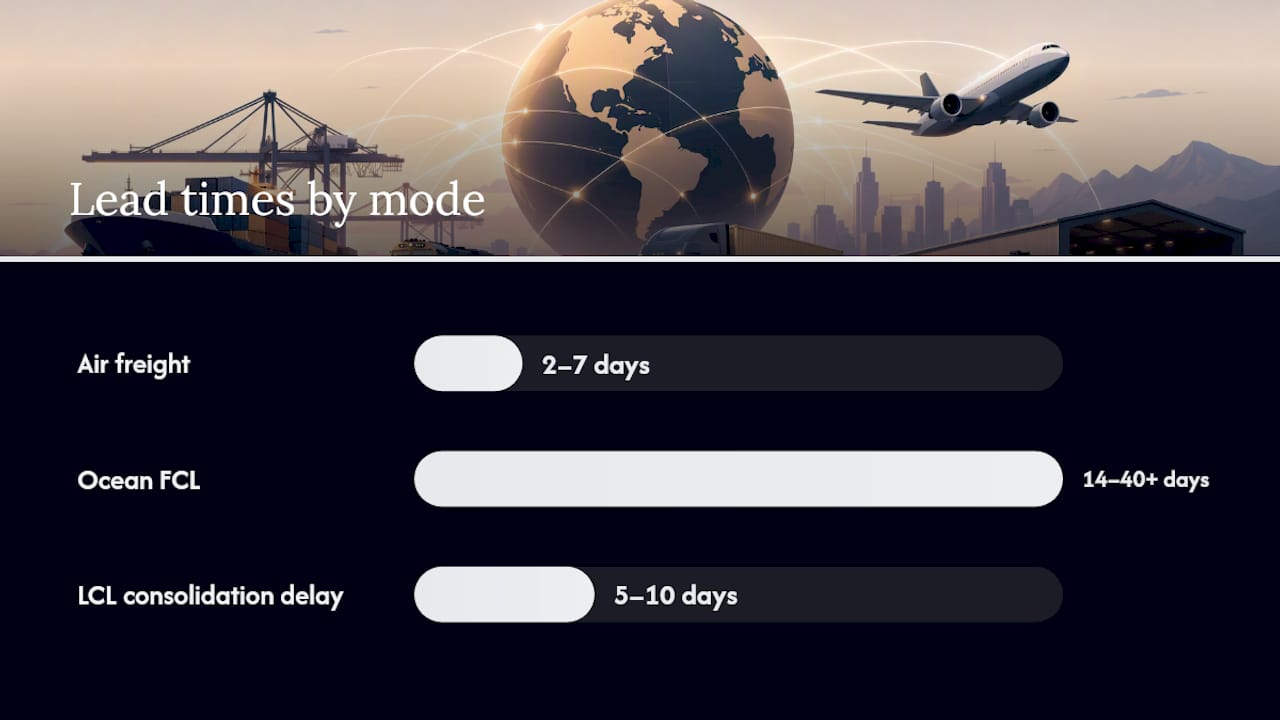
- Air freight: 2–7 transit days, door to door; higher cost per kilogram but fastest for time-sensitive cargo
- Ocean FCL: 14–40+ days depending on trade lane; most cost-effective for full containers
- Ocean LCL: Add 5–10 days for consolidation and deconsolidation; suitable for smaller commercial shipments
- Intermodal (ocean + rail/truck): Extends transit but reduces cost for inland destinations
Incoterms note: Under EXW (Ex Works), the buyer arranges all export clearance and freight. Under DDP (Delivered Duty Paid), the seller handles both. Most commercial transactions use FOB or CIF, where export clearance stays with the seller/exporter and the buyer handles import entry. Confirm Incoterms in your sales contract before assigning filing responsibilities.
Cargo insurance, claims handling, and bond management
Standard carrier liability under a bill of lading covers only a fraction of commercial cargo value. A separate cargo insurance policy is the only way to protect the full commercial value of a shipment.
- Calculate insured value correctly. Use the commercial invoice value plus freight costs, and add a standard markup (commonly 10%) to cover incidental expenses in a total-loss scenario.
- Document condition at origin. Photograph cargo before loading, retain packing declarations, and confirm weight and piece count on the bill of lading. This documentation is critical if a claim arises.
- Give timely notice of loss or damage. Most marine cargo policies require notice within a specific window after delivery. Delayed notice can void coverage.
- Engage a surveyor for significant losses. For high-value or complex claims, an independent marine surveyor’s report strengthens the claim and speeds settlement.
- Manage bond exposure. A continuous bond must cover the full estimated annual duty liability. If your import volume grows significantly mid-year, notify your broker to increase bond coverage before CBP flags a deficiency.
Pro Tip: Never rely on a forwarder’s standard terms and conditions as a substitute for cargo insurance. Forwarding contracts typically limit liability to a low per-kilogram or per-unit cap that bears no relationship to your cargo’s actual commercial value.
Worldwideexpress supports U.S. businesses shipping commercial cargo overseas
Worldwideexpress delivers end-to-end freight forwarding and customs brokerage for U.S. businesses moving commercial cargo by air, ocean, or intermodal. In-house licensed customs brokers handle CBP entry filing, bond management, and duty deposits directly, eliminating the coordination gap between forwarding and brokerage that causes most compliance delays.
Services include import and export freight forwarding, U.S. customs brokerage, cargo insurance, warehousing, and real-time shipment tracking. The engagement path is straightforward: share your commodity description, Schedule B or HTS code, origin/destination, and estimated cargo dimensions to receive a freight quote. Worldwideexpress then sets up the POA, assigns filing responsibilities, and manages the shipment through final delivery and any claims support. To get started, request a freight quote at Worldwideexpress.
Authoritative resources for compliance and next steps
U.S. government sources:
- Basic Importing and Exporting, U.S. Customs and Border Protection: CBP’s primary trade guidance page, including port-specific procedures and de minimis rules
- Find Import/Export Forms, Department of Homeland Security: CBP Form 3461, entry summary procedures, and bond requirements
- Freight Forwarder Guidance and Best Practices, Bureau of Industry and Security: BIS guidance on EAR obligations, routed transactions, and POA requirements
Worldwideexpress resources:
- Ocean freight forwarding steps: Step-by-step ocean shipment process
- Customs bond requirements explained: Bond types and when they apply
- Customs documentation guide: Commercial invoice, packing list, and bill of lading preparation
The compliance gap most U.S. exporters ignore until it costs them
The conventional advice on international freight forwarding focuses almost entirely on cost: compare rates, pick the cheapest forwarder, and move on. That framing misses the actual risk. The most expensive outcome in commercial cargo shipping is not a high freight rate. It is a CBP hold on $500,000 of inventory, a BIS violation that triggers a denial order, or a cargo loss that a forwarding contract covers at pennies on the dollar.
What the evidence in this guide actually supports is a different priority order: compliance infrastructure first, cost optimization second. That means a written POA before the first shipment, an ECCN determination before booking, and a cargo insurance policy that reflects commercial invoice value, not carrier liability caps. Forwarders that cannot provide an AES ITN on request or that resist a written SOP are not saving you money. They are transferring regulatory risk onto your balance sheet.
The other underestimated factor is the value of an in-house customs broker. Many forwarders outsource brokerage to a third party, which adds a communication layer at exactly the moment speed matters most: when CBP issues a query or a hold. A forwarder with licensed brokers on staff resolves those situations faster, and that speed has a direct dollar value in demurrage and storage fees avoided.
Worldwideexpress: a direct path from compliance planning to cleared cargo
Moving commercial cargo overseas without a compliance-first partner means absorbing the cost of every filing error, missed deadline, and underinsured loss yourself. Worldwideexpress gives U.S. businesses a single point of contact for freight forwarding, customs brokerage, cargo insurance, and tracking, with licensed brokers handling CBP filings directly rather than through a third-party referral chain.
The difference is operational: one team owns the POA, the bond, the EEI filing, and the entry summary. That structure eliminates the handoff gaps where most compliance failures originate. To get a freight quote and set up your compliance SOP, visit Worldwideexpress.
This article is general information, not a substitute for advice from a qualified lawyer. Consult a qualified legal professional about your own circumstances before acting on anything here.
Sources
- Basic Importing and Exporting | U.S. Customs and Border Protection
- Find Import/Export Forms | Homeland Security
- Freight forwarder guidance and best practices | Bureau of Industry and Security
- What Does a Freight Forwarder Do, and Do You Need One?
- FIATA
Recommended
- USPS International Shipping: Compliance Essentials for 2026 – Worldwide Express, Inc.
- Importing from Europe: Step-by-Step U.S. Business Guide – Worldwide Express, Inc.
- Step-by-step guide to exporting goods: compliance to shipment – Worldwide Express, Inc.
- Export Procedure in International Business: 2026 Guide – Worldwide Express, Inc.