

Over sixty percent of American logistics managers now face tough choices between nearshoring and offshoring for their shipping operations. As rising transportation costs and global uncertainties impact bottom lines, understanding these strategies becomes critical for companies seeking to control expenses and improve supply chain reliability. This overview brings clarity to the definitions, key differences, and financial implications, empowering decision makers with actionable insights into selecting the most cost-effective approach.
Table of Contents
- Nearshoring Vs Offshoring: Key Definitions
- Core Differences In Supply Chain Management
- Cost Structures And Financial Implications
- Logistics, Risks, And Compliance Challenges
- Selecting The Right Model For Your Business
Key Takeaways
| Point | Details |
|---|---|
| Nearshoring offers geographic and cultural advantages | By relocating to nearby countries, companies can improve communication, reduce logistics costs, and achieve quicker response times. |
| Offshoring focuses on cost advantages | While often providing lower labor costs, offshoring can introduce complexities in communication and logistical management due to distance. |
| Strategic decision-making is essential | Businesses must evaluate operational complexities, cost structures, and regulatory environments when choosing between nearshoring and offshoring. |
| Risk management and compliance are critical | Understanding the regulatory landscape and potential supply chain disruptions is vital for successful international operations. |
Nearshoring vs Offshoring: Key Definitions
In the complex world of global business strategies, nearshoring and offshoring represent two distinct approaches to relocating business operations across international borders. Offshoring fundamentally involves moving business processes, manufacturing, or services to foreign countries, primarily to leverage cost advantages or access specialized labor pools.
Nearshoring, a more nuanced strategy, specifically focuses on relocating business activities to neighboring countries that share geographic, cultural, and time zone proximity. For U.S. companies, this typically means establishing operations in countries like Mexico, where close physical proximity enables more seamless communication and logistics. Geographic and cultural similarities facilitate smoother business interactions and reduced operational complexities compared to traditional offshoring models.
The key distinctions between these strategies lie in their geographic scope and strategic objectives:
Here’s a summary of how nearshoring and offshoring compare across strategic factors:
| Factor | Nearshoring Advantage | Offshoring Advantage |
|---|---|---|
| Time Zone Alignment | Enables real-time collaboration | May require shift adjustments |
| Cultural Proximity | Eases business integration | Can offer diverse perspectives |
| Response Speed | Faster production adjustments | Can benefit from scale |
| Compliance Easiness | Smoother regulatory processes | Possible cost savings, but complex |
- Offshoring: Often involves relocating to distant countries with significant labor cost differences
- Nearshoring: Concentrates on geographically close regions with shared cultural and economic characteristics
- Farshoring: Represents the most distant form of offshoring, typically involving countries on different continents
Pro tip: When evaluating nearshoring or offshoring strategies, always conduct a comprehensive cost-benefit analysis that goes beyond immediate labor expenses and considers long-term operational efficiency, communication challenges, and potential geopolitical risks.
Core Differences in Supply Chain Management
The evolution of global logistics has fundamentally transformed how companies approach supply chain management, with nearshoring and offshoring representing two distinct strategic approaches. Global value chain dynamics reveal critical differences in how businesses optimize their production and distribution networks across international boundaries.
Nearshoring specifically addresses supply chain challenges by prioritizing geographic proximity and reduced logistical complexity. Unlike traditional offshoring models that seek maximum cost reduction, supply chain design strategies now emphasize operational efficiency, risk mitigation, and faster response times. U.S. logistics managers increasingly recognize that proximity can offset potential savings from distant labor markets through improved communication, shorter transportation routes, and more agile manufacturing capabilities.
Key distinctions in supply chain management between nearshoring and offshoring include:
- Communication Efficiency: Nearshoring enables real-time collaboration and reduced language barriers
- Logistics Complexity: Shorter transportation routes reduce transit times and inventory holding costs
- Risk Management: Closer geographic proximity minimizes geopolitical and supply disruption risks
- Regulatory Alignment: Neighboring countries often share similar trade regulations and standards
Pro tip: Conduct a comprehensive total cost of ownership analysis that evaluates not just labor expenses, but includes transportation costs, communication overhead, inventory carrying costs, and potential supply chain disruption risks.
Cost Structures and Financial Implications
Navigating the complex financial landscape of global logistics requires a nuanced understanding of how nearshoring and offshoring impact cost structures for U.S. companies. Labor market dynamics reveal that these strategies fundamentally transform the economic calculus of manufacturing and service delivery, extending far beyond simple wage arbitrage.

While traditional offshoring models prioritized maximizing labor cost reductions, modern nearshoring strategies demand a more holistic financial approach. Economic policy implications demonstrate that total cost of ownership now encompasses multiple financial considerations beyond direct labor expenses. U.S. logistics managers must evaluate hidden costs such as transportation expenses, communication infrastructure, quality control, intellectual property risks, and potential supply chain disruptions.
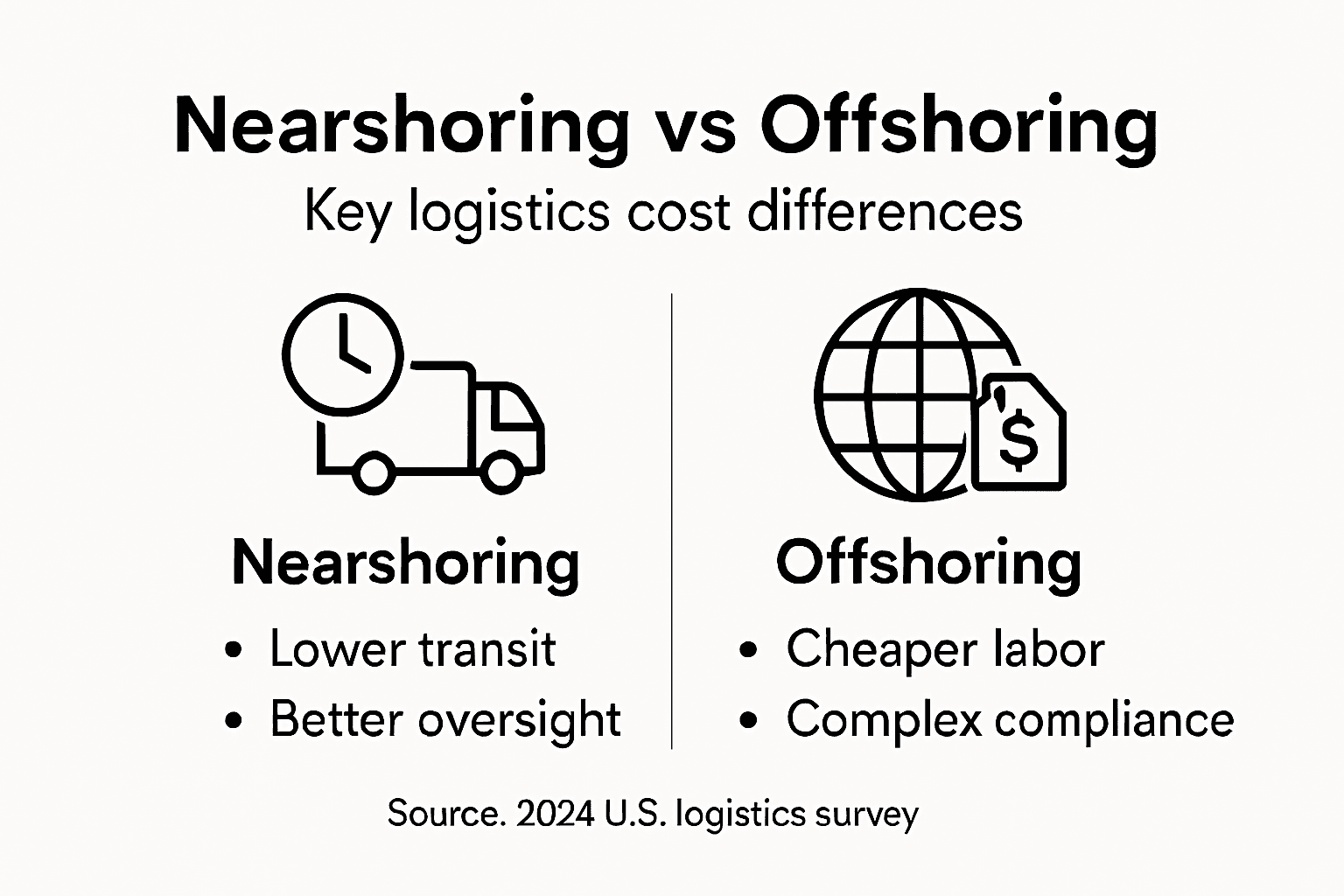
Key financial considerations in nearshoring versus offshoring include:
Use this table as a quick reference for financial impacts:
| Financial Aspect | Nearshoring Impact | Offshoring Impact |
|---|---|---|
| Transportation Costs | Significantly lower | Higher due to distance |
| Management Overhead | Reduced due to proximity | Increased coordination needed |
| Risk of Disruption | Lower, easier contingency planning | Higher, more variables involved |
| Infrastructure Needs | Modest upgrades often sufficient | Potential for larger investment |
- Direct Labor Costs: Wage differentials between home and target countries
- Indirect Expenses: Transportation, communication, and management overhead
- Risk Mitigation: Potential savings from reduced geopolitical and operational risks
- Compliance Costs: Varying regulatory and legal expense structures
- Technology Investment: Infrastructure and integration expenses
Pro tip: Develop a comprehensive financial model that includes a five-year total cost of ownership analysis, factoring in not just immediate labor savings but potential long-term strategic advantages of geographic proximity and reduced operational complexity.
Logistics, Risks, and Compliance Challenges
Navigating the complex landscape of international logistics requires U.S. companies to carefully evaluate the intricate risks associated with nearshoring and offshoring strategies. Backshoring and nearshoring trends reveal a nuanced approach to managing global supply chain complexities, with particular emphasis on risk mitigation and operational resilience.
The evolving geopolitical environment demands a sophisticated understanding of compliance challenges that extend far beyond traditional cost considerations. Trade policy uncertainties create additional layers of complexity for logistics managers seeking to optimize their international operations. U.S. companies must now consider a comprehensive risk matrix that includes regulatory compliance, cultural adaptability, intellectual property protection, and potential supply chain disruptions.
Key logistics, risks, and compliance challenges include:
- Regulatory Complexity: Navigating different legal frameworks and trade regulations
- Cultural Alignment: Managing communication and operational differences
- Intellectual Property Protection: Mitigating risks of technology and knowledge transfer
- Supply Chain Vulnerability: Addressing potential disruption points and contingency planning
- Geopolitical Uncertainty: Adapting to changing international trade dynamics
Pro tip: Develop a comprehensive risk assessment framework that includes quarterly reviews of geopolitical, regulatory, and operational risks, with contingency plans for potential supply chain disruptions and compliance challenges.
Selecting the Right Model for Your Business
Choosing between nearshoring and offshoring demands a strategic approach that goes beyond simplistic cost comparisons. Strategic decision-making criteria reveal that successful logistics strategies require a comprehensive evaluation of multiple interconnected factors affecting business operations and competitive positioning.
The selection process involves a nuanced assessment of organizational capabilities, market dynamics, and long-term strategic objectives. Outsourcing model selection demands a holistic approach that considers not just immediate financial benefits, but also operational flexibility, risk management, and potential future scalability. U.S. logistics managers must critically analyze their specific business requirements, technological infrastructure, and global expansion goals.
Key considerations for selecting the right model include:
- Operational Complexity: Evaluate your current supply chain infrastructure
- Communication Requirements: Assess language and cultural compatibility
- Cost Structure: Analyze total cost of ownership, not just labor expenses
- Innovation Potential: Consider proximity to technological ecosystems
- Regulatory Environment: Understand compliance and legal implications
- Talent Availability: Evaluate specialized skill pools in potential locations
Pro tip: Conduct a comprehensive multi-year strategic assessment using a weighted scoring matrix that objectively evaluates nearshoring and offshoring options across financial, operational, and strategic dimensions.
Streamline Your Supply Chain with Expert Nearshoring and Offshoring Logistics Solutions
Navigating the challenges of nearshoring and offshoring can feel overwhelming when dealing with shifting regulations, complex compliance, and unpredictable risks. If your business is seeking to optimize communication efficiency, reduce transportation costs, and mitigate supply chain disruptions, understanding the full impact on U.S. logistics is crucial. Worldwide Express offers tailored freight forwarding and customs brokerage services designed to handle these exact pain points, simplifying international shipping across borders.
Take control of your global operations today by partnering with a logistics provider that understands both nearshoring and offshoring dynamics. Visit Worldwide Express to explore how our air and ocean transportation, warehousing, and supply chain management tools can provide you with faster response times, improved compliance, and enhanced risk mitigation. Request a freight quote or start tracking your shipments with experts who keep your business moving forward.
Learn more about our full range of services at Worldwide Express Solutions and experience logistics built for your success.
Frequently Asked Questions
What is the main difference between nearshoring and offshoring?
Nearshoring involves relocating business operations to neighboring countries with geographic and cultural proximity, while offshoring means moving operations to distant countries primarily to leverage cost savings or specialized labor.
How does nearshoring benefit supply chain management?
Nearshoring enhances supply chain management by facilitating better communication, reducing logistics complexity, and minimizing risks related to geopolitical instability, ultimately allowing for faster response times and operational efficiency.
What are the financial implications of nearshoring compared to offshoring?
Nearshoring typically results in lower transportation costs and reduced management overhead due to proximity, while offshoring may incur higher transportation expenses and increased coordination complexities, impacting the overall cost structure.
What risks should companies consider when choosing between nearshoring and offshoring?
Companies should evaluate regulatory compliance challenges, cultural differences, intellectual property protection, and potential supply chain disruptions, as these risks can significantly impact the effectiveness of their chosen strategy.
Recommended
- Trade War Impacts – How They Shape U.S. Logistics – Worldwide Express, Inc.
- Growing Your Business Online: Strategies for Logistics – Worldwide Express, Inc.
- Remote Team Management Tips for Logistics Leaders – Worldwide Express, Inc.
- Free Trade Agreement Benefits for U.S. Logistics – Worldwide Express, Inc.
- Understanding Shipping Electronics Internationally – buy2fix