

Choosing between self-filing and hiring a customs broker sounds straightforward until your shipment gets held at the port, a penalty notice arrives, or CBP flags your entry for audit. Many importers assume that filing their own customs documentation saves money and keeps them in control. The reality is more complicated. Regulatory requirements have grown more demanding, AI-driven audits are catching errors that once slipped through, and the cost of a single misclassified tariff code can dwarf years of broker fees. This guide gives you a clear, practical comparison of both methods so you can make the right call for your trade operation.
Table of Contents
- Understanding self filing and customs broker services
- Regulatory requirements and compliance risks
- Comparing self filing and using a customs broker: cost, speed, and risk
- Situations where self filing or a customs broker makes sense
- Making your customs filing decision: steps for importers and exporters
- Expert customs clearance solutions for global trade success
- Frequently asked questions
Key Takeaways
| Point | Details |
|---|---|
| Importer always liable | No matter who files, you are responsible for accuracy and compliance. |
| Brokers add expertise | Customs brokers reduce error risk in complex, high-value, or regulated shipments. |
| Costs go beyond fees | Penalties, delays, and lost time often outweigh direct broker savings. |
| Hybrid strategies work | Experienced importers combine self-filing for routine shipments and brokers for expert support. |
| Right fit depends on cargo | The best customs clearance method depends on shipment type, value, and internal expertise. |
Understanding self filing and customs broker services
Before comparing costs and risks, it helps to be precise about what each method actually involves.
Self-filing means the importer of record files customs documentation directly with U.S. Customs and Border Protection (CBP). You prepare the entry, classify goods under the Harmonized Tariff Schedule (HTS), calculate duties, and submit everything through the Automated Broker Interface (ABI) or ACE portal. You own every decision.
Using a customs broker means hiring a CBP-licensed professional to manage that process on your behalf. Brokers handle classification, valuation, documentation, and communication with CBP. Understanding what a customs broker does makes it clear why their expertise often pays for itself quickly.
Here is where most importers get tripped up: hiring a broker does not transfer your legal liability. Under the reasonable care doctrine, importers are always responsible for the accuracy of their entries, even when a broker files on their behalf. Brokers mitigate risk, they do not absorb it.
Key responsibilities under both methods include:
- Accurate HTS classification of all goods
- Correct valuation and duty calculation
- Timely Importer Security Filing (ISF) submission
- Maintaining records for CBP audit purposes
- Coordinating with Partner Government Agencies (PGAs) where applicable
- Securing an importer bond for formal entries
The difference between customs broker vs freight forwarder is also worth understanding before you build your logistics team, since these roles are often confused but serve distinct functions.
Pro Tip: Most importers underestimate the time required to stay current on tariff changes, CBP rulings, and PGA requirements. A single HTS update can affect dozens of SKUs overnight.
Regulatory requirements and compliance risks
Whether you self-file or use a broker, the same regulatory framework applies. The rules do not bend based on who submits the paperwork.
Core requirements every importer must meet include:
- ISF (10+2) filing: Must be submitted 24 hours before loading at the foreign port. Late or inaccurate ISF filings carry penalties up to $5,000 per violation.
- Formal entry threshold: Any shipment valued over $2,500 requires a formal entry and an ISF 10+2 form along with a continuous or single-entry bond.
- PGA coordination: Goods regulated by the FDA, USDA, EPA, or other agencies require additional documentation and approvals before release.
- Recordkeeping: CBP requires importers to retain all entry records for five years. Audits can reach back that far, and missing records are treated as violations.
Common self-filing pitfalls include wrong HTS codes, undervalued invoices, missing PGA flags, and late ISF submissions. These are not rare edge cases. They are the most frequent triggers for CBP penalties and cargo holds.
“Importers who self-file often discover compliance gaps only during a CBP audit, at which point the cost of correction far exceeds what professional broker support would have cost over the same period.”
Using a broker reduces the likelihood of these errors, but it does not eliminate your exposure. If you provide a broker with incorrect product information, the resulting entry error is still your liability. The customs broker compliance benefits are real, but they depend on accurate data flowing from you to your broker.

Rising tariff complexity in 2026, including Section 301 tariffs, antidumping and countervailing duty orders, and frequent HTS updates, has made the compliance environment significantly harder to navigate without specialized knowledge.
Comparing self filing and using a customs broker: cost, speed, and risk
Let’s put both methods side by side across the dimensions that matter most to importers and exporters.
| Factor | Self-filing | Customs broker |
|---|---|---|
| Filing cost | Low direct cost; high time investment | Broker fee per entry ($75 to $250+ typical) |
| Clearance speed | Slower if errors occur; faster with expertise | Generally faster due to experience and CBP relationships |
| Error and penalty risk | Higher without deep compliance knowledge | Lower, but importer still liable for data accuracy |
| Scalability | Difficult at high shipment volumes | Scales well; brokers handle volume efficiently |
| Record access | Full direct control | Broker maintains records; you must request access |
| PGA handling | Requires importer to manage all agency requirements | Broker coordinates PGA submissions and follow-ups |
| Audit preparedness | Depends entirely on internal systems | Brokers typically maintain organized entry records |
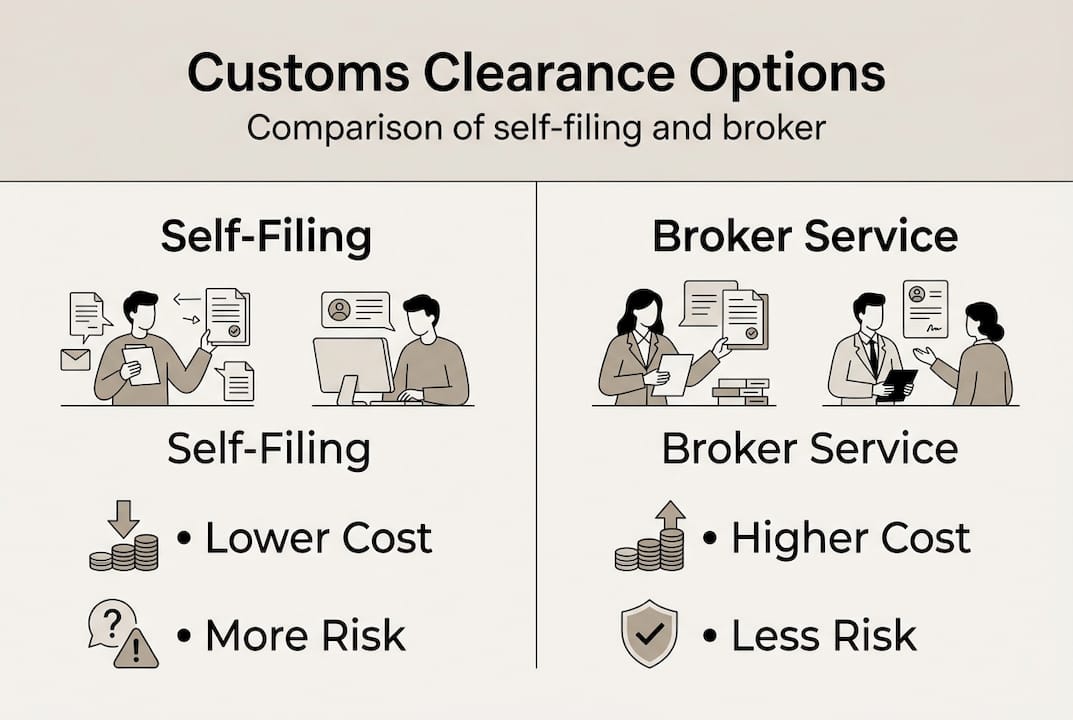
The non-obvious costs of self-filing add up fast. A single cargo hold costs you demurrage and detention fees, which can run hundreds of dollars per day. A penalty for an incorrect HTS code can reach tens of thousands of dollars. The time your trade team spends on classification research and CBP correspondence is time not spent on sourcing, sales, or operations.
Broker fees are an upfront, visible cost. Penalties, delays, and audit defense costs are unpredictable and often much larger. The customs broker efficiency advantage becomes most apparent when you calculate the full cost of errors, not just the cost of the filing itself.
The broker’s compliance role also extends to staying current on regulatory changes, something that requires continuous monitoring that most in-house teams cannot sustain alongside other responsibilities.
Pro Tip: CBP’s increasing use of AI-driven targeting means entries with minor inconsistencies are flagged more frequently than they were five years ago. Both self-filers and broker-assisted importers need tighter data quality than ever before.
Situations where self filing or a customs broker makes sense
Neither method is universally superior. The right choice depends on your shipment profile, internal resources, and risk tolerance.
Self-filing works best when:
- Shipments are low value (under $2,500) and qualify as informal entries
- Your product catalog is narrow and HTS codes are stable and well-established
- Your team includes someone with formal customs compliance training
- You import infrequently and shipment volumes are manageable
- No PGA oversight applies to your goods
A customs broker is the stronger choice when:
- Goods are valued over $2,500 and require formal entry
- Products fall under FDA, USDA, or other PGA jurisdiction
- You import frequently or in high volumes
- Shipments are time-sensitive and delays carry real business cost
- Your product mix is complex or includes goods subject to special duties
- You have faced CBP penalties or audits in the past
Many experienced importers use a broker hybrid support model. Routine, low-complexity entries are handled in-house, while a broker manages high-value, PGA-regulated, or first-time product entries. This approach balances cost control with risk management.
Here is a quick reference for matching your situation to the right method:
| Trigger | Recommended approach |
|---|---|
| Shipment value under $2,500 | Self-filing viable |
| Shipment value over $2,500 | Customs broker recommended |
| PGA oversight (FDA/USDA/EPA) | Customs broker strongly recommended |
| High shipment frequency | Customs broker or hybrid |
| First-time product or supplier | Customs broker for initial entries |
| Active CBP audit history | Customs broker required |
| Stable, simple product catalog | Self-filing viable with trained staff |
The formal entry bond requirement for shipments over $2,500, combined with ISF obligations and five-year recordkeeping rules, means that most commercial importers benefit from at least some level of professional broker support.
Making your customs filing decision: steps for importers and exporters
Use this framework to assess your readiness and choose the right approach before your next shipment moves.
-
Evaluate shipment complexity. List your product types, HTS codes, and whether any goods require PGA clearance. The more complex the product mix, the stronger the case for a broker.
-
Assess your compliance knowledge. Does your team understand ISF requirements, cargo entry timing, HTS classification, and CBP audit obligations? Honest self-assessment here prevents costly surprises.
-
Review your available resources. Self-filing requires access to ACE, ABI software or a service provider, and staff time. Factor in the ongoing cost of staying current on tariff changes and regulatory updates.
-
Estimate your cost and risk exposure. Calculate the realistic cost of a delay, a penalty, or an audit response. Compare that against annual broker fees for your shipment volume.
-
Decide on your model. Choose self-filing, full broker support, or a hybrid approach based on steps one through four. Document your decision and review it annually as your trade volume and product mix evolve.
-
Build your audit readiness. Regardless of which method you choose, establish a recordkeeping system that retains all entry documents, invoices, and correspondence for at least five years.
Key self-assessment questions to ask before you decide:
- Have we ever received a CBP penalty or cargo hold?
- Do any of our products require FDA, USDA, or other agency approval?
- Can our team realistically stay current on HTS and tariff changes?
- What would a 48-hour cargo delay cost our business?
- Do we have a continuous bond in place for formal entries?
The answers will tell you more than any general rule of thumb.
Expert customs clearance solutions for global trade success
Navigating customs clearance is one of the highest-stakes decisions in your supply chain. Getting it right means faster cargo release, lower penalty exposure, and a compliance record that holds up under CBP scrutiny.
Worldwide Express offers U.S. customs brokerage services built for importers and exporters who need reliable, compliant clearance without the guesswork. Our licensed brokers handle classification, ISF filing, PGA coordination, and recordkeeping so your shipments move on schedule. Whether you need full-service brokerage or support for complex entries alongside your in-house team, our freight forwarding guide and customs broker resources give you the tools to make smarter logistics decisions. Connect with our team to build a customs strategy that fits your trade volume, product mix, and compliance goals.
Frequently asked questions
Can I switch between self filing and using a customs broker for different shipments?
Yes, importers often use a hybrid approach, self-filing for routine low-complexity entries and engaging a broker for complex or high-risk goods. This model balances cost control with professional risk management.
Who is responsible if a customs broker makes a mistake?
The importer is ultimately liable under the reasonable care doctrine, even when a broker files on your behalf. Brokers reduce the likelihood of errors but cannot transfer your legal responsibility to CBP.
Do all shipments require a customs broker in the U.S.?
No, U.S. importers can self-file most shipments as long as they meet all regulatory requirements. However, broker use is strongly recommended for goods subject to PGA oversight or formal entry obligations.
What is the minimum value for a formal customs entry?
Shipments valued over $2,500 require a formal entry bond and must meet enhanced documentation and compliance requirements set by CBP.
Recommended
- Customs broker vs agent: Clear roles for easier compliance – Worldwide Express, Inc.
- Benefits of U.S. customs brokers for efficient trade – Worldwide Express, Inc.
- How customs brokers streamline global trade in 2026 – Worldwide Express, Inc.
- Why use a customs broker: cut costs by 15% in 2026 – Worldwide Express, Inc.