TL;DR:
- Reliable international shipping requires coordination of multiple transportation modes, compliance, and documentation.
- Key players include freight forwarders, customs brokers, and carriers, each with distinct roles.
- Early booking, digital tools, and proper Incoterm selection are crucial for efficient cross-border logistics.
Most businesses entering international trade assume the hardest part is finding customers abroad. The real challenge, it turns out, is getting the product there reliably. Cross-border shipping involves a layered web of transportation modes, regulatory requirements, documentation standards, and timing pressures that can derail even well-funded operations. A single customs error can hold a shipment for days or trigger costly penalties. This article breaks down how international shipping logistics actually works, who the key players are, how responsibilities are divided, and what practical steps businesses can take right now to move goods across borders with confidence and efficiency.
Table of Contents
- What is shipping logistics? Scope and components
- Key players in global shipping logistics
- Incoterms and responsibilities: What every business should know
- Timing, tech, and best practices for efficient shipping
- What businesses really get wrong about shipping logistics
- Streamline your global shipping with expert support
- Frequently asked questions
Key Takeaways
| Point | Details |
|---|---|
| Comprehensive logistics process | International shipping logistics coordinates transportation, customs, and warehouses for worldwide trade success. |
| Clear roles and responsibilities | Freight forwarders, customs brokers, and carriers each handle specific areas to streamline your shipments. |
| Incoterms guide business risk | Choosing the right Incoterm is critical for clarifying cost and risk in any global transaction. |
| Plan and use tech tools | Booking early and leveraging digital logistics systems can prevent delays and increase compliance in global shipping. |
What is shipping logistics? Scope and components
Shipping logistics, in an international context, refers to the end-to-end coordination of moving goods from one country to another. It is not simply about booking a carrier. According to Shopify’s breakdown of the international logistics process, international shipping logistics involves coordinating transportation across air, ocean, and land, alongside warehousing, inventory management, customs clearance, and compliance across borders. That is a significant operational surface area for any business to manage.
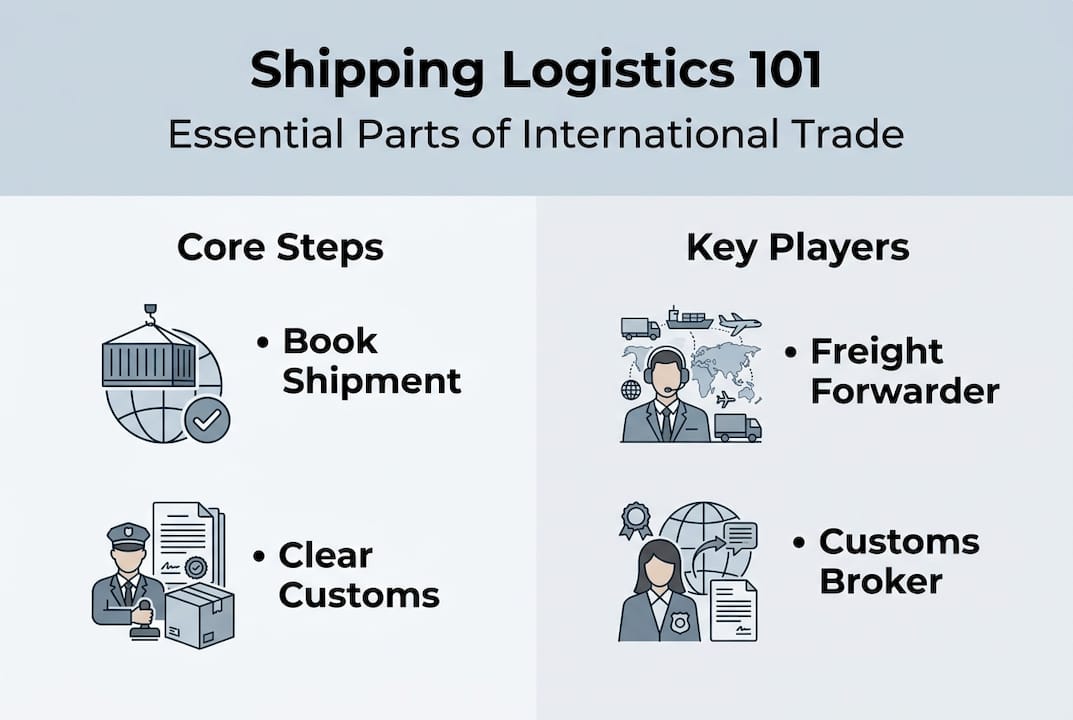
The core components of a typical international logistics chain include:
- Transportation: Choosing between air freight, ocean freight, road, or rail based on cost, speed, and cargo type.
- Warehousing: Storing goods at origin, in-transit hubs, or at the destination before final delivery.
- Inventory management: Tracking stock levels across locations to prevent shortfalls or overstock situations.
- Customs clearance: Filing the correct documentation with border authorities to legally move goods across jurisdictions.
- Compliance: Adhering to import and export regulations, tariff classifications, and trade agreements.
When these components are poorly coordinated, the consequences are measurable. Research consistently shows that a significant share of cross-border shipments face delays tied directly to documentation errors, miscommunication between partners, or gaps in compliance planning. For businesses trying to optimize logistics for global shipping, understanding this full picture is the starting point.
Clarity in logistics also translates into competitive advantage. Businesses that map their supply chain end-to-end can identify bottlenecks before they become crises. They can negotiate better rates, plan for seasonal demand spikes, and build redundancy into their operations. Working with experienced customs clearance companies is one proven way to reduce compliance risk and keep shipments moving on schedule.
With the scope of shipping logistics set, let’s understand the major players who make global trade possible.
Key players in global shipping logistics
Understanding who does what in international shipping is surprisingly undervalued. Many businesses treat logistics as a single-vendor relationship when it actually involves several distinct specialists. Per Worldwide Express’s breakdown of shipping roles explained, freight forwarders, customs brokers, and carriers each play distinct roles in facilitating cross-border shipments.
Here is how each key player fits into the picture:
- Freight forwarder: Acts as the orchestrator of international shipments. They negotiate with carriers, book space, prepare documentation, and manage the overall movement of cargo from origin to destination.
- Customs broker: A licensed professional who ensures that imports and exports comply with all relevant regulations. They classify goods, calculate duties, and submit declarations to customs authorities.
- Carriers: The companies that physically transport goods, whether by ocean vessel, aircraft, truck, or rail. They execute the movement but typically do not manage compliance or documentation.
| Partner | Primary role | Key business value |
|---|---|---|
| Freight forwarder | Coordinates full shipment lifecycle | Saves time, reduces operational complexity |
| Customs broker | Manages regulatory compliance | Reduces delays, avoids penalties |
| Ocean/air carrier | Transports cargo | Provides capacity and speed options |
| Trucking company | Last-mile or inland delivery | Connects ports to warehouses or end customers |
The distinction between a freight forwarder and a customs broker is especially important. Some providers offer both services under one roof, which can simplify communication and accountability. However, businesses should verify that the customs expertise is genuine and not just a secondary offering. Experienced customs brokers in global trade bring deep knowledge of tariff schedules, trade agreements, and country-specific requirements that generalist forwarders may lack.

Pro Tip: When vetting logistics partners, ask for references from businesses in your specific industry and for shipments to your target markets. A forwarder experienced in electronics exports to Europe may not be the right fit for perishable goods heading to Southeast Asia.
Now that we’ve demystified who does what, it’s essential to understand how shipping terms and responsibilities are clearly set.
Incoterms and responsibilities: What every business should know
Incoterms, short for International Commercial Terms, are a standardized set of trade terms published by the International Chamber of Commerce. They define who is responsible for costs, risk, insurance, and customs clearance at each stage of a shipment. Getting them wrong is one of the most expensive mistakes a business can make in international trade.
As the Incoterms guide from Logicom Hub explains, Incoterms define responsibilities for costs, risks, insurance, and clearance, with EXW placing all responsibility on the buyer and DDP placing all responsibility on the seller, including import duties.
| Incoterm | Who arranges transport | Who pays freight | Who handles import customs |
|---|---|---|---|
| EXW (Ex Works) | Buyer | Buyer | Buyer |
| FOB (Free on Board) | Buyer | Buyer | Buyer |
| CIF (Cost, Insurance, Freight) | Seller | Seller | Buyer |
| DDP (Delivered Duty Paid) | Seller | Seller | Seller |
Choosing the right Incoterm is a strategic decision, not just a contractual formality. Here is a practical process for making that choice:
- Assess your customs expertise. If you lack in-house customs knowledge, avoid terms like EXW that place full import responsibility on you.
- Evaluate your carrier relationships. FOB and CIF work best when you have established carrier contracts and can negotiate competitive freight rates.
- Consider your risk tolerance. DDP offers maximum control for sellers but exposes them to unpredictable import duty fluctuations in foreign markets.
- Align your contracts and insurance. Every Incoterm implies specific insurance obligations. Misalignment between your contract and your policy creates gaps in coverage.
- Review with legal and logistics counsel. Incoterms interact with local law, so what works in one market may create liability in another.
Businesses that skip this analysis often discover hidden costs after the fact, including unexpected duty bills, uninsured cargo losses, or disputes over who was responsible for a delayed shipment. Solid customs clearance compliance planning starts with choosing the right Incoterm.
Pro Tip: Always align your commercial invoice, insurance certificate, and shipping contract to reflect the same Incoterm. Inconsistencies between documents are a common trigger for customs holds.
Incoterms set the ground rules, but real logistical success depends on timing, technology, and preparation.
Timing, tech, and best practices for efficient shipping
Even businesses with solid partner relationships and well-chosen Incoterms can run into serious problems if their operational practices are reactive rather than proactive. The two most consistent drivers of shipping delays are poor documentation and last-minute bookings. Both are preventable.
On timing, the guidance from Shopify’s analysis of digital logistics tools is clear: booking 2-3 months ahead of peak seasons is essential, alongside using Transportation Management Systems for tracking and compliance. Peak periods like Q4 holiday shipping or post-Chinese New Year restocking create massive capacity crunches. Businesses that wait until demand spikes hit often pay premium rates or face weeks-long delays.
Here is a practical workflow for integrating digital tools into your logistics operations:
- Implement a Transportation Management System (TMS). A TMS centralizes shipment data, automates carrier selection, and provides real-time visibility across your supply chain.
- Connect your TMS to compliance databases. Automated tariff classification and sanctions screening reduce manual errors and speed up customs processing.
- Set up real-time tracking alerts. Proactive notifications allow your team to respond to delays before they cascade into larger disruptions.
- Digitize your documentation workflow. Electronic bills of lading, commercial invoices, and packing lists reduce processing time and minimize transcription errors.
- Audit your data regularly. Periodic reviews of shipment data reveal patterns in delays, costs, and compliance issues that manual oversight would miss.
“The businesses that consistently outperform in international logistics are not necessarily the ones with the biggest budgets. They are the ones with the clearest data and the most disciplined processes.”
Pro Tip: Most customs delays are triggered by documentation errors, not physical inspections. Investing in document accuracy upfront is far cheaper than paying demurrage fees or rerouting shipments after the fact.
For businesses looking to sharpen their approach, exploring international freight shipping strategies and customs compliance tips can provide a strong operational foundation.
Understanding best practices ensures you can move from theory to effective, profitable logistics.
What businesses really get wrong about shipping logistics
The most common mistake businesses make in international logistics is treating it as a cost center rather than a strategic function. The focus narrows to freight rates, and everything else, compliance rigor, partner quality, documentation accuracy, gets treated as secondary.
That mindset is where real risk accumulates. Poor communication between a freight forwarder and a customs broker, for instance, can result in misclassified goods, triggering audits or seizures that cost far more than any freight savings. Lack of digital visibility means problems are discovered after they have already escalated.
Operational excellence in logistics is fundamentally about anticipation. The businesses that run the most reliable supply chains are not the ones that react fastest to problems. They are the ones that have designed their systems to surface problems early, before a delayed shipment becomes a broken customer promise.
Years of solving complex freight and customs challenges point to one consistent truth: the businesses that invest in efficient global shipping insights and treat logistics as a core competency consistently outperform those that treat it as an afterthought. The savings from cutting corners on logistics partners or compliance tools are almost always illusory.
With those lessons in mind, here’s how you can connect the dots for your business.
Streamline your global shipping with expert support
Navigating international shipping logistics requires more than general knowledge. It demands experienced partners, reliable systems, and a clear strategy for compliance and coordination. Worldwide Express brings decades of specialized expertise across freight forwarding, customs brokerage, and digital supply chain tools to help businesses move goods across borders without costly surprises.
Whether you are new to international trade or looking to sharpen an existing operation, the right resources make a measurable difference. Explore the freight forwarding guide for a deeper look at how freight coordination works, review customs brokerage services to understand how compliance is managed at the border, or browse the full range of logistics services tailored for businesses engaged in global trade.
Frequently asked questions
What are the main steps in international shipping logistics?
The main steps include preparing documents, arranging transport, clearing customs, managing warehousing, and delivering to the final destination. Each step must be coordinated carefully, as international logistics spans air, ocean, and land transportation alongside compliance and inventory management.
How do Incoterms affect shipping costs and risk?
Incoterms define who pays for and bears risk at each shipping stage, directly impacting insurance obligations, customs responsibilities, and total landed costs. Misunderstanding them, as the Incoterms framework makes clear, can expose businesses to unexpected duty bills or uninsured cargo losses.
Why is booking shipments early important for international trade?
Booking 2-3 months in advance helps businesses avoid peak season capacity shortages and secures better freight rates before demand spikes. Per Shopify’s supply chain analysis, early booking is one of the most effective ways to maintain shipping reliability.
What does a freight forwarder do versus a customs broker?
A freight forwarder organizes and coordinates international shipments from origin to destination, while a customs broker focuses specifically on ensuring regulatory compliance and customs clearance. Both roles are distinct, as shipping roles explained by Worldwide Express details.
How can technology improve shipping logistics?
Transportation Management Systems enable real-time tracking, automated compliance checks, and centralized shipment data, reducing both errors and delays. Digital logistics tools are now considered essential infrastructure for businesses managing cross-border operations at scale.
Recommended
- 7 Steps to Streamline International Shipping Services – Worldwide Express, Inc.
- How to Optimize Logistics for Efficient Global Shipping – Worldwide Express, Inc.
- Expedited International Shipping: Fast-Track Your Global Deliveries – Worldwide Express, Inc.
- Optimize international freight transit times: key strategies – Worldwide Express, Inc.