TL;DR:
- Customs clearance at airports is faster with accurate documentation, trusted trader programs, and digital filings.
- Best-in-class air cargo clearance can be achieved in 90 minutes, significantly faster than seaport times.
- Systematization and strong broker partnerships are key to maintaining consistently quick clearance speeds.
Air cargo moves fast, but customs clearance can stop it cold. While air cargo clears in under 4 hours at most airports versus 20 to 24 hours at seaports, that advantage evaporates the moment a shipment hits a documentation error or a physical exam. Some importers routinely clear air cargo in a fraction of the theoretical minimum, while others watch their time-sensitive goods sit in a bonded warehouse accumulating fees. The difference is rarely luck. It comes down to process, preparation, and the right partnerships. This guide breaks down exactly how airport customs clearance works, what the benchmarks look like, and which strategies actually move the needle.
Table of Contents
- How customs clearance works at airports
- Benchmark clearance times: Airports vs. seaports
- What speeds up or slows down airport customs clearance
- Proven strategies to streamline your airport customs clearance
- A fresh perspective on airport customs clearance
- Unlock smoother global shipping with expert customs support
- Frequently asked questions
Key Takeaways
| Point | Details |
|---|---|
| Clearance speed matters | Airports clear trusted, well-prepared shipments in hours, but mistakes can add days. |
| Risk channels drive outcomes | Green, Yellow, and Red lanes reflect importer status and documentation accuracy. |
| Brokers and digital tools | Licensed customs brokers and pre-arrival filing minimize hassle and delay. |
| Benchmark your process | Monitor against WCO TRS benchmarks to find and fix bottlenecks each quarter. |
How customs clearance works at airports
Airport customs clearance is faster than seaport clearance by design, but the underlying process is no less rigorous. Understanding each step helps businesses anticipate where friction occurs and how to prevent it.
Here is the standard sequence at most major international airports:
- Arrival and cargo transfer. The aircraft lands and cargo is moved to a bonded warehouse or cargo terminal under customs control.
- Documentation handover. The freight forwarder or customs broker submits the required paperwork, including the Air Waybill (AWB), commercial invoice, packing list, and any applicable import or export declarations.
- Risk-based screening. Customs authorities run the shipment through an automated risk assessment engine that assigns a channel based on the importer’s history, commodity type, declared value, and country of origin.
- Channel assignment and review. The shipment is routed to one of three channels: Green (automatic release), Yellow (documentary review only), or Red (physical examination required).
- Clearance and release. Once customs is satisfied, the shipment is released for delivery or onward transport.
As ISM Logistics notes, Green channel shipments clear automatically, Yellow channel adds a document review, and Red channel physical exams can add one to three days to the timeline. Low-risk and trusted importers consistently land in the Green lane.
“The channel your shipment enters is not random. It reflects your compliance history, your documentation accuracy, and whether customs authorities already trust your business.”
Key players in this process include customs agencies, licensed customs brokers, freight forwarders, and the importing business itself. Understanding the difference between broker and agent roles is also important, since each carries distinct legal responsibilities. Most delays occur at the Red channel stage, which is why avoiding it through accurate filing and trusted trader status is the single most impactful thing a business can do.
Benchmark clearance times: Airports vs. seaports
With the process understood, it is essential to set realistic expectations for how long customs actually takes compared to other modes.
The WCO Time Release Study Guide 2025 provides the most authoritative global benchmarks available. Air cargo clearance typically comes in under four hours at well-functioning airports, while some leading global hubs target 90 minutes for pre-filed, low-risk shipments. Seaport export clearance, by contrast, averages 20 to 24 hours.
| Mode | Typical clearance time | Best-in-class target |
|---|---|---|
| Air cargo (airport) | Under 4 hours | 90 minutes |
| Sea cargo (seaport) | 20 to 24 hours | 6 to 8 hours |
| Red channel (any mode) | Add 1 to 3 days | N/A |
Those numbers assume everything goes right. Peak-season backlogs at high-volume airports can push even air cargo clearance into days, not hours. Holiday surges, major trade events, and geopolitical disruptions all create bottlenecks that even well-prepared importers cannot fully avoid.
Key stat: Some top-performing airports clear pre-filed air cargo in 90 minutes, making documentation accuracy and pre-arrival filing the single biggest controllable variable.
Free storage time at airport cargo terminals typically runs 24 to 48 hours before demurrage fees begin. A one-day delay caused by a missing document can therefore generate real financial cost on top of the operational disruption. Businesses that benchmark their own clearance times against WCO TRS data can identify chronic bottlenecks and build a case for process investment.
Pro Tip: Track your average clearance time per lane (Green, Yellow, Red) over a rolling 90-day period. If your Red channel rate exceeds 10%, that is a signal to audit your classification and documentation practices immediately. Strategies for avoiding customs delays can help guide that audit.
What speeds up or slows down airport customs clearance
Benchmarks give us targets, but what actually makes the difference in hitting the fastest clearance times?
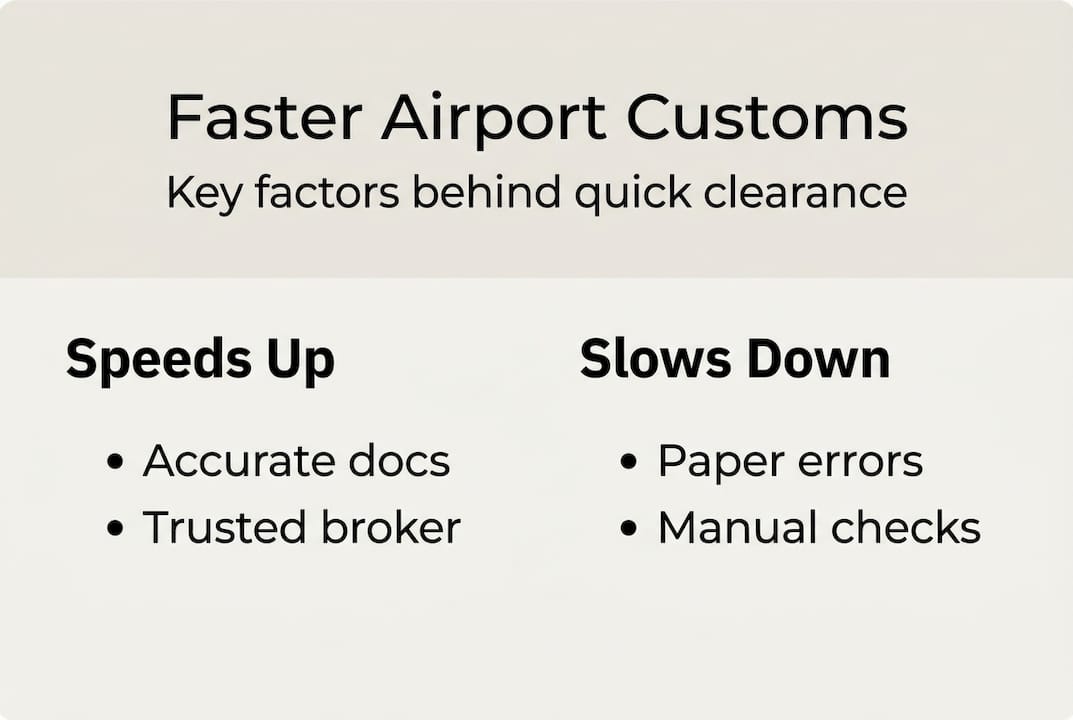
The controllable factors fall into two categories: things that create delays and things that prevent them.
Common bottlenecks businesses can fix:
- Incomplete or mismatched paperwork (AWB values that do not match the commercial invoice)
- HS code classification errors, which trigger manual review or penalty
- Late Importer Security Filing (ISF), which can result in holds before cargo even arrives
- Missing certificates of origin or permits for regulated goods
- Inconsistent shipper details across documents
The CBP Trade Compliance Handbook 2025 makes a striking point: accurate HS classification alone prevents roughly 80% of errors that lead to customs holds. Using licensed brokers, enrolling in AEO (Authorized Economic Operator) or CTPAT (Customs Trade Partnership Against Terrorism) programs, and submitting pre-arrival digital filings are the three fastest routes to consistent Green channel clearance.
Trusted trader programs deserve special attention. AEO status, recognized across many countries, and CTPAT, the U.S. equivalent, signal to customs authorities that your business has been vetted and poses low risk. The practical result is fewer physical exams and faster processing.
Pro Tip: If your business ships regularly to the same markets, invest in broker compliance strategies early. The upfront cost of getting classification right and enrolling in trusted trader programs pays back quickly in avoided delays and penalties. Businesses that understand how brokers impact trade consistently outperform those managing compliance in-house without specialist support.
Seasonal surges require a separate layer of planning. Filing earlier, communicating with brokers about volume spikes, and pre-positioning documentation all reduce the risk of getting caught in a backlog.
Proven strategies to streamline your airport customs clearance
It is possible to take control. Here are focused steps and side-by-side comparisons to overhaul your clearance outcomes.
- Select a licensed customs broker. A broker who knows your commodity categories, your target markets, and your compliance history is the fastest path to consistent Green channel clearance. Per ISM Logistics, brokers, AEO status, and digital pre-filing are the prime strategies for reducing customs delays.
- Standardize your documentation. Build master data templates for your most common shipment types. Lock in HS codes, shipper details, and valuation methods so every filing is consistent.
- File digitally and pre-arrival. Most customs authorities now accept or require pre-arrival electronic filing. Submitting documentation before the aircraft lands gives customs time to complete risk assessment before cargo even touches the terminal.
- Enroll in AEO or CTPAT. The application process takes time, but the payoff is measurable. Trusted trader status routes your shipments to lower-risk channels systematically.
- Monitor with WCO TRS benchmarks. The WCO Time Release Study is the global gold standard for tracking improvement. Use it to set internal KPIs and identify where your process lags behind best-in-class performance.
| Approach | Clearance speed | Risk of delay | Cost impact |
|---|---|---|---|
| No broker, paper filing | Slow | High | High demurrage risk |
| Broker, manual filing | Moderate | Moderate | Reduced |
| Broker, digital pre-filing | Fast | Low | Minimal |
| Broker, AEO/CTPAT, digital | Fastest | Very low | Lowest |
The pattern is clear. Each layer of preparation compounds. Businesses that combine broker benefits for efficiency with digital filing and trusted trader status operate in a different performance tier than those relying on reactive, paper-based processes.
A fresh perspective on airport customs clearance
After reviewing the tips and steps, it is worth considering what really separates elite performers in airport customs from the merely compliant.
The rules are public. Every business has access to the same WCO guidelines, the same CBP handbooks, and the same broker marketplace. Yet clearance outcomes vary dramatically. The reason is not knowledge. It is systematization.
Businesses that clear consistently fast have built internal processes that make accuracy automatic. They do not rely on individual employees remembering to check HS codes. They have master data governance, automated document generation, and broker relationships built on shared data systems. Mistakes become structurally difficult to make.
There is also a less-discussed angle: advocacy. Businesses that push their home airports to adopt WCO TRS benchmarking and digital processing standards create a better environment for everyone. Understanding why brokers matter at a strategic level, not just an operational one, is what separates businesses that occasionally clear fast from those that do it every single time.
The uncomfortable truth is that most customs delays are self-inflicted. And that is actually good news, because it means they are fixable.
Unlock smoother global shipping with expert customs support
Putting these best practices into action is easier when you are backed by expert support.
Worldwide Express brings licensed U.S. customs brokerage expertise directly to your shipping operation, managing filings, risk filtering, and exception handling so your team avoids costly airport delays. Digital tools give your team real-time shipment status and compliance insights across every lane. Whether you are new to international trade or looking to upgrade a fragile process, exploring how customs brokers streamline global trade is a smart starting point. For a broader view of your international logistics strategy, the 2026 freight forwarding guide offers a practical framework built for businesses operating at scale.
Frequently asked questions
What documents are required for customs clearance at airports?
Key documents include the air waybill, commercial invoice, packing list, and import or export declarations. Regulated goods may also require certificates of origin or special permits.
How long does airport customs clearance usually take?
Air cargo clearance typically takes under four hours for low-risk shipments, but Red channel physical examinations can add one to three days to the timeline.
How can businesses avoid delays at airport customs?
Using licensed customs brokers, joining AEO or CTPAT trusted trader programs, and filing accurate digital documentation before arrival are the most effective strategies.
What is a trusted trader program and why does it matter?
Trusted trader programs like AEO and CTPAT reduce a business’s risk rating with customs authorities, routing shipments to the Green channel for faster, lower-friction clearance.
Recommended
- Master customs compliance tips for smoother shipping – Worldwide Express, Inc.
- Expedited International Shipping: Fast-Track Your Global Deliveries – Worldwide Express, Inc.
- How to Avoid Customs Delays for Smooth International Shipping – Worldwide Express, Inc.
- Power of Attorney for Customs Clearance: Streamline US Imports – Worldwide Express, Inc.
- International Shipping Workflow: Cut Costs By 20% Efficiently | ParcelPlanet