

Every year, sudden shifts in import costs can disrupt American supply chains when customs quotas fill faster than expected. For logistics managers, unraveling the rules behind Tariff Rate Quotas (TRQs) is key to keeping shipments on time and budgets under control. Understanding how U.S. Customs and Border Protection administers these quota-driven tariff systems will help your team tap lower duty rates, avoid costly surprises, and make smarter, more compliant import decisions.
Table of Contents
- Tariff Rate Quota Explained for U.S. Trade
- Types of Tariff Rate Quotas and Key Differences
- How TRQs Function in Customs Processing
- Legal and Compliance Requirements for Importers
- Cost Impacts, Risks, and Strategic Considerations
Key Takeaways
| Point | Details |
|---|---|
| Understanding TRQs | Tariff Rate Quotas allow specified quantities of goods to be imported at lower tariffs, with higher rates applied once the quota is exceeded. |
| Strategic Planning | Importers must monitor TRQ allocations closely to optimize import volumes and costs effectively. |
| Compliance Importance | Accurate documentation and adherence to regulatory requirements are crucial to avoid penalties in TRQ management. |
| Cost Considerations | The two-tier tariff system necessitates careful financial planning to mitigate risks associated with tariff increases. |
Tariff Rate Quota Explained for U.S. Trade
Tariff Rate Quotas (TRQs) represent a sophisticated mechanism in international trade that allows a specific quantity of goods to be imported at reduced tariff rates during designated periods. These import quotas are administered by U.S. Customs and Border Protection to balance foreign product access while protecting domestic industries. When U.S. import quotas are established, they create a structured framework that manages trade flows and ensures compliance with international regulations.
The administration of Tariff Rate Quotas involves a systematic approach where importers can bring in predetermined quantities of goods at lower duty rates. Once the allocated quota is reached, subsequent imports are subject to significantly higher tariff rates. This mechanism serves multiple strategic purposes: protecting domestic producers from overwhelming foreign competition, generating revenue through graduated tariff structures, and maintaining controlled international trade relationships.
U.S. trade agreements frequently incorporate these TRQs with country-specific allocations. Tariff rate quotas under trade agreements are typically administered on a first-come, first-served basis, which means importers must act quickly to secure lower-rate import opportunities. The quantities and specific terms can vary depending on the particular trade agreement, making it essential for logistics managers to stay informed about current quota allocations and upcoming changes.
Pro Tip: Develop a proactive tracking system for monitoring current TRQ allocations to maximize your import opportunities and minimize unexpected high-rate tariff expenses.
Types of Tariff Rate Quotas and Key Differences
Tariff Rate Quotas (TRQs) represent a nuanced approach to international trade regulation, offering a flexible mechanism that goes beyond traditional import restrictions. Two-tiered tariff systems enable governments to balance domestic production protection with international market access. Unlike absolute quotas that completely restrict import volumes, TRQs allow imports but impose graduated tariff rates based on predetermined quantity thresholds.
The primary types of Tariff Rate Quotas include country-specific and global quotas, each with distinct operational characteristics. Country-specific quotas allocate import privileges to particular nations, while global quotas distribute import opportunities more broadly. These quotas typically feature a lower tariff rate for imports within the specified quantity and a substantially higher rate for quantities exceeding the established threshold. This two-tier structure allows governments to generate revenue, protect domestic industries, and maintain some level of international trade flexibility.
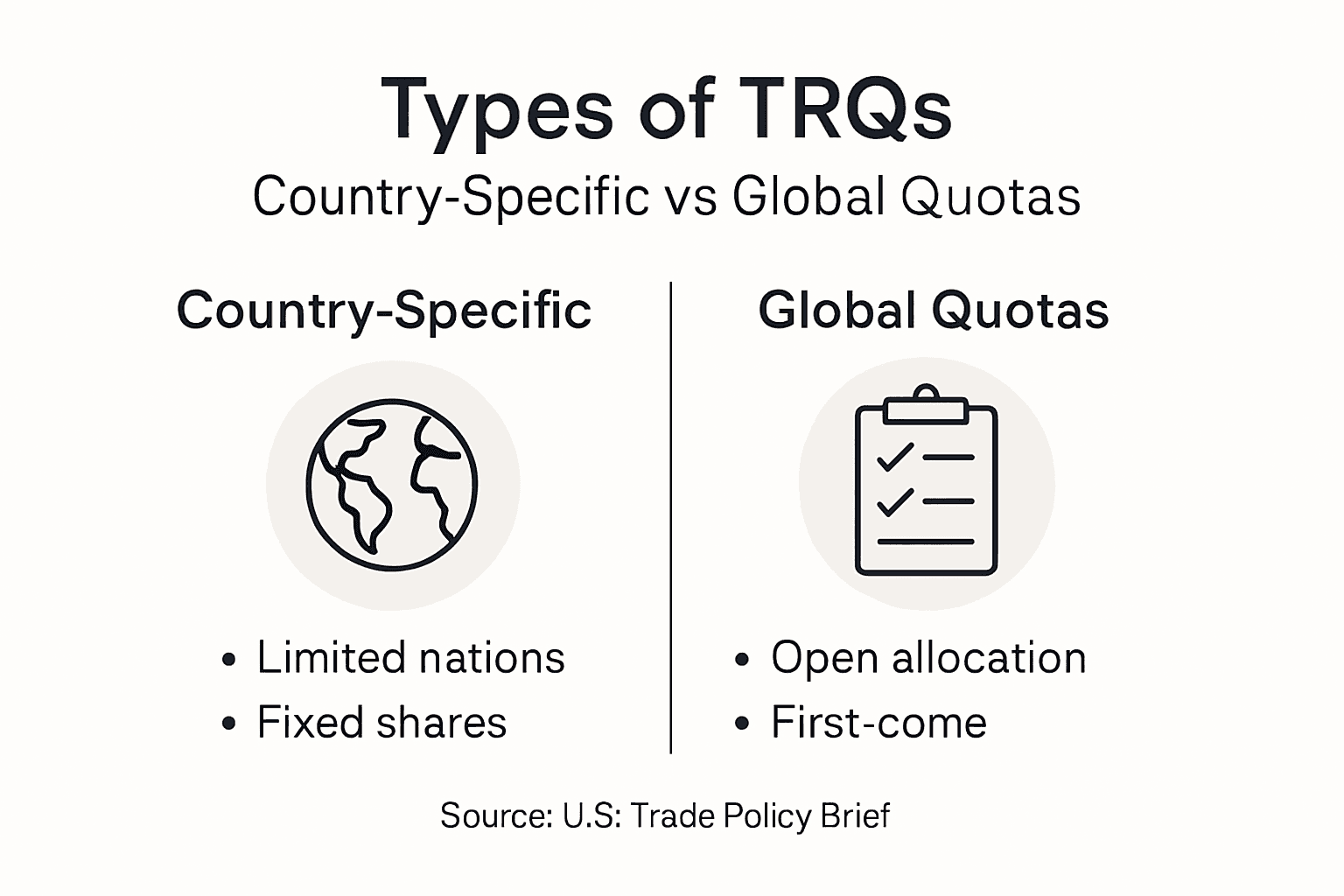
Administrative approaches to TRQs can vary significantly across different trade agreements. Quota administration methods often depend on factors like first-come, first-served allocation, prorated distribution, or country-specific negotiated terms. Some TRQs are designed to be more restrictive, with punitive out-of-quota tariff rates that effectively discourage excessive imports, while others provide more generous import opportunities. The complexity of these systems requires importers to develop sophisticated tracking and planning strategies to navigate the intricate landscape of international trade regulations.
Here’s a summary of the main types of Tariff Rate Quotas and how they differ:
| TRQ Type | Allocation Basis | Market Impact | Typical Use Case |
|---|---|---|---|
| Country-specific | Assigned to select nations | Favors specific trade partners | Bilateral trade agreements |
| Global | Open to all countries | Promotes wider market access | Large multilateral treaties |
| Two-tiered Tariff | Based on import quantity | Controls import volumes, generates revenue | Sensitive agricultural goods |
Pro Tip: Develop a comprehensive tracking system that monitors TRQ allocations in real-time, enabling your organization to strategically plan import volumes and maximize lower-rate import opportunities.
How TRQs Function in Customs Processing
Tariff Rate Quotas (TRQs) represent a complex administrative mechanism within the United States customs processing system, requiring meticulous documentation and precise timing. Customs entry management involves careful tracking of import quantities and corresponding tariff rates. When importers submit their entries, U.S. Customs and Border Protection evaluates each shipment against the established quota limits, determining the applicable duty rates based on the specific import volume.

The operational workflow of TRQs follows a structured protocol where import entries are processed in distinct stages. During the initial quota period, importers can bring goods into the country at preferential lower tariff rates within the designated quantity limits. Once the quota threshold is reached, subsequent imports are subject to significantly higher tariff rates. This two-tiered system creates a dynamic environment where importers must strategically plan their import volumes to maximize cost-effectiveness and maintain compliance with trade regulations.
Administrative procedures for TRQs are particularly intricate, involving multiple potential allocation methods. Some quotas are managed on a first-come, first-served basis, while others utilize prorated distribution mechanisms. Importers must submit comprehensive documentation promptly, demonstrating precise product classifications, country of origin, and exact quantities to qualify for the lower tariff rate. The complexity of these requirements necessitates sophisticated tracking systems and deep understanding of international trade regulations to navigate the customs processing landscape successfully.
Pro Tip: Invest in advanced tracking software that provides real-time monitoring of TRQ allocations and alerts your team when quota thresholds are approaching to optimize import strategies.
Legal and Compliance Requirements for Importers
Navigating the complex landscape of Tariff Rate Quota (TRQ) compliance requires importers to understand a comprehensive set of legal and regulatory obligations. Trade compliance regulations mandate precise documentation and strict adherence to established import protocols. U.S. Customs and Border Protection enforces these requirements, with potential penalties for importers who fail to meet the prescribed standards of accurate goods declaration, quantity reporting, and timely filing.
The legal framework surrounding TRQs involves multiple layers of regulatory oversight. Importers must meticulously prepare documentation that demonstrates compliance with specific trade agreements, including detailed certifications of product origin, classification, and precise quantity measurements. Each import entry must be carefully evaluated against the current quota limits, with importers responsible for understanding the nuanced rules governing reduced tariff rates and potential out-of-quota penalties. This intricate process requires a deep understanding of international trade regulations and the ability to navigate complex administrative procedures.
Key compliance requirements include timely submission of import entries, accurate product classification, and maintaining comprehensive records that can withstand potential customs audits. The U.S. International Trade Commission plays a critical role in overseeing these regulations, ensuring that importers meet the stringent standards set forth in trade laws and international agreements. Importers must develop robust internal systems to track quota allocations, monitor changing regulatory requirements, and maintain meticulous documentation to demonstrate full compliance with all applicable trade regulations.
Pro Tip: Implement a comprehensive compliance management system that automatically tracks TRQ allocations, generates real-time alerts for regulatory changes, and maintains detailed documentation to mitigate potential legal risks.
Cost Impacts, Risks, and Strategic Considerations
Tariff Rate Quotas introduce a complex cost landscape that demands sophisticated strategic planning from U.S. importers. Quota-driven cost dynamics create a dual-tier pricing structure that significantly impacts import strategies and financial calculations. The immediate consequence is a compelling economic incentive for importers to carefully time and volume-manage their imports to maximize cost efficiency and minimize potential financial risks.
The strategic risks associated with TRQs extend beyond simple cost calculations. When quota limits are reached, importers face dramatic tariff increases that can instantly transform product profitability. These sudden shifts create substantial supply chain uncertainties, forcing businesses to develop robust contingency plans. Potential strategies include early quota period entry, diversified sourcing approaches, and maintaining flexible inventory management systems that can quickly adapt to changing tariff environments.
Financial planning under TRQ regulations requires a multilayered approach that considers short-term and long-term implications. Importers must develop comprehensive cost models that account for potential quota fill rates, potential tariff escalations, and market demand fluctuations. Advanced risk mitigation techniques might include exploring alternative import channels such as bonded warehouses or foreign trade zones, which can provide additional flexibility in managing import-related financial exposures. The goal is to create a dynamic import strategy that balances cost optimization with regulatory compliance and operational resilience.
The following table outlines strategic risks and cost considerations for TRQ importers:
| Risk/Consideration | Description | Mitigation Strategy |
|---|---|---|
| Sudden tariff increases | Rates jump when quotas are reached | Monitor quota fill rates closely |
| Supply chain uncertainty | Unpredictable tariff changes impact supply | Diversify sourcing, stagger imports |
| Documentation penalties | Fines for inaccurate or late filings | Implement strict compliance systems |
Pro Tip: Develop a quarterly cost modeling system that simulates multiple TRQ scenarios, allowing your organization to proactively adjust import strategies and financial forecasts.
Optimize Your Import Strategy with Expert Logistics Support
Navigating the complexities of Tariff Rate Quotas can create costly challenges for importers trying to manage sudden tariff increases and strict compliance requirements. With pressure to monitor quota fill rates and submit precise documentation, avoiding financial risks and supply chain disruptions is more important than ever. By choosing a logistics partner that specializes in customs clearance, compliance, and real-time tracking, your business can gain the strategic advantage needed to control costs and streamline international shipments.
Worldwide Express offers tailored logistics solutions designed to manage the intricate details of TRQs effectively. Our experienced team helps you optimize import volumes, maintain regulatory compliance, and mitigate risks through advanced shipment tracking and customs brokerage services. Act now to transform your import challenges into competitive opportunities by partnering with Worldwide Express. Discover how we support your cross-border trade goals at Worldwide Express and start maximizing your cost savings today.
Frequently Asked Questions
What is a Tariff Rate Quota (TRQ)?
A Tariff Rate Quota (TRQ) is a trade mechanism that allows a specific quantity of goods to be imported at reduced tariff rates during designated periods, while higher rates apply to any quantity beyond the set limits.
How do TRQs affect import costs?
TRQs create a two-tiered tariff system where lower tariff rates apply until a specified quota is reached, after which much higher rates are imposed, significantly impacting importers’ costs and pricing strategies.
What types of TRQs exist, and how do they differ?
There are primarily two types of TRQs: country-specific quotas, which allocate privileges to certain nations, and global quotas that allow broader access. Each type has different impacts on market access and tariff structures.
What compliance requirements must importers meet for TRQs?
Importers must adhere to strict documentation standards, accurately report quantities, and comply with specific trade agreement terms, maintaining records to demonstrate compliance with U.S. Customs and Border Protection regulations.
Recommended
- Import Tariffs by Country: Impact on U.S. Trade – Worldwide Express, Inc.
- Harmonized Tariff Schedule: Impact on U.S. Importers – Worldwide Express, Inc.
- Trade War Impacts – How They Shape U.S. Logistics – Worldwide Express, Inc.
- Import License Requirements: Ensuring U.S. Trade Compliance – Worldwide Express, Inc.
- Federal Reserve Cuts Interest Rates by 0.50% – Implications for Mortgage Rates, Real Estate, and the Economy – Bold Street AI