TL;DR:
- Small businesses can significantly benefit from exporting due to rapid growth in global markets and demand outside the US.
- Overcoming challenges like financing, logistics, and compliance is manageable through government programs and strategic planning.
- Building reliable logistics infrastructure and leveraging expert support is essential for successful long-term international trade expansion.
Most small business owners operate with a persistent blind spot: they assume international trade is reserved for large corporations with deep pockets, entire compliance departments, and established global networks. That assumption costs them dearly. 96% of global consumers and roughly two-thirds of the world’s purchasing power sit outside the United States, waiting to be reached. For small businesses willing to look beyond domestic borders, exporting represents one of the most powerful levers for sustainable growth, competitive advantage, and long-term business survival available today.
Table of Contents
- The global advantage: Why exporting matters for small business
- Top benefits of exporting for small businesses
- Overcoming export challenges: Funding, logistics, and compliance
- Government programs and expert resources for exporters
- The reality behind small business exporting: Lessons, risks, and what most guides miss
- Expand your export capabilities with expert logistics solutions
- Frequently asked questions
Key Takeaways
| Point | Details |
|---|---|
| Global market access | Exporting opens your business to 96% of global consumers and increases sales growth opportunities. |
| Risk reduction | Diversifying into international sales reduces reliance on the US market and protects against domestic downturns. |
| Government support resources | Various programs and grants help small businesses overcome export challenges and fund international expansion. |
| Strategic approach required | Success in exporting comes from careful planning, leveraging expert guidance, and understanding key risks. |
The global advantage: Why exporting matters for small business
The scale of what exists beyond US borders is genuinely staggering. The global middle class is expanding rapidly across Asia, Latin America, and Africa, creating demand for American-made goods, software, agricultural products, and specialized services that simply cannot be met by local suppliers in those regions. For small businesses, this is not a minor opportunity. It is a structural shift in who has the money and the appetite to buy.
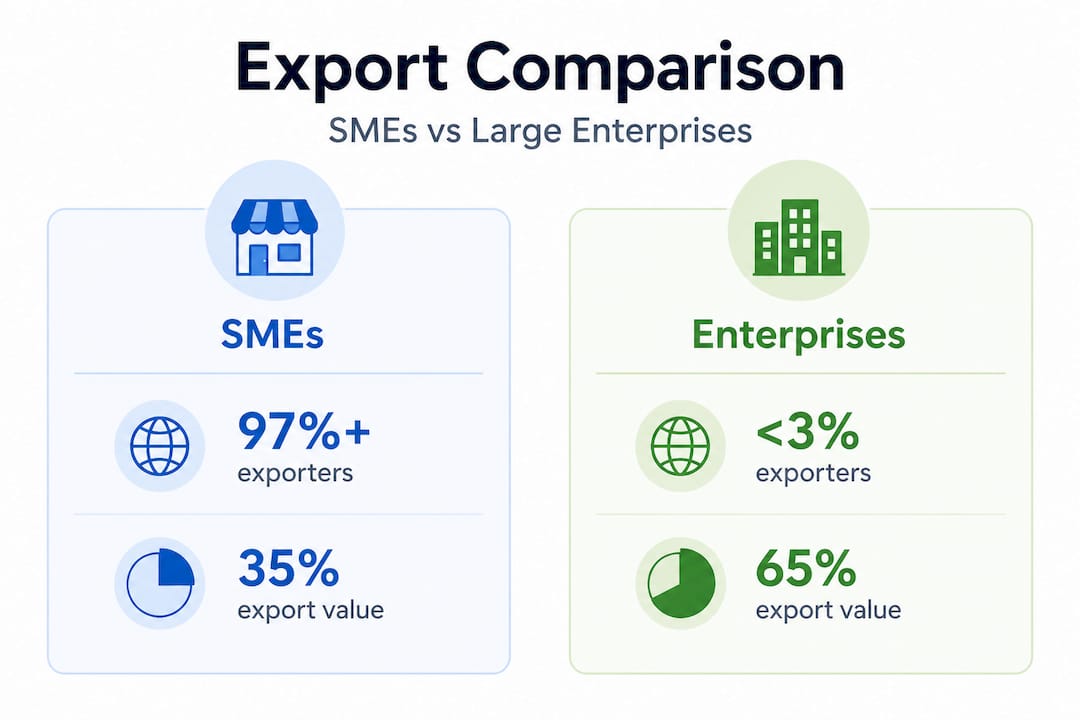
A surprising data point: SMEs represent 97%+ of identified US exporters, yet they account for only roughly 35% of known export value. That gap reveals something important. Enormous numbers of small and mid-size businesses are already exporting, but most are barely scratching the surface of what they could be doing. The value concentration remains with larger players, which means the growth runway for small businesses is wide open.
| Export metric | Small and mid-size businesses | Large enterprises |
|---|---|---|
| Share of US exporters | 97%+ | Less than 3% |
| Share of total export value | ~35% | ~65% |
| Average markets served | 1 to 2 countries | 5+ countries |
| Access to export finance programs | Often underutilized | Well established |
Common myths continue to hold small businesses back. The first is that exporting is too complex to manage without a dedicated logistics team. The second is that startup costs are prohibitive. Both are outdated. Modern tools, third-party freight forwarders, and government assistance programs have dramatically lowered the practical barrier to entry. Understanding the exporting goods process today looks very different from what it did even a decade ago, and the infrastructure supporting small exporters has never been stronger.
Top destinations for US exports include Canada, Mexico, China, Japan, the United Kingdom, Germany, South Korea, the Netherlands, France, and India. These markets represent vastly different consumer profiles, regulatory environments, and logistical demands, which is why strategic market selection matters enormously at the start.
Top benefits of exporting for small businesses
The case for exporting is not abstract. It is backed by measurable business outcomes that separate exporters from their domestically focused counterparts in consistent and meaningful ways.
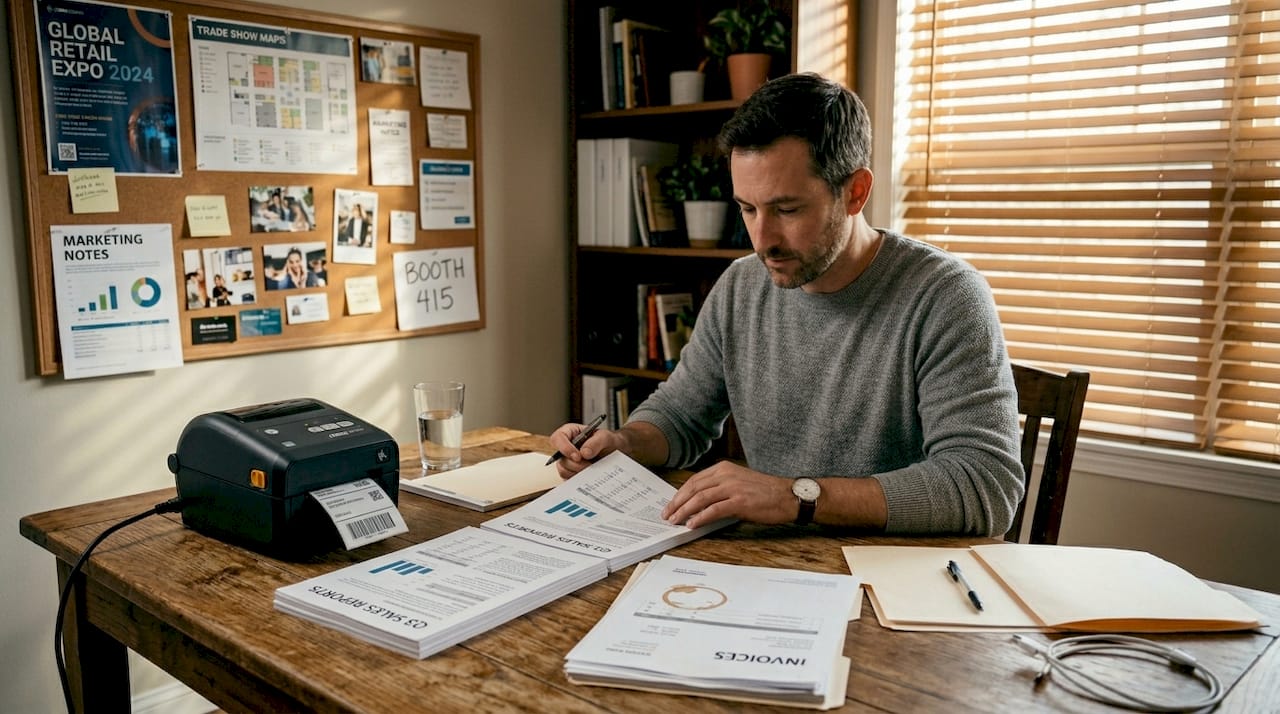
Per data from the US Chamber of Commerce, US exporters grow faster than non-exporters, are 8.5% less likely to go out of business, and benefit from the kind of market diversification that reduces vulnerability to domestic economic cycles. That last point deserves emphasis. A business selling only in one country is entirely exposed to that country’s recessions, regulatory changes, and shifting consumer preferences. A business with customers in five countries spreads that risk across multiple economic environments.
Here are the core benefits that exporting consistently delivers for small businesses:
- Revenue expansion: New international markets create entirely new sales channels, often with less competition than saturated domestic markets.
- Higher margins: In many cases, American-made goods command premium pricing abroad, particularly in markets where quality perception favors US brands.
- Business resilience: Market diversification protects revenue when domestic demand softens, which has proven critical during periods like the 2008 financial crisis and the pandemic era.
- Longer product life cycles: Products approaching market saturation domestically can find strong new demand internationally.
- Innovation pressure: Competing globally forces businesses to improve product quality, streamline operations, and adopt better practices faster than domestic competition alone would require.
Pro Tip: Before selecting a target export market, use free trade data tools at Commerce.gov to identify which countries are already importing products similar to yours. This shortcut helps you avoid markets with high barriers and target the ones where demand already exists.
| Business metric | Exporters | Non-exporters |
|---|---|---|
| Revenue growth rate | Higher | Lower |
| Business failure rate | 8.5% less likely to close | Baseline risk |
| Innovation rate | Elevated (global competition) | Moderate |
| Wages paid | Higher on average | Lower on average |
| Employment growth | Faster | Slower |
Finding the right entry point matters as much as finding the right market. Reviewing export market entry tips from logistics and trade specialists can help small businesses avoid the common mistake of entering markets without fully understanding local demand, tariff exposure, or distribution requirements.
Overcoming export challenges: Funding, logistics, and compliance
Real talk: exporting is not without friction. According to the US Chamber of Commerce, the key challenges exporters face include financing access, shipping costs, regulatory compliance, cultural and language barriers, and the need for targeted market research. Each of these is solvable, but ignoring any one of them can derail an otherwise well-planned export strategy.
Financing barriers are the most commonly cited obstacle for small businesses. Fortunately, the SBA has built a suite of tools specifically to address this. Per the SBA’s export finance program, Export Express loans of up to $500,000 can receive approval within 36 hours, making them ideal for businesses that need quick capital to fulfill a new international order. Export Working Capital loans go up to $5 million and are designed to fund the ongoing working capital needs of active exporters. International Trade loans, also capped at $5 million with a 90% SBA guarantee, support longer-term investments in facilities and equipment needed to expand international capacity.
Logistics and shipping challenges involve both cost management and documentation accuracy. A single error on a commercial invoice, a missed HS code, or an incorrectly valued shipment can trigger customs delays that damage relationships with new international buyers. Learning how to properly pack goods for export and prepare documentation is an investment that pays off immediately.
Regulatory compliance is arguably the steepest learning curve. Different countries maintain different import restrictions, labeling requirements, sanitary and phytosanitary standards, and rules of origin requirements. Staying current on export compliance essentials is not optional. It is the foundation of a sustainable export operation.
Here is a practical numbered approach to overcoming these challenges systematically:
- Assess readiness first. Evaluate your production capacity, cash flow position, and team bandwidth before committing to a new international market.
- Secure financing early. Apply for SBA export finance programs before you need the capital, not after you have already made commitments to a buyer.
- Partner with a freight forwarder. A qualified forwarder handles documentation, customs clearance, and routing, reducing the compliance burden on your team significantly.
- Research your target market. Understand tariff rates, import regulations, and consumer preferences before you ship a single unit.
- Start with one market. Phasing expansion country by country allows your team to learn the process before complexity multiplies.
Pro Tip: Use the phased approach of plan, finance, ship. Lock down your export plan and financing structure before spending a single dollar on shipping or market entry. Businesses that reverse this order frequently encounter cash flow crises when international payment terms stretch 60 to 90 days.
Government programs and expert resources for exporters
One of the least-publicized advantages available to US small business exporters is the breadth of free and subsidized government support. Most businesses leave this on the table entirely, either because they are unaware it exists or because they assume the application process is too complicated.
The State Trade Expansion Program, commonly known as STEP, is one of the most accessible entry points. Per Washington State’s commerce department, STEP grants in states like Washington provide up to $10,000 per voucher to cover trade show participation, international marketing materials, and travel costs associated with entering foreign markets. Many other states operate similar programs with comparable or higher funding caps. This is grant money, not a loan, meaning eligible businesses can offset significant export development costs without adding debt.
Beyond STEP, the landscape of available support is impressively broad:
- US Commercial Service: Offers free counseling sessions, detailed market research reports, and business matchmaking services in more than 75 countries.
- Gold Key Matchmaking: A paid but low-cost service through the Commercial Service that arranges pre-screened meetings with vetted potential partners and distributors abroad.
- Trade.gov: The central hub for US government trade resources, providing market intelligence, export guides, and regulatory information organized by country and industry.
- Export-Import Bank of the United States (EXIM): Provides export credit insurance, working capital guarantees, and direct loans to help small businesses compete against foreign subsidized competitors.
Per the USTR’s 2025 small business resource update, Trade.gov and US Commercial Service offer free counseling, market research, partner matching, and Gold Key matchmaking services designed specifically for small and mid-size exporters.
| Program | Type of support | Funding/value | Contact |
|---|---|---|---|
| STEP grants | State grants for trade promotion | Up to $10,000+ per voucher | State commerce department |
| SBA Export Express | Fast loan approval | Up to $500,000 | SBA.gov |
| US Commercial Service | Counseling, research, matchmaking | Free to low cost | Trade.gov |
| EXIM Bank | Credit insurance and guarantees | Varies by deal | EXIM.gov |
| SBA International Trade Loan | Long-term export investment capital | Up to $5 million | SBA.gov |
Smart exporters also pay attention to export tax planning strategies that can reduce their effective tax burden through provisions like the IC-DISC structure, which allows qualifying exporters to defer or reduce taxes on export income. This is an underused tool that accountants familiar with international trade can set up relatively quickly.
The reality behind small business exporting: Lessons, risks, and what most guides miss
Most guides on exporting for small businesses are relentlessly optimistic. The statistics are real. The programs are legitimate. The growth potential is genuine. But the practical experience of moving a business from domestic-only to international is harder, slower, and more expensive than those guides typically acknowledge.
Cash flow is the quiet killer of otherwise promising export strategies. International buyers routinely operate on 60 to 90 day payment terms, and in some markets, 120 days is not unusual. A small business that lands a substantial export order can find itself funding production, logistics, and customs costs for months before a single dollar arrives from the buyer. Per the US Chamber of Commerce, exporters face risks including cash flow strain and unexpected compliance costs, with 60% of exporters encountering compliance surprises at some point in their international experience.
The businesses that succeed long-term are not necessarily the ones with the best products. They are the ones that plan for the cash gap, build compliance knowledge into their operations from day one, and resist the temptation to expand into too many markets simultaneously. Diversification is powerful, but only when each market entry is deliberate and properly resourced.
Another truth that rarely appears in export guides: the cultural and relationship dimension of international business requires patience that most American business owners underestimate. In many key export markets, particularly in Asia and the Middle East, trust-building precedes transactions by months. Businesses that treat international buyers the same way they treat domestic ones often find negotiations stalling for reasons that have nothing to do with price or product quality.
The most resilient exporters build systems, not just deals. They create repeatable processes for documentation, work with reliable logistics partners, and continuously improve based on what each market teaches them. Those interested in building that kind of operational foundation should explore how to streamline international shipping as part of a longer-term export strategy rather than treating logistics as an afterthought.
Exporting rewards preparation and penalizes improvisation. Businesses that treat it as a side experiment rarely succeed. Those who commit strategically, leverage available support, and build the operational infrastructure to handle international complexity consistently achieve results that domestic-only competitors simply cannot match.
Expand your export capabilities with expert logistics solutions
Small businesses ready to act on their export ambitions need more than a plan. They need the right logistics infrastructure behind them to execute reliably across borders, time zones, and regulatory environments.
Worldwide Express, Inc. specializes in exactly that. From freight forwarding guide fundamentals to end-to-end customs brokerage and compliance support, the company’s services are built for businesses moving goods across international borders with precision. Explore how international shipping logistics can reduce delays, lower costs, and keep your supply chain predictable as you scale globally. For businesses ready to explore the full range of available support, the logistics services portfolio covers everything from air and ocean freight to warehousing and supply chain management tailored to your industry’s needs.
Frequently asked questions
What is the biggest benefit of exporting for small businesses?
Exporting allows small businesses to tap into 96% of global consumers and two-thirds of world purchasing power that sit outside the US, driving significantly faster growth and stronger long-term survival odds than domestic-only operations.
What funding options help small businesses start exporting?
The SBA provides dedicated export finance tools, including Export Express loans up to $500,000 with 36-hour approvals, Export Working Capital loans up to $5 million, and International Trade loans up to $5 million with a 90% SBA guarantee.
How do small businesses find customers in other countries?
Trade.gov and US Commercial Service provide free counseling, market research, and international partner matching, including the Gold Key Matchmaking service that connects small businesses with pre-screened buyers and distributors abroad.
What is the STEP program for exporters?
The STEP program delivers state-administered grants for trade shows, international marketing, and travel expenses to help small businesses break into foreign markets, with some states offering up to $10,000 or more per voucher to qualifying applicants.
Recommended
- Export compliance essentials: Key regulations and best practices – Worldwide Express, Inc.
- How to export technology products: complete business guide – Worldwide Express, Inc.
- Small Business Tax Planning for U.S. Exporters – Worldwide Express, Inc.
- 10 export market entry tips for global logistics success – Worldwide Express, Inc.
- Transparent shipping rates for Singapore SMEs: Save more