Choosing between local and international freight isn’t as simple as distance. Logistics managers face hidden cost multipliers, regulatory complexity, and operational risks that can swing total logistics spend by 300% or more. The decision impacts delivery speed, supply chain resilience, and bottom-line profitability. This guide cuts through the confusion with evidence-backed comparisons, cost breakdowns, and strategic frameworks to help you evaluate freight options confidently. You’ll gain practical criteria to align logistics choices with your business priorities and discover how transport mode, routing, and partnerships shape outcomes in ways that aren’t immediately obvious.
Table of Contents
- Key takeaways
- Understanding local and international freight: definitions and context
- Cost drivers and operational challenges in local versus international freight
- Comparing transport modes and route options: strategic implications
- Making the right choice: evaluating local versus international freight for your business
- Explore logistics solutions with Worldwide Express
- FAQ
Key Takeaways
| Point | Details |
|---|---|
| Cost drivers contrast | Local freight tends to be cheaper and more predictable, while international freight introduces tariffs, customs processing, and documentation costs that can push total spend higher and vary by route. |
| Forwarders essential internationally | Freight forwarders negotiate rates, handle paperwork, arrange customs clearance, and provide risk reduction through end to end visibility. |
| Modes and routing | Local freight relies on trucking and rail within familiar networks while international combines ocean or air with multimodal coordination across borders. |
| Practical evaluation criteria | Use a practical framework including total cost of ownership, transit times, regulatory risk, service reliability, and partner capabilities to compare freight options. |
Understanding local and international freight: definitions and context
Local freight refers to transportation within a single country or close border region, typically using trucks or rail. It involves straightforward routing, minimal regulatory paperwork, and predictable cost structures. You’re dealing with familiar infrastructure, known carriers, and domestic regulations. International freight crosses country borders, triggering customs procedures, tariff assessments, and multi-jurisdictional compliance requirements. It often combines ocean shipping, air cargo, and ground transport in complex multi-modal arrangements.
The distinction matters because international freight introduces layers of complexity that local operations avoid. Practitioners emphasize forwarder partnerships and risk management as essential for navigating these challenges. When goods cross borders, you’re not just moving cargo. You’re managing documentation, coordinating with customs brokers, calculating duty payments, and ensuring compliance with import/export regulations. Each step adds time, cost, and potential delay points.
Transport modes differ significantly. Local freight leverages:
- Trucking for flexible, door-to-door delivery
- Rail for bulk goods over medium distances
- Regional carriers with established routes
International freight requires:
- Ocean shipping for cost-effective, high-volume cargo
- Air freight for time-sensitive, high-value goods
- Multi-modal coordination across sea, air, and land
- Freight forwarders to orchestrate logistics
Freight forwarders play a bigger role internationally. They negotiate rates, handle documentation, arrange customs clearance, and provide end-to-end visibility. Domestically, you might work directly with carriers. Internationally, forwarders become strategic partners who absorb complexity and reduce risk. Understanding terms like CIF (Cost, Insurance, Freight) and FEU (Forty-Foot Equivalent Unit) helps you communicate effectively and compare quotes accurately. For deeper insights on choosing between service types, explore our international courier vs freight guide.
Cost drivers and operational challenges in local versus international freight
Cost structures diverge sharply between local and international freight. Distance matters, but it’s not the only factor. Africa domestic logistics costs 3-4x global average due to processing inefficiencies, limited infrastructure, and higher per-mile pricing. Internationally, tariffs add unpredictable expense layers. A shipment might face 10-25% duty rates depending on product classification and origin country. Customs processing fees, documentation costs, and compliance requirements pile on.
2025 Asia-US ocean shipping benchmarks reveal variable costs by route and container type. A 40-foot container from Shanghai to Los Angeles might cost $1,500-$3,000, while smaller regional moves within the US run $800-$1,200 for similar distances. The difference isn’t just mileage. It’s regulatory overhead, port handling, and fuel surcharges that fluctuate with global oil prices and geopolitical tensions.
| Cost Element | Local Freight (Typical) | International Freight (Typical) |
|---|---|---|
| Base Rate per FEU | $800-$1,200 | $1,500-$3,500 |
| Tariffs/Duties | None | 10-25% of goods value |
| Customs Processing | N/A | $100-$500 per shipment |
| Documentation Fees | Minimal | $50-$200 |
| Transit Time Variability | Low (1-3 days) | High (14-45 days) |
Operational challenges multiply internationally. Customs clearance can delay shipments by days or weeks if documentation is incomplete or classifications are disputed. You need accurate Harmonized System (HS) codes, certificates of origin, and commercial invoices. Errors trigger inspections, fines, and storage fees. Domestically, you might deal with weather delays or traffic. Internationally, you face port congestion, labor strikes, and sudden policy changes.

Risk management becomes critical. Tariff volatility driven by trade disputes can swing costs 20-30% in months. Currency fluctuations add another layer of unpredictability. Local freight offers stability. You quote in one currency, face consistent regulations, and work with known carriers. International freight demands scenario planning and flexible contracts. For a detailed breakdown of cost factors, see our shipping costs comparison.
Key operational hurdles include:
- Coordinating multiple parties: carriers, customs brokers, forwarders, consignees
- Managing time zone differences and communication delays
- Ensuring cargo insurance covers international transit risks
- Tracking shipments across fragmented systems
Pro Tip: Develop strong partnerships with reliable forwarders to mitigate risks effectively. Their expertise in customs regulations, carrier negotiations, and problem-solving can prevent costly delays and compliance issues. A good forwarder acts as your logistics intelligence network, alerting you to tariff changes, route disruptions, and cost-saving opportunities before they impact your supply chain.
Comparing transport modes and route options: strategic implications
Transport mode selection shapes cost, speed, capacity, and risk profiles. Each mode offers tradeoffs that align differently with local versus international freight needs. Understanding these differences helps you optimize logistics strategy.
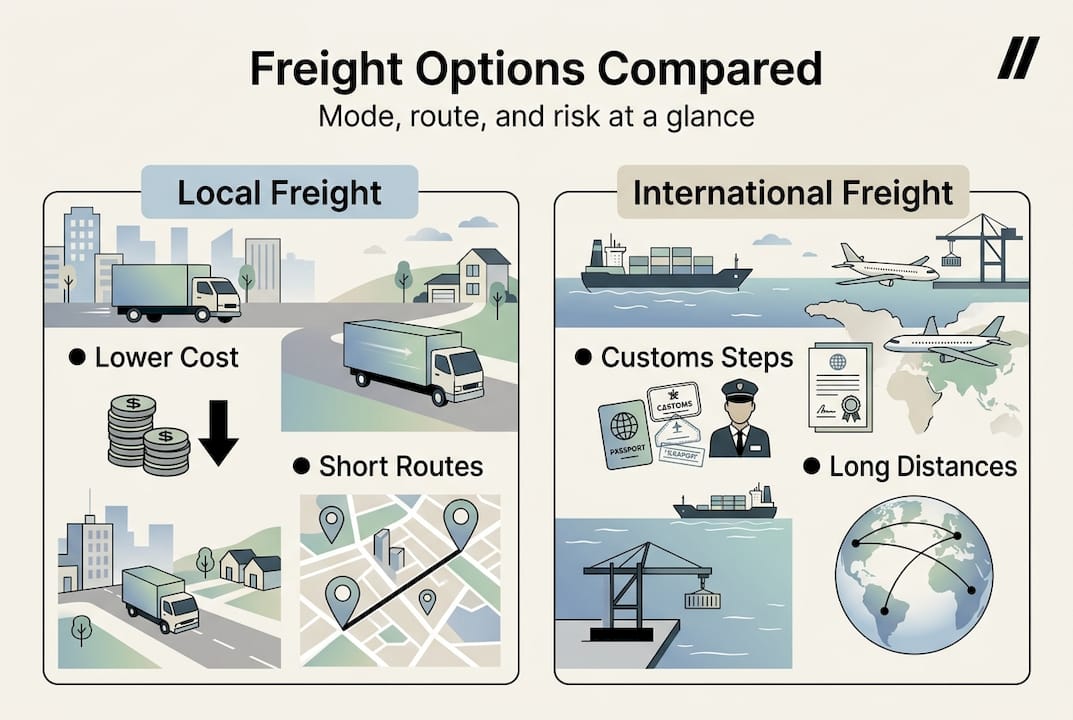
| Transport Mode | Cost | Speed | Capacity | Risk Factors | Best For |
|---|---|---|---|---|---|
| Truck (Local) | Moderate | Fast (1-3 days) | Medium | Weather, traffic | Flexible, door-to-door delivery |
| Rail (Local) | Low | Moderate (2-5 days) | High | Infrastructure limits | Bulk goods, predictable routes |
| Ocean (International) | Very Low | Slow (14-45 days) | Very High | Port delays, weather | High-volume, cost-sensitive cargo |
| Air (International) | Very High | Very Fast (1-7 days) | Low | Fuel costs, capacity limits | Time-sensitive, high-value goods |
| Multi-Modal (International) | Variable | Variable | Variable | Coordination complexity | Optimizing cost and speed |
Routing strategy matters as much as mode. Europe-Asia routes have diverse sea and rail options with different time and environmental costs. Ocean shipping via the Suez Canal takes 30-40 days but costs significantly less than air freight. Rail through Central Asia cuts transit to 18-25 days at moderate cost. Direct routes minimize handling and delay risk but may cost more. Transshipment routes (stopping at intermediate ports) reduce expense but add complexity and time.
Port location influences competitiveness. Major hubs like Singapore, Rotterdam, and Los Angeles offer frequent departures, competitive rates, and advanced infrastructure. Smaller ports may have limited service, higher fees, and longer wait times. Domestically, proximity to rail terminals or highway networks affects local freight efficiency. Internationally, port choice impacts customs processing speed, storage costs, and onward transportation options.
When selecting freight mode and route, evaluate these five factors:
- Total cost of ownership: Include not just freight rates but tariffs, insurance, storage, and potential delay costs.
- Delivery speed requirements: Match transit time to your inventory turnover and customer expectations.
- Reliability and consistency: Prioritize carriers and routes with proven on-time performance.
- Risk tolerance: Assess exposure to geopolitical disruptions, weather events, and regulatory changes.
- Sustainability goals: Consider carbon footprint, fuel efficiency, and environmental regulations.
Multi-modal solutions combine modes to optimize tradeoffs. You might use ocean freight for the main haul, then rail or truck for final delivery. This balances cost and speed while maintaining flexibility. Internationally, this is standard practice. Domestically, intermodal rail-truck combinations offer similar benefits for longer distances. For comprehensive guidance on mode selection, visit our freight transportation modes resource.
Pro Tip: Consider environmental and geopolitical factors affecting route viability and sustainability goals. Carbon pricing, emissions regulations, and corporate sustainability commitments increasingly influence mode and route decisions. Rail and ocean freight produce fewer emissions per ton-mile than air or truck. As regulations tighten, green logistics choices can reduce future compliance costs and enhance brand reputation.
Making the right choice: evaluating local versus international freight for your business
Selecting between local and international freight requires aligning logistics capabilities with business priorities. Start by defining your criteria clearly. What matters most: cost minimization, speed, reliability, or risk mitigation? Different scenarios demand different emphases.
Practical criteria to evaluate:
- Cost breakdown: Compare all-in costs including freight, tariffs, insurance, and delay contingencies. Don’t focus solely on base rates.
- Delivery speed: Match transit time to inventory needs. Just-in-time operations demand faster, more reliable options.
- Risk tolerance: Assess your ability to absorb delays, cost volatility, and regulatory surprises. High-risk environments favor diversified routes and strong forwarder partnerships.
- Regulatory compliance: Ensure you have expertise and systems to handle customs, documentation, and tariff management. Non-compliance triggers fines and shipment holds.
- Partnership strength: Evaluate forwarder or carrier reliability, communication quality, and problem-solving capability. Practitioners emphasize forwarder partnerships and risk management as decision-making cornerstones.
Apply these criteria to common scenarios. If you’re sourcing raw materials internationally, cost and reliability matter more than speed. Ocean freight with a trusted forwarder makes sense. If you’re distributing finished goods domestically with tight delivery windows, trucking offers flexibility and speed. If you’re launching a new product globally, air freight ensures rapid market entry despite higher costs.
Continuous supply chain risk management is essential. Monitor geopolitical developments, tariff announcements, and carrier performance metrics. Build visibility into your logistics network with real-time tracking and proactive communication. Develop contingency plans for route disruptions, carrier failures, and regulatory changes. Diversify your carrier and forwarder relationships to avoid single points of failure.
Regularly review freight options as markets evolve. Rate volatility, new routes, and carrier consolidations create opportunities and risks. Quarterly reviews help you capture savings and avoid being locked into outdated contracts. Benchmark your costs against industry standards and competitor practices. For expert insights on forwarder selection and management, explore our cargo freight forwarders role guide.
Pro Tip: Regularly review freight options and develop contingency plans to adapt to market changes. Set up quarterly logistics reviews with your forwarders and carriers. Track key performance indicators like on-time delivery rates, cost per shipment, and incident frequency. Use this data to renegotiate contracts, switch providers when necessary, and identify emerging risks before they disrupt operations. Proactive management turns logistics from a cost center into a competitive advantage.
Explore logistics solutions with Worldwide Express
Navigating the complexities of local and international freight requires expertise, technology, and global reach. Worldwide Express specializes in freight forwarding and logistics solutions tailored to businesses engaged in international trade. Our team manages customs brokerage, multi-modal transportation, and supply chain optimization to streamline your operations and reduce costs.
Whether you’re evaluating freight options, optimizing existing routes, or expanding into new markets, we provide the insights and support you need. Explore our comprehensive guides on logistic provider key concepts explained to deepen your understanding. Learn how to optimize logistics for global shipping with practical strategies. Dive into our understanding freight forwarding 2026 guide for the latest best practices. Partner with us to turn logistics complexity into strategic advantage.
FAQ
What is the main difference between local and international freight?
Local freight operates within a single country or region, using trucks or rail with minimal regulatory requirements and predictable costs. International freight crosses country borders, involving customs clearance, tariff payments, and multi-modal transport coordination. The key distinction is complexity: international shipments face regulatory layers, longer transit times, and cost volatility that local freight avoids.
How do tariffs impact international freight costs?
Tariffs and geopolitical tensions drive volatility in international shipping costs, adding 10-25% or more to total expenses depending on product classification and origin. Tariff rates change with trade policies, creating unpredictability that complicates budgeting. Beyond direct duty payments, tariffs trigger administrative costs for compliance, classification disputes, and potential delays. Understanding tariff structures and planning for variability is essential for accurate cost forecasting. For insights on managing this volatility, see our tariff volatility in global shipping resource.
What are the benefits of partnering with freight forwarders?
Freight forwarders coordinate complex shipments, manage regulatory compliance, and reduce risks by leveraging expertise and carrier relationships. They handle customs documentation, negotiate competitive rates, arrange multi-modal transport, and provide end-to-end visibility. Strong forwarder partnerships improve risk management and logistics efficiency, especially for international freight where regulatory and operational complexity is high. Forwarders act as strategic advisors, alerting you to cost-saving opportunities and potential disruptions. Learn more about their role in our cargo freight forwarders role guide.
How can logistics managers optimize freight mode selection?
Evaluate tradeoffs between cost, speed, reliability, and environmental impact based on your specific business needs and shipment characteristics. Use data on carrier performance, route options, and cost benchmarks to inform decisions. Leverage expert advice from forwarders who understand market conditions and regulatory requirements. Consider multi-modal solutions that balance competing priorities. Regularly review mode choices as market conditions, rates, and service levels evolve. For detailed strategies, visit our optimize freight transportation modes resource.
Recommended
- International courier vs freight: guide for managers 2026 – Worldwide Express, Inc.
- How to Choose a Freight Forwarder for Smooth Shipping – Worldwide Express, Inc.
- Freight transportation modes: optimize shipping in 2026 – Worldwide Express, Inc.
- Best Freight Forwarding Services – Expert Comparison 2025 – Worldwide Express, Inc.
- Zašto su profesionalne usluge selidbe najbolji izbor za vas?