TL;DR:
- Containerization revolutionized global trade through standardized, intermodal steel boxes that enhanced efficiency, security, and cost predictability. Choosing the right container type and understanding the shipping process are crucial for protecting cargo and reducing delays. Market trends, port performance, and compliance accuracy significantly impact supply chain reliability and operational costs.
Containerization is one of the most quietly powerful forces in modern commerce. Over 90% of global seaborne trade moves inside steel boxes stacked on vessels crossing every ocean. Yet many businesses involved in international trade still operate without a clear picture of how the system actually works, what container options exist, or how compliance missteps can derail an otherwise smooth shipment. This guide cuts through the complexity, covering container types, the loading process, market dynamics, port performance, and the compliance essentials that keep cargo moving reliably across borders.
Table of Contents
- How containerization revolutionized global trade
- Container types and choosing the right solution
- Inside the shipping container process: Steps and best practices
- Market dynamics, port performance, and compliance essentials
- Our perspective: Mastering container shipping with nuance and compliance
- Unlock expert freight and customs solutions with Worldwide Express
- Frequently asked questions
Key Takeaways
| Point | Details |
|---|---|
| Intermodal efficiency | Containerization supports seamless cargo transfer between ships, trains, and trucks, saving businesses time and money. |
| Choosing the right container | Selecting between FCL and LCL, and among container types, directly affects shipping speed, cost, and cargo safety. |
| Operational best practices | Following structured container loading and transport steps reduces risk of delays and damage. |
| Market and compliance awareness | Monitoring market trends and port performance, plus ensuring customs compliance, helps optimize container shipping strategies. |
| Expert-driven solutions | Leveraging brokers and digital tools maximizes efficiency and minimizes costly customs errors for global trade. |
How containerization revolutionized global trade
Containerization is not simply a method of packing goods. It is a standardized, intermodal system that transformed how the world moves products from one country to another. Before containerized shipping became the norm, cargo was loaded piece by piece, a labor-intensive process that invited theft, damage, and massive delays. The shift to standardized steel boxes changed everything.
ISO-standard steel containers enable seamless transfer between ships, trains, and trucks without repacking the cargo inside. That single capability is what makes the intermodal supply chain possible. A container loaded at a factory in Shenzhen can arrive at a warehouse in Chicago without anyone opening it until it reaches its final destination.
The advantages this system delivers are substantial:
- Efficiency: Standardized dimensions allow ports to automate loading and unloading with cranes and stacking equipment, cutting turnaround times dramatically.
- Security: Sealed containers reduce exposure to theft and contamination throughout the journey.
- Reduced handling: Cargo is packed once and unpacked once, minimizing damage from repeated manual handling.
- Intermodal flexibility: The same box moves by sea, rail, and road without modification.
- Cost predictability: Standardized units make freight pricing more transparent and easier to compare.
“Containerization did not just improve shipping. It fundamentally restructured global manufacturing, enabling companies to source components from anywhere on the planet with confidence.”
Today, the system handles an astounding share of world trade volume. Businesses that understand how it works gain a real operational edge, because they can make smarter decisions about common container types, booking windows, and carrier selection. Those who treat containerized shipping as a black box tend to absorb unnecessary costs and delays that a more informed approach would eliminate.
The ISO standards that govern container dimensions, specifically the 20-foot and 40-foot units that dominate global fleets, are what allow ports worldwide to use the same equipment and protocols. This uniformity is not accidental. It was the result of deliberate standardization efforts that took decades to fully take hold, and it now underpins the reliability of international supply chains.
Container types and choosing the right solution
Choosing the right container is one of the most consequential decisions a shipper makes. The wrong choice leads to wasted space, cargo damage, or regulatory complications. The right choice keeps costs controlled and cargo protected.
Key container types include dry, reefer, tank, open-top, and flat-rack, each designed for specific cargo profiles. Here is a breakdown of when each type makes sense:
- Dry containers (20ft/40ft): The workhorse of global shipping, suited for general cargo including electronics, textiles, and consumer goods.
- Reefer containers: Temperature-controlled units for perishables like food, pharmaceuticals, and chemicals requiring cold chain integrity.
- Tank containers: Designed for liquids, gases, and hazardous materials in bulk form.
- Open-top containers: Allow oversized cargo to be loaded from above using cranes, ideal for machinery or large equipment.
- Flat-rack containers: Used for heavy or oversized cargo that cannot fit inside a standard box, such as vehicles or industrial equipment.
Beyond container type, businesses must decide between FCL and LCL. Understanding FCL vs LCL shipping choices is essential for balancing cost and speed.
| Factor | FCL (Full Container Load) | LCL (Less than Container Load) |
|---|---|---|
| Space | Entire container | Shared with other shippers |
| Cost | Higher upfront | Lower for small volumes |
| Speed | Faster, fewer stops | Slower, consolidation adds time |
| Security | Higher, sealed unit | Lower, multiple handlers |
| Best for | Large or sensitive shipments | Small or trial shipments |
FCL is generally preferred when cargo volume justifies it, when goods are fragile or high-value, or when delivery speed is critical. LCL works well for businesses testing new trade lanes or shipping smaller volumes that do not fill a box. Reviewing container types explained in detail helps businesses match cargo characteristics to the right unit before booking.

Pro Tip: If your shipment fills more than 50% of a standard 20-foot container, FCL often becomes cost-competitive with LCL once you factor in consolidation fees, longer transit times, and the added handling risk that shared containers introduce.
Inside the shipping container process: Steps and best practices
Understanding the operational steps in container shipping helps businesses anticipate delays, reduce errors, and protect cargo integrity. The process is more structured than many shippers realize, and each stage carries specific risks if not managed carefully.
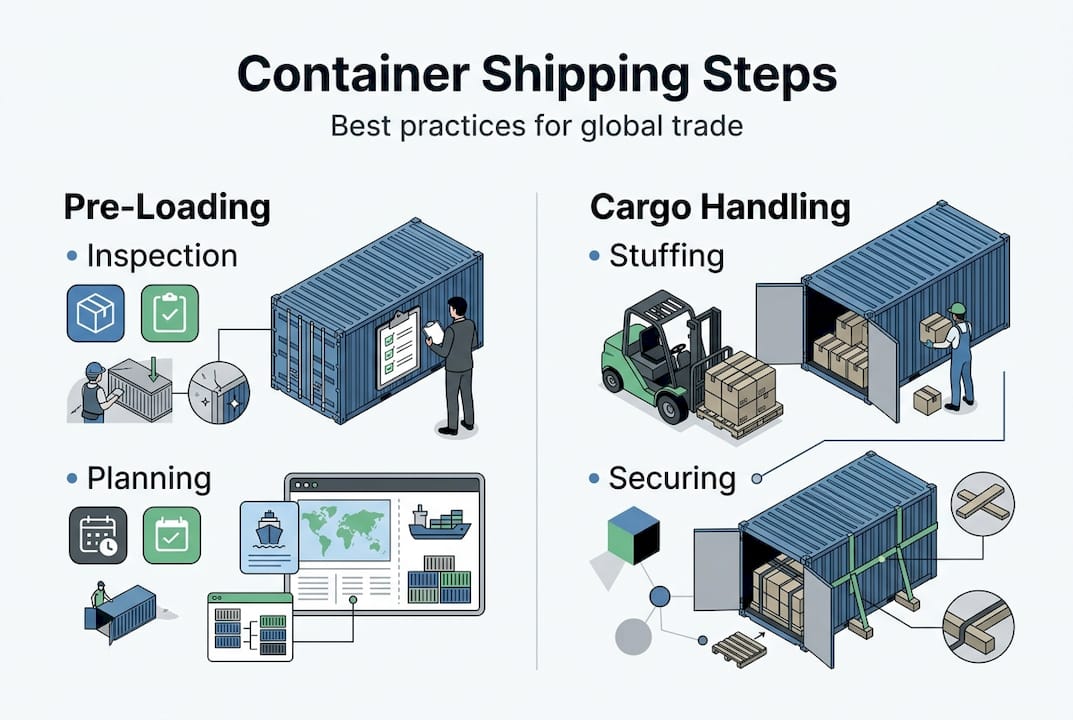
Here is the sequence that governs how a container moves from origin to vessel:
- Booking: The shipper or freight forwarder secures space on a vessel with a carrier, confirming the container type, route, and schedule.
- Pre-shipment inspection: The container is inspected for structural integrity, cleanliness, and absence of pests or residue before loading.
- Cargo preparation and stuffing: Goods are packed, labeled, and loaded into the container with attention to weight distribution and securing.
- Documentation: Bills of lading, packing lists, and customs declarations are prepared and submitted.
- Terminal delivery: The loaded container is transported to the port terminal and checked in.
- Crane loading: Containers are lifted onto the vessel using ship-to-shore cranes and positioned per the stowage plan.
- Stacking and lashing: Containers are stacked and secured with twist locks and lashing rods to withstand sea conditions.
- Transit: The vessel departs and the container moves to the destination port, where the process reverses.
Per industry guidance, loading best practices require pre-planning for weight distribution, thorough container inspections, crane loading protocols, stacking per the stowage plan, and lashing appropriate for sea conditions. Skipping any of these steps introduces real risk.
| Stage | Common risk | Best practice |
|---|---|---|
| Stuffing | Uneven weight, shifting cargo | Use dunnage, secure with straps |
| Documentation | Missing or incorrect data | Double-check HS codes and weights |
| Terminal delivery | Missed cut-off times | Confirm terminal deadlines early |
| Lashing | Cargo movement at sea | Follow carrier lashing requirements |
Pro Tip: Always request a container condition report before loading. A damaged container that passes a visual check at origin can cause a cargo insurance claim to be disputed at destination, adding weeks to resolution.
Reviewing a shipping rates overview before booking helps businesses benchmark costs against current market conditions and avoid overpaying during peak seasons.
Market dynamics, port performance, and compliance essentials
The container shipping market is growing, and understanding where it is headed helps businesses plan procurement, inventory, and logistics budgets more accurately.
The shipping container market is projected to grow from USD 12.32 billion in 2025 to USD 15.53 billion in 2032, with Asia Pacific holding a 37.54% regional share. That growth reflects rising global trade volumes, nearshoring trends, and continued investment in port infrastructure across emerging markets.
Key market and port dynamics businesses should track:
- Asia Pacific dominance: The region drives container manufacturing and trade volume, making it a critical variable in global freight pricing.
- Port congestion cycles: Congestion at major hubs like Los Angeles, Rotterdam, and Singapore ripples through supply chains globally.
- Carrier consolidation: Fewer major carriers mean less spot market flexibility, making long-term contracts more valuable.
- Digital tracking adoption: Real-time visibility tools are becoming standard, reducing uncertainty across transit legs.
Port performance is measured through the Container Port Performance Index (CPPI), which benchmarks vessel time in port. The CPPI improved post-2022 and correlates negatively with supply chain stress, meaning that when ports perform well, downstream disruptions decrease significantly. Businesses routing cargo through high-performing ports gain measurable reliability advantages.
“Port efficiency is not just an operational metric. It is a direct input into inventory planning, customer commitments, and working capital cycles for any business engaged in international trade.”
Compliance is where many businesses lose time and money without realizing it. Accurate HS (Harmonized System) code classification is non-negotiable. Errors trigger customs holds, unexpected duties, and in some cases, cargo seizure. Reviewing container shipping market trends alongside compliance updates helps businesses stay ahead of regulatory changes. Digital tools and Maritime Single Window (MSW) platforms reduce paperwork errors that account for roughly 20% of customs delays. Strategies for lowering shipping rates also benefit from compliance accuracy, since clean documentation speeds clearance and reduces demurrage charges.
Our perspective: Mastering container shipping with nuance and compliance
Most businesses focus on finding the cheapest freight rate. That instinct is understandable but often counterproductive. The real cost of a shipment includes demurrage, customs holds, cargo damage, and the operational disruption that follows a delayed delivery. Optimizing for rate alone ignores all of those variables.
From a practical standpoint, LCL vs FCL nuance matters more than most shippers acknowledge. FCL is frequently the smarter choice even when a shipment does not fill the container completely, because the security, speed, and reduced handling exposure justify the cost premium for time-sensitive or high-value goods.
Compliance is equally misunderstood. Accurate HS classification is not a paperwork formality. It is the foundation of every customs interaction. Digital tools and experienced customs brokers dramatically reduce the error rate that drives roughly 20% of avoidable delays. Businesses that invest in proper classification and broker relationships consistently outperform those that treat compliance as an afterthought. The most efficient container shippers are not necessarily the ones with the lowest rates. They are the ones who lose the least time and cargo to preventable errors.
Unlock expert freight and customs solutions with Worldwide Express
Navigating container shipping efficiently requires more than booking space on a vessel. It demands expertise in freight forwarding, customs compliance, and cargo protection that most businesses do not have in-house.
Worldwide Express brings that expertise to every shipment. From freight forwarding explained in clear terms to hands-on customs brokerage services that keep cargo moving through clearance without costly holds, the team is built for businesses that need reliable, scalable international logistics. Protecting cargo value is equally important, and cargo insurance basics help businesses understand coverage options before a claim becomes necessary. Reach out to Worldwide Express for a freight quote tailored to your trade lanes and cargo profile.
Frequently asked questions
What are the main types of shipping containers?
The main types include standard dry, reefer, tank, open-top, and flat-rack containers, each designed for specific cargo characteristics and shipping conditions.
How does FCL differ from LCL in container shipping?
FCL gives one shipper exclusive use of a container for faster, more secure transit, while LCL consolidates multiple shippers’ cargo into one container, offering cost savings for smaller volumes at the expense of speed and handling simplicity.
What steps are involved in loading a shipping container?
Loading requires pre-planning for weight distribution, container inspections, crane placement, stacking per the stowage plan, and securing with lashing appropriate for sea transit conditions.
Why is accurate HS classification important in container shipping?
Correct HS classification prevents customs holds and unexpected duties; digital tools and licensed customs brokers are the most reliable way to ensure classification accuracy and reduce clearance delays.
How do port performance and market trends impact container shipping?
Port efficiency benchmarks like the CPPI directly affect supply chain reliability, while the market’s projected growth to USD 15.53 billion by 2032 signals rising demand that will influence capacity, pricing, and regional logistics strategies.
Recommended
- How to Optimize Logistics for Efficient Global Shipping – Worldwide Express, Inc.
- 7 Proven Ways to Lower International Container Shipping Rates – Worldwide Express, Inc.
- Master International Freight Shipping for Successful Trade – Worldwide Express, Inc.
- How to Choose a Freight Forwarder for Smooth Shipping – Worldwide Express, Inc.
- Zeecontainer verzenden: complete gids voor e-commerce 2026 – Send with Parcel International