TL;DR:
- Understanding roles of carriers and forwarders is crucial for cost and risk management in shipping.
- Forwarders leverage volume to reduce costs and handle complex logistics, unlike carriers with fixed routes.
- Combining both strategies can optimize efficiency and savings for international freight operations.
A single misstep in understanding who does what in international freight can cost your business thousands of dollars and weeks of delay. Many import/export operations book a carrier expecting full-service coordination, only to discover that the carrier simply moved the cargo and left documentation, customs clearance, and route optimization entirely unaddressed. Others pay a freight forwarder’s margin on top of carrier rates without realizing they could negotiate direct contracts for high-volume lanes. Knowing the precise difference between a carrier and a freight forwarder is not a textbook exercise. It is a practical skill that directly shapes your shipping budget, your risk exposure, and your competitive edge.
Table of Contents
- What is a carrier and what is a forwarder?
- Core differences: Roles, responsibilities, and contracts
- How carriers and forwarders impact shipping cost and risk
- When to use a carrier vs a forwarder: Practical decision guide
- What most logistics managers miss about carrier vs forwarder strategies
- Optimize your shipping with the right partner
- Frequently asked questions
Key Takeaways
| Point | Details |
|---|---|
| Roles clearly defined | Carriers physically move goods while forwarders organize and optimize shipping logistics. |
| Cost and risk factors | Choosing the right partner impacts your costs, liability, and shipment flexibility. |
| Market leverage | Forwarders negotiate rates using volume, sometimes securing better deals than direct carrier contracts. |
| Practical decision-making | Match your choice to shipment type: use carriers for regular large loads, forwarders for complex or variable needs. |
What is a carrier and what is a forwarder?
To understand how these roles affect your business, let’s clarify what each actually does.
A carrier is any company that physically owns or operates the transportation assets used to move goods. That includes container shipping lines, airlines, trucking companies, and rail operators. When a carrier accepts your freight, it takes physical possession of the cargo and assumes responsibility for getting it from point A to point B using its own vehicles, vessels, or aircraft. The carrier issues a bill of lading (a legal document that serves as a receipt and contract for the shipment), sets the freight rate for its routes, and is bound by international conventions such as the Hague-Visby Rules for ocean freight or the Montreal Convention for air cargo.
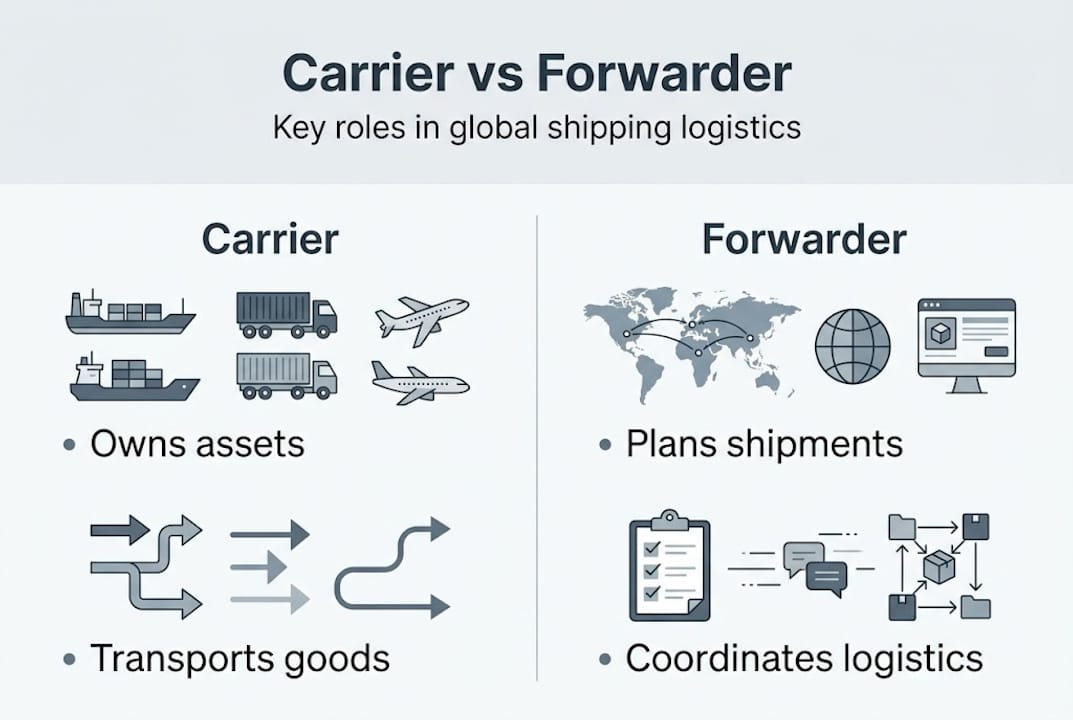
A freight forwarder, by contrast, does not typically own the transport assets. Think of a forwarder as the architect of your shipment’s journey. The forwarder negotiates with multiple carriers, books space, arranges documentation, coordinates customs clearance, and sometimes consolidates cargo from several shippers into a single container to unlock volume-based pricing. Understanding the role of cargo freight forwarders helps clarify why so many businesses rely on them for cross-border complexity.
Here is a quick breakdown of what each party typically handles:
Carriers typically handle:
- Physical transport of goods using owned or leased assets
- Issuing the bill of lading as the contract of carriage
- Setting tariff rates on their specific routes
- Delivering cargo to the agreed destination port or terminal
Freight forwarders typically handle:
- Booking space across multiple carriers
- Preparing and managing shipping documentation
- Customs brokerage and import/export compliance
- Route planning, consolidation, and cargo insurance coordination
- Last-mile logistics coordination and tracking updates
“Understanding who controls what at each stage of the shipment journey can mean the difference between a smooth delivery and a costly standstill at a port.”
Research into international shipping roles shows that the relationship between carriers and forwarders is more nuanced than simple competition. Per a study on freight market pricing dynamics, carriers pay price premiums to forwarders in market conditions that favor carriers, recognizing the forwarder’s role in channeling demand. This dynamic alone illustrates why these two parties are deeply interdependent, not simply buyer and seller.
Core differences: Roles, responsibilities, and contracts
Now that definitions are clear, let’s break down where the roles truly diverge.
The most critical distinction lies in legal liability and contractual responsibility. A carrier is directly liable for cargo damage or loss while goods are in its physical custody, subject to the limits set by applicable international conventions or its tariff terms. A freight forwarder’s liability is far more variable. It depends on whether the forwarder is acting as an agent (on behalf of the shipper) or as a principal (taking on responsibility as if it were the carrier itself). This distinction has enormous financial consequences when a claim arises.
Here is a side-by-side comparison of core differences:
| Factor | Carrier | Freight Forwarder |
|---|---|---|
| Asset ownership | Owns or operates transport assets | Typically no owned transport assets |
| Legal document issued | Bill of lading (master) | House bill of lading (to shipper) |
| Liability for cargo | Direct liability in transit | Contractual/agency-based liability |
| Pricing model | Tariff rates per route | Bundled service fees + margin on carrier rates |
| Route flexibility | Fixed routes and schedules | Multi-carrier, multi-mode flexibility |
| Customs handling | Rarely included | Often included or coordinated |
| Best for | Direct, high-volume single-mode freight | Complex, multi-leg, or consolidated shipments |
According to freight market pricing research, forwarders leverage volume from multiple clients to secure better rates from carriers than individual shippers could negotiate alone. This is the core economic proposition that makes forwarders attractive for small and mid-sized importers and exporters.
Here is how a standard freight forwarder engagement unfolds in practice:
- The forwarder receives your shipment details, including weight, dimensions, commodity type, origin, and destination.
- It identifies the most cost-effective and reliable carrier options across air, ocean, or road.
- It books space, prepares the commercial invoice, packing list, and customs entry documents.
- It coordinates pickup from your warehouse and delivery to the port or airport.
- It tracks the shipment through transit and notifies you of any delays or exceptions.
- It manages arrival customs clearance and arranges final delivery.
Exploring shipping cost differences between direct carrier contracting and forwarder bundled services reveals that neither is universally cheaper. The better choice depends on your shipment profile. For a comparison of related roles, the broker vs forwarder differences is also worth reviewing, as brokers add yet another layer some shippers confuse with forwarders.
Pro Tip: Always read the fine print in your forwarding agreement to identify whether the forwarder is acting as your agent or as a principal. If the forwarder acts as a principal, it assumes carrier-like liability. If it acts as an agent, your recourse for cargo loss may lie only with the underlying carrier.
How carriers and forwarders impact shipping cost and risk
Understanding the distinction is vital, but what does it mean for your bottom line and operational risk?
Cost and risk management are where the carrier-versus-forwarder question becomes intensely practical. Forwarders create value by consolidating freight. A Less than Container Load (LCL) shipment, where your cargo fills only part of a container, is a prime example. If you book directly with a carrier, you typically pay for the entire container or at elevated per-unit rates. A forwarder, however, groups your cargo with other shippers’ goods, fills the container, and passes along the volume discount. For importers moving smaller, irregular shipments, this consolidation can cut ocean freight costs by 20 to 40 percent compared to direct carrier booking.

Here is a simplified cost and risk breakdown across common scenarios:
| Shipment Type | Direct Carrier Cost | Forwarder Bundled Cost | Liability Coverage | Flexibility |
|---|---|---|---|---|
| Full Container Load (FCL), fixed lane | Lower tariff rate | Marginally higher (forwarder margin) | Carrier liability | Low |
| LCL or partial shipment | High per-unit rate | Lower via consolidation | Forwarder terms | High |
| Multi-leg international route | Requires multiple bookings | Single point of contact | Mixed | Very high |
| Time-sensitive air freight | Carrier direct rate | Competitive via forwarder volume | Airline terms | Moderate |
The market itself is not static. Per research on freight market pricing, carriers pay premiums to forwarders in certain market conditions, particularly when carrier capacity is tight and forwarders control access to consolidated demand. This means that during peak seasons or supply chain disruptions, forwarders sometimes hold the rate advantage because carriers need their volume.
Risk is a separate but equally important dimension. Carriers carry legal responsibility for physical loss and damage while cargo is in their custody, but their liability limits are often set well below the actual value of goods. An ocean carrier under the Hague-Visby Rules may only be liable for roughly $500 per shipping unit, which could mean pennies on the dollar for a high-value electronics shipment. Forwarders typically recommend, and often arrange, cargo insurance that covers the full commercial value of your goods, which carriers rarely include as a default.
Pro Tip: Before finalizing your logistics partner for a new shipping lane, request a landed-cost comparison that includes the carrier rate, forwarder margin, insurance premium, and customs fees. That total figure is what you’re actually paying, and it frequently tells a different story than a simple freight quote.
When to use a carrier vs a forwarder: Practical decision guide
To make these insights actionable, let’s look at how to decide for each shipment.
The right choice depends on your shipment profile, your operational capacity, and the complexity of your trade lanes. Neither carriers nor forwarders are universally superior. The decision is situational.
Scenarios where working directly with a carrier is the better choice:
- Your business ships full container loads on the same fixed route every month.
- You have an in-house logistics team capable of handling documentation and customs compliance.
- You have enough volume to negotiate favorable direct contracts without needing consolidated rates.
- Your supply chain is domestic or limited to one transportation mode.
- Speed of booking and simplicity of invoicing are higher priorities than value-added services.
Scenarios where a freight forwarder delivers more value:
- Your shipments are small, irregular, or involve partial container loads.
- You import or export across multiple countries with different customs regulations.
- You need multi-modal routing, combining ocean, air, and trucking on a single shipment.
- Your team lacks the time or expertise to manage international documentation and compliance.
- You want a single point of contact for tracking, exceptions, and problem resolution.
As freight market analysis confirms, forwarders leverage volume for better rates, which makes them particularly valuable for growing businesses that have not yet reached the shipment volumes required to command carrier attention directly.
Here are the key questions to work through when evaluating your next logistics partner:
- How much freight do I ship per month, and can I commit to a volume contract with a carrier?
- How many different countries or ports of entry are involved in my supply chain?
- Does my team have licensed customs brokers or documented compliance processes?
- How time-sensitive is this shipment, and how costly is a delay?
- Do I need ancillary services such as warehousing, labeling, or cargo insurance?
Consider a real-world scenario. A mid-sized apparel importer sourcing from Vietnam, Mexico, and Portugal simultaneously sends partial container loads from all three origins converging at a U.S. distribution center. Booking directly with three separate carriers means managing three bills of lading, three customs entries, and three sets of arrival notifications. A forwarder consolidates all three origins under one house bill of lading, coordinates customs clearance at the U.S. port, and delivers a unified tracking experience. Choosing a freight forwarder with the right regional expertise in this scenario dramatically reduces operational overhead and customs risk.
For businesses looking to build long-term logistics strategy, the freight forwarding guide offers a broader perspective on how to structure your global supply chain partnerships for 2026 and beyond.
What most logistics managers miss about carrier vs forwarder strategies
Here is a hard-won industry perspective that most logistics articles skip over. Forwarders do not simply act as intermediaries who add a markup to carrier rates. They actively shape market pricing by aggregating demand. When forwarders bundle dozens of smaller shippers into full containers, they create negotiating leverage that no individual shipper could replicate. That consolidated demand gives forwarders structural pricing power that benefits their clients. Ignoring this dynamic leads logistics managers to assume that going direct to a carrier is always cheaper, when in fact it is only cheaper at sufficient scale.
The other blind spot is the assumption that carriers and forwarders are adversaries competing for your budget. In practice, the most efficient supply chains use both in a coordinated way, relying on the role of freight forwarder for complexity and compliance while negotiating direct carrier agreements for stable, high-volume lanes. Treating this as an either/or decision costs businesses real money through missed negotiation opportunities and unnecessary risk exposure.
Optimize your shipping with the right partner
If you’re ready to apply these distinctions for real savings and efficiency, here’s how to start.
Navigating the choice between carriers and forwarders is one of the most consequential decisions an import/export business makes. Getting it right requires expertise in both logistics strategy and global compliance. Worldwide Express offers exactly that combination, with dedicated specialists who understand how to leverage carrier relationships and forwarder consolidation to build cost-efficient, resilient supply chains tailored to your specific trade lanes and shipment profiles.
Explore the full freight forwarding guide to see how strategic logistics partnerships work in practice. Review the available logistics services to find the right solution for your operation, and get a detailed cost breakdown to see where the real savings live for your shipment profile.
Frequently asked questions
Are carriers or forwarders legally liable for lost shipments?
Carriers typically carry legal liability for cargo loss or damage once goods are in their physical custody, while a freight forwarder’s liability depends on whether it is acting as a principal or an agent under its contract terms.
Can forwarders negotiate better rates than carriers for my shipments?
Yes. Because forwarders leverage volume by pooling multiple customers’ freight into consolidated shipments, they frequently secure lower per-unit rates than an individual shipper could obtain directly from a carrier.
What is the main advantage of working directly with a carrier?
Direct relationships with carriers offer simpler contract structures, clearer liability terms, and often faster booking responses for businesses shipping consistent, high-volume freight on fixed routes.
When should I consider using both a carrier and a forwarder together?
Combining both is the smart approach when your supply chain includes multi-leg international routes, mixed shipment sizes, or complex customs requirements that benefit from a forwarder’s coordination expertise alongside a carrier’s direct transport capacity.
Recommended
- Carrier vs Freight Forwarder: Cut 20% Shipping Costs 2026 – Worldwide Express, Inc.
- Broker vs Freight Forwarder: Key Differences Explained – Worldwide Express, Inc.
- Understanding freight forwarding: a 2026 guide – Worldwide Express, Inc.
- How to Choose a Freight Forwarder for Smooth Shipping – Worldwide Express, Inc.