TL;DR:
- Customs law clearly holds importers solely responsible for customs declarations and duties.
- Most importer penalties stem from misdeclaration, misclassification, undervaluation, and poor recordkeeping.
- Compliance best practices, including accurate documentation and risk management, are essential to reduce liability.
Many importers operate under a dangerous assumption: that when a shipment goes wrong, the exporter shares the blame. It’s a misconception that can cost a company tens of thousands of dollars in fines, seized goods, and reputational damage. A landmark 2024 ruling from the Bombay High Court confirmed what customs law has long held, that foreign exporters are generally not liable for an importer’s customs declarations. The responsibility falls squarely on the importer. This guide breaks down exactly who bears what liability, where the biggest risks hide, and what practical steps can protect your operations.
Table of Contents
- Who’s responsible: Importers vs. exporters
- Top importer liability risks and how to avoid them
- How customs compliance impacts liability
- Best practices for minimizing importer liability
- What most importers still get wrong about liability
- Streamline compliance and minimize risk with expert help
- Frequently asked questions
Key Takeaways
| Point | Details |
|---|---|
| Importers bear main liability | Legal rulings confirm importers, not exporters, are responsible for customs compliance and penalties. |
| Paperwork is crucial | Accurate, complete documentation is the top factor determining importer legal risk. |
| Compliance prevents penalties | Following customs regulations and best practices can help you avoid costly fines and shipment delays. |
| Expert support reduces risk | Leveraging customs brokers and risk management tools can streamline processes but does not remove all your legal responsibility. |
Who’s responsible: Importers vs. exporters
The legal line between importer and exporter liability is clearer than many businesses realize, yet it remains one of the most misunderstood concepts in international trade. Understanding where that line sits is the first step toward building a watertight compliance program.
The importer’s role is broad and deeply consequential. Importers are responsible for the accuracy of customs declarations, timely payment of applicable duties and taxes, and maintaining detailed records of all import transactions. This is not a shared responsibility. The importer of record takes on full legal accountability the moment goods enter a destination country’s customs jurisdiction.
The exporter’s role, by contrast, is largely transactional. The exporter prepares goods for shipment, provides documentation such as commercial invoices and packing lists, and ensures the cargo departs origin. Once goods leave the export country, the exporter’s active legal responsibility in the destination market effectively ends.
The Bombay High Court made this distinction crystal clear when it quashed customs notices against a German exporting firm, ruling that a foreign exporter cannot be held liable for the importer’s customs declarations in India. The court affirmed that attempts to pursue exporters for importer-side customs errors are legally unsound.
“The role of the foreign exporter concludes at the point of shipment. What happens at the port of entry is the exclusive domain of the importer.”
Here is a quick side-by-side comparison of how liability is typically divided:
| Responsibility | Importer | Exporter |
|---|---|---|
| Customs declaration accuracy | Yes | No |
| Duty and tax payment | Yes | No |
| Recordkeeping at destination | Yes | No |
| Export documentation at origin | No | Yes |
| Compliance with destination regulations | Yes | Rarely |
| Goods classification (HS codes) | Yes | Partially (for export only) |
Common importer errors that trigger liability include:
- Misclassifying goods under incorrect Harmonized System (HS) tariff codes
- Undervaluing shipments to reduce duty payments
- Failing to declare all contents accurately
- Missing import permits for restricted goods
- Inadequate or missing supporting documentation
There are very narrow scenarios where an exporter may carry partial liability, such as when an exporter knowingly provides fraudulent invoices or deliberately misrepresents goods to aid the importer in customs fraud. Even then, the importer remains the primary liable party. With the liability framework established, it’s important to understand the specific risks importers face and how customs regulations raise the stakes.
Top importer liability risks and how to avoid them
Liability in customs does not usually come from dramatic schemes. More often, it comes from everyday operational gaps that compound over time. Knowing the most common liability triggers is essential for any importer that wants to stay penalty-free.
1. Misdeclaration of goods
This is the most frequent and costly mistake. Misdeclaration occurs when the description on a customs entry does not accurately match what is physically in the shipment. Even unintentional misdeclarations can result in steep fines, cargo holds, and in serious cases, seizure. Customs authorities in most jurisdictions treat inaccuracy as a strict liability issue, meaning intent is not always a required element for a penalty.
2. Incorrect tariff code classification
Every product entering a country must be assigned an HS code that determines the applicable duty rate. Using the wrong code, even accidentally, can result in duties being underpaid or overpaid. Underpayment leads to penalties and back-duty assessments. This is one of the most common importer mistakes that even experienced logistics managers make.
3. Undervaluation of shipments
Customs value is typically based on the transaction value of goods. Some importers attempt to reduce duty exposure by declaring a lower value than the actual purchase price. Customs agencies are acutely aware of this practice and use price databases to flag suspicious valuations. Undervaluation carries penalties that often exceed the original duty savings.
4. Non-compliance with restricted or prohibited import lists
Every country maintains lists of goods that are either restricted (requiring special permits) or prohibited outright. Importing goods that require licenses without securing them in advance is a fast path to shipment delays and fines. Staying current on these lists is non-negotiable.
5. Incomplete documentation or poor recordkeeping
Importers are required to retain import records, including entry documents, commercial invoices, and proof of payment, for several years after import. Poor recordkeeping leaves importers exposed during audits, even when the original entry was accurate.
A recent industry analysis found that documentation errors contribute to a significant share of customs penalties across all market segments. This underscores the point that paperwork is not administrative busywork. It is legal protection.
Pro Tip: Conduct a pre-clearance document audit before every major shipment. Build a checklist that includes the commercial invoice, packing list, bill of lading or airway bill, certificates of origin, and any required import licenses. Review each document against the actual shipment before submission. This one step, consistently applied, catches a majority of errors before they become violations.
Following customs compliance tips and integrating them into standard operating procedures turns compliance from a reactive process into a proactive shield. With the most critical risks identified, the next step is understanding how customs compliance functions as a structural defense against liability.
How customs compliance impacts liability
Compliance is not just about following rules. It is about building a documented track record that protects the business when disputes arise, audits occur, or shipments are flagged. The financial stakes are substantial.
Here is a breakdown of common non-compliance penalties and how proactive compliance helps prevent them:
| Violation type | Typical penalty range | Compliance measure that prevents it |
|---|---|---|
| Misdeclaration | 2x to 4x unpaid duties | Accurate product descriptions and HS codes |
| Undervaluation | 10% to 40% of cargo value | Transaction value documentation |
| Missing import permits | Cargo hold or seizure | Pre-import permit verification |
| Recordkeeping failure | Fines up to $10,000 per entry | Systematic document retention policy |
| Restricted goods violation | Criminal referral possible | Prohibited goods screening |
Records retention is one of the most overlooked elements of compliance. In the United States, Customs and Border Protection generally requires importers to retain records for five years from the date of import. Similar timeframes apply in the European Union and across much of Asia-Pacific. These records must be accessible and organized, not buried in email archives.
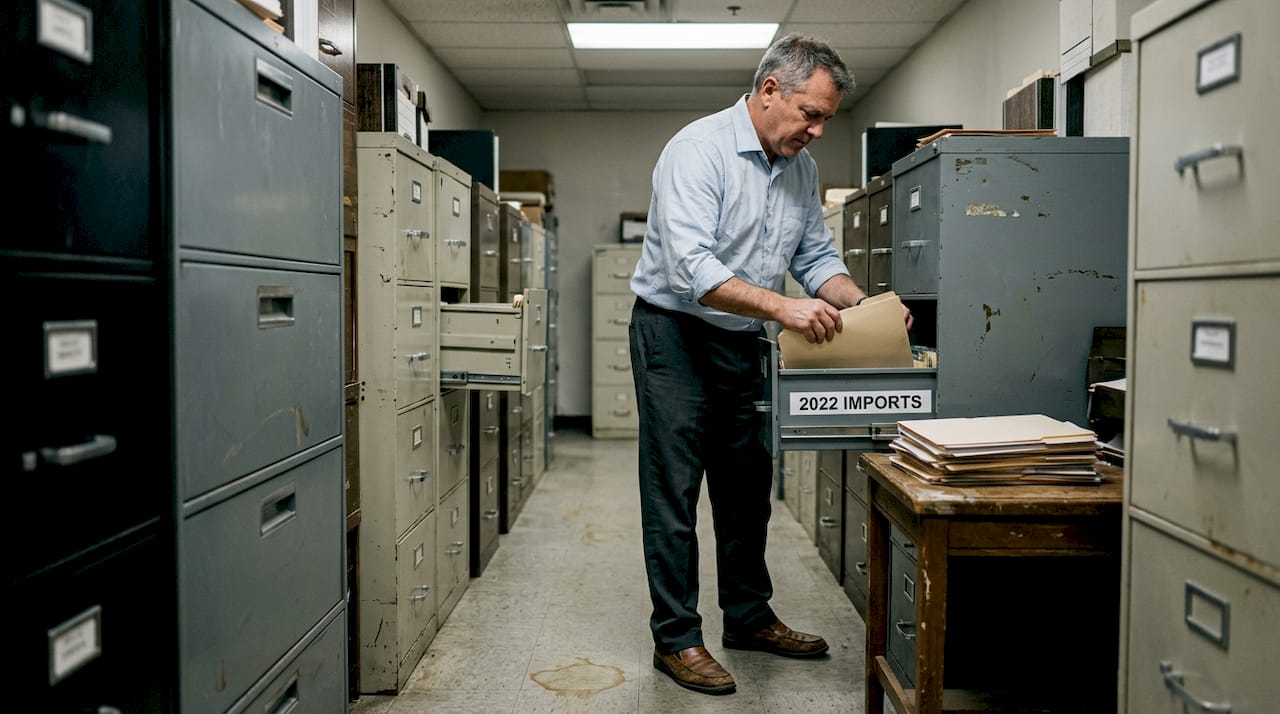
Compliance also functions as powerful protection during legal and audit scenarios. When an importer can produce complete, accurate records quickly, it signals to customs authorities that operations are well-managed. This often results in faster resolution of disputes and more favorable outcomes during audits. As the Bombay High Court ruling illustrated, importers who understand the legal framework they operate within are better positioned to defend their interests.
Core customs compliance best practices every importer should implement include:
- Maintaining a master HS code database for all regularly imported products
- Requiring suppliers to provide complete and accurate commercial invoices
- Establishing a formal document retention system with defined access and backup protocols
- Scheduling regular internal compliance reviews, at minimum annually
- Subscribing to customs authority updates to monitor regulatory changes
- Engaging trained staff or outside specialists for complex import scenarios
Achieving smooth customs clearance consistently comes down to treating compliance as an operational standard rather than a last-minute exercise. Beyond these foundations, there are specific best practices that reliably minimize importer liability over the long term.
Best practices for minimizing importer liability
Reducing importer liability is not a one-time project. It requires a living system of checks, training, and verification that evolves as regulations change. Here is a practical, step-by-step framework that high-performing import operations use.
1. Conduct a comprehensive risk review
Start by mapping all import lanes, product categories, and origin countries. Identify which lanes involve restricted goods, complex tariff classifications, or high-value shipments. Assign a risk level to each category. This prioritization ensures resources go where exposure is highest.
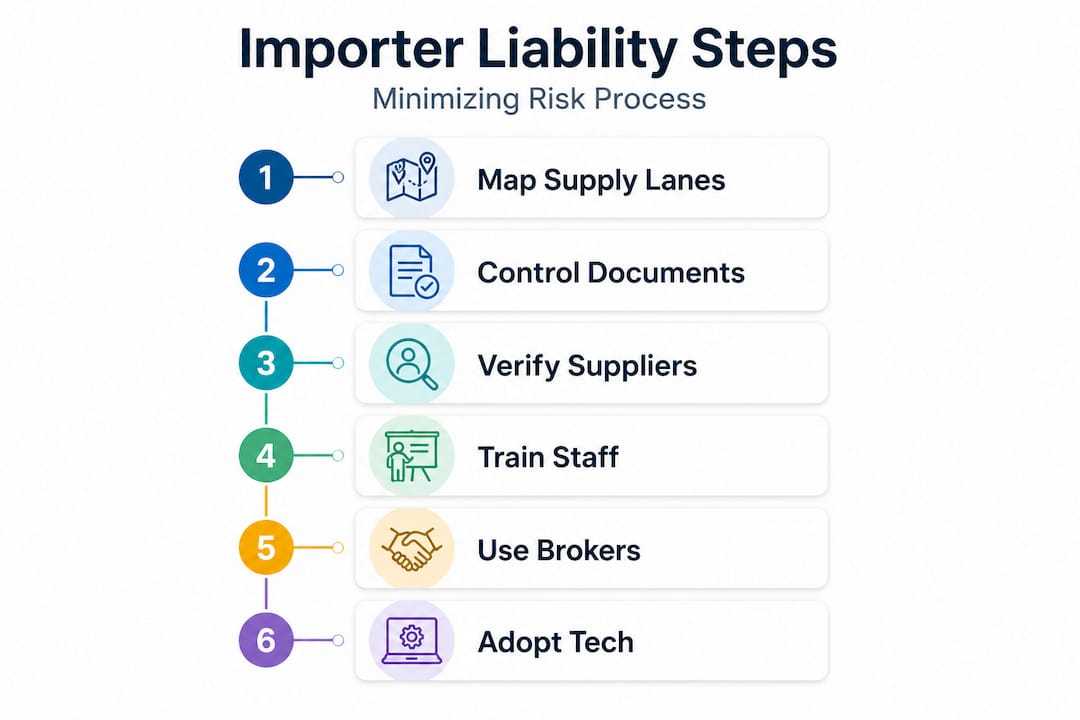
2. Build and maintain a documentation control system
Every import transaction should generate a complete document package: commercial invoice, packing list, transport documents, proof of payment, and any required permits or certificates. These documents should be filed systematically and linked to entry numbers for fast retrieval during audits.
3. Verify supplier information proactively
Before adding a new supplier, verify their export documentation capabilities. Inaccurate supplier invoices are one of the most common upstream causes of importer-side declaration errors. Establish clear documentation standards with suppliers and enforce them contractually.
4. Invest in staff training
Customs regulations change frequently. Staff involved in import operations, including procurement, logistics, and finance teams, should receive regular training on current requirements. A team that understands why compliance matters is far more effective than one that merely follows checklists without context.
Pro Tip: Run periodic mock audits. Select a sample of recent import entries, pull all associated documents, and review them as if customs authorities were auditing them. This stress-tests the system, exposes gaps, and builds organizational confidence in the compliance process before a real audit occurs.
5. Leverage customs brokers strategically
Experienced customs brokers bring specialized knowledge of tariff classification, valuation rules, and country-specific regulations that most in-house teams cannot fully replicate. A qualified broker reduces human error and accelerates clearance. However, using a broker does not transfer legal liability. The importer remains responsible for the accuracy of every declaration, even those submitted by a broker on their behalf.
6. Integrate compliance technology
Modern compliance software can automate tariff code verification, flag restricted goods, and maintain audit-ready records. These tools reduce reliance on manual processes, which are where most errors occur. Technology is not a replacement for expertise, but it dramatically reduces the surface area for human error.
Applying strong risk mitigation strategies across the import lifecycle and connecting them to a broader supply chain risk management framework positions businesses to respond quickly to disruptions without sacrificing compliance. Implementing these practices is a major step, but importers should also be clear-eyed about some persistent blind spots that even experienced operators struggle to see.
What most importers still get wrong about liability
Here is the uncomfortable truth: even importers who believe they have compliance under control are often making one of two critical errors. The first is trusting that their exporter or supplier “handles” customs. The second is assuming that hiring a customs broker transfers legal accountability.
The Bombay High Court ruling was not a surprise to experienced trade lawyers, but it absolutely was to many importers who had assumed a foreign supplier with export experience would somehow share the regulatory burden at the destination port. The court was unambiguous: exporter liability ends at shipment. What happens next is entirely the importer’s problem.
There are documented cases of importers receiving five and six-figure penalty assessments years after the original import, triggered by routine audits that uncovered classification errors the importer had assumed the broker handled correctly. The broker may have filed in good faith based on information the importer provided. But the importer provided the wrong product description. In customs law, that outcome belongs to the importer.
The most experienced importers understand the concept of importer of record obligations at a granular level. They do not outsource the understanding, only the execution. They review broker entries, verify classification decisions, and maintain direct relationships with customs authorities when possible.
Pro Tip: The one due diligence step seasoned importers never skip is reviewing the first entry for any new product category personally, or having a senior compliance team member review it, before establishing it as a standard template. The first entry sets the tone for every shipment that follows.
The optimistic view is that most compliance failures are preventable. The tools, the knowledge, and the professional resources exist to get this right. What is required is the organizational commitment to treat compliance as a business-critical function rather than a back-office checkbox.
Streamline compliance and minimize risk with expert help
Whether you are building an import program from the ground up or tightening the controls on an established operation, the right partners can make a measurable difference in both compliance outcomes and operational efficiency.
Worldwide Express offers customs brokerage services specifically designed to reduce the administrative burden on importers while keeping declarations accurate and timely. From tariff classification support to document review and audit preparation, the team brings deep regulatory expertise to every shipment. For importers who want to understand how customs brokers streamline global trade, the resources and hands-on guidance are readily available. Pairing customs brokerage with end-to-end freight forwarding creates a fully integrated compliance and logistics solution that minimizes risk at every stage of the import journey.
Frequently asked questions
Are importers or exporters liable for customs fines?
Importers are generally liable for customs fines, as exporter liability typically ends once goods are shipped from the origin country.
What’s the best way to reduce importer liability?
Following consistent customs compliance best practices, retaining complete and accurate records, and working with experienced customs brokers significantly reduces importer liability exposure.
Can a customs broker remove all importer liability?
A customs broker can greatly reduce the risk of errors, but the importer still remains legally responsible for the accuracy of all customs declarations filed on their behalf.
How long should import records be kept for compliance?
Most jurisdictions, including the United States, require import records to be retained for at least five years from the date of entry, though specific local regulations may vary.
Why do most importer penalties happen?
The majority of importer penalties result from documentation errors, under-declaration or misdeclaration of shipment value, and failures to conduct proper compliance checks before clearance.
Recommended
- 5 costly importer mistakes and how to fix them – Worldwide Express, Inc.
- Customs compliance best practices: stay penalty-free in 2026 – Worldwide Express, Inc.
- Top cost-saving tips for importers: reduce shipping expenses – Worldwide Express, Inc.
- Avoid costly international shipping mistakes in 2026 – Worldwide Express, Inc.
- International shipping terminology: A clear guide for Singapore