TL;DR:
- Choosing the right shipping partner ensures timely delivery, customs compliance, and cost savings.
- Major companies like Kuehne+Nagel and DHL offer extensive global reach and advanced digital tools.
- Understanding roles of freight forwarders and customs brokers helps optimize logistics and compliance.
Selecting the wrong overseas shipping company can quietly erode your profit margins, delay critical inventory, and leave your business scrambling through customs complications that could have been avoided entirely. For importers, exporters, and logistics managers operating in today’s complex trade environment, the stakes are simply too high to rely on guesswork. The right partner brings global reach, customs expertise, and operational reliability to every shipment. This guide walks through the top companies in the field, offers a direct comparison of their strengths, and delivers a practical framework for matching the right provider to your business profile.
Table of Contents
- What to look for in an overseas shipping company
- Leading overseas shipping companies
- Freight forwarders vs customs brokers: roles and when it matters
- How to match your business to the right shipping partner
- Insider perspective: Why the biggest isn’t always best in overseas shipping
- Leverage expert overseas shipping solutions with Worldwide Express
- Frequently asked questions
Key Takeaways
| Point | Details |
|---|---|
| Choose for your needs | Select a shipping partner based on your business scale, destinations, and customs complexity. |
| Big isn’t always better | Global leaders like Kuehne+Nagel or DHL offer reach, but niche and SMB options can deliver better service for some businesses. |
| Freight vs broker clarity | Know when to use a freight forwarder for logistics, a broker for customs, or both for seamless global trade. |
| Use comparison tools | Tables and checklists help directly compare provider strengths, costs, and specialties. |
What to look for in an overseas shipping company
Before diving into individual companies, it’s essential to know the attributes that distinguish a great overseas shipping partner from a costly mistake.
Not all freight providers are built the same. Some specialize in massive ocean freight volumes across dozens of trade lanes. Others focus on customs compliance or offer tailored international shipping solutions for smaller importers navigating complex regulations. Understanding what separates them is the first step toward making a confident, informed decision.
Here are the core criteria to evaluate when assessing any overseas shipping company:
- Global network reach: Does the provider have established agents, offices, or partners in your target markets? A broad footprint reduces delays and simplifies coordination across time zones.
- Ocean and air freight capacity: Volume matters. Large providers with significant container throughput often negotiate better carrier rates, which can translate to savings for clients.
- Customs brokerage capability: Import and export compliance is non-negotiable. A provider with in-house licensed customs brokers reduces the risk of costly clearance delays and penalties.
- Digital tracking and visibility tools: Real-time shipment data is no longer a luxury. Businesses need live status updates, document management portals, and proactive exception alerts.
- Specialized services for SMBs: Small and mid-sized businesses often get lost inside the systems of massive global providers. Look for firms that offer dedicated account management or SMB-specific freight programs.
- Cargo insurance and risk management: Overseas freight involves real exposure. Providers that bundle or facilitate comprehensive insurance give businesses a meaningful safety net.
Size does matter in this industry, but not always in the way you expect. Enormous freight forwarders move millions of containers annually and command impressive carrier relationships. However, a company that ships millions of TEUs per year may route your mid-sized shipment through automated queues with minimal human attention. That scale can work against you when a problem arises at customs or when a shipment requires time-sensitive handling.
Pro Tip: Ask potential providers directly how they handle exceptions and delays. A company that gives you a clear, specific escalation path is almost always more valuable than one that points you to a generic customer service hotline.
Leading overseas shipping companies
With selection criteria in mind, let’s meet the global names that set the standard for overseas shipping.
The freight forwarding industry is dominated by a relatively small group of major players who collectively control a substantial share of global trade flows. According to A&A’s Top 25 Global Freight Forwarders, leading companies such as Kuehne+Nagel, DSV, and DHL Global Forwarding each handle 4.3M+ TEU ocean freight volumes, establishing them as true titans in the space. TEU, or twenty-foot equivalent unit, is the standard measure for container volume and serves as a reliable proxy for a provider’s operational scale.

| Company | Key strength | Global offices | Notable differentiator |
|---|---|---|---|
| Kuehne+Nagel | Ocean freight volume | 100+ countries | Deep carrier relationships, digital platforms |
| DSV | Integrated logistics | 80+ countries | Road, air, and sea under one roof |
| DHL Global Forwarding | Air freight leadership | 220+ countries | Unmatched global reach, compliance tools |
| Expeditors | Technology focus | 60+ countries | Proprietary logistics software |
| DB Schenker | Industrial freight | 130+ countries | Strong in automotive and manufacturing |
For businesses seeking expert reviews of shipping company performance and transparency, reviewing verified industry rankings and third-party data remains the most reliable approach.
Here’s a closer look at each major player’s standout qualities:
- Kuehne+Nagel: Particularly strong in perishable and temperature-sensitive cargo. Their digital platform, myKN, offers real-time shipment visibility and document access.
- DSV: Acquired Panalpina in 2019 and Agility in 2021, creating a powerhouse for integrated supply chains. Excellent for businesses that need road, sea, and air under one provider.
- DHL Global Forwarding: Its sheer presence in 220-plus countries makes it the go-to for businesses shipping to emerging or difficult-to-reach markets.
- Expeditors: Widely respected for its technology infrastructure, making it a strong fit for data-driven logistics teams.
- DB Schenker: A natural match for manufacturers in the automotive, pharmaceutical, and industrial sectors.
For businesses that move significant container volumes and require established ocean freight forwarding relationships, these firms offer hard-to-replicate advantages. However, their size comes with tradeoffs that smaller shippers often discover only after committing to a contract.
Freight forwarders vs customs brokers: roles and when it matters
While the giants offer broad logistics, unraveling the difference between a freight forwarder and a broker is crucial for compliance and cost.
This distinction trips up even experienced import/export managers. The two roles are related but serve very different functions in a trade transaction. Understanding the broker vs freight forwarder differences can save businesses from serious compliance exposure and unnecessary costs.
A freight forwarder is essentially your logistics architect. They organize the movement of goods from origin to destination, booking cargo space, coordinating pickups, managing documentation, and communicating with carriers. They are the strategic planners of the shipping world.
A customs broker, by contrast, is a licensed compliance expert. Their specific expertise lies in navigating the rules, tariffs, duties, and regulatory requirements that govern goods crossing international borders. Many businesses overlook how critical this role is until a shipment gets held at the port.
“Large freight forwarders like DHL Global Forwarding and Kuehne+Nagel excel in scale and network coverage, but specialized customs brokers add significant value when navigating complex trade nuances, duty optimization, or high-compliance-risk product categories,” per A&A’s 2025 Freight Rankings.
Here’s a practical numbered framework for deciding when to use each:
- Use a freight forwarder when you need end-to-end logistics coordination, carrier negotiations, consolidation of shipments, or warehousing services in addition to transport.
- Use a customs broker when your goods are subject to complex tariff classifications, anti-dumping duties, import quotas, or specialized permits such as FDA or USDA requirements.
- Use both when you are importing goods that require simultaneous logistics orchestration and detailed regulatory compliance, which is the case for most serious import operations.
- Consider a combined provider when you want simplicity and a single point of accountability for the entire process from origin to cleared delivery.
For deeper analysis of how these roles interact, the customs broker vs freight forwarder comparison and the detailed freight forwarding vs broker breakdown offer strong reference points.
| Characteristic | Freight forwarder | Customs broker |
|---|---|---|
| Primary role | Logistics coordination | Customs compliance |
| Licensing required | No specific federal license | CBP-licensed required |
| Best for | Moving cargo efficiently | Clearing cargo legally |
| Adds value in | Route planning, consolidation | Duty savings, classification |
| Typical clients | All exporters/importers | High-compliance importers |
The key takeaway here: these are complementary roles, not competing ones. The most sophisticated logistics programs use both.
How to match your business to the right shipping partner
Armed with comparison insights, you’re ready to narrow choices and find your best match based on your company’s profile and goals.
There is no single correct answer for every business. The right overseas shipping company depends on your trade volume, the destinations you serve, the nature of your products, and how much customs complexity you face. A high-volume consumer goods exporter has very different needs than a specialty chemicals importer dealing with hazardous material regulations.
Here’s a practical decision checklist every importer and exporter should run through before committing to a provider:
- Monthly or annual shipment volume: High-volume shippers gain more leverage with the global giants. Lower-volume businesses may find better service and pricing with mid-tier or specialized firms.
- Primary trade destinations: If you ship to emerging or politically complex markets, prioritize firms with strong local presence and regulatory knowledge in those specific regions.
- Product category and compliance risk: Goods subject to FDA review, USDA permits, antidumping orders, or export controls require a provider with demonstrated compliance experience in those specific categories.
- Need for specialized services: Some shippers need temperature-controlled containers, project cargo handling, or dangerous goods expertise. Verify these capabilities before signing.
- Technology requirements: If your ERP or inventory system needs to integrate with your freight provider’s platform, confirm API compatibility or data exchange formats upfront.
- Budget flexibility and cost predictability: Spot-rate pricing can be volatile. Ask whether the provider offers contract rates or rate cap programs that provide more budget certainty.
Example matches that reflect real-world scenarios:
- A high-volume electronics exporter shipping 500-plus containers per year to Europe and Asia benefits most from Kuehne+Nagel or DSV, given their carrier relationships and digital visibility platforms.
- A mid-sized specialty food importer bringing temperature-sensitive goods from South America needs a provider with robust cold chain capability and strong FDA knowledge, possibly a boutique forwarder with niche expertise.
- A small business importing handcrafted goods for retail may find the best fit with a freight forwarder that also offers licensed customs broker support for relatively low-volume, high-compliance shipments.
For businesses focused on growing their import freight services efficiently, the alignment between provider capabilities and business-specific needs is where real competitive advantage is built.
Pro Tip: Request a sample customs entry from any broker you are evaluating. A quality broker will walk you through exactly how they would classify your goods, what duties apply, and what documentation they need. That exercise reveals their depth of knowledge faster than any sales conversation.
Insider perspective: Why the biggest isn’t always best in overseas shipping
Now that you know how the options compare, consider this insight from years of helping businesses navigate global logistics.
The conventional wisdom in freight procurement is that bigger providers equal better outcomes. The logic seems sound: more volume means more carrier leverage, more offices mean better global coverage, and more resources mean fewer problems. But this view misses something important, and it catches many growing businesses off guard.
Mid-market and SMB importers frequently discover that once they sign with a global giant, their account gets managed by rotating junior staff, their calls go to generalized support desks, and their customs filings receive minimal strategic review. The best freight forwarding services for a Fortune 500 company are not necessarily the best for a company moving 50 containers per year.
What actually drives value for most businesses outside the enterprise tier is something the industry rankings rarely measure: responsiveness, customs depth, and strategic alignment. A provider that understands your specific industry, knows the tariff classifications for your goods inside and out, and picks up the phone when a shipment is sitting at port holds genuinely more value than a brand-name firm with offices on every continent.
The uncomfortable truth is that strategic partnership, not network scale, determines whether an overseas shipping relationship actually improves your supply chain. The best fit is the provider that treats your account as meaningful, offers proactive guidance rather than reactive problem-solving, and grows its understanding of your business over time. That kind of relationship is available at providers of many sizes, but it requires asking the right questions during selection rather than defaulting to the biggest name.
Leverage expert overseas shipping solutions with Worldwide Express
Ready to take your trade to the next level? Here’s how Worldwide Express can simplify your next overseas shipment.
Worldwide Express brings together the depth of customs expertise, the breadth of freight forwarding capability, and the personalized attention that businesses across every growth stage deserve. Whether you are navigating your first international shipment or optimizing a high-volume import program, Worldwide Express provides a freight forwarding guide backed by real industry experience.
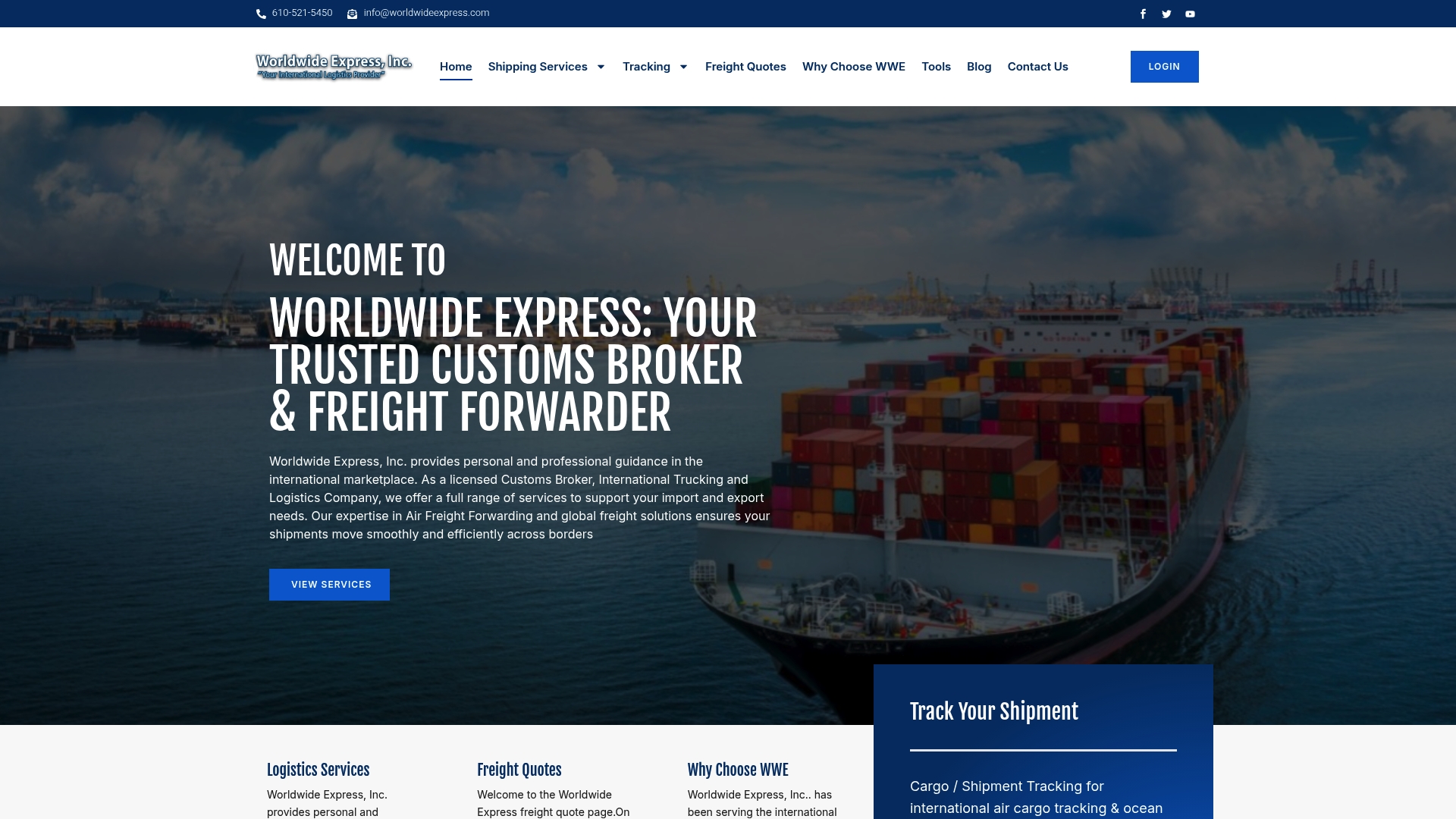
From licensed US customs brokerage services to end-to-end ocean and air freight coordination, Worldwide Express is built around client-specific solutions rather than one-size-fits-all systems. Explore how shipping logistics can be streamlined through a partner that prioritizes your operational goals, compliance profile, and budget realities from day one.
Frequently asked questions
Which overseas shipping company is best for small businesses?
Smaller businesses often benefit from forwarders or brokers that specialize in SMBs, since large global firms tend to prioritize high-volume clients. Per the A&A’s Top 25 Freight Forwarders rankings, specialized providers often outperform giants in personalized service and customs nuance for lower-volume shippers.
How do I compare overseas shipping companies on reliability and cost?
Evaluate each provider’s shipment volumes, global network coverage, specialty capabilities, and access to licensed customs support to gauge both reliability and total landed cost. The top freight forwarders data shows leaders like Kuehne+Nagel and DHL Global Forwarding handling 4.3M+ TEU volumes, a strong signal of operational scale.
Is it better to use a freight forwarder or a customs broker?
Most businesses need both: a freight forwarder to orchestrate the logistics movement and a customs broker to handle regulatory compliance. Many providers, as highlighted in A&A’s global rankings, now offer both services under one roof.
What are TEUs and why do they matter in shipping company comparisons?
TEU stands for twenty-foot equivalent unit, the standard measure of container shipping capacity. Volume rankings by TEU help businesses quickly assess a provider’s operational scale and carrier relationships.
What specialized services can set one overseas shipper apart from another?
Advanced customs handling, cold chain logistics, dangerous goods expertise, and integrated digital tracking platforms are differentiators that can make a measurable difference. Per freight forwarder rankings, specialized capability often matters more than raw volume for businesses in niche product categories.
Recommended
- How to Choose a Freight Forwarder for Smooth Shipping – Worldwide Express, Inc.
- Top International Shipping Solutions Reviewed – 2025 – Worldwide Express, Inc.
- Best Freight Forwarding Services – Expert Comparison 2025 – Worldwide Express, Inc.
- How to Reduce Shipping Costs: Effective Strategies for 2025 – Worldwide Express, Inc.
- Transport międzynarodowy auta: sprowadź luksusowy samochód z USA