TL;DR:
- Effective troubleshooting relies on proactive planning, real-time monitoring, and clear team roles to prevent delays from escalating into crises. Recognizing common causes such as customs issues, port congestion, and carrier capacity problems helps teams address bottlenecks swiftly and systematically. Building a continuous improvement process with documentation, analysis, and preventative measures enhances supply chain resilience and competitive advantage.
A critical shipment sits motionless at a port overseas. Your production line runs out of components in 48 hours, and your largest customer’s order ships in three days. This scenario plays out for import/export businesses every week, and the difference between a minor setback and a full operational crisis often comes down to one thing: how quickly and systematically your team can troubleshoot the delay. Logistics managers who rely on instinct alone frequently lose hours to guesswork. Those with a repeatable framework act fast, communicate clearly, and resolve issues before the damage compounds.
Table of Contents
- Common causes of shipping delays
- Preparing to troubleshoot: what you need
- Step-by-step troubleshooting process
- Verification and prevention: how to avoid future delays
- Why effective troubleshooting is a business differentiator
- Expert solutions for faster, trouble-free shipping
- Frequently asked questions
Key Takeaways
| Point | Details |
|---|---|
| Identify delay causes early | Proactive monitoring of SLAs and KPIs helps spot potential delays before they escalate. |
| Prepare systematic troubleshooting | Have all documents, tools, and roles defined so teams can quickly address issues. |
| Follow a structured process | Step-by-step troubleshooting increases the chance of fast, effective results. |
| Analyze and prevent recurrence | Post-incident reviews and ongoing metrics tracking are essential for avoiding future delays. |
Common causes of shipping delays
Let’s identify what typically triggers shipping delays before exploring solutions.
International shipments face a remarkable number of potential failure points between origin and destination. Recognizing the most common causes is the first line of defense for any logistics manager who wants to intervene before a small hiccup becomes a costly disruption.
The most frequent root causes include:
- Customs clearance complications: Incomplete or inaccurate documentation, undervalued goods, or restricted product classifications routinely stall shipments. Understanding customs clearance delay causes allows teams to preempt many of these holdups before a shipment even departs.
- Port congestion: Major hubs such as Los Angeles, Rotterdam, and Shanghai regularly experience vessel backlogs. When vessel queues stretch to dozens of ships, even flawlessly documented cargo waits days or weeks for berth space.
- Carrier capacity issues: Rolled cargo, where a carrier offloads your shipment to make room for higher-priority freight, is more common than most shippers realize, especially during peak seasons.
- Severe weather and force majeure events: Hurricanes, typhoons, and blizzards disrupt both ocean and air lanes unpredictably.
- Inaccurate shipping documents: A single mismatched field between a commercial invoice and a packing list can freeze a shipment in customs indefinitely.
- Logistics handoff failures: Gaps between freight forwarders, drayage carriers, and warehouses create invisibility zones where cargo goes missing in transit.
Proactive shipping risk mitigation strategies start with knowing which of these causes is most prevalent in your specific trade lanes.
| Delay cause | Average impact duration | Detection difficulty |
|---|---|---|
| Customs documentation error | 2 to 7 days | Medium |
| Port congestion | 3 to 14 days | Low (publicly tracked) |
| Carrier capacity rollover | 1 to 5 days | High |
| Severe weather disruption | 1 to 10 days | Low (forecastable) |
| Logistics handoff failure | 1 to 3 days | High |
Real-time monitoring is not optional for teams managing complex supply chains. Per SLA monitoring best practices, setting up KPI and SLA dashboards helps catch SLA breaches and manage delays proactively, giving teams the earliest possible warning when a shipment drifts off course.
Pro Tip: Review your KPI dashboard weekly, not just when a crisis occurs. Recurring patterns in delay data, such as consistent customs holds on a specific trade lane, signal systemic process issues that deserve a structural fix rather than repeated manual intervention.
Preparing to troubleshoot: what you need
Understanding delay causes makes it easier to prepare the right troubleshooting setup.
Effective troubleshooting is not improvised. The logistics managers who resolve delays fastest are those who assembled their tools, documents, and team roles before a problem ever materialized. Scrambling to find a carrier’s emergency contact number while cargo sits idle at a foreign terminal is a losing proposition.
Documents and information to have ready:
- Complete shipment details, including bill of lading numbers, container IDs, booking references, and shipper and consignee information.
- Carrier and freight forwarder contact lists, including after-hours emergency lines.
- Customs paperwork package: commercial invoice, packing list, certificate of origin, and any permits or licenses specific to the product type.
- Tracking credentials for all carrier portals and third-party visibility platforms.
- Your SLA documents, which define agreed delivery windows and escalation procedures with partners.
Tracking SLA metrics such as delivery windows and exception handling is essential for identifying issues early, before they reach a critical threshold that triggers customer complaints or production shutdowns.
The cargo tracking benefits available through modern visibility platforms go well beyond simple location pings. They include predictive estimated arrival updates, customs event alerts, and exception flags that surface hours before a manual check would catch the same problem.
Setting up a troubleshooting control room:
| Tool type | Purpose | Key feature to prioritize |
|---|---|---|
| Real-time tracking platform | Locate shipment instantly | Multi-carrier integration |
| KPI/SLA dashboard | Monitor performance metrics | Automated SLA breach alerts |
| Incident log template | Record actions and outcomes | Timestamped entries |
| Internal communication channel | Coordinate the response team | Mobile access |
Teams that understand how to track delivery truck effectively at the final-mile stage often overlook the same rigor needed at ocean or air freight stages. Visibility discipline applies across every mode of transport in an international shipment’s journey.
Building your response team:
Assign clear roles before a delay happens. A logistics lead manages the carrier relationship and escalation timeline. A customs contact, either in-house or through a licensed customs broker, handles all regulatory and documentation queries. A customer communications designate keeps affected clients informed with accurate, measured updates rather than speculation. Defined roles prevent overlap, reduce confusion under pressure, and accelerate resolution.

Step-by-step troubleshooting process
With preparation in place, you can move quickly to structured troubleshooting.
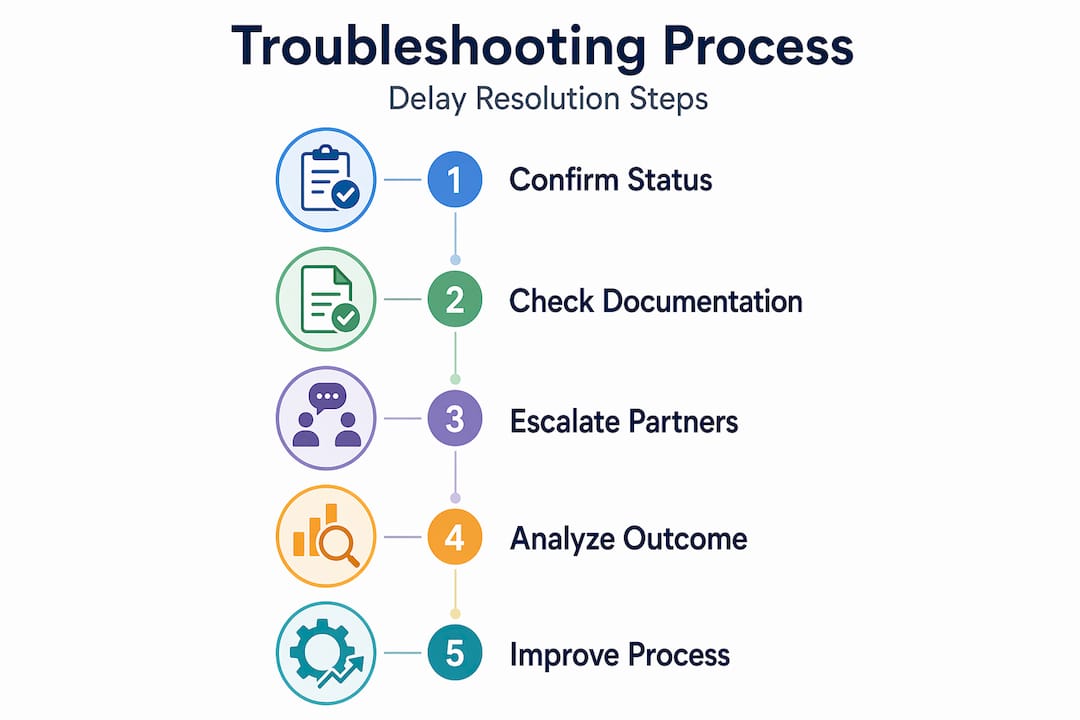
A four-step escalation framework keeps teams organized and ensures nothing falls through the cracks when a shipment goes off track. Speed matters, but so does accuracy. Rushing to escalate before confirming the actual nature of a delay can waste valuable time and credibility with carriers.
Step 1: Confirm status and the true nature of the delay
Pull real-time tracking data immediately. Identify where the shipment is, when it was last scanned, and whether it is flagged with an exception code. Carriers and terminal operators use specific codes for holds, customs examinations, missed connections, and weather delays. Understanding the code narrows the response path before any calls are made.
Step 2: Check for customs or documentation-related holdups
If the tracking data points to a customs hold, retrieve your documentation package and cross-reference every field against the customs entry. A mismatched country of origin, an incorrect HS tariff code, or a missing import permit are among the most common culprits. Contact your customs broker immediately and provide all supporting documents. In many cases, rapid document resubmission resolves the hold within 24 to 48 hours. For teams working to optimize logistics for global shipping, building a pre-departure documentation checklist dramatically reduces the frequency of customs-driven delays.
Step 3: Escalate to carriers or logistics partners
When tracking data is unclear or documents appear correct but the shipment remains stalled, escalate to your carrier representative or freight forwarder. Provide the full shipment reference, the last known location, and your contractual SLA delivery deadline. Ask for a written explanation of the hold and a committed resolution timeline. Vague answers warrant escalation to a senior account contact. Effective shipping logistics management depends on holding partners to documented service commitments rather than accepting uncertainty.
Step 4: Document and analyze the incident
Even before the shipment arrives, begin logging every action taken, every contact made, and every response received. Timestamped incident logs serve multiple purposes. They support future claims if cargo is damaged or a carrier owes service credits. They also provide raw data for the post-mortem analysis that prevents the same delay from recurring.
“Exception dashboards help teams handle delays when KPIs breach SLAs, providing the visibility needed to escalate and resolve issues faster than manual monitoring allows.”
Pro Tip: Configure your exception dashboard to send automated alerts the moment a shipment misses an expected scan event. Waiting until a shipment is hours overdue to notice a problem means the resolution window narrows significantly. Early exception alerts give teams a head start that often makes the difference between a minor delay and a missed delivery.
Verification and prevention: how to avoid future delays
After resolving a shipping delay, take active steps to prevent recurrence.
Resolution is not the finish line. The most operationally mature logistics teams treat every significant delay as a data point and invest the time to understand exactly what went wrong and why. That discipline is what separates organizations that repeatedly face the same problems from those that systematically improve.
Key prevention measures:
- Conduct a structured post-mortem after every delay that exceeds your SLA threshold. Involve all parties who touched the shipment: freight forwarder, customs broker, carrier, and warehouse.
- Audit your documentation templates annually. Trade regulations, tariff classifications, and import licensing requirements change, and outdated templates silently create compliance risks.
- Integrate automated alerts at every transit milestone, not just origin and destination. Mid-route gaps in tracking data are often where problems originate.
- Review carrier scorecards quarterly. Patterns of underperformance by a specific carrier on a specific lane are a strong signal to diversify your carrier mix.
- Improve logistics handoff processes between partners by establishing written SOPs (standard operating procedures) for data exchange at every transfer point.
Statistics reinforce the value of this proactive approach. Per SLA monitoring research, on-time delivery rate and exception response time are core dashboard metrics for ongoing SLA monitoring, and teams that track these metrics consistently outperform those that measure performance only after customer complaints.
The best strategies for optimizing freight transit times are not about reacting faster. They are about building systems that reduce how often reactions are necessary in the first place.
Pro Tip: Set a monthly review cadence where your logistics lead and customs contact jointly examine the previous month’s exception report. Cross-functional review often surfaces issues that neither team would catch in isolation, such as a documentation field that consistently causes customs queries on a specific product category.
Building a continuous improvement loop:
The cycle runs: monitor, detect, resolve, analyze, and improve. Teams that skip the analysis and improvement stages resolve the same delays repeatedly, burning resources and eroding carrier relationships. Teams that complete the loop build institutional knowledge that makes each successive disruption shorter and less costly to address.
Why effective troubleshooting is a business differentiator
Most businesses treat troubleshooting as an afterthought, a reactive scramble that begins only after a delay has already disrupted operations and strained customer relationships. That reactive posture is understandable given how busy logistics teams typically are. But it is also a significant missed opportunity.
The most competitive logistics operations have quietly reframed troubleshooting as a proactive discipline, not a crisis response mode. Real-time visibility tools, SLA dashboards, and structured post-mortems are not just problem-solving utilities. They are signals to carriers, partners, and customers that the organization manages its supply chain with precision and accountability.
There is a measurable reputational dimension to this as well. Shippers who escalate issues clearly, document outcomes rigorously, and follow up with root-cause analyses earn better responsiveness from carriers over time. Carriers prioritize customers who communicate professionally and hold everyone, including themselves, to documented standards. That dynamic is rarely discussed in logistics circles, but it is real, and it translates directly into faster exception resolution when delays occur.
The ROI of proactive troubleshooting also appears in customer retention numbers. A delayed shipment communicated promptly with a credible resolution timeline typically preserves the business relationship. A delayed shipment discovered by the customer before the logistics team even knew about it, that is the scenario that costs accounts. Growing your logistics business sustainably depends as much on protecting existing relationships as it does on winning new ones.
The honest assessment is that troubleshooting capability, when built into daily workflow rather than reserved for emergencies, becomes a genuine competitive advantage. It shortens delays, protects margins, strengthens partner relationships, and differentiates the operation in a market where reliability is the ultimate differentiator.
Expert solutions for faster, trouble-free shipping
If shipping delays are undermining your operations, professional solutions can help maintain reliability as you grow.
Worldwide Express offers digital tools and hands-on expertise specifically designed for businesses navigating complex international shipping environments. From customs brokerage to freight visibility, the right support infrastructure shortens the gap between a delay detected and a delay resolved.
Whether you need guidance on building a stronger compliance process or want to explore end-to-end logistics services that reduce delay exposure across multiple trade lanes, Worldwide Express brings the industry experience to make it practical. The freight forwarding guide provides an excellent starting point for teams evaluating their current approach, and dedicated customs brokerage services address one of the most common and costly sources of international shipping delays directly at the source.
Frequently asked questions
What are the first steps to take when a shipment is delayed?
Immediately confirm the shipment’s status with real-time tracking and check for customs or documentation issues before escalating to the carrier. Per KPI and tracking dashboards, these tools reveal where shipments are stuck and help teams manage delays with accurate, timely information.
How can I reduce the risk of future shipping delays?
Monitor SLA metrics, automate exception notifications, and conduct regular process reviews to identify and address recurring issues before they compound. Monitoring SLA breaches through dashboard metrics consistently helps teams prevent delays from becoming patterns.
Who should be on my troubleshooting team for shipping delays?
A logistics lead, a customs contact (in-house or a licensed broker), and a customer communications designate form the core team needed for a fast, organized, and credible delay response.
What role do KPIs and SLAs play in minimizing delays?
KPIs and SLAs provide early warnings of delivery performance issues, enabling quick intervention well before a delay reaches the customer. SLAs define delivery metrics monitored through dashboards for proactive supply chain management.
Recommended
- Why customs clearance delays happen and how to fix them – Worldwide Express, Inc.
- How to Reduce Shipping Costs: Effective Strategies for 2025 – Worldwide Express, Inc.
- How to Avoid Customs Delays for Smooth International Shipping – Worldwide Express, Inc.
- Navigating the rejected shipments process for trade success – Worldwide Express, Inc.