TL;DR:
- Vaccine customs clearance remains a major bottleneck despite rapid vaccine development, but understanding classification and documentation can reduce delays to hours.
- Upcoming HS code updates in 2028 will enhance speed by enabling more precise, disease-specific classifications, lowering inspection risks.
Vaccine innovation moves faster than ever, but customs clearance for vaccines remains one of the most stubborn chokepoints in global health logistics. A single misclassified HS code, a missing FDA Prior Notice, or a temperature log that doesn’t match the shipment record can freeze a critical cargo at the border for days. WCO code updates confirm that regulatory, classification, and inspection hurdles still derail time-sensitive shipments despite every advance in vaccine R&D. The good news: logistics teams that understand the full customs process for vaccines are clearing shipments in hours, not days.
Table of Contents
- Understanding vaccine classification and customs regulations
- Required documentation and regulatory compliance essentials
- Cold chain logistics and inspection: Meeting integrity requirements
- Digitalization and pre-arrival strategies for faster clearance
- Handling common clearance challenges and advanced solutions
- A logistics leader’s perspective: What most compliance guides miss
- Partnering for seamless vaccine customs clearance
- Frequently asked questions
Key Takeaways
| Point | Details |
|---|---|
| Accurate classification | Using the correct HS code and subheading is crucial for swift vaccine customs clearance. |
| Complete documentation | All required permits and declarations must be on hand to prevent holds and delays. |
| Cold chain integrity | Certified handlers and temperature monitoring are non-negotiable for vaccine shipments. |
| Leverage digital processing | Pre-arrival digital filing and single window systems can cut clearance time by up to 40 percent. |
| Plan for edge cases | Proactive strategies, including parallel waivers and robust broker partnerships, mitigate disruptions. |
Understanding vaccine classification and customs regulations
Precision in HS classification is where efficient customs clearance for vaccines either begins or breaks down. Vaccines are classified under HS Chapter 30, with the primary subheading for human vaccines currently sitting at HS 3002.41. That single code covers a wide range of products today, but the World Customs Organization has announced a significant shift coming in January 2028: new, disease-specific subheadings under Chapter 30.07 will distinguish between vaccines for measles, polio, COVID-19, and other conditions.
Why does that matter operationally? Granular subheadings reduce the ambiguity that triggers manual inspections. When a customs officer can confirm at a glance that a shipment is a polio vaccine rather than a broad “human vaccine,” the risk-scoring algorithm at most ports assigns a lower scrutiny level. That translates directly to faster release. Teams importing vaccines should already be mapping anticipated shipments to the upcoming 2028 codes and flagging those classifications with their customs brokers now, not in late 2027.
Understanding HS code updates for U.S. importers is also critical because tariff treatment, import duties, and partner-country agreements often hinge on the exact subheading declared. A mismatch between the declared code and the product’s actual composition is one of the fastest ways to trigger a hold.
Quick reference: Key HS codes and core documentation
| HS Code | Product description | Key documents required |
|---|---|---|
| 3002.41 | Human vaccines (current, through 2027) | Commercial invoice, air waybill, FDA Prior Notice |
| 3002.42 | Veterinary vaccines | Commercial invoice, USDA permit, packing list |
| 30.07 (2028+) | Disease-specific human vaccines | Updated invoice, revised COA, new subheading declaration |
| 3002.90 | Other immunological products | Commercial invoice, FDA registration, packing list |
Logistics teams handling biological shipment guidelines should cross-reference these codes against the specific biological classification of each vaccine to avoid mismatches at the point of entry.
Pro Tip: Pre-assign the correct 2028 subheading to any vaccine product in your ERP system now. When the transition date arrives, your documentation templates will already be accurate, and you won’t face a classification scramble mid-shipment.
Required documentation and regulatory compliance essentials
With a clear understanding of classifications, the next critical lever is complete and timely documentation. Incomplete or mismatched documents account for 80% of vaccine holds at customs worldwide. That statistic is both alarming and actionable: it means the vast majority of delays are preventable.
U.S. vaccine imports require a CBP entry declaration, FDA Prior Notice (submitted through the FDA’s Prior Notice System Interface at least two hours before arrival by air), and additional permits from the CDC or USDA depending on the vaccine’s biological components. Each agency plays a distinct role, and missing any one of them can result in outright seizure, not just a delay.
Step-by-step documentation flow for U.S. vaccine imports
- Confirm the correct HS code and product description before generating any commercial documents.
- Prepare the commercial invoice with full product name, quantity, unit value, country of origin, and consignee details.
- Generate the air waybill or bill of lading, ensuring the shipper, consignee, and notify party fields match the invoice exactly.
- Submit FDA Prior Notice through PNSI at least two hours before air arrival or eight hours before sea arrival.
- Obtain any required CDC import permits (for vaccines containing live biological agents) and USDA permits (for vaccines derived from animal sources).
- Compile the packing list, certificate of analysis (COA), and temperature monitoring records.
- File the CBP entry summary and pay applicable duties.
- Confirm receipt of all agency approvals before the shipment departs the origin country.
Document and permit requirements by market
| Requirement | United States | European Union | China |
|---|---|---|---|
| Customs declaration | CBP Form 3461/7501 | Single Administrative Document | Customs Declaration Form |
| Health authority filing | FDA Prior Notice | EMA/national MAH notification | NMPA pre-approval |
| Biological permits | CDC/USDA permits | National competent authority | GACC registration |
| Cold chain records | Required at entry | Required at entry | Required; AI-verified at some ports |
| Certificate of analysis | Mandatory | Mandatory | Mandatory |
For teams building out their customs compliance tips library, the EU and China columns above deserve particular attention. China’s GACC registration requirement for biological products is a step many first-time importers miss entirely, and the EU’s reliance on national competent authorities means requirements can vary by member state even within a single trade bloc.
Cold chain logistics and inspection: Meeting integrity requirements
Effective documentation will get your shipment to inspection. Keeping your vaccines viable from that point forward depends on rigorous temperature and chain-of-custody protocols that customs officers are increasingly trained to verify.
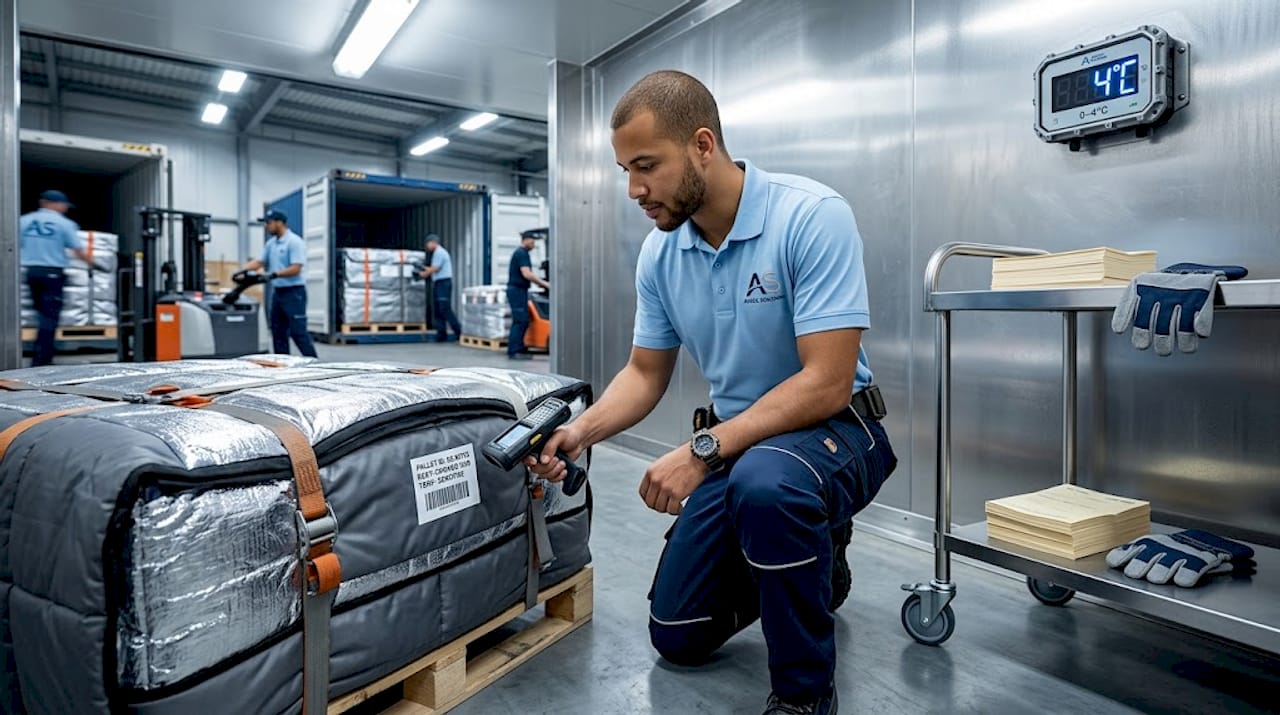
The WHO and IATA set the baseline standards for vaccine packaging and shipping, covering everything from approved packaging materials to temperature monitoring device specifications. IATA’s CEIV Pharma certification goes further, requiring handlers at every node in the supply chain to demonstrate documented competency. Customs authorities in the U.S., EU, and many Asian markets now recognize CEIV Pharma certification as a positive risk indicator, meaning certified shipments face fewer random inspections.
Common cold chain failure points and how to avoid them
- Packaging gaps: Use validated shipper configurations tested to the specific temperature range required (typically 2°C to 8°C for most vaccines, or ultra-cold for mRNA products). Never substitute untested packaging based on availability.
- Data logger gaps: Ensure continuous temperature data loggers are activated before packing, not after. Gaps in the log are treated as excursions by most customs authorities.
- Handoff delays: Pre-arrange certified cold storage at or near the port of entry. Delays between aircraft offload and customs release are a leading cause of excursions.
- Documentation mismatch: The temperature range on the commercial invoice must match the validated range on the packaging qualification report.
- Carrier certification: Confirm your airline or ocean carrier holds current IATA CEIV Pharma or equivalent certification before booking.
“When temperature excursions are detected at the border, some customs authorities are authorized to grant direct-exit procedures, allowing shipments to move immediately to qualified cold storage rather than waiting in standard inspection queues. Proactively disclosing a minor excursion and presenting a pre-approved contingency plan is almost always better than hoping it goes unnoticed.” — Cold chain compliance specialist, per WHO guidelines on vaccine shipping.
Knowing how to streamline airport clearance for temperature-sensitive cargo is a real competitive advantage. Teams that pre-register their cold chain contingency plans with the destination port authority report measurably faster release times even when minor excursions occur.
Pro Tip: Stage contingency cold storage at or within two miles of your primary port of entry. When customs inspection runs long, you need a certified holding location that can accept the shipment immediately, not one that requires a 45-minute transfer.
Digitalization and pre-arrival strategies for faster clearance
Logistics doesn’t stop at compliance and cold chain. Digital-first strategies now make the biggest difference in how fast vaccines actually clear. Pre-arrival digital processing and single window systems reduce clearance times by 25 to 40%, with best practice calling for document submission three to five days before arrival.
The core tools driving this shift are the electronic air waybill (e-AWB), IATA ONE Record (a single data model replacing fragmented paper and PDF workflows), and national single window portals that allow simultaneous submission to CBP, FDA, and other agencies in one filing. For vaccine shipments, where every hour matters, these tools are not optional extras.
Pre-arrival digital vs. manual clearance: Time comparison
| Clearance method | Air freight clearance time | Sea freight clearance time |
|---|---|---|
| Manual, paper-based | 12 to 24 hours | 36 to 72 hours |
| Digital, pre-arrival filing | 90 minutes to 4 hours | 20 to 28 hours |
| Digital + AEO/CTPAT status | Under 90 minutes | 16 to 20 hours |
China’s AI-driven smart clearance lane for priority medical devices is one of the most striking examples of what’s possible. The system cross-references pre-filed digital data against risk profiles in real time, releasing compliant medical shipments in minutes rather than hours. The Philippines has implemented a risk-based two-border system that similarly accelerates release for pre-approved importers.
How to build a digital pre-arrival submission workflow
- Integrate your ERP or TMS with your customs broker’s filing platform to auto-generate entry data from purchase orders.
- Enroll in your destination country’s single window portal and pre-register your product catalog, including HS codes and FDA/USDA registration numbers.
- Submit all documents three to five days before arrival, not two hours before.
- Apply for Authorized Economic Operator (AEO) or CTPAT status to access priority lanes and reduced inspection rates.
- Use IATA ONE Record to share a single, live data record with your carrier, handler, customs broker, and regulatory agencies simultaneously.
Reviewing customs pre-clearance benefits and understanding 2026 airport customs processing changes will help your team build a submission calendar that accounts for port-specific lead time requirements. The air vs. sea freight decision also shifts when you factor in digital clearance capabilities: air is the clear winner for urgent vaccine shipments, but sea becomes viable for planned inventory replenishment when digital pre-filing is used.
Handling common clearance challenges and advanced solutions
Even with strong planning, the reality of global logistics means handling surprises. The most experienced vaccine logistics teams aren’t just reactive; they build contingency protocols into their standard operating procedures before problems arise.
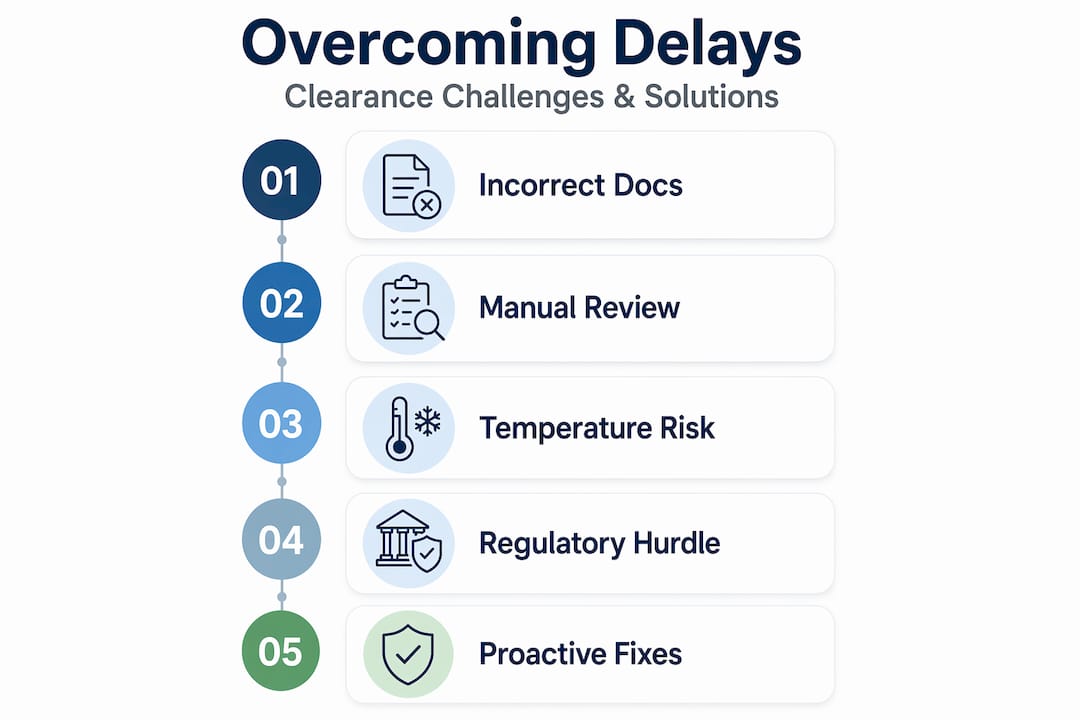
Common edge cases include document errors that trigger the 80% hold rate cited earlier, temperature excursions that result in outright rejection, dual-use or biosecurity red flags that elevate scrutiny, and surge events (pandemic response, seasonal campaigns) that overwhelm standard customs queues. Each one has a proven mitigation path.
Clearance challenge prevention checklist
- Assign a dedicated customs compliance officer to each vaccine import lane, not just a general freight coordinator.
- Pre-file all FDA Prior Notices and CDC/USDA permits before the shipment departs origin, not after.
- Maintain a live document checklist that your broker can access and update in real time during transit.
- Register for AEO, CTPAT, or the National Account Resolution Program (NARP) to access parallel waiver processing during high-volume periods.
- Keep certified cold storage reservations at the port of entry active year-round, not just during known campaign periods.
- Conduct a post-shipment review after every import, documenting what worked, what was flagged, and what was corrected.
- Establish a direct communication channel with your assigned CBP port director and FDA district office contact.
Per IOR and broker best practices, using Importer of Record services alongside specialized customs brokers for FDA and CBP filings, combined with parallel waiver processing, represents the highest-efficiency model for complex vaccine imports. This approach is especially valuable during emergency health responses when standard timelines compress dramatically.
Pro Tip: Don’t wait for a problem to establish your relationship with customs authorities. Proactive communication during normal operations builds the trust that gets your calls returned during a crisis.
For a deeper operational breakdown of what causes delays and how to fix them, the guide on why customs delays happen is worth reviewing with your entire compliance team.
A logistics leader’s perspective: What most compliance guides miss
Every checklist in this article is accurate. Follow it, and your vaccine shipments will clear faster. But here’s what the checklists don’t tell you: the difference between a 90-minute clearance and a 12-hour hold often comes down to relationships and real-time communication, not documentation perfection.
Seasoned logistics managers who move vaccines regularly will tell you that their fastest clearance windows happened not because their paperwork was flawless, but because they had a known, trusted relationship with the customs broker, the port health authority, and the airline’s pharma handling team. When a data logger showed a borderline temperature reading at 3 a.m., it was a phone call to a known contact at the port that got the shipment into contingency cold storage within 20 minutes instead of sitting in a queue for six hours.
The second thing most guides miss is the value of live document correction. Digital platforms like IATA ONE Record aren’t just about speed; they allow corrections to be pushed to all parties simultaneously when a requirement changes mid-transit. A country that updates its import health certificate format during a disease outbreak response isn’t going to wait for your next shipment. Teams using live digital document platforms can update and resubmit in minutes. Teams relying on email chains and PDF attachments find out about the change at the border.
The third insight is about planning for parallel waivers and direct-exit procedures as standard operating procedure, not emergency measures. The teams achieving consistent sub-two-hour clearance windows have pre-negotiated these arrangements with customs authorities as part of their annual import program review. They don’t apply for a parallel waiver when a shipment is already on the ground. They have standing approval.
Finally, the improvement loop never ends. Every shipment, regardless of outcome, should generate a post-event review shared between your internal compliance team, your customs broker, and your cold chain handler. The teams that improve fastest treat each clearance as a data point, not just a transaction. That continuous feedback cycle is what separates the teams hitting expedited shipping benchmarks from those still wondering why their clearance times vary by hours from shipment to shipment.
Partnering for seamless vaccine customs clearance
Knowing the process is one thing. Executing it consistently across multiple origin countries, regulatory environments, and cold chain configurations is another challenge entirely.
Worldwide Express brings deep experience in life science and pharmaceutical logistics, including customs brokerage, international compliance management, and cold chain coordination for vaccine shipments. From managing FDA Prior Notice filings and CBP entry summaries to coordinating CEIV Pharma-certified handlers and contingency cold storage at major U.S. ports, the team is built to handle the full customs process for vaccines without the missteps that cause costly holds. Explore customs brokerage services tailored for regulated cargo, review freight forwarding options for international vaccine shipments, or connect with a specialist through the full range of logistics services to build a clearance program that works every time.
Frequently asked questions
What is the correct HS code for importing human vaccines?
The current HS code for human vaccines is 3002.41, valid through 2027. Starting January 2028, disease-specific subheadings under Chapter 30.07 will apply, so importers should begin mapping their product catalogs to the new codes now.
How early should documents be submitted for vaccine imports?
Best practice calls for submitting all documents three to five days before shipment arrival to enable pre-arrival processing and reduce the risk of holds at the border.
What agencies must approve vaccine shipments to the U.S.?
CBP, FDA, CDC, and USDA may all be involved depending on the vaccine type, with each agency requiring specific permits, registrations, or advance notifications before the shipment arrives.
How do customs handle cold chain vaccine inspections?
Customs authorities check for WHO/IATA packaging compliance and CEIV Pharma certification, and may authorize direct-exit procedures to move temperature-sensitive vaccines to certified cold storage without waiting in standard inspection queues.
Is air or sea freight faster for vaccine customs clearance?
Air freight achieves clearance in 90 minutes to four hours when digital pre-arrival filing is used, while sea freight typically requires 20 hours or more even with digital systems in place.
Recommended
- Customs clearance for businesses: compliance and smooth trade – Worldwide Express, Inc.
- Common customs forms: your guide to global trade success – Worldwide Express, Inc.
- Streamline airport customs clearance for faster shipping – Worldwide Express, Inc.
- Step-by-step guide to exporting goods: compliance to shipment – Worldwide Express, Inc.