TL;DR:
- Most businesses treat overseas sourcing as a simple purchase, overlooking its complex supply chain layers. Failing to properly verify suppliers, calculate landed costs, or ensure compliance can erase expected savings and cause costly delays. Effective global sourcing requires strategic risk management, thorough supplier verification, and meticulous cost and compliance planning.
Most businesses that start sourcing products abroad make the same mistake: they treat it as a purchasing exercise rather than a supply chain strategy. The assumption is that overseas sourcing is simply about finding a cheaper manufacturer, placing an order, and waiting for goods to arrive. In practice, international procurement (the formal industry term) is a multi-layered discipline that spans supplier verification, landed cost modeling, customs compliance, and risk management. Get any one of those layers wrong, and the cost savings you expected can disappear fast.
Key takeaways
| Point | Details |
|---|---|
| Landed cost beats unit price | A $25,000 shipment can realistically land at over $40,000 after freight, duties, and fees. |
| Supplier verification matters | Certifications, samples, and RFQ comparisons protect you from costly sourcing errors. |
| Compliance starts pre-shipment | Customs obligations begin before goods ship, not at the port of entry. |
| Tariff exposure is real in 2026 | A temporary Section 122 import duty adds 10% to landed cost for many product categories. |
| Use freight partners strategically | Working with customs brokers and freight forwarders reduces delays and compliance risk. |
Sourcing products abroad: finding and verifying suppliers
The supplier discovery process is where most new importers rely too heavily on the first result they find. Platforms like Alibaba, Global Sources, and ThomasNet give you a broad view of potential manufacturers, but a listing does not equal a vetted partner. The real work begins after you find a name.

Verification should follow a structured sequence. Start by checking for recognized certifications (ISO, CE, or product-specific quality marks), then request references from existing buyers in markets similar to yours. Most importantly, order product samples before committing to any minimum order quantity. A sample shipment costs far less than a rejected container.
When requesting quotes, always send structured RFQs (Request for Quotations) to at least three to five suppliers simultaneously. Side-by-side comparisons reveal pricing inconsistencies, lead time gaps, and hidden fees that a single-supplier conversation never surfaces. Verified supplier platforms can speed up shortlisting, but they do not replace your own due diligence.
One step that is consistently underestimated: translating product specifications into customs-ready descriptions. Generic product descriptions lead to customs delays. Every description submitted to customs must include material composition, intended use, model or part numbers, and country of origin. Getting this right at the supplier stage prevents expensive clearance problems later.
Pro Tip: Ask your shortlisted suppliers to provide the HS (Harmonized System) code they use when exporting your product. Cross-reference that code against your own country’s import tariff schedule. Discrepancies are common and can signal misclassification risk.
Breaking down landed cost
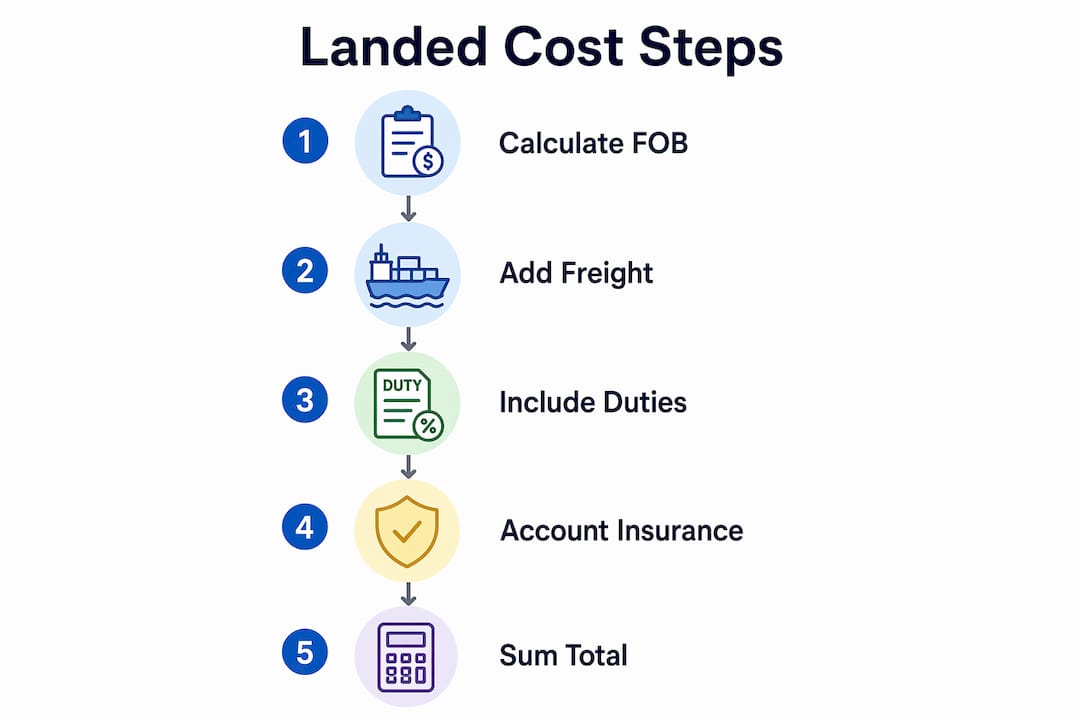
The supplier price is just the starting line. International procurement professionals use the term “landed cost” to describe the true total cost of getting a product to your warehouse door, and the gap between the two numbers is frequently startling.
A landed cost stack typically includes the following components:
| Cost component | Description | Example (USD) |
|---|---|---|
| Product cost (FOB) | Factory price including domestic freight to port | $25,000.00 |
| International freight | Ocean or air freight to destination port | $3,200.00 |
| Marine insurance | Typically 0.5–1% of cargo value | $250.00 |
| Customs duty | Based on HS code and origin country | $5,000.00 |
| MPF/HMF (government fees) | Merchandise Processing Fee and Harbor Maintenance Fee | $520.91 |
| Customs broker fee | Professional clearance services | $400.00 |
| Domestic trucking | Port to warehouse delivery | $1,000.00 |
| Total landed cost | All-in cost | $35,370.91 |
Per expert analysis, a $25,000 shipment from China can reach $40,370.91 after all charges are applied, depending on the duty rate and freight mode. That is a 61% premium over the purchase price. If your margin calculations were based on the supplier invoice alone, the business case collapses entirely.
The 2026 environment makes this calculation even more urgent. A temporary 10% Section 122 duty applies for 150 days starting February 24, 2026, affecting a broad range of imports. Certain USMCA-compliant goods are exempt, but most sourcing from Asia is not. That single surcharge can erase the margin you assumed when you signed the supplier agreement.
Negotiating on FOB price alone is the most common landed cost mistake. Expert practice recommends negotiating on all-in landed cost, which means suppliers and logistics partners both need to be part of your cost-control conversation. Use Worldwideexpress’s landed cost resources to build accurate shipment models before committing to a sourcing decision.
Pro Tip: Build a landed cost spreadsheet for every new product before you finalize a supplier. Update it whenever tariff policy changes. Duty rates can shift mid-year, as the 2026 surcharge demonstrated, and teams that re-forecast landed cost promptly avoid expensive surprises.
Compliance essentials for importers
Customs compliance is not a one-time administrative task. It is an ongoing operational responsibility that begins before your goods ship and continues long after they clear the port.
The foundation of import compliance starts with understanding your role as the Importer of Record (IOR). Per U.S. Customs and Border Protection, the IOR is legally responsible for paying all applicable duties and taxes and for complying with CBP requirements as well as those of Partner Government Agencies (PGAs) such as the FDA, USDA, and EPA. These obligations are commodity-specific, meaning the compliance checklist for a food product looks nothing like the one for an industrial component.
Key compliance steps every importer should address:
- File CBP Form 5106 to establish your importer identity with U.S. Customs. This is required for first-time importers and must be completed before any entry is processed. Per USAGov guidance, customs entries must be filed within 15 calendar days of a shipment’s arrival.
- Classify your products accurately. Commodity codes are internationally specific and govern which duty rates and restrictions apply. A wrong code does not just delay clearance. It can trigger audits, penalties, and seizure of goods.
- Determine if import licenses or permits are required. Licensing requirements are product-driven, not importer-driven. The regulating federal agency for your product category sets the rules. Check early, before production finalizes, because permits follow their own timelines independent of your shipping schedule.
- Engage a licensed customs broker. Brokers know the nuances of CBP requirements, PGA coordination, and entry filing timelines that most businesses do not have the internal expertise to manage.
- Prepare complete, specific documentation. Packing lists, commercial invoices, bills of lading, and certificates of origin must all be accurate and consistent with one another. Discrepancies between documents are one of the top causes of customs holds.
The shared responsibility principle that CBP applies means you cannot delegate compliance entirely to a broker. You are still accountable for the accuracy of the information you provide. Worldwideexpress offers a customs forms guide that breaks down exactly which documents are required for standard import transactions.
Strategic risk management in global sourcing
Beyond cost and compliance, businesses that succeed at global product sourcing understand and actively manage the non-financial risks that can disrupt their supply chains at any time.
Lead times are the first variable to stress-test. Ocean freight from Asia to the U.S. East Coast typically runs 25 to 35 days, but port congestion, weather events, and customs holds routinely extend that window. Your inventory planning needs to account for worst-case lead times, not average ones.
Other critical risk factors to evaluate and monitor:
- Minimum order quantities (MOQs). Suppliers set MOQs to protect their production economics. If your demand does not justify the minimum, you may end up with excess inventory that erodes your working capital.
- Supplier concentration risk. Relying on a single overseas supplier for a core product is a fragile position. Political tensions, factory fires, and regulatory changes have each caused businesses to scramble for alternatives mid-season.
- Tariff policy volatility. The 2026 Section 122 surcharge is a textbook example of how quickly duty structures can change. Agile landed cost management and flexible supplier agreements that allow for price renegotiation are now table stakes for any serious importer.
- Ethical and sustainability factors. Buyers in retail and B2B markets increasingly require documentation of ethical labor practices and environmental standards. Suppliers that cannot provide third-party audit reports are a reputational liability, regardless of price.
Pro Tip: Maintain a shortlist of two to three alternate suppliers for any product that represents more than 15% of your revenue. You do not need to place orders with all of them. Just keep the relationships warm so you can pivot fast when your primary source has a disruption.
Practical steps to operationalize your sourcing
Turning a sourcing strategy into a functioning supply chain requires the right sequence of actions, the right tools, and the right partners. Here is a practical framework for going from supplier selection to goods-in-warehouse:
- Build your landed cost model first. Before you confirm any supplier, use a landed cost calculator to model the full cost stack including freight mode, duty rate, and brokerage fees. Adjust the model for both ocean and air freight to understand your options.
- Issue structured RFQs simultaneously. Send identical RFQ documents to all shortlisted suppliers and require line-item pricing. This creates a true apples-to-apples comparison and often reveals negotiating room.
- Select your freight forwarder early. Freight forwarders arrange the physical movement of goods and can provide binding freight rate quotes before you finalize supplier terms. Engaging them early prevents the common mistake of assuming a freight cost that proves inaccurate.
- Engage a customs broker before goods ship. Your broker should review product descriptions, verify HS code classification, and confirm whether any PGA permits are required. This pre-shipment compliance check is far cheaper than resolving a clearance hold after the fact.
- Set up shipment tracking. Use your freight forwarder’s tracking tools or a third-party visibility platform to monitor your cargo from origin to delivery. Real-time visibility lets you respond to delays before they cascade into stockouts.
- Audit your documentation package. Before goods ship, confirm that the commercial invoice, packing list, bill of lading, and any certificates required by your product category are complete, consistent, and in hand. A single document mismatch can delay an entire shipment.
- Review and repeat. After each shipment cycle, compare actual landed cost to your model. Identify where the gaps were and update your templates for the next order.
Worldwideexpress provides import freight services across ocean, air, and ground modes, coordinated with customs brokerage to handle the full movement from origin port to domestic delivery.
My take on the real cost of going global
I’ve watched businesses enter international procurement with a spreadsheet showing a 40% cost reduction over domestic manufacturing. Six months later, they’ve achieved maybe 10% savings, and a few have actually increased their per-unit costs after factoring in delays, rework, and compliance penalties. The gap between the projection and reality is almost always traced back to one of two things: an incomplete landed cost model or a compliance issue that nobody anticipated.
What I’ve learned from working across dozens of international supply chains is that the businesses that win at global sourcing treat compliance as a competitive advantage, not an administrative burden. They know their HS codes cold. They model every tariff scenario before confirming orders. And they build relationships with customs brokers and freight forwarders who catch problems before they become crises.
My honest advice: spend as much time on the logistics and compliance side of a new supplier relationship as you do on price negotiation. The Importer of Record responsibilities you take on are real, and they can follow you long after a bad shipment is forgotten. Partner with people who have done this thousands of times before you have.
— Ian
Simplify your international shipping with Worldwideexpress
Sourcing internationally means managing a lot of moving pieces at once. Worldwideexpress is built for exactly that.
Worldwideexpress offers freight forwarding, customs brokerage, ocean and air transportation, domestic trucking, and warehousing through a single coordinated platform. Whether you are importing finished goods from Asia, raw materials from Europe, or components from Latin America, the Worldwideexpress team handles customs clearance and compliance so you can focus on your business. Their logistics services are tailored to businesses of all sizes, from first-time importers to established operations managing complex multi-origin supply chains. Get a freight quote and see how Worldwideexpress can take the complexity out of your next overseas shipment.
FAQ
What is landed cost and why does it matter?
Landed cost is the total cost of a product once it reaches your facility, including freight, duties, insurance, broker fees, and domestic delivery. A $25,000 shipment can realistically reach over $40,000 after all charges, which is why sourcing decisions must be based on landed cost rather than purchase price alone.
Who is the Importer of Record?
The Importer of Record is the individual or company legally responsible for ensuring that imported goods comply with U.S. laws and for paying all applicable duties and taxes. Per CBP guidelines, this responsibility includes commodity-specific Partner Government Agency requirements.
Do I need an import license to buy products from abroad?
It depends on your product category. Import licenses and permits are required for certain regulated goods, including food, agriculture, pharmaceuticals, and firearms, and are granted by the relevant federal agency rather than by CBP.
How do I find and verify international suppliers?
Start with established sourcing platforms and directories, then verify through certifications, references, and product samples. Always send RFQs to multiple suppliers simultaneously and confirm that their product descriptions match customs classification requirements.
How does the 2026 tariff environment affect sourcing costs?
A temporary 10% Section 122 duty applies for 150 days starting February 24, 2026, adding meaningful cost to many imports from outside USMCA-compliant trade partners. Importers should re-model their landed cost forecasts immediately if this surcharge applies to their product categories.
Recommended
- Managing Inventory Overseas: A Practical Guide for Importers – Worldwide Express, Inc.
- Top cost-saving tips for importers: reduce shipping expenses – Worldwide Express, Inc.
- Step-by-step guide to exporting goods: compliance to shipment – Worldwide Express, Inc.
- How to Import Goods: A Step-by-Step Guide for Success – Worldwide Express, Inc.