TL;DR:
- USPS international shipping costs depend on service type, package weight, destination price group, and payment method, with optimizing all four reducing expenses. The three main services vary in speed and cost, and knowing the destination’s price group and qualifying for commercial pricing can lead to significant savings. Since September 2024, Global Express Guaranteed is suspended, requiring shippers to consider alternatives like PMEI or private carriers for express deliveries.
USPS international shipping rates are determined by four variables: service type, package weight, destination price group, and payment method. Getting even one of those wrong can mean paying significantly more than necessary. The three primary services are Priority Mail Express International (PMEI), Priority Mail International (PMI), and First-Class Package International Service (FCPIS). Each targets a different combination of speed, weight, and budget. Knowing how retail versus commercial pricing works within these services is where most businesses find their biggest cost savings.
1. USPS international shipping rates by service: what each option costs
The fastest option USPS offers for cross-border shipments is Priority Mail Express International, with retail prices starting at $62.70 and estimated delivery in 3 to 5 business days. Flat rate envelopes under PMEI max out at 4 lbs, while weight-based boxes go up to 70 lbs. This service is the go-to for time-sensitive documents and high-value merchandise when speed justifies the premium.

Priority Mail International starts at $32.65 retail and delivers to approximately 180 countries in about 6 to 10 business days. Flat rate envelopes and small flat rate boxes cap at 4 lbs, while medium and large flat rate boxes allow up to 20 lbs. PMI includes tracking and insurance up to $100 for documents and $200 for merchandise, making it the most practical mid-range option for regular international shippers.
First-Class Package International Service is the lowest-cost tier, starting at $19.40 for packages up to 4 lbs. It suits lightweight items like apparel samples, small electronics accessories, or printed materials. Tracking availability varies by destination country, and insurance is not included, so it works best for low-value, non-urgent shipments.
| Service | Starting Price | Delivery Time | Max Weight | Insurance Included |
|---|---|---|---|---|
| Priority Mail Express International | $62.70 | 3–5 business days | 70 lbs | Yes |
| Priority Mail International | $32.65 | 6–10 business days | 20 lbs (flat rate box) | Up to $200 |
| First-Class Package International Service | $19.40 | Varies | 4 lbs | No |
One critical update for 2026 planning: Global Express Guaranteed (GXG) has been suspended since September 29, 2024. Shippers who previously relied on GXG for guaranteed express delivery now need to route those shipments through PMEI or evaluate private carrier alternatives.
Pro Tip: If your shipment weighs under 4 lbs and the recipient country supports FCPIS tracking, this service often delivers acceptable transit times at a fraction of PMEI cost. Always weigh the package before selecting a service tier.
2. How destination price groups shape your actual shipping cost
USPS does not charge a flat rate to every country. The postal service organizes destinations into price groups, and the same service costs differently depending on which group a country falls into. A PMI shipment to Canada sits in a lower price group than a shipment to a remote Pacific island nation, which means the starting rate of $32.65 is not the rate you will pay for every destination.
The complete price group tables are published in USPS Notice 123 and the International Mail Manual (IMM). These documents break down every country by service and weight increment, giving shippers the data needed to calculate USPS international rates accurately before printing a label. Relying on the published starting price without checking the destination group is one of the most common errors in international shipping cost estimation.
For businesses shipping to multiple destinations, a lane-by-lane rate analysis is the correct approach. Applying a blanket starting rate across all countries produces inaccurate cost projections, which distorts landed cost calculations and erodes margin. Map each destination country to its USPS price group before building any shipping cost model.
| Price Group Factor | Impact on Rate |
|---|---|
| Country classification | Determines base rate per weight increment |
| Service type | PMEI, PMI, and FCPIS each have separate group tables |
| Package weight | Rate increases at defined weight breakpoints per group |
| Flat rate vs. weight-based | Flat rate bypasses group pricing up to weight limits |
3. Retail vs. commercial pricing: where the real savings are
USPS Notice 123 defines two pricing tiers: retail prices and commercial prices. Commercial Base pricing provides a discount below retail, and it is available to customers who prepare and pay for shipments through specific channels. Permit imprint and authorized PC Postage vendors qualify. Click-N-Ship does not qualify for commercial pricing, which surprises many small business owners who assume all online tools produce the lowest rate.
The practical implication is direct: a business printing labels through Click-N-Ship pays retail rates on every international shipment. A business using a permit imprint account or an authorized PC Postage vendor pays the commercial rate. The price increase for PMI averaged about 5.9% in the January 2026 rate adjustment, which means the gap between retail and commercial pricing has grown in absolute dollar terms.
- Qualifying channels for commercial pricing: permit imprint, authorized PC Postage vendors
- Channels that pay retail: Click-N-Ship, post office counter
- Commercial Base pricing: discount below published retail rates
- Commercial Plus pricing: available to high-volume shippers with negotiated agreements
Pro Tip: If you ship more than 50 international packages per month, contact your USPS Business Solutions representative to evaluate permit imprint eligibility. The setup cost is typically recovered within the first month of volume shipping.
4. USPS Delivered Duty Paid and other cost-affecting add-ons
USPS Delivered Duty Paid (DDP) allows shippers to prepay import duties and taxes at the time of mailing, removing the surprise charges that often cause international recipients to refuse or delay package acceptance. DDP is available only at mailing time and applies to select mail types and a limited set of countries. It is not available with First-Class Mail International, International Priority Airmail, or M-bags.
Integrating DDP into label creation workflows has a measurable effect on delivery success rates for e-commerce businesses. When recipients know all duties are prepaid, refusal rates drop and customer satisfaction improves. The current fee structure for DDP started at $0.00 but is subject to increase, so checking the current Notice 123 before building DDP costs into pricing models is necessary.
Other add-ons that affect the total international shipping cost include:
- Tracking: Included with PMEI and PMI; varies by country for FCPIS
- Insurance: Up to $200 for PMI merchandise; not available on FCPIS
- Fuel surcharges: Applied temporarily and updated periodically; check current USPS notices before quoting customers
- Flat rate packaging limits: Envelopes and small boxes max at 4 lbs; medium and large boxes max at 20 lbs. Exceeding these limits shifts pricing to weight-based calculation, which can significantly change the cost.
5. Choosing the right USPS service for your shipment
Matching the shipment to the correct service tier is the fastest way to control international shipping costs. The decision framework is straightforward when you apply it systematically.
- Weigh the package first. Shipments under 4 lbs qualify for FCPIS, which is the lowest-cost option. If the destination country supports tracking on FCPIS and the item has low declared value, this is the default choice for cost-conscious shippers.
- Check the destination price group. Use the IMM price group tables to find the actual rate for your destination, not just the published starting price. A shipment to a high-group country may cost substantially more than the base rate suggests.
- Evaluate flat rate packaging. If your item fits in a PMI flat rate envelope or box and weighs under the applicable limit, flat rate pricing often beats weight-based pricing for denser or heavier items. The flat rate max weight limits gate this option at 4 lbs for envelopes and small boxes, and 20 lbs for medium and large boxes.
- Assess urgency. PMEI at $62.70 and up is the right call when delivery in 3 to 5 business days is a contractual or customer-facing requirement. For non-urgent shipments, PMI at $32.65 and up delivers in 6 to 10 business days at a meaningfully lower cost.
- Confirm commercial pricing eligibility. If you qualify for commercial rates through a permit imprint or authorized PC Postage vendor, apply that pricing before comparing services. The discount changes the cost ranking between service tiers in some weight and destination combinations.
- Plan for GXG absence. Since GXG is suspended, shippers needing guaranteed express delivery should evaluate expedited international alternatives alongside PMEI to find the best fit for time-critical lanes.
- Factor in DDP for e-commerce destinations. For countries where USPS DDP is available, prepaying duties at label creation reduces delivery friction and total landed cost uncertainty for the recipient.
Speed and service tier are the primary cost drivers, per USPS guidance, but rate shopping across weight and packaging options consistently produces savings that flat-rate-only approaches miss.
Key takeaways
USPS international shipping rates are controlled by four variables: service tier, package weight, destination price group, and payment channel. Optimizing all four simultaneously produces the lowest possible cost per shipment.
| Point | Details |
|---|---|
| Service tier drives base cost | FCPIS starts at $19.40, PMI at $32.65, PMEI at $62.70 for retail pricing. |
| Destination price groups matter | The same service costs more to high-group countries; always check the IMM tables. |
| Commercial pricing beats retail | Permit imprint and authorized PC Postage vendors qualify; Click-N-Ship does not. |
| Flat rate limits gate eligibility | Envelopes and small boxes max at 4 lbs; medium and large boxes max at 20 lbs. |
| GXG is suspended | Express shippers must use PMEI or private carrier alternatives since September 2024. |
What I’ve learned about USPS rates after years of watching shippers get it wrong
The single most expensive mistake I see businesses make is assuming that printing a label online automatically gets them the best rate. Click-N-Ship is convenient, but it pays retail. A company shipping 200 international packages a month through Click-N-Ship and never questioning the rate is almost certainly leaving hundreds of dollars on the table every month. The fix is not complicated. It requires setting up the right payment channel, which takes a few days and a conversation with a USPS Business Solutions rep.
The second mistake is applying a blanket starting rate to all destinations. I have seen cost models built entirely on the $32.65 PMI starting price, applied uniformly to shipments going to Western Europe, Southeast Asia, and the Pacific. The actual invoiced costs come in higher, the margin projections are wrong, and no one can explain why. The answer is always the price group tables. They are publicly available in the IMM, and using them takes less than an hour to build into a basic cost model.
USPS DDP is underused. Most shippers I talk to either do not know it exists or assume it is too complex to integrate. For e-commerce businesses shipping to DDP-eligible countries, it is one of the most direct ways to improve delivery success rates without changing carriers. The total landed cost predictability it provides is worth the workflow adjustment.
— Ian
Beyond USPS: how Worldwideexpress helps you optimize international shipping costs
USPS is a strong option for many cross-border shipments, but it is not the only tool available, and it is rarely the optimal choice for every lane, weight class, or urgency level. Worldwideexpress specializes in international freight forwarding, customs brokerage, and logistics services that help businesses identify the most cost-effective routing across carriers and modes. Whether you need air freight, ocean consolidation, or customs clearance support, Worldwideexpress brings the expertise to reduce total landed cost and eliminate the guesswork from international shipping decisions.
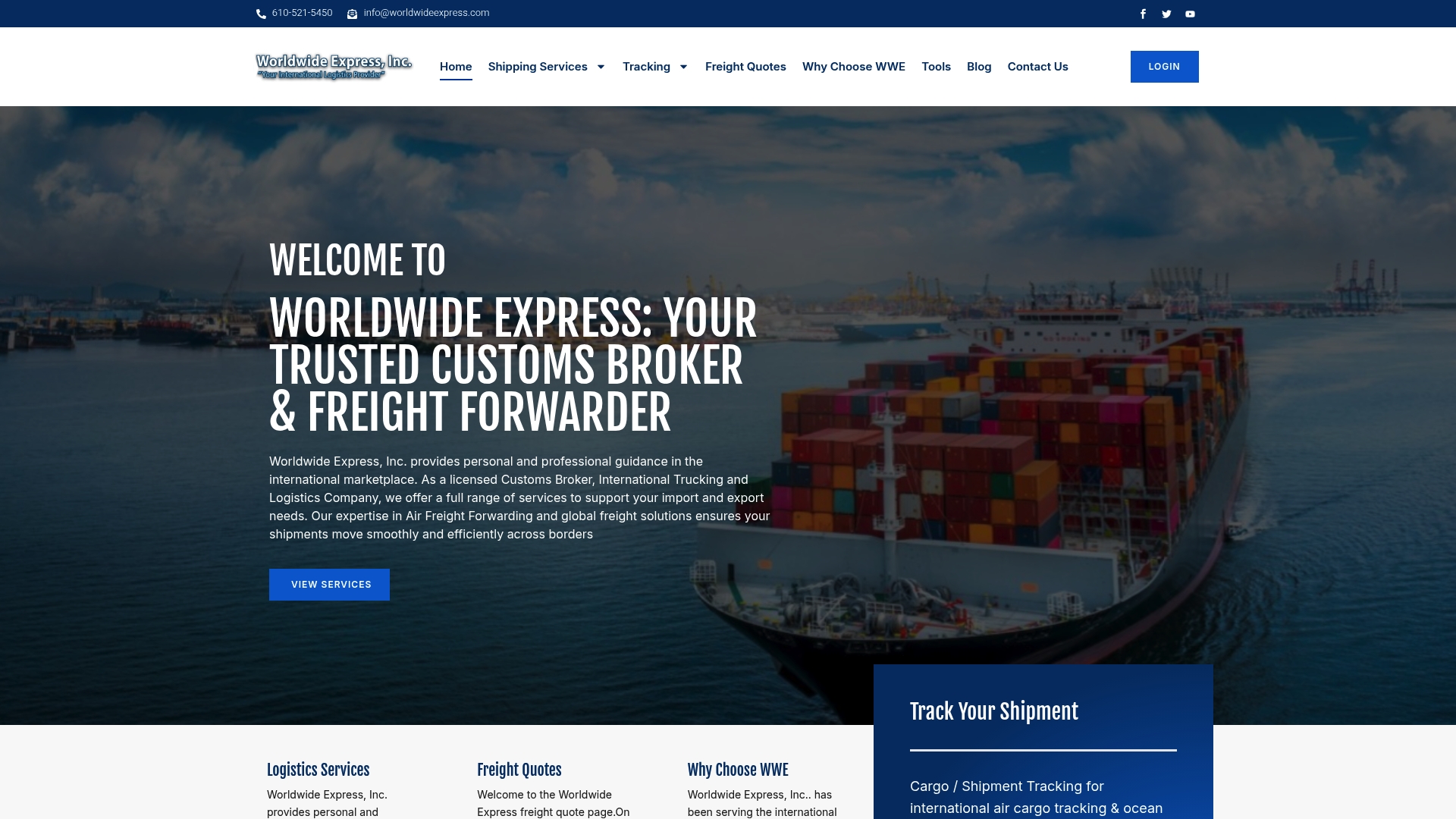
For businesses managing multiple international lanes, Worldwideexpress provides shipping cost strategies that go beyond rate tables and into carrier selection, documentation compliance, and supply chain efficiency. The goal is not just a lower label cost. It is a lower total cost per delivered shipment.
FAQ
What are the current USPS international shipping starting prices?
As of 2026, retail starting prices are $19.40 for First-Class Package International Service, $32.65 for Priority Mail International, and $62.70 for Priority Mail Express International.
Does Click-N-Ship qualify for commercial USPS pricing?
No. Click-N-Ship users pay retail rates. Commercial Base pricing requires preparation through permit imprint or an authorized PC Postage vendor, per USPS Notice 123.
What happened to Global Express Guaranteed?
USPS suspended Global Express Guaranteed on September 29, 2024. Shippers needing express international delivery must now use Priority Mail Express International or a private carrier alternative.
How do destination price groups affect my shipping cost?
USPS assigns every country to a price group, and the same service costs more to higher-group destinations. The full tables are in USPS Notice 123 and the International Mail Manual.
What is USPS Delivered Duty Paid and who should use it?
USPS DDP lets shippers prepay import duties and taxes at mailing time, reducing delivery refusals and improving recipient experience. It is available for select mail types and countries, and is particularly useful for e-commerce businesses shipping internationally.
Recommended
- FedEx International Shipping Rates: 2026 Business Guide – Worldwide Express, Inc.
- Understanding International Shipping Costs: Key Insights – Worldwide Express, Inc.
- USPS International Shipping: Compliance Essentials for 2026 – Worldwide Express, Inc.
- 7 Key Tips for Managing UPS International Shipping Rates – Worldwide Express, Inc.