TL;DR:
- An HS code is a six-digit numerical system used worldwide to classify traded products for customs purposes. Countries add their own digits to this base, making national codes differ but keeping the first six digits consistent globally. Accurate classification prevents penalties, delays, and fines, and requires careful application of the General Rules of Interpretation and proper documentation.
An HS code is defined as a standardized numerical system used by over 200 countries to classify every product traded across international borders. The World Customs Organization (WCO) administers this system, formally called the Harmonized System, and it covers more than 5,000 commodity groups representing over 98% of global merchandise trade. Customs authorities use these codes to determine duty rates, flag regulatory requirements, and process import and export declarations. For importers, exporters, and logistics professionals, understanding what is hs code in shipping is not optional. A wrong code can trigger fines, shipment holds, or worse.
What is HS code in shipping and how is it structured?
The Harmonized System assigns every traded product a six-digit base code that is identical across all participating countries. Those six digits break into three layers: a two-digit chapter, a two-digit heading, and a two-digit subheading. Chapter 61, for example, covers knitted or crocheted clothing. Heading 6109 narrows it to T-shirts. The subheading then specifies the fiber content.

Beyond the six-digit international base, individual countries add their own digits. The United States uses a 10-digit HTS code administered by the U.S. International Trade Commission. The European Union uses an eight-digit Combined Nomenclature (CN) code. India uses an eight-digit HSN code, which stands for Harmonized System of Nomenclature, a term you will encounter frequently in South Asian trade documentation.
| Country / Region | Code Name | Total Digits |
|---|---|---|
| International (WCO) | HS Code | 6 |
| United States | HTS Code | 10 |
| European Union | CN Code | 8 |
| India | HSN Code | 8 |
| China | CIQ Code | 13 |
The first six digits are always the same globally. The extra digits reflect national tariff schedules and statistical tracking needs. This means a product classified under HS 8471.30 in Geneva carries the same first six digits in Tokyo, São Paulo, and Chicago, even though the full national code differs.
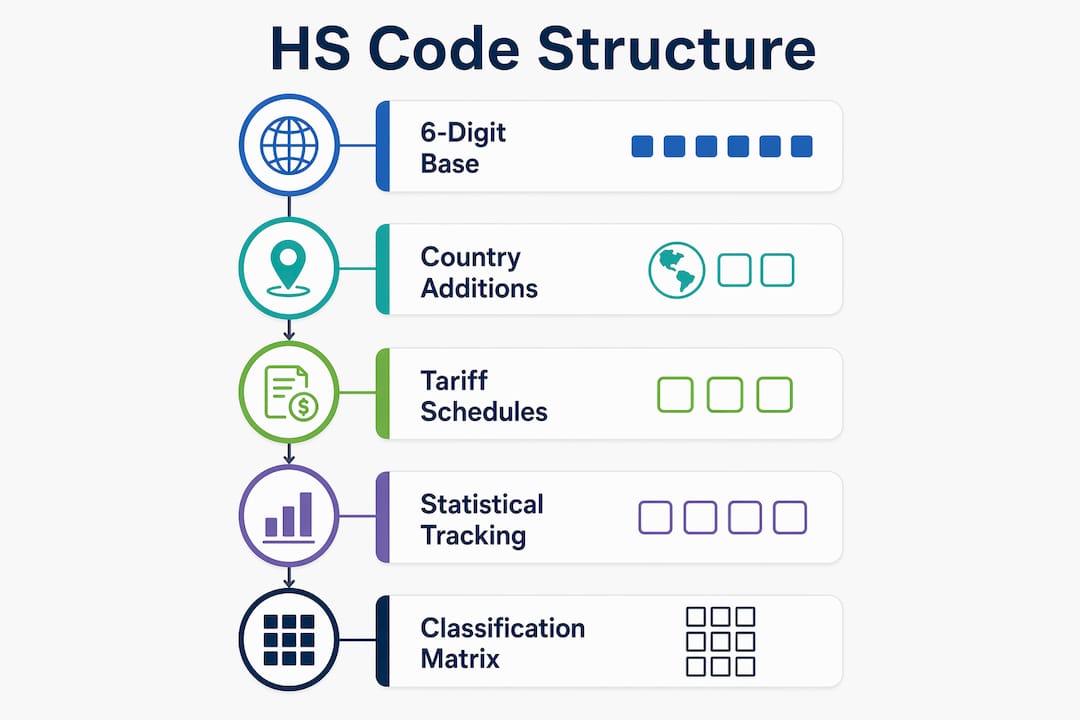
Pro Tip: When shipping to multiple countries, build a classification matrix that maps your product’s six-digit HS base to each destination country’s national extension. This prevents last-minute scrambles at customs and keeps your documentation consistent.
What roles do HS codes play in customs clearance and trade compliance?
HS codes do far more than calculate duties. They serve as the primary regulatory trigger in customs systems worldwide. When a shipment enters a country, the declared code determines which rules apply before a single officer reviews the cargo.
The compliance roles of a shipping HS code include:
- Duty and tariff calculation. The code maps directly to a duty rate in the national tariff schedule. A misclassified product can result in underpayment or overpayment of duties.
- Import and export license requirements. Certain codes require permits, such as those covering controlled chemicals, firearms components, or dual-use technology.
- Anti-dumping and countervailing duties. Specific codes trigger additional duties when goods originate from countries subject to trade remedy orders.
- Agency holds and inspections. Codes linked to food, agriculture, or pharmaceuticals route shipments to agencies like the FDA or USDA for review.
- Trade agreement eligibility. Preferential duty rates under agreements like USMCA depend on the correct HS code to prove origin and qualify for reduced tariffs.
Incorrect codes can cause missed licenses, anti-dumping triggers, or agency holds that delay shipments by days or weeks. That delay has real costs: warehousing fees, missed delivery windows, and damaged client relationships. The code is not a formality. It is the engine that drives every customs decision downstream.
Pro Tip: Never classify a product by its commercial name alone. A “smart speaker” could fall under audio equipment, telecommunications devices, or automatic data processing machines depending on its primary function. Read the chapter notes before you assign any code.
What are the consequences of incorrect HS code classification?
Misclassification carries financial and legal consequences that catch many importers off guard. In the United States, penalties fall under 19 U.S.C. 1592, which establishes three tiers based on intent: negligence, gross negligence, and fraud.
- Negligence. Penalties can reach up to two times the unpaid duties. This applies when an importer fails to exercise reasonable care but had no intent to deceive.
- Gross negligence. Penalties can reach up to four times the unpaid duties. This tier applies when the failure is reckless or shows a pattern of disregard.
- Fraud. Penalties can equal the full value of the merchandise. This applies when misclassification is intentional.
The U.S. Customs and Border Protection (CBP) collected over $600 million in penalty claims in 2025, with average audit duty adjustments reaching $127,000 per case. That average represents a serious financial exposure for mid-size importers who assume classification errors go unnoticed.
Shipment seizure is also possible when codes suggest prohibited goods or when the discrepancy is severe enough to indicate fraud. Beyond seizure, CBP can place an importer on a heightened examination list, meaning every future shipment faces additional scrutiny and delay.
Recovering overpaid duties is not automatic. Importers must file a Post Summary Correction within 180 days of the entry summary or submit a timely protest. Missing that window means the overpayment becomes permanent. Proactive correction is the only path to recovery.
How to accurately classify products using HS codes
Accurate classification starts with a detailed product dossier. Technical specifications, bills of materials, product photos, and manufacturing descriptions all feed the classification process. Vague descriptions like “machine parts” or “electronic components” are the leading cause of classification errors.
The General Rules of Interpretation, known as the GRI, provide the mandatory framework for classification. GRI 1 alone resolves approximately 90% of classification cases when applied correctly. The rules must be applied in sequence, from GRI 1 through GRI 6, stopping when the first rule conclusively identifies the correct heading.
Best practices for classification include:
- Start with the official tariff schedule. Use the U.S. Harmonized Tariff Schedule (USHTS) or the relevant national schedule, not a third-party lookup tool alone.
- Read section and chapter notes first. These notes carry binding legal authority and can include or exclude goods regardless of what a heading’s plain language suggests.
- Apply GRIs sequentially. Skipping steps leads to errors that auditors will find. Document which rule you applied and why.
- Request a binding ruling from CBP. When classification is genuinely ambiguous, a binding ruling gives you legal certainty and protects against penalties.
- Maintain a classification file. Keep records of the product description, the tariff notes reviewed, the GRI applied, and the final code selected. This file is your defense in an audit.
Relying solely on lookup tools without reading notes is one of the most common failures among importers. A tool may suggest a heading, but the chapter notes may expressly exclude your product from that heading. The notes always win.
You can also consult resources on freight classification challenges to understand how classification intersects with broader logistics compliance in 2026.
What is the importer’s legal responsibility for HS code accuracy?
The importer of record holds full legal responsibility for the accuracy of every HS code declared to customs. This responsibility does not transfer to a customs broker, freight forwarder, or any third party. Customs brokers reduce risk but do not absorb legal liability when a classification is wrong.
The standard CBP applies is “reasonable care.” An importer demonstrates reasonable care by:
- Providing complete and accurate product information to the broker
- Reviewing the classification before filing, not just signing off on paperwork
- Maintaining records that show the classification process was deliberate and documented
- Updating classifications when products change or tariff schedules are revised
Reasonable care documentation is the single most effective defense in a CBP audit. An importer who can show a clear paper trail of how a classification was reached, even if the final code turns out to be wrong, faces significantly lower penalties than one who cannot explain the process at all.
Working with a licensed customs broker is strongly advisable, particularly for complex or high-value goods. Brokers bring tariff expertise and classification experience that most importers do not have in-house. The key is treating the broker as a partner in the process, not a service that removes your obligation to understand what is being declared on your behalf. Worldwideexpress offers U.S. customs brokerage services that support importers in building exactly this kind of documented, defensible classification process.
Key Takeaways
Accurate HS code classification is the single most important compliance act an importer performs, because every customs decision, from duty rates to agency holds, flows directly from that code.
| Point | Details |
|---|---|
| Six-digit global standard | The WCO’s six-digit HS base code is identical across all 200+ participating countries. |
| National extensions vary | The U.S. uses 10 digits (HTS), the EU uses 8 digits (CN), and India uses 8 digits (HSN). |
| Misclassification carries real penalties | CBP penalties under 19 U.S.C. 1592 range from double unpaid duties for negligence to full merchandise value for fraud. |
| GRI 1 resolves most cases | Applying General Rule of Interpretation 1 correctly resolves approximately 90% of classification decisions. |
| Importer bears full liability | The importer of record is legally responsible for classification accuracy, even when using a licensed customs broker. |
The classification error I see most often
After years of watching shipments move through customs, the pattern that stands out most is not fraud or deliberate evasion. It is confident ignorance. An importer receives a product, searches a code on a free lookup tool, finds something that sounds right, and files it. No chapter notes reviewed. No GRI applied. No binding ruling requested. The code looks plausible, so it gets used.
That approach works until it does not. And when CBP audits a company with years of the same misclassified entry, the exposure is not one shipment. It is every shipment in the audit window, often going back five years. The $127,000 average audit adjustment figure is not a worst-case scenario. For importers with high-volume, low-unit-value goods, it can be the floor.
The fix is not complicated, but it requires discipline. Build a product classification file before the first shipment, not after the first audit. Read the notes. Apply the GRI in order. If the answer is not clear, request a binding ruling from CBP. That ruling costs nothing and provides legal certainty that no lookup tool can offer.
The transportation and logistics sector, including professionals working across import and export operations, increasingly recognizes that classification accuracy is a core competency, not a back-office detail. The companies that treat it that way ship faster, pay the right duties, and stay off CBP’s radar.
— Ian
How Worldwideexpress supports accurate HS code compliance
Misclassification risk does not have to be a constant concern for your shipping operations.
Worldwideexpress provides logistics and customs brokerage services designed to help importers and exporters classify goods correctly, file accurate declarations, and move shipments through customs without unnecessary delays or penalties. The team brings hands-on tariff expertise and works directly with clients to build the kind of classification documentation that holds up in a CBP audit. Whether you are shipping a single product line or managing a complex multi-origin supply chain, Worldwideexpress offers the support needed to keep your trade operations compliant and on schedule in 2026.
FAQ
What is an HS code in shipping?
An HS code is a standardized six-digit number assigned to every traded product under the World Customs Organization’s Harmonized System. Customs authorities in over 200 countries use it to determine duties, licenses, and regulatory requirements for imported and exported goods.
What does HSN code mean?
HSN stands for Harmonized System of Nomenclature. It is the term used primarily in India and some other countries for the same WCO-based product classification system, extended to eight digits for national tariff purposes.
How do I find the correct HS code for my product?
Start with the official national tariff schedule, read the relevant chapter and section notes, and apply the General Rules of Interpretation sequentially. For ambiguous products, request a binding ruling from CBP to get legal certainty before filing.
What happens if I use the wrong HS code?
Under 19 U.S.C. 1592, U.S. penalties for misclassification range from double the unpaid duties for negligence to the full value of the merchandise for fraud. Shipments can also be delayed, held, or seized.
Does a customs broker take responsibility for HS code errors?
No. The importer of record holds full legal responsibility for classification accuracy. A customs broker can reduce risk through expertise, but legal liability stays with the importer if a code is wrong.
Recommended
- 8 Key Freight Terms Definitions Every Importer Should Know – Worldwide Express, Inc.
- Master customs compliance tips for smoother shipping – Worldwide Express, Inc.
- Harmonized Tariff Schedule: Impact on U.S. Importers – Worldwide Express, Inc.
- Top cost-saving tips for importers: reduce shipping expenses – Worldwide Express, Inc.