TL;DR:
- Effective trade show import logistics require early planning, precise documentation, and the strategic use of customs instruments to prevent delays and control costs.
- Organizing coordination among freight forwarders, customs brokers, and show contractors ensures timely delivery, proper handling, and compliance with all import regulations.
Trade show import logistics is defined as the coordinated management of international freight, customs clearance, and on-site material handling to deliver exhibition materials safely and on schedule to trade show venues. For importers and exporters, this process involves far more than booking a carrier. It requires mastering tools like ATA Carnets and Temporary Import Bonds, choosing the right delivery strategy, and building documentation precise enough to satisfy customs officers on two continents. Specialized logistics providers achieve on-time delivery rates up to 99.8% by building buffer times into all schedules and monitoring shipments proactively. That figure reflects what disciplined planning actually produces, and it sets the standard every exhibitor should aim for.
What are the main components of trade show import logistics?
Trade show import logistics differs from standard commercial shipping in one critical way: the goods are temporary. Exhibit displays, product samples, and demonstration equipment cross borders not to be sold, but to be shown and returned. That distinction shapes every customs decision you make.
The core components break down as follows:
- International versus domestic freight: Air freight suits tight deadlines and high-value items; ocean freight works for large, heavy exhibit structures with longer lead times. Domestic trucking handles the final leg from port or warehouse to venue.
- Customs compliance and documentation: Every shipment needs a commercial invoice, packing list, and accurate Harmonized System (HS) codes. Incomplete manifests with missing HS codes or declared values cause delays and trigger physical inspections.
- Temporary import mechanisms: The ATA Carnet and the Temporary Import Bond (TIB) are the two primary tools for bringing goods into a country without paying permanent duties. Both require proof of re-export.
- Freight forwarding and customs brokerage: A licensed customs broker handles tariff classification and clearance paperwork. A freight forwarder coordinates carriers, warehousing, and delivery scheduling. Many exhibitors use a single provider that covers both functions.
- Drayage and on-site material handling: Drayage charges are billed per hundredweight for moving goods from the loading dock to your booth space. These fees frequently exceed the freight charges themselves, making crate design and weight management a financial priority.
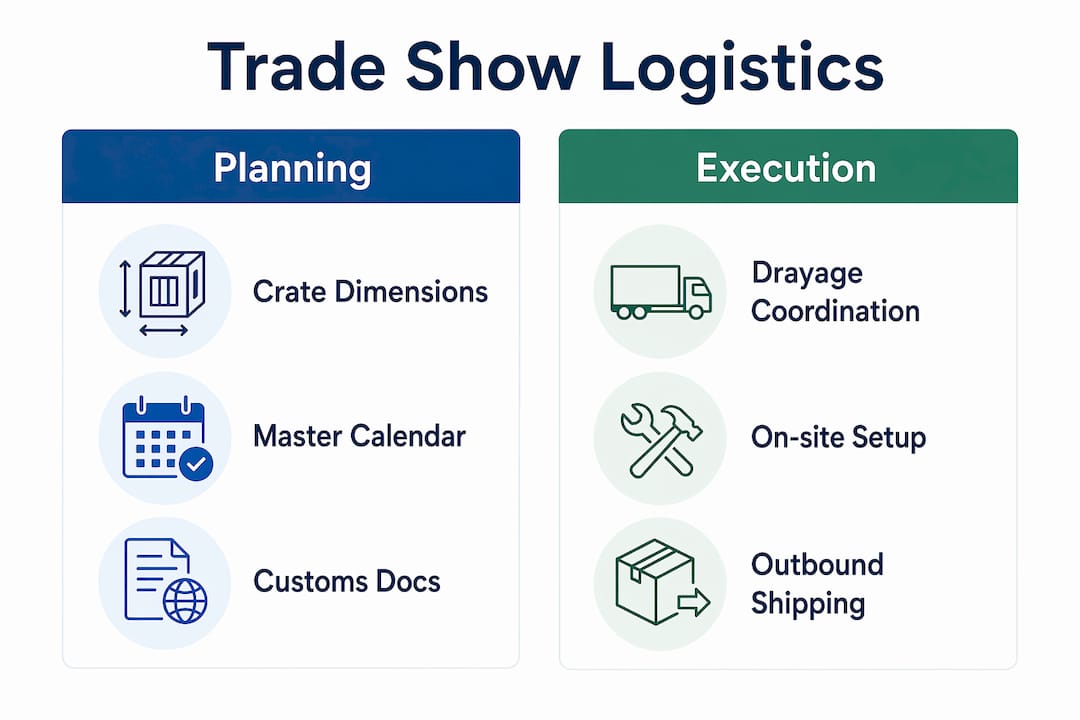
Pro Tip: Request the official show contractor’s drayage rate card before you finalize your crate dimensions. Knowing the per-hundredweight rate lets you calculate the exact cost impact of every extra pound.
Understanding these components as an interconnected system, rather than separate tasks, is what separates exhibitors who arrive ready from those who scramble at the dock.
How to plan trade show imports to avoid common delays and extra costs
Effective planning for international trade show transport starts earlier than most exhibitors expect. Freight planning should begin at least three weeks before the event date to absorb customs clearance timelines, packaging preparation, and venue scheduling requirements. For intercontinental shipments, six to eight weeks is more realistic.
Follow this sequence to keep your shipment on track:
- Confirm show dates and venue contractor deadlines. Every trade show publishes an exhibitor manual with hard cutoff dates for advance warehouse and direct-to-show deliveries. Miss these windows and your freight sits at the dock.
- Choose your delivery method. Advance warehouse delivery accepts freight one to three weeks early, giving you a buffer against weather delays or carrier issues. Direct-to-show delivery has a narrow window, often just one or two days, and carries significantly higher risk for international shipments.
- Separate temporary and permanent goods in your documentation. Misclassification of goods as permanent when they are temporary triggers costly duty reclassification. Keep giveaways, literature, and consumables on a separate invoice from display hardware.
- Engage a freight forwarder with venue-specific experience. Carriers familiar with venues like the Las Vegas Convention Center or McCormick Place in Chicago already know the dock schedules, contractor relationships, and local customs quirks.
- Build a buffer into every deadline. If the advance warehouse opens on a Monday, target the prior Wednesday for your freight to arrive at the origin port. That two-day cushion absorbs most carrier delays.
“Treating trade show logistics as choreographed coordination between multiple parties is critical for predictable success, rather than a ‘booking a truck’ mindset.” — HighVolve Trade Show Logistics Guide
Pro Tip: Build a master logistics calendar that maps every deadline backward from the show open date: customs clearance, freight departure, packaging completion, and document submission. Share it with every vendor involved.
What are best practices for packaging, labeling, and documentation?
Packaging and labeling decisions made in your warehouse directly affect what you pay at the venue dock and how quickly customs clears your freight. Getting these right is not a detail. It is a cost-control strategy.
Packaging that protects and saves money
Custom-built crates with foam-lined interiors protect fragile display components during international transit. Standard pallet sizes (40 x 48 inches in the U.S.) fit most dock equipment and reduce handling time. Stackable crates reduce the floor footprint, which matters when drayage is billed by weight and labor. Every crate should be built to survive multiple round trips, since trade show materials often travel to four or more events per year.
Labeling that moves freight faster
Each crate needs four pieces of information on every visible face: your booth number, the venue name and hall, the crate contents (in general terms), and your on-site contact name and phone number. Missing or illegible labels cause dock workers to set freight aside for manual sorting, which adds hours and fees. Color-coded labels by crate number also help your installation crew identify priority pieces during setup.
Documentation that clears customs
The table below compares the two most common documentation errors and their consequences:
| Common error | Consequence |
|---|---|
| Missing or incorrect HS codes | Physical inspection, clearance delay of 24 to 72 hours |
| Vague item descriptions (e.g., “display parts”) | Customs query, potential duty assessment on full value |
| Declared value inconsistent with invoice | Hold for verification, possible penalty |
| Temporary and permanent goods on one invoice | Duty charged on all items, costly amendment required |

Customs officers prioritize clarity and precision in manifests. Vague or inconsistent documentation significantly raises the risk of inspections. A well-prepared shipping manifest lists every item with its HS code, country of origin, declared value, and temporary or permanent status. Prepare this document before you pack the first crate.
How do ATA Carnets and Temporary Import Bonds simplify trade show imports?
The ATA Carnet and the Temporary Import Bond are the two customs instruments that make international trade show transport financially viable. Without them, exhibitors would pay full import duties on goods they intend to bring home after the show.
ATA Carnet: the passport for goods
The ATA Carnet simplifies temporary imports in participating countries by acting as both a customs declaration and a duty guarantee. It covers over 80 countries and territories. The carnet lists all goods in advance, is stamped at each border crossing, and requires re-export within a period typically capped at one year. The U.S. Council for International Business issues carnets for U.S. exporters, and the process takes several business days, so apply early.
Temporary Import Bond: the U.S.-specific alternative
The Temporary Import Bond lets exhibitors bring goods into the U.S. temporarily without paying duties upfront. The bond covers the estimated duty amount as a surety guarantee. When goods are re-exported within the allowed period, the bond is canceled. Bond costs and documentation management are the primary considerations. TIBs are particularly useful when goods are not covered by an ATA Carnet or when the carnet process is impractical for the shipment type.
| Feature | ATA Carnet | Temporary Import Bond |
|---|---|---|
| Geographic coverage | 80+ countries | Primarily U.S. inbound |
| Upfront cost | Carnet fee plus security deposit | Bond premium (percentage of duties) |
| Re-export proof required | Yes, stamped at departure | Yes, documented export filing |
| Best for | Multi-country exhibition tours | Single U.S. event imports |
| Processing time | Several business days | Faster, often same week |
Pro Tip: If your exhibition calendar includes three or more countries in a single year, the ATA Carnet pays for itself quickly. Calculate the combined duty exposure across all events before deciding between carnet and individual TIBs.
For optimizing international freight transit times, pairing the right customs instrument with the right carrier schedule is the single most effective move an exhibitor can make.
What strategies ensure smooth on-site logistics and outbound shipping?
The freight arriving at the venue is only half the challenge. What happens at the dock, on the show floor, and during outbound shipping determines whether your total logistics cost stays within budget.
Key strategies for on-site and return logistics include:
- Understand the difference between freight and drayage. Freight is the transport from origin to venue. Drayage costs often surpass freight expenses and depend heavily on crate design. Using standard pallets and clear labels expedites handling and reduces labor fees. The Worldwideexpress resource on trade show drayage explains how these charges are calculated and how to contest errors.
- Coordinate dock appointments in advance. Most convention centers assign unloading windows. Missing your window means your freight waits in a queue, sometimes for hours. Confirm your appointment 48 hours before arrival.
- Keep material handling paperwork with the freight. The show contractor’s material handling agreement travels with each crate. Sign it accurately. Errors on this form create billing disputes that take weeks to resolve.
- Label outbound shipments before the show closes. Pre-print return labels and attach them to crates before setup. When the show ends, your crew applies labels and calls the carrier rather than scrambling to create documentation under time pressure.
- Plan for contingencies. Identify a local expedited freight option before the show opens. If a crate goes missing or arrives damaged, you need a same-day solution, not a phone tree.
The 2014 drayage crisis demonstrated how quickly on-site logistics can collapse without contingency planning. Exhibitors who had backup carriers and pre-arranged storage recovered quickly. Those who did not lost setup days.
Key takeaways
Effective trade show import logistics requires early planning, precise documentation, and the right customs instruments to control costs and avoid delays at every stage of the shipment.
| Point | Details |
|---|---|
| Start planning early | Begin freight coordination at least three weeks out; six to eight weeks for intercontinental shipments. |
| Use the right customs tool | Choose ATA Carnet for multi-country tours and Temporary Import Bond for single U.S. events. |
| Separate temporary and permanent goods | Document them on separate invoices to prevent misclassification and unexpected duty charges. |
| Optimize crate design | Standard pallets and clear labeling reduce drayage costs, which often exceed freight charges. |
| Choose advance warehouse delivery | It provides a buffer against delays that direct-to-show delivery cannot absorb. |
The real cost of treating trade show logistics as an afterthought
Having covered trade show import logistics for years, the pattern that stands out most is not the complexity of customs rules. It is how often experienced importers underestimate the coordination required between parties who have never worked together before.
A customs broker in Frankfurt, a freight forwarder in Chicago, a show contractor at the Las Vegas Convention Center, and your own installation crew are all operating on different timelines with different priorities. When one of them receives incomplete information, the entire chain stalls. The exhibitor pays for that stall in drayage overtime, storage fees, or a booth that is not ready when the doors open.
The documentation piece deserves more respect than it typically gets. Customs officers do not give credit for good intentions. A manifest that says “display components” instead of listing each item with its HS code and declared value is not a minor oversight. It is an invitation for a physical inspection that could hold your freight for two days. Two days before a trade show is not a recoverable situation for most exhibitors.
What actually works, based on real shipment outcomes, is treating the logistics plan as a living document that every party signs off on before freight moves. That means your freight forwarder confirms the customs instrument is in place, your packaging team confirms crate weights against the drayage rate card, and your on-site coordinator confirms the dock appointment. When all three confirmations exist before departure, the 99.8% on-time delivery rate that top logistics providers achieve becomes believable rather than aspirational.
The exhibitors who consistently hit that standard are not lucky. They are organized.
— Ian
How Worldwideexpress supports your trade show shipping needs
Worldwideexpress brings together customs brokerage, international freight forwarding, and on-site logistics coordination under one roof, specifically for exhibitors who cannot afford delays. The team handles ATA Carnet preparation, TIB management, and itemized manifest filing so your freight clears customs without surprises. Worldwideexpress also manages advance warehouse scheduling and outbound return freight, covering the full logistics cycle from origin to booth and back. For importers and exporters managing multi-event calendars across multiple countries, the logistics services offered by Worldwideexpress provide the proactive monitoring and documentation precision that trade show timelines demand. Get a freight quote today and put a professional team behind your next exhibition.
FAQ
What is trade show import logistics?
Trade show import logistics is the coordinated process of managing international freight, customs clearance, and on-site material handling to deliver exhibition goods safely and on time to trade show venues.
How early should I start planning trade show freight?
Freight planning should begin at least three weeks before the event date, and six to eight weeks for international shipments, to allow time for customs clearance and venue scheduling.
What is the difference between an ATA Carnet and a Temporary Import Bond?
An ATA Carnet covers temporary imports across 80-plus countries and acts as a combined customs declaration and duty guarantee, while a Temporary Import Bond is a surety instrument used primarily for U.S. inbound shipments that covers estimated duties until goods are re-exported.
Why are drayage costs often higher than freight costs?
Drayage is billed per hundredweight for moving goods from the dock to your booth, and labor-intensive handling of oversized or poorly labeled crates drives fees above the original freight cost.
What happens if customs paperwork is incomplete?
Incomplete or vague manifests trigger physical inspections and clearance delays of 24 to 72 hours, and misclassified goods can result in unexpected duty charges that require costly amendments to resolve.
Recommended
- How to Import Goods: A Step-by-Step Guide for Success – Worldwide Express, Inc.
- Master International Freight Shipping for Successful Trade – Worldwide Express, Inc.
- Master the Export Documentation Process in 2025 – Worldwide Express, Inc.
- Understanding freight forwarding: a 2026 guide – Worldwide Express, Inc.