TL;DR:
- Most exports do not require a license, but all are subject to export control laws and regulations.
- Export license requirements depend on the product, destination, and end user, with only about 5% of U.S. exports needing one.
An export license is a government-issued permit that authorizes the export of specific goods, technology, or software to particular destinations, and understanding export licenses is the first step toward legal, penalty-free international trade. Most businesses assume they need one for every shipment. They do not. But the exceptions carry serious legal weight, and getting them wrong costs far more than the paperwork would have.
In the United States, the Bureau of Industry and Security (BIS) and the Directorate of Defense Trade Controls (DDTC) govern the bulk of export licensing decisions. In the United Kingdom, the Export Control Joint Unit (ECJU) holds that authority. Both systems share the same underlying logic: certain goods, sent to certain places, for certain purposes, require explicit government approval before they leave the country.
What determines when an export license is required?
The answer comes down to three factors evaluated together: the item being exported, the destination country, and the end user or end use. No single factor triggers a license requirement on its own. A piece of dual-use electronics shipped to Canada for commercial manufacturing is treated very differently from the same component shipped to a sanctioned country for military integration.
Only about 5% of U.S. exports require an export license. That figure is worth sitting with. It means the vast majority of cross-border shipments move without formal licensing, yet every single one remains subject to export control laws. The distinction matters because “no license required” is not the same as “no rules apply.”
The items most likely to trigger licensing requirements fall into several controlled categories:
- Dual-use goods: Commercial products with potential military or weapons applications, such as advanced semiconductors, encryption software, and certain chemical compounds
- Defense articles and services: Items on the U.S. Munitions List (USML), administered by DDTC under the International Traffic in Arms Regulations (ITAR)
- Sanctioned destinations: Countries subject to Office of Foreign Assets Control (OFAC) restrictions, including Iran, North Korea, and Cuba
- Restricted end users: Individuals or organizations on the BIS Entity List, Denied Persons List, or Unverified List
Export license determinations are not automatic by industry. They require evaluating product controls, the buyer’s identity, and the destination collectively. A company that skips any one of those three checks is operating on incomplete information.
Pro Tip: Use the BIS Commerce Control List (CCL) to find your product’s Export Control Classification Number (ECCN). That number tells you which controls apply and whether a license exception might cover your shipment.
What are the main types of export licenses?
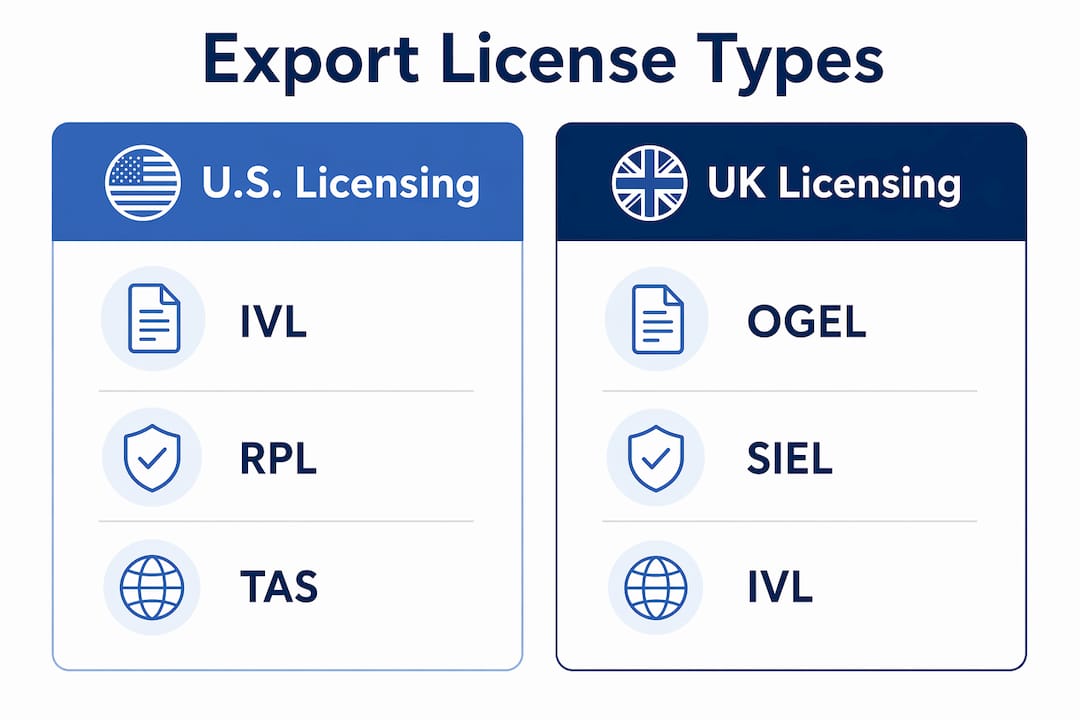
U.S. licensing under the Export Administration Regulations
The Export Administration Regulations (EAR), enforced by BIS, govern most commercial and dual-use exports. Under EAR, exporters can ship under a license exception (a pre-approved category that removes the need for an individual license), or they must apply for a specific license through BIS’s SNAP-R system. U.S. license applications under EAR must be submitted via SNAP-R by a person located in the United States, typically the exporter of record. Foreign freight forwarders or overseas buyers cannot submit on their behalf.

Individual validated licenses (IVLs) are the most common formal license type under EAR. They authorize a specific transaction between named parties for a defined product and destination. License exceptions, such as EAR99 classification or the Technology and Software Unrestricted (TSU) exception, allow shipments to proceed without a formal application when specific conditions are met.
UK licensing under ECJU
The ECJU administers three primary license types. The Open General Export License (OGEL) covers specified controlled goods and allows exporters to ship without applying for an individual license, provided they register and comply with the OGEL’s conditions. The Standard Individual Export License (SIEL) applies to goods not covered by an OGEL and is issued for specific transactions. The Open Individual Export License (OIEL) suits exporters with long-term contracts or ongoing projects requiring repeated shipments of the same controlled goods.
| License Type | Jurisdiction | Authority | Key Feature |
|---|---|---|---|
| Individual Validated License (IVL) | United States | BIS | Transaction-specific, applied via SNAP-R |
| ITAR License | United States | DDTC | Required for USML defense articles |
| OGEL | United Kingdom | ECJU | Pre-approved for specified goods; registration required |
| SIEL | United Kingdom | ECJU | Single transaction, goods not covered by OGEL |
| OIEL | United Kingdom | ECJU | Long-term or repeat shipments under one license |
Pro Tip: UK exporters using an OGEL must include the specific OGEL license reference on their customs declarations. Missing or incorrect references can constitute a criminal offense under regulations effective since late 2025.
How do you obtain an export license and meet filing requirements?
The export licensing process in the U.S. follows a defined sequence. Getting it right requires coordination across legal, logistics, and commercial teams before a shipment ever reaches the dock.
- Classify your product. Identify the ECCN using the BIS Commerce Control List or request a commodity classification ruling from BIS directly.
- Screen the transaction. Check the destination country against the Country Chart in EAR Supplement No. 1 to Part 738. Screen the buyer against BIS, OFAC, and State Department restricted party lists.
- Determine license requirement or exception. If a license is required and no exception applies, proceed to the SNAP-R application.
- Submit via SNAP-R. The license applicant must be the exporter, a U.S.-based person. Misalignment on this point causes rejected submissions and shipment delays.
- File through AES. All export information for U.S. shipments must be filed electronically through the Automated Export System (AES), enforced by U.S. Customs and Border Protection (CBP). AES filing is mandatory even when no license is required.
- Retain records. EAR requires exporters to keep records of all export transactions for five years.
The AES filing step trips up more exporters than any other part of the process. AES filing mistakes are common and cause compliance issues, including shipment holds, even when a valid license is already in place. The license approval and the AES filing are two separate obligations that must align. For a detailed walkthrough of the filing process, Worldwideexpress provides a dedicated resource on AES filing requirements that covers the technical steps in full.
For UK exporters, OGEL compliance requires registering with the ECJU’s SPIRE system and then correctly declaring the license reference on every applicable customs form. The ECJU does not automatically verify that exporters are using OGELs correctly. That responsibility sits entirely with the exporter.
Pro Tip: Assign a single internal owner for export licensing decisions. When legal, sales, and logistics teams each assume someone else is handling classification or filing, critical steps get missed. One named compliance lead changes that dynamic immediately.
How do export license requirements vary by industry?
Export license requirements are not uniform across sectors. The variability depends on product characteristics, technical specifications, and the sensitivity of the destination market. Some industries face licensing scrutiny on nearly every international transaction. Others rarely encounter it.
The sectors with the heaviest licensing burden include:
- Defense and aerospace: Items on the USML require ITAR licenses from DDTC. This includes aircraft components, satellite technology, and firearms. Even technical data shared with foreign nationals can trigger a deemed export requirement.
- Dual-use technology: Advanced semiconductors, encryption software, and certain laser systems fall under EAR and often require individual licenses for shipments to higher-risk destinations.
- Chemicals and biological agents: Precursor chemicals for weapons and select biological agents are tightly controlled under both EAR and separate Chemical Weapons Convention obligations.
- Software and cybersecurity tools: Intrusion software and surveillance technology face specific controls under the Wassenaar Arrangement, which the U.S. and UK both implement.
End-user restrictions add another layer of complexity. A product that ships freely to Germany may require a license for the same transaction in Malaysia if the buyer appears on a restricted party list. Embargoes against specific countries, such as those administered by OFAC, can make certain transactions impossible regardless of the product’s classification. The consequences of noncompliance include civil penalties, criminal prosecution, and loss of export privileges. For a grounding in how these controls operate across U.S. trade, the Worldwideexpress guide on export controls basics is a useful starting point.
Key takeaways
Export license compliance requires evaluating the item, destination, and end user together, filing through AES regardless of license status, and assigning clear internal ownership of the process.
| Point | Details |
|---|---|
| Most exports don’t need a license | Only about 5% of U.S. exports require a license, but all are subject to export control laws. |
| Three factors drive license decisions | Product classification, destination country, and end user must all be evaluated together. |
| AES filing is always mandatory | U.S. exporters must file through AES even when no export license is required. |
| UK exporters face new declaration rules | OGEL license references must appear on customs declarations or exporters risk criminal liability. |
| Internal role clarity prevents delays | The license applicant must be the U.S.-based exporter of record; misalignment causes rejected submissions. |
What I’ve learned from watching exporters get this wrong
After years of working alongside businesses shipping goods across borders, the pattern I see most often is not ignorance of export controls. It is overconfidence about the easy cases. A company ships the same product to the same region for five years without incident, assumes the sixth shipment is identical, and misses a regulatory update that added their buyer’s parent company to the Entity List.
The other failure mode is structural. CBP enforces export regulations but does not decide licensing requirements. Exporters must direct commodity licensing questions to BIS or DDTC directly. Many companies do not know that distinction and waste weeks waiting for answers from the wrong agency.
The 2026 regulatory environment has added new pressure points. The UK’s updated OGEL declaration requirements, effective since late 2025, caught a number of exporters off guard because the change was procedural rather than substantive. The goods were still eligible. The license was valid. But the customs declaration was wrong, and that alone created a compliance violation.
My honest advice: treat export compliance as a continuous process, not a one-time checklist. Regulations change. Buyer circumstances change. Destination risk profiles change. The exporters who stay clean are the ones who build monitoring into their operations rather than reviewing controls only when a new contract lands. The Worldwideexpress resource on export compliance best practices reflects exactly that ongoing discipline.
— Ian
How Worldwideexpress supports your export compliance
Worldwideexpress brings deep expertise to the documentation and compliance requirements that come with international freight forwarding. From customs brokerage to AES filing guidance, the team at Worldwideexpress helps businesses identify their licensing obligations before a shipment is booked, not after it is held at the border.
Whether you are shipping dual-use technology, defense-adjacent components, or commercial goods to higher-risk markets, Worldwideexpress provides tailored logistics solutions that account for regulatory requirements at every stage. The freight forwarding guide for 2026 outlines how those services connect to the compliance obligations covered in this article. Contact Worldwideexpress to discuss your specific export requirements and build a shipping process that holds up to scrutiny.
FAQ
What is an export license?
An export license is a government-issued authorization that permits the export of specific controlled goods, technology, or software to designated destinations. In the U.S., BIS and DDTC issue the majority of export licenses depending on the product category.
Do all exports require a license?
No. Only about 5% of U.S. exports require a license, though all exports remain subject to export control laws and AES filing requirements enforced by CBP.
Who can apply for a U.S. export license?
Under EAR Part 748, only a person located in the United States may apply for an export license through the BIS SNAP-R system. The applicant is typically the exporter of record.
What are the main UK export license types?
The ECJU administers three primary types: the OGEL for specified controlled goods, the SIEL for individual transactions not covered by an OGEL, and the OIEL for long-term or repeat export projects.
What happens if you export without a required license?
Exporting controlled goods without a required license can result in civil penalties, criminal prosecution, and permanent loss of export privileges under both U.S. EAR and UK export control regulations.
Recommended
- Master the Export Documentation Process in 2025 – Worldwide Express, Inc.
- Step-by-step guide to exporting goods: compliance to shipment – Worldwide Express, Inc.
- Import License Requirements: Ensuring U.S. Trade Compliance – Worldwide Express, Inc.
- Complete Guide to Export Controls Basics for U.S. Trade – Worldwide Express, Inc.