When searching for international shipping near me, the single most important action is this: confirm the provider holds an active FMC Ocean Transportation Intermediary (OTI) license and can name the specific CBP-licensed customs broker who will sign your entry documents. Everything else follows from that.
Run these verification steps before signing anything:
- Check the FMC OTI record. Search the provider’s exact legal business name at the FMC licensed forwarder database — not the trade name on their website.
- Ask for the named CBP broker. Request the individual broker’s license number, not just a company permit. Per AHAeCommerce, that broker signs entries under penalty of perjury.
- Request an itemized landed-cost quote. It must break out freight, duties, ISF filing fee, handling, insurance, and destination charges separately.
- Confirm bond and cargo insurance arrangements. Ask who places the policy and how claims are filed.
- Verify lane experience. Ask how many shipments they moved on your specific origin-to-U.S.-port lane in the past 12 months.
- Request sample paperwork. A House Bill of Lading and a sample ISF filing process summary are reasonable asks before any commitment.
Red flags: vague answers about licensing, refusal to name the broker who will sign entries, all-in quotes with no line-item breakdown, and no sample documentation on request. Walk away from any provider who cannot clear these in one conversation, per guidance from Artemus Group.
Key Takeaways
Choosing a compliant, reliable local international freight forwarder requires verifying FMC OTI and CBP credentials, demanding an itemized landed-cost quote, and confirming lane experience before any shipment is booked.
| Point | Details |
|---|---|
| Verify FMC OTI and CBP licenses | Pull the provider’s exact legal name from the FMC database and ask for the individual CBP broker license number. |
| Demand an itemized landed-cost quote | The quote must break out freight, duties, ISF, handling, insurance, and destination charges separately. |
| Confirm lane experience and agent network | Ask how many shipments the provider moved on your specific lane and who their destination agent is. |
| Understand cargo insurance and bonded warehousing | Confirm whether all-risk cargo insurance is placed and whether bonded storage is available for duty deferment. |
| Worldwideexpress as a verified option | Worldwideexpress provides FMC-licensed forwarding, named CBP brokerage, cargo insurance, and bonded warehousing with a pre-shipment audit checklist on every new lane. |
Table of Contents
- Who is responsible for cargo insurance under common Incoterms?
- What drives timelines and costs on common international lanes?
- Which certifications signal a more reliable provider?
- How do bonded warehouses fit into the customs process?
- How do you stay ahead of customs compliance changes?
- What should you expect from tracking and communication?
- Worldwideexpress covers the full range of cross-border logistics
- What experienced buyers get wrong when vetting local forwarders
- Authoritative resources for license verification and compliance
- Sources
Who is responsible for cargo insurance under common Incoterms?
Carrier liability under standard ocean bills of lading is limited, often far below the commercial value of the goods. Under CIF (Cost, Insurance, and Freight) terms, the seller arranges minimum insurance coverage to the named destination port. Under FOB (Free on Board) or EXW (Ex Works), the buyer bears full risk from the point of origin and must arrange their own all-risk cargo policy. Under DDP (Delivered Duty Paid), the seller covers all costs including duties, but cargo insurance terms still need explicit confirmation.
The practical takeaway: regardless of Incoterms, ask your forwarder whether they place separate all-risk cargo insurance or rely on carrier liability limits. The difference between the two can be significant when a container is damaged at sea.
What drives timelines and costs on common international lanes?
Air freight from major Asian hubs to U.S. gateway airports typically transits in 3–7 days; ocean LCL (less-than-container-load) on the same lanes runs 18–35 days depending on the port pair and transshipment routing. Full container load (FCL) ocean shipments from Northern Europe to U.S. East Coast ports average 10–14 days on direct services. These are transit times only — add 2–5 business days for customs clearance at destination.
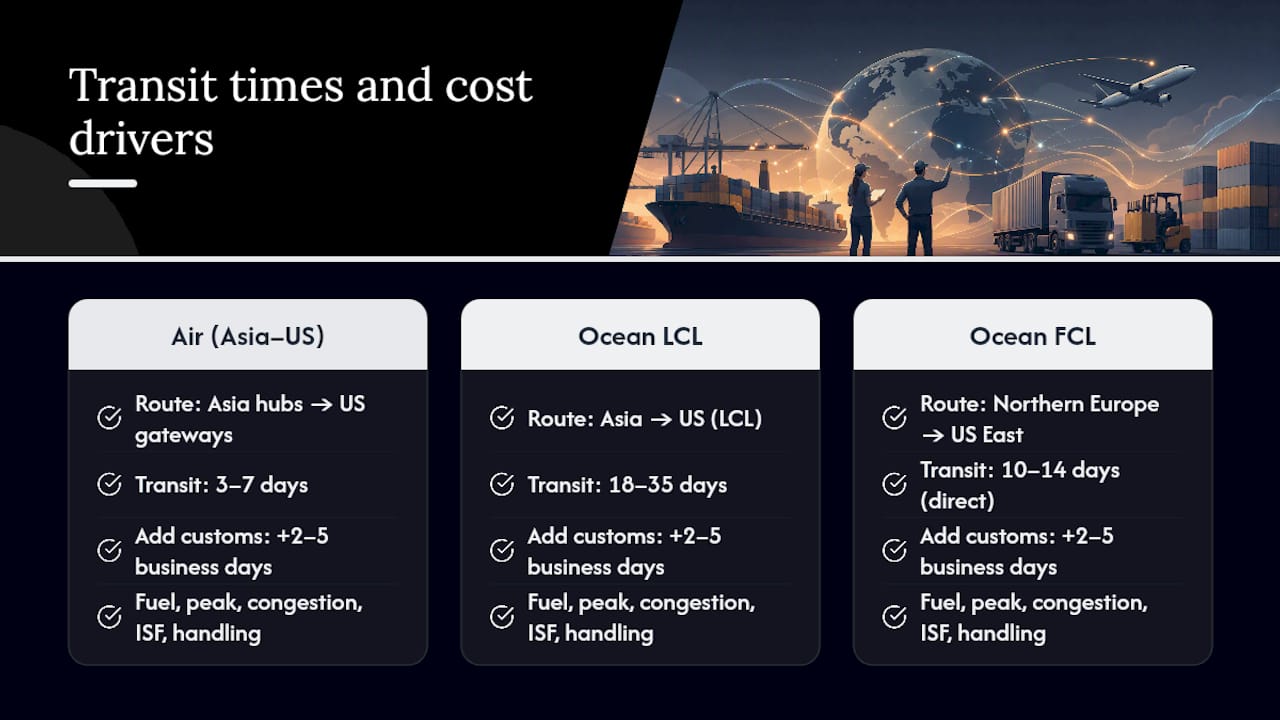
Cost drivers include fuel surcharges, peak-season space premiums, port congestion fees, ISF filing costs, and destination handling. A detailed air vs. ocean freight comparison helps clarify which mode fits your cargo value and lead-time tolerance.
Which certifications signal a more reliable provider?
Beyond FMC OTI and CBP licensing, look for these:
- C-TPAT membership (Customs-Trade Partnership Against Terrorism): indicates the provider meets CBP’s supply chain security standards and can accelerate border processing for your cargo.
- IATA accreditation: required for agents handling air cargo on commercial airlines; confirms the provider can book directly with carriers.
- ISO 9001 certification: signals documented quality management processes, which matters for document control and error rates.
- NCBFAA membership (National Customs Brokers and Forwarders Association of America): a professional membership that indicates ongoing compliance education.
None of these replace the FMC OTI and CBP license checks, but they meaningfully reduce operational risk on complex lanes.
How do bonded warehouses fit into the customs process?
A bonded warehouse is a CBP-approved facility where imported goods can be stored for up to five years without paying duties until the goods are formally entered into U.S. commerce. This matters for importers managing cash flow on high-duty merchandise, or for businesses that re-export a portion of their inventory. Confirm whether your provider has access to bonded warehouse facilities and how duty deferment and disbursement will appear in your landed-cost quote.

How do you stay ahead of customs compliance changes?
Customs regulations shift frequently — HTS classification updates, new antidumping and countervailing duty orders, and CBP enforcement priorities can change with little notice. The most effective approach is to work with a CBP-licensed customs broker who actively monitors Federal Register notices and CBP binding ruling updates. Ask your provider how they communicate regulatory changes to clients and whether they conduct periodic HTS classification reviews. Missed ISF filings, inaccurate classifications, and incomplete documentation are among the most common triggers for delays and penalties — and all three are preventable with the right broker relationship, as project44 notes.
When a customs hold or exam does occur, your provider should notify you within hours, not days. Ask upfront who your point of contact is during a CBP exam, what the escalation path looks like, and whether they carry errors and omissions coverage.
What should you expect from tracking and communication?
A reliable provider offers shipment-level visibility: confirmed booking, departure, arrival at port, customs release, and final delivery, each with timestamps. Ask whether tracking is available through a portal or requires manual status requests. For high-value or time-sensitive cargo, milestone alerts via email or SMS are a reasonable expectation. Supply chain visibility tools have made real-time tracking standard at most established forwarders — if a provider cannot offer it, that is worth noting during vetting.

Worldwideexpress covers the full range of cross-border logistics
Cross-border freight is faster and less costly when one provider handles forwarding, brokerage, and insurance without handoff gaps.
Worldwideexpress offers U.S. customs brokerage, ocean and air forwarding, cargo insurance placement, bonded warehousing, trucking, and shipment visibility tools under one roof. The onboarding process starts with a lane-specific landed-cost estimate that itemizes every charge, followed by a pre-shipment audit checklist covering ISF responsibility, HTS classification review, packing and labeling requirements, and bond confirmation. FMC OTI credentials and named CBP license holders are available on request before any booking. For import freight services or a full logistics services overview, request a quote directly and receive a response with lane-specific figures.
What experienced buyers get wrong when vetting local forwarders
Most procurement failures trace back to one of three oversights: trusting a polished website without pulling the FMC record, accepting a company-level customs permit instead of asking for the individual broker’s license number, and ignoring the provider’s agent network at destination.
That last point is underappreciated. A forwarder with weak local agents at the destination port cannot resolve a customs hold quickly, cannot secure space during peak season, and cannot give you accurate local delivery estimates. Ask specifically: “Who is your agent at [destination port], and how long have you worked with them?”
Per AHAeCommerce’s breakdown of forwarder vs. broker roles, splitting the forwarder and customs broker functions can reduce costs for shippers with high repeat volumes and stable classifications. The logic: a standalone broker who handles only your entries can often negotiate a lower per-entry fee than a bundled service. For occasional or complex shipments, the coordination overhead usually outweighs the savings.
Pro Tip: Request a redacted sample of a prior House Bill of Lading and a completed CBP Form 7501 before signing any service agreement. A provider confident in their documentation quality will share these without hesitation. Include one SLA line in your contract: “Provider will notify shipper within four business hours of any CBP exam or hold.”
Authoritative resources for license verification and compliance
Use these tools and resources to confirm credentials and review compliance requirements before contracting any provider:
- FMC OTI License Search: FMC licensed forwarder database — verify ocean freight forwarder and NVOCC licenses, bond amounts, and renewal dates.
- CBP Broker License Verification: Search the CBP broker database at cbp.gov to confirm an individual broker’s license status and district.
- Project44 customs broker explainer: What is a customs broker — clear overview of CBP licensing, Form 7501 responsibilities, and why brokers prevent border delays.
- Worldwideexpress customs brokerage resources: Customs broker roles explained and how to choose a freight forwarder for next steps.
Before ending any provider conversation, capture and save: a screenshot of their FMC OTI record, the named broker’s license number, a sample House B/L or Form 7501, and the full itemized quote with all surcharges listed.
Sources
- Licensed Freight Forwarders – Trade Names
- What is a customs broker in supply chain? | project44
- How To Choose A Freight Forwarder: A US Guide
- Freight Forwarder vs Customs Broker: The Two Roles Explained | AHAeCommerce
Recommended
- International Shipping Companies Near Me: 2026 Guide – Worldwide Express, Inc.
- Top International Shipping Solutions Reviewed – 2025 – Worldwide Express, Inc.
- Cheap International Shipping: A 2026 Guide for Businesses – Worldwide Express, Inc.
- Worldwide Express Shipping and Related Tools for Efficient