The five highest-impact employee retention strategies HR leaders should act on right now are: strengthening manager capability, building a structured onboarding program, aligning total compensation to market, creating visible career pathways, and offering genuine schedule flexibility. Organizations that address all five simultaneously see measurably lower voluntary turnover than those chasing isolated fixes.
Here is what to start this week:
- Manager training: Audit which managers have the highest quit rates on their teams and schedule a skills session within 30 days.
- Onboarding: Map your current first-90-day experience and identify the single biggest gap.
- Total rewards review: Pull a compensation benchmarking report against your region and industry.
- Career pathways: Publish at least one visible internal job ladder before the next all-hands meeting.
- Flexible work: Survey employees on scheduling preferences and commit to a response within two weeks.
Key Takeaways
The most effective employee retention strategies combine manager accountability, structured onboarding, competitive total rewards, visible career pathways, and continuous feedback into a coordinated system rather than isolated programs.
| Point | Details |
|---|---|
| Manager training drives results | Team-level quit rates tied to manager scorecards produce faster retention gains than policy fixes alone. |
| Measure three core KPIs | Track overall retention rate, voluntary turnover rate, and 90-day cohort retention every month. |
| U.S. labor churn is real | BLS JOLTS May 2026 data shows 7,594,000 job openings and a 3.2% total separations rate nationally. |
| Legal compliance is non-negotiable | ADA accommodations, EEOC equity audits, and RETAIN early-intervention practices must be built into every program. |
| Cost-of-turnover analysis wins budget | A formal turnover cost estimate ($15,000–$20,000 per mid-level departure) is the most persuasive tool for securing executive funding. |
Table of Contents
- Why employee retention strategies matter more than ever in the U.S.
- 12 proven employee retention strategies, prioritized for U.S. employers
- How to prioritize and implement your retention plan
- How to measure whether your retention programs are working
- U.S. legal and equity requirements for retention programs
- What current U.S. labor data tells HR about retention urgency
- A practitioner’s perspective on what actually moves the needle
- Sources
Why employee retention strategies matter more than ever in the U.S.
Retention drives predictable operations. When experienced employees leave, the direct and indirect costs hit simultaneously: recruiting fees, reduced productivity during the vacancy, onboarding time for the replacement, and the quiet erosion of institutional knowledge that never fully transfers to a new hire.
The labor market is still churning. According to the BLS JOLTS May 2026 release, there were approximately 7.6 million job openings in the U.S. in May 2026, with a total separations rate of 3.2% and a hires rate slightly above 3%. Those numbers confirm that workers are still moving, and employers competing for the same talent pool have little margin for retention failures.
To put the cost in concrete terms: replacing a mid-level employee earning $60,000 annually typically involves recruiting fees (often 15–20% of salary), 30–60 days of reduced productivity during the search, and 60–90 days of ramp-up time for the new hire. That adds up to a conservative estimate of thousands of dollars per departure, before accounting for the loss of client relationships, project continuity, or team morale. A formal cost-of-turnover analysis that captures all these categories is one of the most persuasive tools HR has for securing executive funding.
The indirect costs are harder to quantify but often larger. Pew Research Center data shows that American workers place significant weight on feeling respected, having opportunities for advancement, and receiving recognition. When those expectations go unmet, voluntary quits follow. The SHRM retention toolkit notes that organizations with structured retention programs consistently outperform those relying on reactive fixes.
Key indirect costs worth capturing in your business case:
- Loss of specialized knowledge held by tenured employees
- Reduced team output during the vacancy and ramp-up period
- Customer experience degradation when experienced staff disappear
- Recruiting brand damage from repeated turnover in visible roles
12 proven employee retention strategies, prioritized for U.S. employers
1. Build a structured onboarding program
Poor onboarding is one of the fastest routes to early attrition. New hires who experience a disorganized first 90 days often decide to leave before they have fully ramped up, meaning the organization absorbs the full cost of recruiting without capturing the productivity benefit.
Action steps: Create a written 30/60/90-day onboarding checklist covering role clarity, team introductions, systems access, and a first performance conversation. Assign a peer buddy for the first 30 days.
Success indicator: Track 90-day retention rate by cohort. A well-structured program should show measurable improvement within two hiring cycles.
2. Align compensation and benefits to market
Pay is rarely the only reason people leave, but it is consistently among the top reasons. Compensation that falls below market median signals to employees that the organization does not value their contribution, and that signal compounds over time.
Action steps: Run an annual compensation benchmarking exercise using published salary surveys for your industry and geography. Close gaps for roles where you are more than 10% below median. Review benefits — health coverage, retirement match, and paid leave — against competitors in your labor market.
Success indicator: Reduction in exit-interview mentions of pay as a departure reason; improved offer acceptance rates.
3. Create visible career pathways
Pew Research data consistently shows that advancement opportunity ranks among the top factors American workers weigh when deciding whether to stay. When employees cannot see a path forward, they look for one elsewhere.
Action steps: Publish role ladders for your most populated job families. Hold career development conversations at least twice per year, separate from performance reviews. Identify at least three internal promotion candidates per quarter and give them stretch assignments.
Success indicator: Internal promotion rate as a percentage of open roles filled; reduction in voluntary turnover among employees with 1–3 years of tenure.
4. Invest in manager training and accountability
Program evaluations cited by the U.S. Department of Labor show that employer-focused changes, particularly improving managers’ soft skills and redesigning management practices, produce better retention outcomes than expecting workers to adapt to rigid structures. Managers are the single most controllable variable in voluntary turnover.
Action steps: Audit team-level quit rates by manager. Provide structured training in feedback delivery, conflict resolution, and psychological safety. Include a retention metric in manager performance reviews.
Success indicator: Correlation between manager training completion and team-level voluntary turnover rate, tracked quarterly.
5. Implement continuous feedback and performance conversations
Annual reviews are too infrequent to catch disengagement before it becomes a resignation. Employees who receive regular, specific feedback report higher job satisfaction and are more likely to raise concerns before they escalate.
Action steps: Move to monthly or bi-weekly one-on-ones with a structured agenda (progress, blockers, development). Use pulse surveys (tools like Lattice, Culture Amp, or Glint) to track engagement signals between formal check-ins.
Success indicator: Pulse survey participation rate and engagement score trend; reduction in surprise resignations.
6. Offer flexible work and schedule options
Flexibility has moved from a perk to a baseline expectation for a large portion of the U.S. workforce. For logistics and operations roles where full remote work is not possible, schedule flexibility, shift-swapping options, and compressed workweeks can still meaningfully improve retention. Worldwideexpress has published practical guidance on remote work strategies for logistics teams that applies directly to hybrid and distributed workforce planning.
Action steps: Survey employees on which flexibility options matter most to them. Pilot a compressed workweek or flexible start/end times in one department before scaling.
Success indicator: Reduction in absenteeism; improvement in employee satisfaction scores related to work-life balance.
7. Build recognition and rewards programs
Recognition does not require a large budget. The 3 R’s model — Respect, Recognition, and Rewards — captures the core of what employees want: to feel seen, appreciated, and fairly compensated. Informal recognition from a direct manager often carries more weight than a formal award program.
Action steps: Train managers to deliver specific, timely recognition tied to behaviors and outcomes, not just results. Establish a peer-recognition channel (Slack, Teams, or a dedicated tool like Bonusly). Review whether your formal rewards program reaches frontline employees, not just leadership.
Success indicator: Frequency of recognition events per employee per quarter; correlation with engagement scores.
8. Invest in training and upskilling
The World Economic Forum’s Future of Jobs report projects significant skill shifts across industries through the late 2020s, making continuous learning a retention lever as much as a workforce-planning tool. Employees who see the organization investing in their skills are less likely to look elsewhere for growth. The DOL ETA’s upskilling resources offer employer-focused frameworks for building internal training programs and averting layoffs through redeployment.
Action steps: Identify the top five skill gaps in your workforce. Launch a tuition reimbursement or learning stipend program. Create an internal mentoring program pairing senior employees with high-potential staff.
Success indicator: Training hours per employee per year; internal mobility rate (promotions and lateral moves).
9. Prioritize workplace culture and belonging
Culture is not a values poster. It is the daily experience of whether employees feel included, respected, and psychologically safe enough to speak up. DEI programs that go beyond compliance, and that are tied to measurable outcomes, reduce voluntary turnover among underrepresented groups and improve overall team cohesion.
Action steps: Conduct a belonging survey annually. Review whether your recognition, promotion, and development programs reach employees equitably across demographic groups. Train managers on inclusive practices, not just anti-discrimination policy.
Success indicator: Retention rate by demographic group; belonging survey scores; representation in promotion cohorts.
10. Address burnout and support mental health
Burnout is a leading driver of voluntary quits, particularly in high-demand roles. Employees who feel chronically overloaded and unsupported will eventually leave, even when they value the work itself. Worldwideexpress’s guidance on work-life balance for logistics leaders addresses the specific pressures that operations professionals face.

Action steps: Audit workload distribution across teams. Ensure your Employee Assistance Program (EAP) is actively promoted, not just listed in the benefits guide. Train managers to recognize early burnout signals: increased errors, withdrawal from team interactions, and rising absenteeism.
Success indicator: EAP utilization rate; absenteeism trend; burnout-related exit-interview mentions.
11. Strengthen communication and leadership visibility
Employees who feel disconnected from organizational direction are more likely to disengage. Leadership visibility, transparent communication about business performance, and honest conversations about challenges build the trust that keeps people through difficult periods.
Action steps: Schedule quarterly all-hands meetings with a Q&A segment. Create a communication calendar so employees know when to expect updates on strategy, compensation, and organizational changes. Train senior leaders to share both wins and setbacks honestly.
Success indicator: Internal communication satisfaction scores; reduction in “lack of communication” mentions in exit interviews.
12. Design phased retirement and flexible options for experienced workers
Tenured employees carry institutional knowledge that is genuinely irreplaceable. Phased retirement programs, which allow experienced workers to reduce hours gradually rather than exit abruptly, preserve that knowledge while supporting workforce planning. DOL guidance on phased retirement recommends auditing benefits plans to confirm they do not inadvertently penalize employees who shift to part-time status.
Action steps: Review your benefits plan for part-time eligibility thresholds. Create a formal phased retirement option with a documented transition process. Pair departing senior employees with successors for a structured knowledge transfer period.
Success indicator: Knowledge transfer completion rate; retention of employees aged 55+ through planned transition rather than abrupt departure.
How to prioritize and implement your retention plan
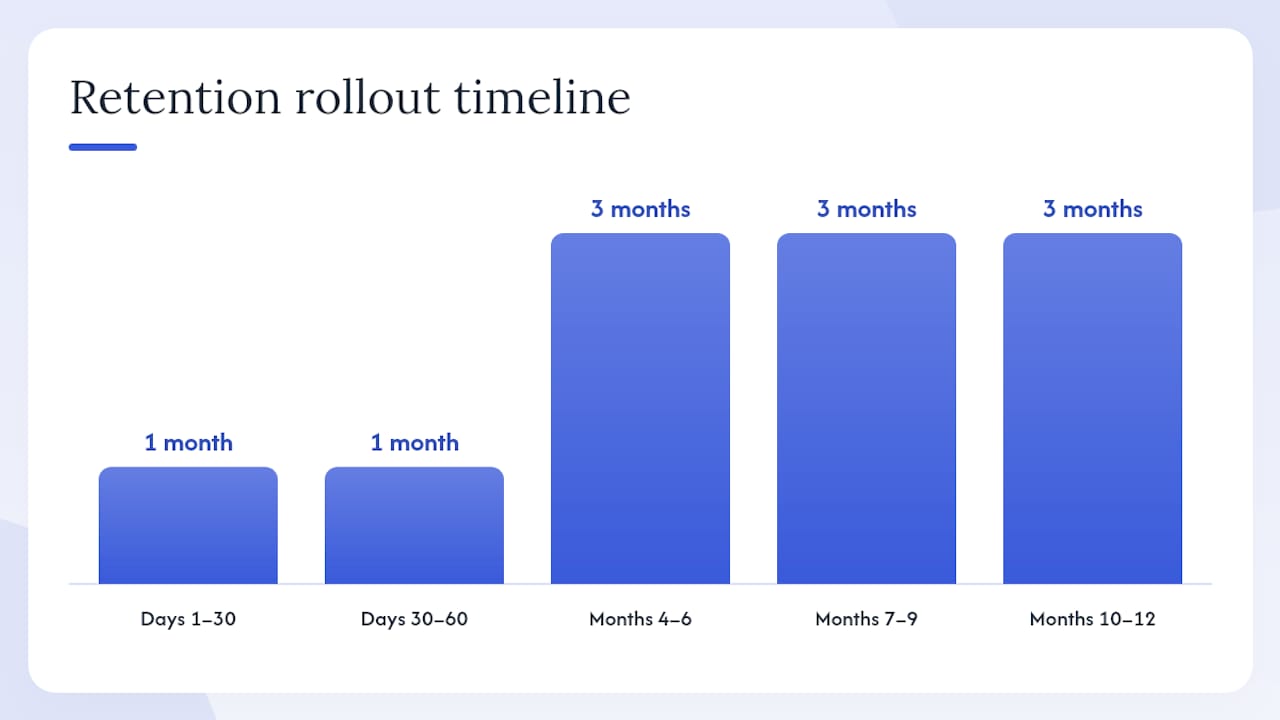
Not every strategy deserves equal urgency. A practical prioritization framework weighs two variables: impact on voluntary turnover and implementation effort. High-impact, low-effort actions belong in the first 90 days. High-impact, high-effort structural investments follow in months 4–12.
Prioritization by organization size:
- Small organizations (under 100 employees): Focus on manager training, onboarding, and recognition first. These require minimal budget and deliver fast results.
- Mid-size organizations (100–1,000 employees): Add compensation benchmarking and career pathways in parallel with manager development. Invest in a pulse survey tool.
- Large organizations (1,000+ employees): Sequence structural programs (career ladders, formal DEI initiatives, phased retirement) after quick wins are embedded. Use cohort-level data to identify the highest-risk employee segments.
| Timeline | Priority Actions | Owner | Success Milestone |
|---|---|---|---|
| Days 1–30 | Audit manager-level quit rates; launch pulse survey | HR Director | Baseline data collected |
| Days 30–60 | Deliver manager training cohort 1; publish first role ladder | HR + L&D | Training completion rate high |
| Months 4–6 | Complete compensation benchmarking; close critical pay gaps | Total Rewards | Pay gap report finalized |
| Months 7–9 | Launch upskilling program; formalize career development conversations | L&D + Managers | Training hours per employee tracked |
| Months 10–12 | Review DEI representation in promotions; launch phased retirement pilot | HR + Leadership | Cohort retention rate improvement |
Change management checklist before you launch:
- Align senior leadership on the business case using the DOL TEGL 07-22 costing framework.
- Communicate the retention initiative to employees before it launches, not after.
- Pilot each new program in one department or team before scaling.
- Assign a named owner and a review date to every initiative.
- Report progress to leadership quarterly using the KPIs defined in the next section.
The SHRM retention toolkit provides practical communication templates and program design guidance that can accelerate this rollout significantly.
How to measure whether your retention programs are working
Three KPIs form the core of any retention measurement system: retention rate, voluntary turnover rate, and cohort retention rate. Track all three, and report them to leadership on a consistent cadence.
Retention rate formula:
Retention Rate = (Employees at end of period ÷ Employees at start of period) × 100
Example: You start January with 200 employees and end December with 185. Retention rate = (185 ÷ 200) × 100 = 92.5%.
Voluntary turnover rate formula:
Voluntary Turnover Rate = (Voluntary departures during period ÷ Average headcount) × 100
The BLS JOLTS quits timeseries provides national benchmarks for voluntary quits by industry, which you can use to contextualize your own rate. Per the JOLTS program overview, quits are defined as voluntary separations initiated by the employee, making the quits rate the cleanest signal of retention health.
Cohort retention rate: Track the percentage of employees hired in a given quarter who are still employed at 90 days, 6 months, and 12 months. This surfaces onboarding and early-tenure problems that aggregate retention rates can mask.
| KPI | Why It Matters | Calculation | Reporting Cadence |
|---|---|---|---|
| Overall retention rate | Tracks workforce stability over time | (End headcount ÷ Start headcount) × 100 | Monthly, quarterly |
| Voluntary turnover rate | Isolates controllable departures | (Voluntary quits ÷ Avg headcount) × 100 | Monthly |
| 90-day cohort retention | Flags onboarding failures early | (New hires still employed at 90 days ÷ Total new hires) × 100 | Per hiring cohort |
| Manager-level quit rate | Identifies high-risk managers | Team voluntary quits ÷ Team headcount | Quarterly |
| Internal promotion rate | Measures career pathway effectiveness | Internal promotions ÷ Total open roles filled | Quarterly |
What to watch in early windows: A drop in 90-day cohort retention is the fastest signal that onboarding needs attention. A spike in manager-level quit rates points to a people-management problem, not a compensation one. Tracking both prevents misdiagnosis and wasted budget.
U.S. legal and equity requirements for retention programs
Retention programs must be equitable and legally defensible. A program that inadvertently excludes employees with disabilities, concentrates development opportunities in one demographic group, or fails to accommodate religious or medical needs creates legal exposure and undermines the trust that retention depends on.
Practical compliance checkpoints:
- ADA reasonable accommodations: Retention programs must account for employees with disabilities. The DOL ODEP guidance recommends proactive accommodation processes and early-intervention programs to support stay-at-work outcomes. Waiting for an accommodation request to arrive is a reactive posture; building accommodation into your retention design is the stronger approach.
- EEOC non-discrimination: Development programs, mentoring cohorts, and recognition programs must be accessible to all employees regardless of race, sex, age, religion, national origin, or disability status. Document selection criteria for any competitive program.
- RETAIN early-intervention model: The DOL’s RETAIN initiative, supported by DOL ETA training resources, focuses on keeping employees at work following injury or illness through early intervention, modified duty, and coordinated support. Logistics and operations employers, where physical injury risk is real, benefit directly from formalizing this approach.
- Leave and benefits alignment: Confirm that FMLA, ADA leave, and your internal PTO policies are consistently applied. Inconsistent leave administration is a common source of both legal risk and employee distrust.
- DOT compliance for trucking roles: For logistics employers with driver or fleet staff, safety compliance intersects with retention. A resource like DOT compliance guidance for trucking companies can help align safety program requirements with your broader retention and wellbeing framework.
Compliance audit checklist for retention program design:
- [ ] All programs have documented, objective eligibility criteria
- [ ] Accommodation request process is published and accessible
- [ ] Development and recognition programs are audited for demographic equity annually
- [ ] Leave policies are consistently applied and documented
- [ ] Manager training includes ADA and EEOC basics, not just soft skills
- [ ] Early-intervention process exists for employees returning from injury or illness
What current U.S. labor data tells HR about retention urgency
The April 2026 JOLTS release provides the clearest current picture of U.S. labor market churn. Three figures stand out for retention planning:
7,594,000 job openings (May 2026, preliminary). 3.3% hires rate. 3.2% total separations rate. Per the BLS JOLTS program, total separations include voluntary quits, layoffs and discharges, and other separations.
What these numbers mean for HR strategy:
- Job openings remain elevated. With nearly 7.6 million open positions nationally, employees in most industries have real alternatives. That keeps voluntary quit risk high even when the broader economy softens.
- The hires rate and separations rate are nearly equal. A 3.3% hires rate against a 3.2% separations rate signals a labor market in near-equilibrium churn, where organizations are constantly replacing departures rather than building net headcount.
- Quits are the signal to watch. The BLS quits timeseries allows HR teams to benchmark their voluntary turnover rate against national and industry-level trends. An organization running above the national quits rate for its sector has a retention problem that compensation alone will not solve.
The practical implication: retention programs are not a nice-to-have when job openings are near 7.6 million. They are a direct operational cost-control measure. For logistics employers specifically, where driver shortages and warehouse labor competition are structural, the urgency is compounded. Worldwideexpress’s analysis of top trucking trends shaping freight strategies covers how workforce dynamics are reshaping operational planning across the sector.
A practitioner’s perspective on what actually moves the needle
The most common mistake HR teams make with retention is treating it as a program portfolio rather than a management capability problem. A well-designed recognition platform, a generous tuition reimbursement benefit, or a polished onboarding checklist will all underperform if the direct manager relationship is broken. The DOL’s own program evaluations are unambiguous on this point: employer-focused changes, particularly in how managers are trained and held accountable, produce better retention outcomes than structural policy fixes alone.
The second mistake is measuring retention only at the aggregate level. An organization with a 90% overall retention rate can still be hemorrhaging talent in its highest-value roles or among its most recently hired cohorts. Cohort-level and manager-level tracking surfaces those problems before they become expensive.
Pro Tip: Build retention metrics directly into manager performance scorecards. When a manager’s team-level voluntary turnover rate appears alongside revenue and quality metrics in their quarterly review, the conversation about retention shifts from HR’s problem to a shared leadership accountability. Managers who know their numbers are being watched tend to have better conversations with their people.
The optimistic reality is that most of the high-impact interventions here are not expensive. Manager training, structured onboarding, career conversations, and recognition cost far less than the thousands of dollars per departure that chronic turnover generates. The business case is clear. The execution is what separates organizations that retain talent from those that keep recruiting it.
Sources
The following primary sources support the data, frameworks, and recommendations throughout this article:
- Job Openings and Labor Turnover Survey News Release – 2026 M05 Results
- Job Openings and Labor Turnover Survey – Quits timeseries
- Recruitment and retention – Office of Disability Employment Policy (ODEP) – U.S. Department of Labor
- Develop and upskill your current workforce and avert possible layoffs – DOL ETA
- TEGL 07-22: Costing turnover and program justification – DOL ETA (TEGL 07-22)
- How to Improve Employee Retention and Reduce Turnover – SHRM
- How Americans view their jobs – Pew Research Center
Recommended
- Remote work in logistics: efficient strategies for global teams – Worldwide Express, Inc.
- Building Customer Loyalty for Logistics Success – Worldwide Express, Inc.
- Remote Team Management Tips for Logistics Leaders – Worldwide Express, Inc.
- International Logistics: A 2026 Strategy Guide for Businesses – Worldwide Express, Inc.