Six high-impact, manager-led actions can meaningfully raise employee morale within 30 to 90 days: strategic recognition tied to company values, weekly one-on-ones with genuine praise, targeted manager coaching, job-crafting experiments, flexible scheduling pilots, and regular pulse feedback. Gallup reports that only about 31% of U.S. employees are engaged at work. That single statistic reframes the entire morale conversation: the manager’s daily behavior is the intervention. HBS research links meaningful well-being improvements to an average productivity increase of roughly 10%, with supervisor relationships, job design, and work-life balance identified as the primary levers.
Start in the next 72 hours:
- Send one specific, values-linked recognition message to a team member today.
- Schedule weekly 15-minute one-on-ones with each direct report for the next four weeks.
- Deploy a three-question pulse survey to get a baseline before spending a dollar on programs.
Key Takeaways
Managers who prioritize consistent daily behaviors over one-off programs, and who measure morale with defined KPIs before investing in technology, produce the most durable engagement gains.
| Point | Details |
|---|---|
| Managers drive engagement | Gallup finds managers explain ~70% of team engagement variance; train them first. |
| Recognition must be values-linked | SHRM data shows values-tied recognition reduces turnover; invest at least 1% of payroll. |
| Sequence your interventions | Baseline with a pulse survey before spending; quick wins in 30 days, programs at 90 days. |
| Flexibility produces measurable gains | HBS-cited research found a 13% performance increase and halved turnover in a flexibility pilot. |
| Measure with defined KPIs | Track eNPS, pulse satisfaction, absenteeism, and voluntary turnover on a monthly or quarterly cadence. |
Table of Contents
- 1. How to boost employee morale with strategic recognition
- 2. Run weekly one-on-ones that actually build trust
- 3. Invest in manager training before anything else
- 4. Design flexible work options that reduce exhaustion
- 5. Build psychological safety and inclusive culture
- 6. Offer career development and learning opportunities
- 7. Use job crafting to make work more meaningful
- 8. Implement well-being programs with in-person components
- 9. Create a Voice of Employee feedback loop
- 10. Celebrate milestones and use simple morale boosters
- 11. Address remote and hybrid team morale specifically
- 12. Track morale with metrics, not instinct
- How to implement these strategies: a 30–90–365 day plan
- How to measure morale and prove impact
- Why these approaches work: the evidence behind the strategies
- Your manager-ready checklist and red flags to watch for
- Where to focus first, and why the sequence matters
- Sources
1. How to boost employee morale with strategic recognition
Recognition is the fastest-acting lever available to any manager, and the research is unambiguous about what makes it work. SHRM and Globoforce survey data show that recognition programs explicitly tied to company values correlate with lower employee frustration and reduced turnover.
The distinction between generic praise (“great job this week”) and values-linked recognition (“the way you kept the client updated during that shipment delay is exactly what we mean by transparency”) is not cosmetic. The second version reinforces culture, gives the recipient a replicable behavior to repeat, and signals to the whole team what excellence looks like.
Peer-to-peer recognition programs, where colleagues nominate each other through a simple platform or even a shared Slack channel, distribute the recognition load beyond managers and build social connection simultaneously. Both effects matter for morale.
Pro Tip: When you deliver recognition in a team meeting, name the specific behavior, connect it to one company value by name, and describe the business impact. That three-part structure takes 30 seconds and produces far stronger cultural reinforcement than a generic shout-out.
2. Run weekly one-on-ones that actually build trust
One-on-ones are the most underused morale tool in most organizations, largely because managers treat them as status updates rather than relationship investments. A 15-minute weekly check-in focused on the employee’s priorities, obstacles, and energy level does more for job satisfaction than most formal programs.
The structure matters. Open with a question about the person, not the project. “What’s getting in your way this week?” surfaces problems early. “What are you most proud of since we last talked?” creates a natural recognition moment without requiring a formal program. Closing with one clear commitment from the manager (“I’ll remove that approval bottleneck by Thursday”) builds the trust that sustains morale through difficult periods.
SHRM Labs guidance is direct on this point: analytics and digital tools can identify engagement problems at scale, but they cannot replace authentic manager behavior and consistent communication. The weekly check-in is where data becomes action.
3. Invest in manager training before anything else
Most morale programs fail not because the ideas are wrong but because the managers delivering them lack the skills to do it well. A recognition platform without trained managers produces mechanical, hollow praise. A pulse survey without managers who know how to act on results produces cynicism.
Manager training should cover three competencies: delivering specific, values-linked feedback; conducting psychologically safe one-on-ones; and reading early warning signals in team behavior. These are learnable skills, not personality traits. A half-day workshop followed by monthly peer-coaching circles is a practical format many mid-size U.S. organizations use successfully.
Systematic reviews across individual, group, leader, and organizational levels of intervention find that multilevel approaches produce synergistic effects. Training managers while also adjusting organizational policies creates compounding returns that neither effort achieves alone.
4. Design flexible work options that reduce exhaustion
Flexibility is no longer a perk. About a third of U.S. workers who can work from home do so all the time, which means hybrid and remote arrangements are now baseline expectations for knowledge workers. For logistics and operations teams where full remote work is not feasible, schedule flexibility (shift swaps, compressed workweeks, flexible start times) serves the same psychological function.
The evidence on outcomes is striking. A large-scale work-from-home experiment cited in HBS research found a 13% performance increase and turnover that was cut in half among the group given flexibility, compared to the control group. The mechanism is reduced exhaustion and greater perceived autonomy, both of which are direct drivers of morale.

For practical guidance on designing flexible schedules in logistics environments, Worldwideexpress publishes work-life balance tips tailored to operational teams.
5. Build psychological safety and inclusive culture
Psychological safety, the belief that speaking up will not result in punishment or humiliation, is the foundation of every other morale initiative. Teams without it produce surface-level engagement at best. Managers build it through consistent, small behaviors: thanking people for raising problems, visibly acting on feedback, and never punishing honest mistakes with public criticism.
Inclusion reinforces safety. When employees see that recognition, development opportunities, and leadership attention are distributed equitably across the team, trust in the system grows. When they see the opposite, even well-designed programs feel performative.
Social connection is the third pillar. Structured team rituals (a brief weekly team standup, a monthly informal lunch, a shared project channel) create the relational fabric that makes people want to show up. These are not expensive. They require manager intention, not budget.
6. Offer career development and learning opportunities
Stagnation is one of the most reliable predictors of low morale. Employees who see no path forward disengage quietly before they leave loudly. Career development does not require a formal L&D department. A quarterly 30-minute conversation between a manager and each direct report about skills, goals, and growth opportunities costs nothing and signals that the organization sees the person as a long-term investment.
Stretch assignments, cross-functional projects, and access to online learning platforms (LinkedIn Learning, Coursera, or industry-specific certifications) give employees concrete evidence that development is real, not rhetorical. For logistics managers, pairing a frontline team member with a senior operations lead for a quarter-long project is a low-cost, high-signal development move.
7. Use job crafting to make work more meaningful
Job crafting is the practice of reshaping a role’s tasks, relationships, or cognitive framing to better align with an employee’s strengths and interests. It is one of the three fundamental well-being drivers identified by HBS researchers, alongside supervisor relationships and work-life balance.
A warehouse coordinator who loves training new hires can take on a formal onboarding mentor role. A driver who is strong at customer communication can be the primary contact for a key account. Neither change requires a title change or a budget line. Both produce measurable morale gains because the work becomes more intrinsically rewarding.
8. Implement well-being programs with in-person components
Workplace well-being programs, particularly those using mindfulness and cognitive behavioral approaches, have a solid evidence base. A Frontiers meta-analysis of workplace interventions found a pooled positive effect on subjective well-being (SMD ≈ 0.51), with psychological interventions showing significant results in subgroup analyses. A 2025 MDPI review of Positive Psychological Interventions confirms that in-person delivery tends to outperform remote formats.
The practical implication: if budget allows only one format, prioritize in-person or hybrid delivery for well-being workshops. A six-week mindfulness program run on-site during lunch, or a quarterly resilience workshop facilitated by an external coach, will likely outperform an app-only solution. That said, app-based tools (Calm for Business, Headspace for Work) serve as useful supplements between structured sessions.
9. Create a Voice of Employee feedback loop
Pulse surveys are only as valuable as the actions they trigger. The most common morale mistake organizations make is surveying employees, sharing results, and then doing nothing visible with the data. That sequence is worse than not surveying at all because it signals that feedback is collected but not respected.
The effective model: run a three-to-five question pulse every four weeks, share aggregated results with the team within two weeks, name one or two things the team said and one concrete change being made in response, then resurvey on that specific item 60 days later. That closed loop builds the trust that makes future feedback honest.
For dispersed or remote logistics teams, Worldwideexpress’s guidance on remote team management covers practical check-in and feedback cadences for distributed workforces.
10. Celebrate milestones and use simple morale boosters
Small, consistent celebrations outperform large, infrequent ones for sustained morale. A team lunch after a difficult quarter, a handwritten note marking a work anniversary, a five-minute shout-out at the start of a Monday standup — these cost almost nothing and accumulate into a culture where people feel seen.
The key is consistency and personalization. A manager who remembers that one team member prefers private recognition and another thrives on public acknowledgment demonstrates the kind of attention that builds loyalty. Generic “employee of the month” programs with no connection to values or specific behaviors produce minimal morale lift and sometimes generate resentment among those not selected.
11. Address remote and hybrid team morale specifically
Remote and hybrid arrangements create specific morale risks: isolation, communication gaps, and the perception that remote workers are less visible for advancement. Managers of distributed teams need deliberate practices to counter these effects.
Structured virtual social time (a 15-minute optional Friday coffee chat, a team trivia session once a month) is not frivolous. It replicates the informal relationship-building that happens naturally in shared physical spaces. Recognition in remote settings must be more explicit and more frequent than in-person recognition, because the ambient social cues that signal appreciation in an office are absent. For logistics teams managing global operations, Worldwideexpress’s resource on remote work strategies offers context-specific guidance.
12. Track morale with metrics, not instinct
Morale is measurable. Managers who rely on gut feel miss early warning signals and cannot demonstrate ROI to leadership. The core metrics to track are employee Net Promoter Score (eNPS), pulse satisfaction scores, voluntary turnover rate, absenteeism rate, and turnover intent (captured via survey). Each tells a different part of the story.
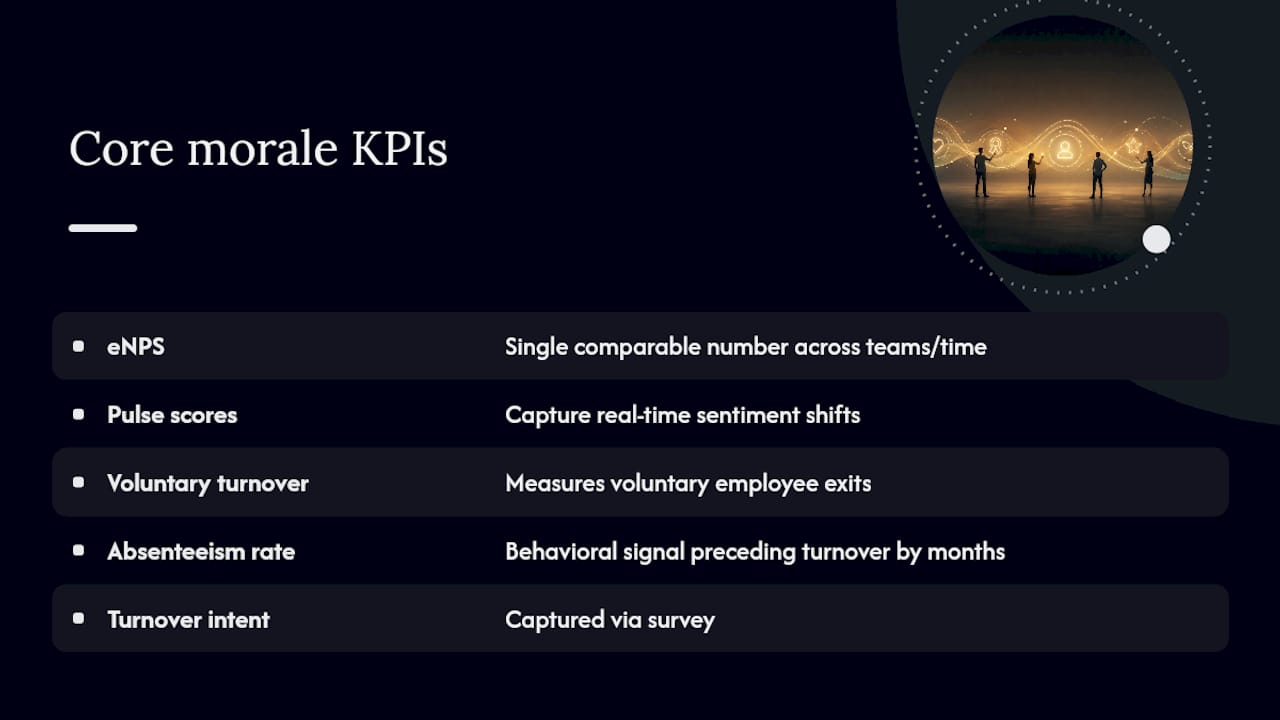
eNPS (“How likely are you to recommend this organization as a place to work, on a scale of 0–10?”) gives a single comparable number across teams and time periods. Absenteeism rate tracks a behavioral signal that often precedes voluntary turnover by several months. Pulse satisfaction scores capture real-time sentiment shifts that annual surveys miss entirely.
How to implement these strategies: a 30–90–365 day plan
Sequencing matters as much as selection. Spending money on a recognition platform before establishing a baseline is a common and costly mistake. The plan below is ordered to build credibility through quick wins before committing to larger investments.
30-day quick wins (low cost, high visibility)
- Deploy a three-question baseline pulse survey (eNPS, satisfaction, one open-ended item).
- Schedule and hold weekly 15-minute one-on-ones with every direct report.
- Deliver at least one specific, values-linked recognition per team member.
- Share pulse results with the team and name one change being made in response.
- Identify one job-crafting opportunity per team member through a brief conversation.
Rough cost: Near zero. Time investment is the primary resource: roughly 2–3 hours per manager per week.
Pro Tip: Run the baseline pulse before any other intervention. Without it, you cannot attribute later score changes to specific actions, and leadership will ask for evidence. A free tool like Google Forms or a low-cost platform like Officevibe handles this for small teams.
90-day programs (medium investment)
- Launch a peer-to-peer recognition program (a shared Slack channel or a platform like Bonusly).
- Run a half-day manager training workshop on feedback and psychological safety.
- Pilot one flexible scheduling option (compressed workweek or flexible start times) with a volunteer cohort.
- Introduce a monthly team social ritual (lunch, virtual coffee, or a brief team challenge).
- Begin quarterly career development conversations using a simple three-question template.
- Resurvey on the specific items from the 30-day pulse to measure change.
Rough cost: Low to medium. Manager training runs $500–$2,000 per session for an external facilitator; peer recognition platforms range from free to roughly $3–$5 per employee per month.
365-day structural changes (higher investment, lasting impact)
- Formalize a recognition budget at or above 1% of payroll, tied explicitly to company values.
- Build manager coaching into the performance review cycle, not just annual training.
- Conduct a full engagement survey (Gallup Q12 or equivalent) and benchmark against industry.
- Establish a well-being program with at least one in-person component per quarter.
- Review job design across the team and make structural role adjustments where crafting experiments proved effective.
- Report morale KPIs to senior leadership quarterly alongside operational metrics.
Rough cost: Medium to high. A full engagement survey platform (Culture Amp, Glint) runs $5,000–$20,000 annually for mid-size teams. Well-being programs vary widely; budget $50–$150 per employee per year for a structured offering.
Checklist for managers (copy into your planning tool):
- [ ] Baseline pulse survey deployed and results shared
- [ ] Weekly one-on-ones scheduled and held consistently
- [ ] One values-linked recognition delivered per team member per month
- [ ] Job-crafting conversation completed with each direct report
- [ ] Flexible scheduling option piloted and evaluated
- [ ] Career development conversation held quarterly
- [ ] Morale KPIs tracked and reported to leadership
How to measure morale and prove impact
Measurement is where most morale programs lose credibility. The table below defines the core KPIs, how to capture them, and the recommended cadence.
| Metric | Definition | How to measure | Cadence |
|---|---|---|---|
| eNPS | Likelihood to recommend the org as a place to work (0–10 scale) | Single survey question | Monthly |
| Pulse satisfaction | Overall job satisfaction score (1–5 scale) | 1-question pulse survey | Monthly |
| Turnover intent | Share of employees considering leaving within 12 months | Survey item: “I plan to stay at this organization for at least one more year” (agree/disagree) | Quarterly |
| Voluntary turnover rate | Percentage of employees who leave voluntarily in a period | HR records | Quarterly |
| Absenteeism rate | Unplanned absences as a percentage of scheduled workdays | HR records | Monthly |
Sample pulse survey questions (copy verbatim):
- “On a scale of 0–10, how likely are you to recommend this organization as a place to work?”
- “On a scale of 1–5, how satisfied are you with your work this week?”
- “Do you feel recognized for your contributions? (Yes / Somewhat / No)”
- “What is one thing that would most improve your experience at work right now?” (open-ended)
Pro Tip: For teams under 15 people, individual pulse responses can be identifiable even when anonymous. Aggregate results into bands (“4 out of 10 team members scored satisfaction below 3”) rather than sharing raw distributions, and consider a minimum response threshold of 5 before reporting results. This protects psychological safety and keeps future response rates high.
To attribute score changes to specific interventions, use a phased rollout: implement one change at a time, measure for 60 days, then add the next. This is not a randomized controlled trial, but it produces far cleaner signal than launching five programs simultaneously and wondering which one moved the needle.
Why these approaches work: the evidence behind the strategies
The case for prioritizing manager-led morale work is anchored in two numbers. Gallup’s engagement data puts U.S. That means the single highest-leverage investment any organization can make is improving the quality of its managers’ daily behaviors.
31% of U.S. employees are engaged at work. Managers explain ~70% of the variance in team engagement. — Gallup
HBS research identifies the three primary levers as supervisor relationships, job design (job crafting), and work-life balance. These are not soft factors.
The psychological intervention literature adds further support. The Frontiers meta-analysis found a pooled effect size of SMD ≈ 0.51 across workplace well-being interventions, a moderate and practically meaningful effect. The MDPI review of Positive Psychological Interventions confirms that mindfulness and CBT-based programs reliably improve subjective well-being, with in-person delivery generally outperforming remote formats.
A few important caveats: effect sizes vary considerably across industries, team sizes, and baseline conditions. Programs that work well in knowledge-worker environments may need adaptation for frontline or logistics teams. And no intervention produces lasting results without consistent manager follow-through. The SHRM Labs guidance is explicit: analytics platforms identify problems, but authentic human behavior converts that data into improved morale.
Your manager-ready checklist and red flags to watch for
Recurring practices checklist
- [ ] Weekly: Hold 15-minute one-on-ones; open with a personal question, close with one manager commitment.
- [ ] Weekly: Deliver at least one specific, values-linked recognition (public or private based on preference).
- [ ] Monthly: Run a three-to-five question pulse survey; share results and name one change within two weeks.
- [ ] Monthly: Host one informal team social moment (lunch, virtual coffee, brief team challenge).
- [ ] Quarterly: Hold a 30-minute career development conversation with each direct report.
- [ ] Quarterly: Review flexible-work arrangements and adjust based on team feedback.
- [ ] Quarterly: Report morale KPIs (eNPS, pulse satisfaction, absenteeism) to leadership.
One-on-one prompts managers can use today
- “What’s one thing I could do differently to make your work easier?”
- “What part of your role do you find most energizing right now?”
- “Is there anything getting in your way that I can help remove?”
Red flags that indicate morale is worsening
- Rising unplanned absenteeism over two or more consecutive months.
- Declining pulse survey response rates (below 60% participation is a warning sign).
- One-sided one-on-ones where the employee gives minimal responses.
- Increased “quiet quitting” signals: meeting attendance without contribution, missed optional team events, reduced initiative.
- Spike in voluntary resignations, especially among mid-tenure employees (2–5 years).
Immediate response to red flags: Do not wait for the next scheduled survey. Have a direct, private conversation with the affected team member within 48 hours. Use the prompt: “I’ve noticed [specific behavior]. I want to understand what’s going on for you. What would help?” Then act on what you hear.
Where to focus first, and why the sequence matters
The most common mistake managers make when morale is low is reaching for a program instead of a behavior. A new recognition platform, a well-being app, or a team offsite can all produce short-term lift. Without consistent manager behavior underneath them, that lift fades within 60–90 days and leaves employees more cynical than before.
Start with the two things that cost nothing and signal everything: weekly one-on-ones and specific recognition. These are the behaviors that build the trust necessary for every other intervention to land. Once trust is established, employees believe that a pulse survey is genuinely anonymous, that a career conversation will lead somewhere real, and that a flexible scheduling pilot is not going to be quietly reversed.
The second trap is under-investing in manager training while over-investing in technology. Pulse tools, recognition platforms, and engagement dashboards are genuinely useful for detection and scale. But as SHRM Labs notes, they are delivery mechanisms, not solutions. A manager who does not know how to act on a low pulse score will not improve it regardless of how sophisticated the dashboard is.
Finally, measure before you spend. A three-question baseline survey takes 10 minutes to build and gives you the evidence base to justify every subsequent investment. Without it, morale work is anecdotal. With it, you can show leadership a before-and-after story that connects manager behavior to business outcomes.
Sources
- Global Indicator: Employee Engagement – Gallup
- SHRM / Globoforce recognition survey (Fall 2012)
- Employee well‑being and firm performance (HBS research)
- Interventions for workers’ subjective well‑being (Frontiers, 2020)
Recommended
- Employee Retention Strategies for HR Managers: 2026 Guide – Worldwide Express, Inc.
- Work Life Balance Tips for Logistics Leaders – Worldwide Express, Inc.
- Remote Team Management Tips for Logistics Leaders – Worldwide Express, Inc.
- Improve Worker Safety in Logistics: Proven Protocols for 2026 – Worldwide Express, Inc.