Ocean full container load (FCL) freight is generally the cheapest per-unit mode for large commercial shipments. For relatively small loads, LCL consolidation typically beats FCL on total cost. Two actions to take immediately: calculate your container fill rate before booking, and request all-in landed-cost quotes that include duties, terminal handling charges (THC), and demurrage assumptions.
For regulatory guidance, U.S. Customs and Border Protection (CBP) sets the rules on entry, bonding, and documentation. A licensed customs broker handles the filing mechanics. Worldwideexpress brings the operational perspective: FCL/LCL forwarding, air consolidation, ABI-capable brokerage, and bonded inland transport, all under one roof.
Key Takeaways
Ocean FCL is the cheapest per-unit mode for large commercial shipments when shipment volume is sufficiently large; below that threshold, LCL consolidation or hub groupage typically wins on total landed cost.
| Point | Details |
|---|---|
| FCL vs LCL threshold | FCL beats LCL on per-unit cost above roughly 13–15 m³; fill rate drives the math. |
| All-in quote discipline | Demand base freight, BAF, THC, ISF/AMS, duties, brokerage, and drayage on every quote. |
| ISF filing deadline | Ocean ISF must be filed at least 24 hours before loading; late filing risks up to $5,000 per violation. |
| Broker fee range | Licensed brokers typically charge $75–$250 per routine entry; ABI capability speeds CBP release. |
| Worldwideexpress | Offers FCL/LCL forwarding, ABI-capable brokerage, and bonded transport with all-in landed-cost quotes. |
Table of Contents
- Which freight mode is cheapest for your shipment profile?
- What actually determines your freight price
- How to calculate your landed cost
- Documentation and CBP rules every U.S. importer needs
- Packaging and palletization tactics that cut chargeable weight
- Consolidation and routing tactics that lower your freight bill
- How to request and compare all-in quotes
- When a licensed customs broker is worth every dollar
- How to choose a forwarder or broker for large international shipments
- Transit times and how they affect your mode choice
- What Worldwideexpress sees reduce landed cost repeatedly
- The case for separating forwarding from brokerage
- Worldwideexpress cuts landed cost across every freight mode
- Sources
Which freight mode is cheapest for your shipment profile?
Matching your cargo to the right mode is the fastest way to cut costs on affordable large package shipping. The table below maps common shipment profiles to the typically cheapest option.
Per LoadOptima’s freight cost guide, FCL becomes cheaper per unit above roughly 13–15 m³. Below that threshold, LCL groupage wins on cost, though it adds consolidation time.
- FCL: Best when volume fills at least 60–70% of a 20’ or 40’ container.
- LCL: Best for 1–14 m³ on regular lanes with predictable schedules.
- Air consolidation: Justified only when lead time is critical or cargo value is very high relative to weight.
- Project/OOG ocean: Required for oversized or indivisible cargo; rates are negotiated case by case.
What actually determines your freight price
Freight quotes are rarely what they appear. Freight invoices routinely omit or separate surcharges such as BAF (bunker adjustment factor), CAF (currency adjustment factor), THC, and terminal handling, which can shift the real cost by tens of percent versus the headline rate.
Chargeable weight logic: Carriers bill the greater of actual weight and volumetric weight. Volumetric factors by mode: air uses roughly 1 m³ = 167 kg; road uses 1 m³ = 333 kg; sea LCL uses the weight/measurement (W/M) ratio where 1 m³ = 1,000 kg.
Key surcharges to watch on every quote:
- BAF/fuel surcharge and CAF/currency surcharge
- THC at origin and destination ports
- ISF/AMS filing fees (ocean imports)
- Security and documentation fees
- Demurrage (container held at port) and detention (container held inland)
Ancillary costs that often dominate landed cost include import duties, customs brokerage fees, inland drayage, warehousing, and cargo insurance.
Pro Tip: If a quote does not explicitly list THC, ISF/AMS filing, and estimated duties as separate line items, it is not all-in. Ask the forwarder to itemize every charge before comparing quotes.
How to calculate your landed cost
The formula is straightforward:
Freight + Insurance + Duties + Brokerage + Inland Transport + Local Fees = Landed Cost
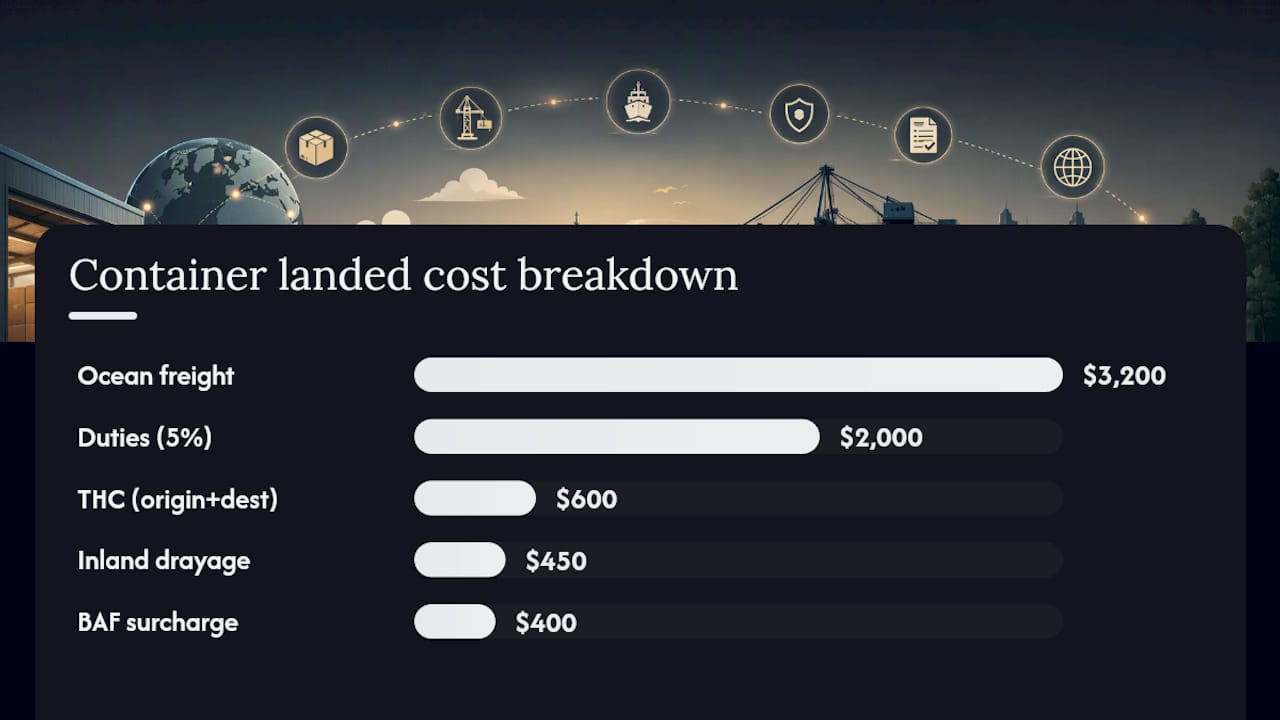
Worked Example A — 40’ HC, half-full (15 m³ of 76 m³ capacity):
- Ocean freight rate: $3,200 (full container)
- BAF surcharge: $400
- THC (origin + destination): $600
- ISF filing: $50
- Customs brokerage: $150
- Duties (assume 5% on $40,000 CIF value): $2,000
- Inland drayage: $450
- Cargo insurance (0.5% of value): $200
- Total landed cost: $7,050
At 15 m³ fill, per-unit cost is high. Filling the same container to 30 m³ cuts per-unit freight roughly in half with minimal change to fixed charges.
Worked Example B — LCL, 6 m³ / 3,000 kg:
- Chargeable W/M: 6 W/M (volumetric wins at 6,000 kg equivalent vs. 3,000 kg actual)
- LCL rate at $85/W/M: $510
- Origin handling + THC: $280
- ISF filing: $50
- Brokerage: $150
- Duties (5% on $12,000 CIF): $600
- Drayage: $300
- Insurance: $60
- Total landed cost: $1,950
Quick steps to run your own calculation:
- Get gross weight and cubic meters from your packing list.
- Calculate chargeable weight for the mode (use W/M for LCL).
- Request an itemized quote covering base freight, all surcharges, and THC.
- Add estimated duties using your HS code tariff rate.
- Add brokerage, drayage, and insurance.
- Divide total by units shipped for per-unit landed cost.
Formal CBP entry is required for commercial shipments over $2,500, and a customs bond is mandatory for formal entries. Importers with multiple annual shipments generally find a continuous bond more economical than single-entry bonds.
Documentation and CBP rules every U.S. importer needs
Per the CBP commercial importer guide, goods arriving by commercial carrier must be entered by the owner/purchaser or a licensed customs broker. When a broker files entry, a CBP power of attorney is required.
Mandatory documents checklist:
- [ ] Commercial invoice (seller, buyer, description, quantity, unit value, total value, country of origin, HS codes, currency)
- [ ] Bill of lading (ocean) or airway bill (air)
- [ ] Packing list (pieces, weights, dimensions)
- [ ] HS code classification for each commodity
- [ ] CBP customs bond (continuous or single-entry)
- [ ] ISF filing (ocean only, submitted at least 24 hours before loading at foreign port)
- [ ] CBP Form 7512 (for bonded transport between U.S. ports under Immediate Transportation procedures)
- [ ] English translation of any foreign-language documents
ABI (Automated Broker Interface) participation speeds CBP release materially. Ask any broker you evaluate whether they are ABI-capable and whether they file through ACE. Those that do reduce exception handling time and clearance delays. Learn more about how customs brokers streamline global trade.
Packaging and palletization tactics that cut chargeable weight
Wasted cubic meters are direct cost. On air and LCL lanes, where volumetric weight drives the invoice, tight palletization can change the chargeable weight calculation by tens of percent, per LoadOptima’s analysis.
Practical steps:
- Choose the right pallet format (standard 48"×40" GMA vs. Euro 47"×31") for the destination market and container type.
- Minimize void space with appropriate fill material; avoid oversized boxes for small items.
- Stack safely to use vertical space, keeping within container height limits.
- Record pallet dimensions accurately (L × W × H including pallet base) before requesting quotes.
- Use right-size corrugated boxes; excess packaging adds volumetric weight with no cargo benefit.
Run the W/M math before switching from LCL to FCL — sometimes better packing makes LCL viable at volumes you assumed required a full container.*
Consolidation and routing tactics that lower your freight bill
Hub consolidation is one of the most consistently effective levers for businesses shipping from multiple Asian or European suppliers. Instead of booking separate LCL shipments from each origin, cargo moves to a consolidation hub (Shanghai, Shenzhen, Rotterdam) where an NVOCC combines multiple lots into a single FCL.
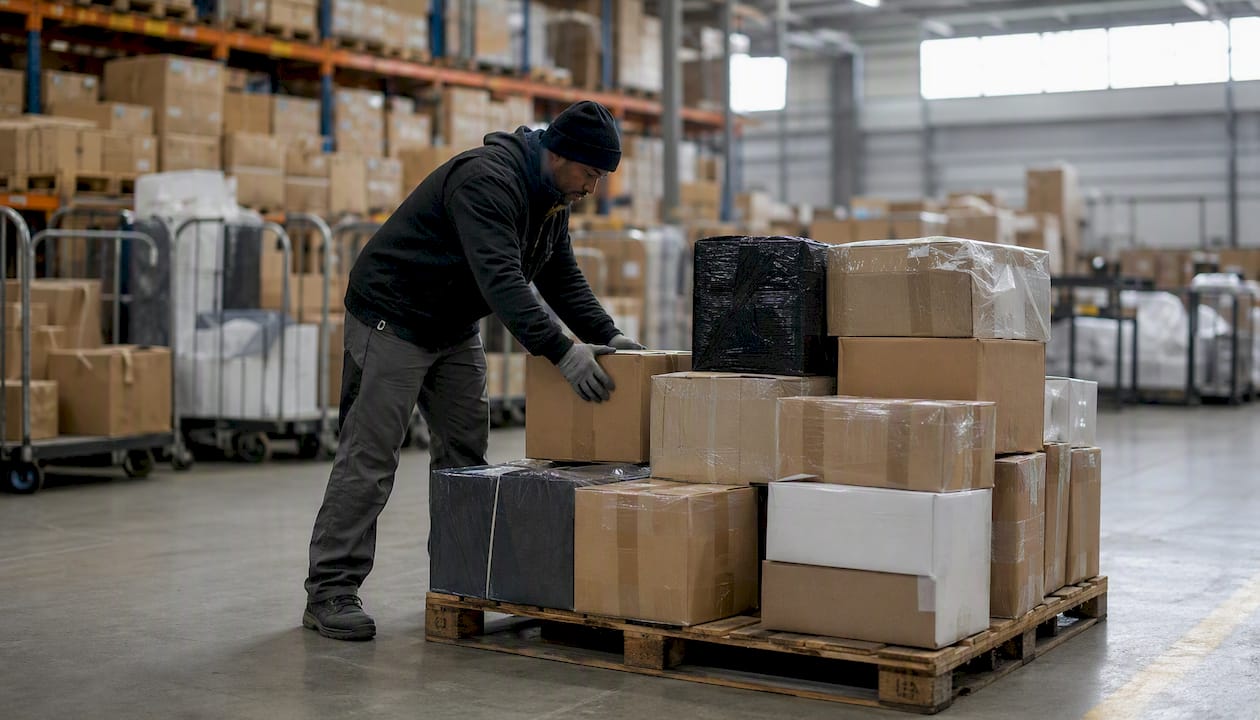
Consider a business sourcing from three suppliers in Guangdong, each shipping 4–5 m³ per month. Individually, each shipment is LCL. Combined at a Shanghai hub, the three lots fill a 20’ container, dropping per-unit ocean freight materially while reducing the number of customs entries.
Routing and port choice also affect total cost. Direct port calls avoid transshipment surcharges and reduce transit variability. Entering through a different U.S. port than your final destination may trigger additional inland drayage charges, so model the full door-to-door cost before selecting a discharge port.
Operational checklist for consolidation negotiations:
- Agree on minimum guaranteed volume per rotation.
- Confirm consolidation window dates and cut-off times.
- Clarify who bears demurrage risk if a supplier misses the cut-off.
- Confirm the NVOCC’s AMS filing capability for each origin.
How to request and compare all-in quotes
Apples-to-apples quote comparison requires discipline on both sides of the RFQ. Provide forwarders with complete information; demand complete information back.
Fields to include in your quote request:
- Origin and destination ports (or door addresses if requesting door-to-door)
- Number of pieces/pallets, gross weight (kg), and cubic meters
- HS codes for each commodity line
- Incoterms (EXW, FOB, CIF, DAP, etc.)
- Required delivery date or latest acceptable arrival
- Cargo value for insurance and duty calculation
- Whether cargo is out-of-gauge (OOG) or hazardous
Fields to demand on every quote reply:
| Line Item | Why It Matters |
|---|---|
| Base ocean/air freight | Benchmark for lane comparison |
| BAF/fuel surcharge | Fluctuates; must be current |
| THC (origin and destination) | Often omitted from headline rate |
| ISF/AMS filing fee | Fixed cost; varies by broker |
| Estimated duties (HS-based) | Largest variable in landed cost |
| Customs broker fee | Confirm ABI-capable broker |
| Inland pickup/delivery | Door-to-door cost completion |
| Demurrage/detention assumptions | Free-time days included |
Validate HS code-based duty estimates against the CBP requirements guide before accepting a forwarder’s estimate. Misclassified HS codes are a common source of unexpected duty bills at clearance.
When a licensed customs broker is worth every dollar
Licensed customs brokers file entries, arrange duty payment, and typically charge $75–$250 per routine entry. Most importers find that fee trivial compared to the cost of a delayed release or a misclassification penalty.
Hire a dedicated broker when any of the following apply:
- You file more than a handful of formal entries per year.
- Your products are regulated by FDA, USDA, CPSC, or FCC.
- Annual duty spend exceeds the cost of broker errors and delays.
- You ship via multiple ports or need bonded transport (Form 7512).
- You import from multiple origins requiring coordinated ISF filings.
ABI-capable brokers reduce exception time. Ask specifically whether a prospective broker files through ACE/ABI and whether they have experience with Form 7512 Immediate Transportation procedures. Explore the role of a U.S. customs broker in detail before making a selection.
How to choose a forwarder or broker for large international shipments
Selection criteria that actually predict performance:
- Lane experience: Has the forwarder moved cargo on your specific trade lane in the last 12 months?
- Consolidation capability: Can they offer scheduled LCL consolidation or NVOCC groupage on your route?
- ABI/AMS participation: Confirmed ACE filing capability, not just a claim.
- In-house vs. third-party brokerage: In-house brokerage reduces coordination friction; third-party may offer better pricing at volume.
- Financial stability: Check bonding and credit references; a forwarder that fails mid-shipment creates serious liability.
- Exception handling references: Ask for a specific example of how they resolved a customs hold or demurrage dispute.
Red flags to watch for:
- Refuses to provide an all-in landed-cost estimate.
- Cannot confirm ABI/AMS filing capability in writing.
- No documented experience with CBP Form 7512 bonded transport.
- Vague or missing demurrage/detention free-time terms in the quote.
- No proof of continuous bond or single-entry bond capability.
Use this checklist during vendor calls or RFP scoring. A forwarder who cannot answer questions 1–3 above clearly is not the right partner for complex commercial shipments. For a structured selection framework, see Worldwideexpress’s guide on how to choose a customs broker.
Transit times and how they affect your mode choice
Tight lead times force mode choice toward air, which can cost five to ten times the ocean rate on a per-kg basis. When ocean is viable, building consolidation scheduling into your procurement calendar, typically 3–7 extra days for LCL groupage, saves materially on freight without changing the delivery date if planned in advance.
Key scheduling notes:
- ISF must be filed at least 24 hours before vessel loading at the foreign port; late filing risks up to $5,000 per violation.
- CBP release windows of 1–5 business days are typical for compliant entries; holds for exam or missing documents can add 5–15 days.
- Bonded transport under Form 7512 adds 1–3 days for in-transit movement between U.S. ports before final entry.
What Worldwideexpress sees reduce landed cost repeatedly
Across commercial shipments, three operational patterns consistently lower landed cost: maximizing container fill rate before booking, separating customs brokerage from forwarding when annual duty spend justifies it, and locking into scheduled consolidation rotations rather than booking ad-hoc LCL.
Common client wins observed by Worldwideexpress:
- Switching from ad-hoc LCL to a weekly consolidation rotation reduced per-unit ocean freight on a regular Asia-to-U.S. lane.
- Re-engineering packaging to reduce volumetric weight brought a shipment below the FCL breakeven threshold, making LCL the right call.
- Separating brokerage from forwarding gave one importer better ABI responsiveness during a CBP hold, resolving the issue faster than a bundled provider had previously managed.
Pro Tip: Reserve a slot in a consolidation rotation before your cargo is ready. Consolidators fill rotations quickly on high-demand lanes, and late bookings often land in the next cycle, adding a week to transit. A standing reservation costs nothing and protects your schedule.
The case for separating forwarding from brokerage
Most logistics guides treat freight forwarding and customs brokerage as a bundle. That framing serves forwarders more than it serves importers. When a forwarder controls both functions, the importer has limited visibility into brokerage pricing and no easy way to benchmark it. The broker’s incentive is to keep the account, not to minimize duty exposure or classification risk.
For businesses with moderate to high import volumes, separating the two functions creates real leverage. You can negotiate brokerage fees independently, switch brokers if classification accuracy slips, and hold each party accountable for their specific scope. The coordination overhead is real but manageable with a clear power of attorney and a shared documentation checklist.
The conventional advice to “use your forwarder’s in-house broker for convenience” is worth questioning once you exceed roughly 20–30 formal entries per year. At that volume, the cost difference and the accuracy difference between a dedicated ABI-capable broker and a bundled service become measurable.
Worldwideexpress cuts landed cost across every freight mode
Worldwideexpress offers FCL and LCL ocean forwarding, air consolidation, ABI-capable customs brokerage, bonded inland transport, and cargo insurance as an integrated service, or as separate functions for importers who prefer to keep brokerage independent. The practical difference: you get all-in landed-cost visibility from a single point of contact, without being locked into a bundled pricing model that obscures brokerage fees.
Services directly relevant to cost reduction include scheduled LCL consolidation on major trade lanes, in-house ABI filing for faster CBP release, Form 7512 bonded transport coordination, and freight quote tools that include duties and surcharges from the first estimate. To get started, prepare your shipment dimensions, HS codes, and Incoterms, then request an all-in freight forwarding quote from Worldwideexpress.
Sources
Regulatory sources (CBP and compliance):
- Freight Cost Calculation 2026: Sea, Air & Road Guide + Volumetric Weight Calculator | LoadOptima
- Importing into the United States A Guide for Commercial Importers
- Customs brokers explained: when you actually need one
Freight cost and calculation:
Worldwideexpress resources:
Recommended
- Cheap International Shipping: A 2026 Guide for Businesses – Worldwide Express, Inc.
- International Postage Rates and Options: 2026 Guide – Worldwide Express, Inc.
- How to Reduce Shipping Costs: Effective Strategies for 2025 – Worldwide Express, Inc.
- 7 Proven Ways to Lower International Container Shipping Rates – Worldwide Express, Inc.