TL;DR:
- A single notation on a shipping document can halt payments, delay cargo, or lead to costly legal disputes. Understanding the difference between clean and dirty bills of lading is crucial, as even minor defect notations can jeopardize transaction compliance and legal certainty. Proper pre-shipment inspection and careful documentation management help safeguard against unintended clausing and ensure smooth international trade flows.
A single annotation on a shipping document can freeze payment, strand cargo, or trigger a legal dispute costing far more than the shipment itself. For import/export businesses operating under documentary credit, the difference between a clean and a dirty bill of lading is not a technicality reserved for lawyers. It is a front-line commercial reality that determines whether banks release funds, buyers accept goods, and shipments move forward without interruption. This guide breaks down exactly what these terms mean, how specific wording triggers compliance risk, and what managers can do right now to protect their operations.
Table of Contents
- Understanding clean and dirty bills of lading
- How wording and notations affect compliance and risk
- Common scenarios: clean versus dirty in real shipments
- Best practices for ensuring clean documentation
- Why clean bills matter more than most managers realize
- How Worldwide Express can support your shipping compliance
- Frequently asked questions
Key Takeaways
| Point | Details |
|---|---|
| Clean vs dirty definition | A clean bill has no negative notations about condition, while a dirty bill signals defects. |
| Wording impacts payment | Even small remarks can block bank payment or create legal disputes when shipping internationally. |
| Compliance is documentary | Cleanliness is judged by what is written, not by unwritten assumptions about cargo. |
| Best practices vital | Proactive review and training prevent costly mistakes and rejected documents. |
| Professional help matters | Using knowledgeable partners reduces your risk for documentation errors and keeps global trade moving. |
Understanding clean and dirty bills of lading
With the critical impact introduced, it helps to clarify what “clean” and “dirty” actually mean in the context of international shipping documentation.
A clean bill of lading is one that carries no clauses, remarks, or notations indicating that the cargo was in defective, damaged, or short condition at the time of loading. Importantly, the bill does not need to say the word “clean” anywhere on its face. In practice, cleanliness is inferred by the absence of negative remarks. If the carrier loads the goods and issues the document without any qualifying language about their condition, the bill is considered clean by default.
A dirty bill of lading, also called a claused bill, is the opposite. It contains express notations that describe defects, damage, shortfalls in quantity, or other anomalies observed at the point of loading. Notations such as “five cartons visibly damaged,” “packaging torn,” or “goods short-shipped by 10 units” make the document claused and therefore unacceptable under most documentary credit arrangements.
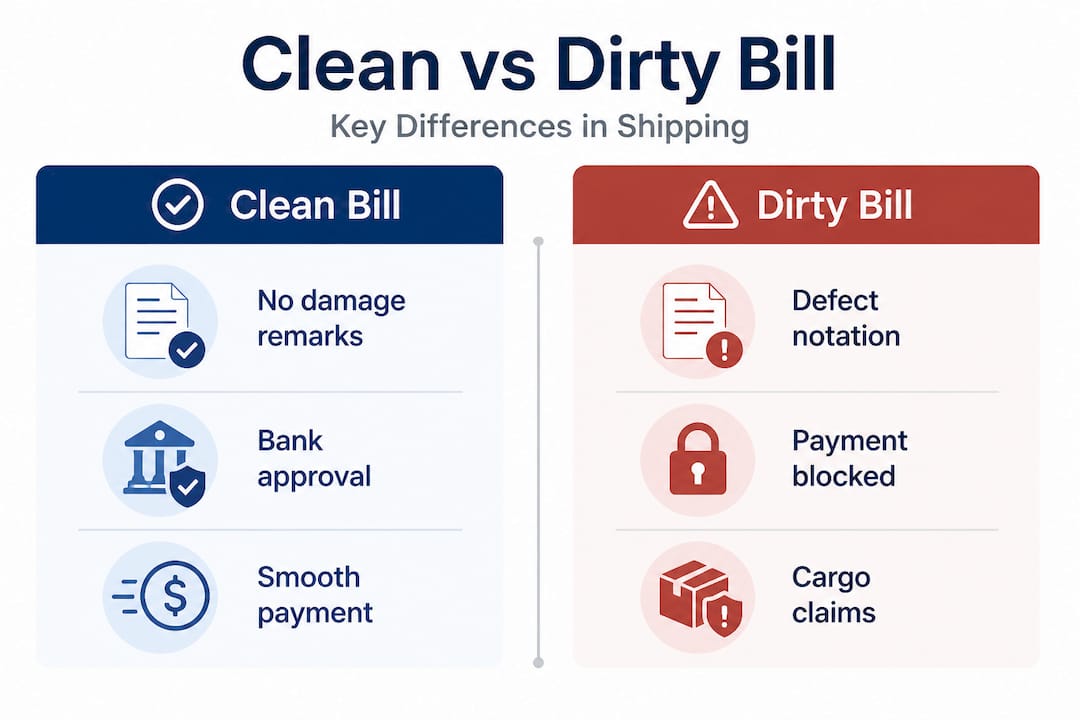
As UCP 600 guidance explains, clean transport documents are those without clauses declaring defective condition, and banks are required to reject any document that carries such clauses in a letter of credit transaction. This is not a discretionary rule. The International Chamber of Commerce’s Uniform Customs and Practice for Documentary Credits (UCP 600) governs the vast majority of international letters of credit, and it sets a firm standard: the document must show no defect language for payment to proceed.
Understanding bill of lading legalities helps managers recognize how even well-intentioned carrier remarks can derail a transaction. Reviewing an example bill of lading also shows precisely where on the form these notations typically appear and how they are formatted.
What types of notations actually matter?
Not every remark automatically makes a bill dirty. The table below illustrates common language and how it is generally treated:
| Notation type | Example phrase | Effect on clean status |
|---|---|---|
| Apparent damage notation | “Three bags torn on loading” | Makes bill dirty |
| Quantity shortfall | “Loaded 490 units, not 500” | Makes bill dirty |
| Packaging defect | “Outer cartons wet on arrival at terminal” | Makes bill dirty |
| Shipper’s load and count | “SLC: contents unknown to carrier” | Does NOT make bill dirty |
| Said to contain | “Said to contain 200 cartons” | Does NOT make bill dirty |
| Weight disclaimer | “Weight as declared by shipper” | Does NOT make bill dirty |
The distinction is critical. Phrases that limit carrier liability for what they cannot verify do not constitute defect notations. They are standard protective language used by carriers worldwide, and banks are well accustomed to them.
Key examples of remarks that trigger dirty status include:
- Any mention of visible physical damage to cargo, packaging, or containers
- Noted discrepancies between declared and actual quantity
- Temperature deviations documented at loading for temperature-sensitive cargo
- Stains, rust, leaks, or odor observations recorded on the face of the document
Understanding where that line sits is the foundation of clean bill compliance.
How wording and notations affect compliance and risk
Now that core definitions are clear, it is essential to understand how every word and notation on a bill can affect both compliance and risk allocation across the entire transaction chain.
A single remark can trigger payment blocks that hold up millions of dollars in trade finance. Banks operating under letters of credit do not exercise judgment on whether a defect is “minor” or “commercially insignificant.” They apply a documentary test. If the clause is present, the document fails. The buyer then has the right to refuse to waive the discrepancy, and the seller faces the prospect of either shipping amended documents, abandoning the shipment, or entering into costly dispute resolution.

Per legal analysis from Mills and Co., clausing or issuing a dirty bill can break documentary credit payment entirely and trigger legal disputes. Courts that assess these cases often test whether the notation relates to the apparent condition of cargo at the time of loading, which is the legal standard carriers are bound by. This means even a vague remark like “condition of cargo unknown” could be scrutinized to determine whether it impairs clean status, depending on jurisdiction and contract terms.
Wording that is neutral versus wording that triggers problems
A useful way to think about this distinction is through a comparison of standard protective phrases versus express defect clauses:
| Phrase type | Language example | Bank treatment | Legal effect |
|---|---|---|---|
| Carrier liability disclaimer | “Said to contain” | Accepted as clean | Limits carrier knowledge |
| Weight qualification | “Weight as per shipper’s declaration” | Accepted as clean | No defect implied |
| Express damage notation | “Corner of crate dented” | Rejected as dirty | Creates defect evidence |
| Quantity discrepancy | “Short-shipped: 20 units missing” | Rejected as dirty | Opens liability claim |
| Condition uncertainty | “Condition of packing doubtful” | Often rejected | Legally ambiguous |
It is also notable that, per UCP 600 interpretation, phrases like “shipper’s load and count” or “said to contain” do not generally make a bill unclean. These are carrier-protective qualifiers, not statements about cargo condition. Managers who understand this distinction avoid unnecessarily challenging standard carrier language while staying alert to the phrases that genuinely threaten clean status.
Pro Tip: Before the bill is finalized, request a draft copy from the carrier and review it line by line. Confirming that no unintended notations appear before the vessel sails is far easier than correcting a claused document after departure.
Reading a bill of lading step by step builds the practical skill to catch problematic language fast. Understanding how bills of lading interact with letters of credit also clarifies the financial stakes when documentary compliance fails.
Common scenarios: clean versus dirty in real shipments
Understanding theory is helpful, but seeing how these distinctions play out in real shipments brings the stakes into focus.
Consider three common scenarios that import/export managers encounter regularly.
-
Scenario one: Clean bill, smooth transaction. A food exporter ships 500 cases of packaged goods. The carrier inspects at loading, notes nothing unusual, and issues the bill without any qualifying defect language. The buyer’s bank receives the document, confirms it is clean, and releases payment under the letter of credit. The buyer clears customs without issue. This is the intended outcome of a well-coordinated shipment with thorough pre-loading inspection.
-
Scenario two: Dirty bill, payment blocked. The same exporter ships a second consignment, but five cartons arrive at the port visibly water-damaged. The carrier notes “five cartons damaged” on the bill. The buyer’s bank receives the document and immediately rejects it as claused. The seller must now either persuade the buyer to waive the discrepancy (a negotiation that often results in price concessions), arrange for a replacement shipment of the five damaged cartons, or face the possibility of losing the transaction altogether. Legal costs, renegotiation time, and reputational damage all accumulate.
-
Scenario three: Clean on board, heightened liability. A machinery exporter includes the phrase “clean on board” to give the buyer additional assurance about cargo condition at the moment of vessel loading. As NNPC Marine analysis notes, “clean on board” adds a stronger positive cargo condition representation and may increase legal liability compared to an ordinary clean bill. If the cargo later arrives damaged and the carrier issued a “clean on board” bill, that carrier faces a stronger evidentiary presumption that the goods were in good order at loading, which carries significant weight in cargo claims litigation.
Reviewing the various types of bill of lading helps managers understand how “clean on board,” “received for shipment,” and other variants each carry distinct implications for liability and payment.
The financial risk is not theoretical. Cargo claims and documentary credit disputes represent millions of dollars annually in delayed or lost payments across global trade. A manager who understands the clean versus dirty distinction up front is in a far stronger position to prevent these outcomes than one who discovers the issue after the vessel has sailed.
Best practices for ensuring clean documentation
To convert the lessons above into better business outcomes, here are the most effective practices for keeping documents clean and shipments on track.
Clean documentation does not happen by accident. It results from systematic pre-shipment preparation, coordinated communication between exporters, carriers, and banks, and a clear understanding of what the letter of credit actually requires.
“Cleanliness is primarily a documentary test based on the absence of clauses, but stronger phrases or letters of indemnity can affect liability and must be managed contractually.” Per clean bill compliance guidance, this means that even when a letter of indemnity (LOI) is used to persuade a carrier to issue a clean bill for goods with minor issues, the underlying legal risk does not disappear. It is simply transferred contractually.
Key practices that logistics managers should implement include:
- Inspect cargo before loading. Pre-shipment inspection by an independent surveyor reduces the risk of surprise carrier notations. If issues are found and corrected before loading, the carrier has nothing negative to document.
- Review draft bills before finalization. Many carriers will issue a draft bill on request. This gives exporters the opportunity to flag and resolve any unintended notations before the document becomes final and negotiable.
- Train staff on the boundary between neutral and defect language. Staff involved in documentation should know that “shipper’s load and count” is acceptable but “packaging inadequate” is not.
- Align bill language with letter of credit terms. The L/C will often specify what the bill must say and must not say. Cross-referencing the two documents before sailing prevents mismatches that banks will reject.
- Engage legal counsel when cargo condition is uncertain. If goods arrive at port in imperfect condition, the temptation to push for a clean bill through an LOI is strong but risky. Legal advice at this stage can prevent a well-intentioned shortcut from becoming a fraud exposure.
Pro Tip: Never instruct a carrier to issue a clean bill for cargo you know is damaged. Beyond the commercial risk, this practice can constitute documentary fraud in many jurisdictions, exposing exporters to criminal liability, not just financial loss.
Reviewing customs compliance guidance reinforces how documentation quality connects to broader customs clearance outcomes. Clean bills support faster clearance; claused bills can trigger additional scrutiny at the border.
Why clean bills matter more than most managers realize
While best practices give you a roadmap, the real edge comes from understanding what even seasoned managers often overlook about these documents.
Many businesses treat the clean bill requirement as an administrative checkbox. The shipment goes out, the bill comes back, and as long as nothing looks obviously wrong, it gets forwarded to the bank. This approach works until it does not, and when it fails, the consequences are rarely minor.
What experienced freight professionals understand is that the clean bill functions simultaneously as a receipt, a contract of carriage, and a document of title. Each of those roles carries independent legal weight. A notation that seems trivial from a logistics standpoint, such as “two pallets slightly misaligned,” may be entirely irrelevant to the physical handling of the cargo but could still give a bank grounds to reject the document and give a buyer a legal hook to dispute the transaction.
The deeper issue is that many managers focus on cargo condition and forget that the documentary representation of that condition is a separate legal event. A carrier issues a bill based on what is apparent at loading. Courts and banks then treat that document as the authoritative record of cargo condition at that moment. Any gap between what the document says and what actually happened creates legal exposure for someone, and that someone is usually the party that pushed for language that did not accurately reflect reality.
There is also a reputational dimension. Buyers who regularly receive shipments accompanied by claused bills start to question the reliability of the supplier’s quality controls and logistics management. Over time, that perception can cost business relationships that took years to build. The attention paid to the legalities of bills of lading at the front end of each shipment is genuinely one of the highest-return investments a logistics team can make.
How Worldwide Express can support your shipping compliance
If you are ready to put these practices into action, leveraging expert guidance and proven logistics technology makes clean documentation a consistent standard rather than a periodic goal.
Worldwide Express works with import/export businesses to ensure that shipping documentation is handled with the precision that international trade demands. From guiding exporters through letter of credit requirements to coordinating with carriers on pre-shipment documentation, the team brings the kind of hands-on expertise that prevents costly surprises. Understanding freight forwarding fundamentals is the starting point, and Worldwide Express builds on that foundation with practical, transaction-specific support. The company’s US customs brokerage services ensure that documentation meets import compliance standards, while cargo insurance options provide a financial safety net when conditions are less than ideal. Reach out to discuss how tailored logistics solutions can make compliant, problem-free international trade your business’s consistent reality.
Frequently asked questions
What makes a bill of lading “dirty”?
A bill is considered dirty when it contains clauses or notations explicitly stating that cargo was damaged, short, or defective at loading, as clauses expressing defects render a bill unclean under international banking standards.
Does “clean on board” mean the same as “clean”?
No; “clean on board” provides a stronger positive assurance than a standard clean bill because, per clean on board liability analysis, it specifically affirms that cargo appeared in good condition at the moment of vessel loading, which carries greater evidentiary weight in any subsequent cargo claim.
Can small remarks make a bill unclean?
Yes; even a minor damage notation is enough to make a bill unclean, though standard qualifying phrases like “shipper’s load and count” do not have the same effect because they address carrier knowledge, not cargo condition.
Why do banks reject dirty bills of lading?
Banks are required under documentary credit rules to reject documents with defect clauses because the payment mechanism of a letter of credit is conditioned on receiving documents that confirm cargo was in apparent good order at loading.
What should I do if my cargo is not in perfect condition?
Document the issue honestly with your carrier, consult legal counsel before requesting a clean bill, and engage your insurer, because misrepresenting cargo condition to obtain a clean bill raises serious fraud and legal liability risks that far outweigh any short-term commercial convenience.
Recommended
- Bill of Lading Types: Cut Shipping Errors by 30% in 2026 – Worldwide Express, Inc.
- Bill of lading legalities: essential 2026 guide – Worldwide Express, Inc.
- Bill of Lading Letter of Credit – Ensuring Secure Trade – Worldwide Express, Inc.
- Example of Bill of Lading – Key Elements and Legal Impact – Worldwide Express, Inc.