TL;DR:
- Most customs delays stem from paperwork errors, such as incorrect values or missing documents, rather than policy changes.
- Understanding the distinction between commercial and regulatory forms and preparing accurate, consistent documentation ensures smoother shipments globally.
Customs paperwork has a reputation for being overwhelming, but that reputation is mostly undeserved. The reality is that most international shipments rely on a predictable set of core documents, and once you understand what each form does, the entire process becomes far more manageable. This guide breaks down the essential customs forms for U.S. trade and major global markets, explains exactly when and why each document is required, and gives you practical steps to keep your shipments moving without unnecessary holds or costly delays.
Table of Contents
- Layers of customs documentation: commercial vs. regulatory forms
- The core customs forms for U.S. imports and exports
- Major customs forms across the EU, UK, and Canada
- How to get customs paperwork right: practical steps for error-free compliance
- Why most customs headaches are paperwork problems—Not policy problems
- How Worldwide Express supports your customs compliance journey
- Frequently asked questions
Key Takeaways
| Point | Details |
|---|---|
| Two form layers | Shipments typically require both commercial and customs-specific regulatory documents. |
| Essential documents | A handful of forms—like the commercial invoice and Entry Summary—cover most trade routes. |
| Region-specific rules | The EU, UK, and Canada each have unique core forms or digital systems for customs clearance. |
| Practical compliance steps | Checklists, electronic submission, and data accuracy prevent most shipping delays. |
| Proactive organization wins | Staying organized with paperwork is the best way to ensure smooth customs clearance. |
Layers of customs documentation: commercial vs. regulatory forms
Before diving into the specifics of each required form, it’s critical to understand the two-pronged nature of customs documentation. Many importers and exporters assume all paperwork belongs in one bucket, but that mistake is what causes confusion and costly errors.
According to trade guidance from the U.S. Department of Commerce, “common customs forms” are two distinct layers: commercial and transaction documents on one side, and customs-specific declarations and entry summaries on the other. The commercial layer includes documents like the commercial invoice, packing list, and certificates of origin. The regulatory layer includes forms like CBP Form 7501 in the United States and the EU’s ICS2 Entry Summary Declaration (ENS) for safety and security filing.
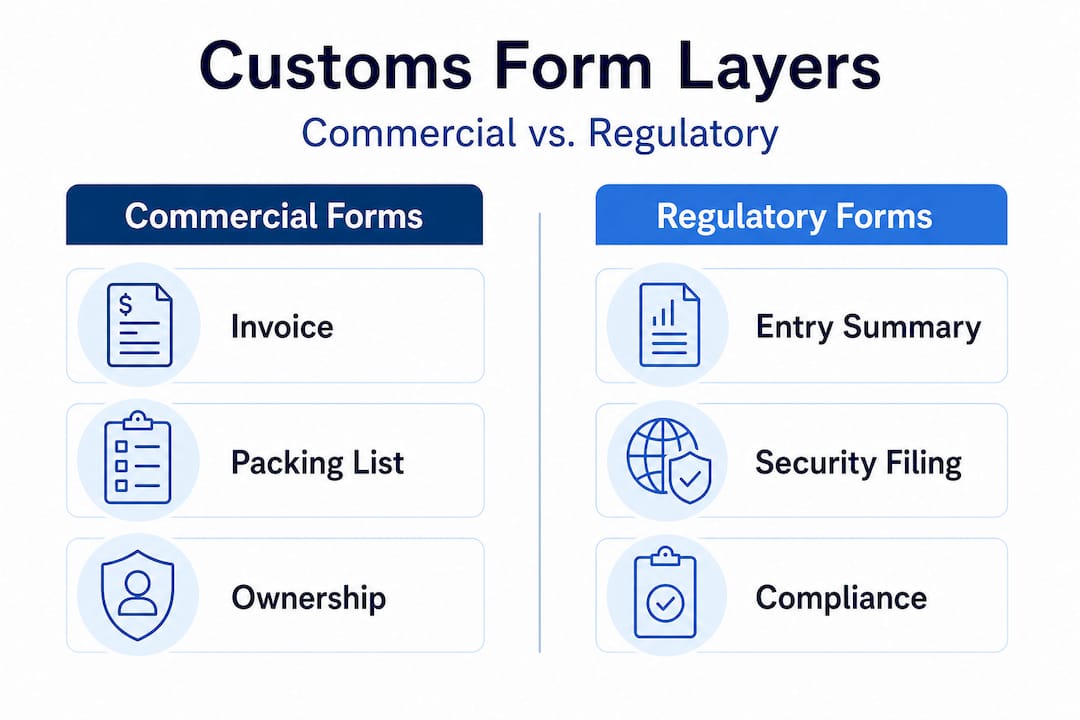
Why does this distinction matter so much? Because each layer has a completely different audience. Commercial documents speak to ownership, value, and terms of sale. Regulatory documents speak to government authorities who need to assess duties, screen for prohibited goods, and verify origin. Mixing up these purposes, or submitting the wrong form to the wrong party, is one of the most frequent triggers for shipment holds.
Here is a quick breakdown of what falls into each category:
Commercial and transaction documents:
- Commercial invoice (establishes value, seller, buyer, and terms)
- Packing list (details contents, quantities, and weights)
- Certificate of origin (proves where goods were made)
- Bill of lading or airway bill (proves title and transport terms)
- Cargo insurance certificate (documents coverage)
Customs-specific regulatory forms:
- CBP Form 7501, the Entry Summary used for U.S. imports
- CBP Form 1302A, the outward vessel cargo manifest for U.S. exports
- EU ICS2 Entry Summary Declaration for safety and security pre-filing
- Canada’s Cargo Control Document (CCD), such as Form A8A(B)
Understanding a commercial invoice explained thoroughly is one of the fastest ways to sharpen your documentation accuracy before moving into the regulatory layer.
| Document layer | Purpose | Who reviews it |
|---|---|---|
| Commercial | Establishes value, ownership, terms | Buyers, banks, freight forwarders |
| Regulatory | Government compliance, duty calculation | Customs authorities, border agencies |
Pro Tip: When building your document package, always prepare the commercial layer first. The values and descriptions on your commercial invoice feed directly into the regulatory forms. An error on the invoice cascades through every form that follows it.
Good customs documentation tips consistently emphasize this layered approach because it creates a logical sequence that prevents duplication and contradiction between documents.
The core customs forms for U.S. imports and exports
With the two paperwork categories defined, let’s walk through exactly which documents you must prepare for U.S. shipments, both inbound and outbound.
For import clearances into the United States, trade guidance confirms that standard requirements center on the commercial invoice and packing list, supplemented by regulatory documents like certificates of origin when applicable. These foundational documents must be accurate and consistent with each other, because customs authorities cross-reference them during review.
The single most important regulatory form for U.S. imports is CBP Form 7501. Per U.S. Customs and Border Protection, CBP Form 7501 serves as the Entry Summary, providing the basis for final appraisement, tariff classification, origin determination, and duty and fee calculation. This is the form that tells CBP exactly what you imported, what it’s worth, where it came from, and what you owe. Getting it wrong triggers audits, delays, and potential penalties.
For U.S. outbound movements, the relevant regulatory document is CBP Form 1302A. According to CBP, Form 1302A functions as the outward vessel cargo manifest, and it must include commercial forms such as copies of bills of lading or equivalent commercial documents. This form gives CBP a complete picture of what is leaving U.S. shores on each vessel.
Here is a numbered list of the essential documents for most U.S. import and export shipments:
- Commercial invoice — must include seller and buyer details, full description of goods, quantity, unit price, total value, currency, and terms of sale (Incoterms)
- Packing list — itemizes every package in the shipment with dimensions, weight, and contents
- Bill of lading or airway bill — the transport contract and receipt issued by the carrier
- Certificate of origin — required when trade agreements or destination requirements demand proof of manufacturing location
- CBP Form 7501 (Entry Summary) — the core U.S. import regulatory filing covering appraisement and classification
- CBP Form 1302A — required for outbound vessel shipments, providing the cargo manifest
- Cargo insurance certificate — documents coverage in case of loss or damage during transit
“CBP relies on CBP Form 7501 Entry Summary to determine relevant information including appraisement, classification, and origin.” — U.S. Customs and Border Protection
Understanding entry summary form 7501 compliance in depth is especially important for businesses importing frequently, because errors on this specific form generate the most common CBP compliance flags.

Pro Tip: For ocean shipments into the U.S., you also need to file an Importer Security Filing (ISF), sometimes called “10+2,” at least 24 hours before cargo is loaded at the foreign port. Missing this filing results in automatic penalties, even if all your other forms are perfect. Review avoiding customs delays to understand the full scope of pre-arrival requirements.
| Form | Direction | Purpose | Filed by |
|---|---|---|---|
| CBP Form 7501 | Import | Entry summary, duty calculation | Importer or broker |
| CBP Form 1302A | Export | Outward vessel cargo manifest | Carrier or agent |
| Certificate of origin | Both | Proof of manufacturing origin | Exporter |
| Commercial invoice | Both | Value and transaction details | Seller/exporter |
Major customs forms across the EU, UK, and Canada
While U.S. forms dominate many trade lanes, global businesses also need to understand documentation norms in other major regions. The EU, UK, and Canada each maintain distinct systems, and misunderstanding regional requirements leads to shipments being held at borders that businesses never expected to be a problem.
European Union: The EU has significantly upgraded its border security processes in recent years. Safety and security filing for EU-bound imports is now handled through the Import Control System 2, known as ICS2. Per the European Commission, the ICS2 system requires carriers and other economic operators to submit an Entry Summary Declaration (ENS) before goods arrive at an EU border. This is not optional filing. The ENS must be submitted electronically before departure or arrival, depending on the transport mode, and failure to comply can result in goods being refused entry entirely.
United Kingdom: Since leaving the EU, the UK maintains its own distinct customs procedures. UK customs clearance now operates under the Customs Declaration Service (CDS). According to UK government guidance, declarations and customs clearance request completion is driven by structured datasets and procedure code rules. Businesses importing into or exporting out of the UK must follow specific completion instructions that differ from pre-Brexit requirements, and many traders who assumed they could use the same documentation processes across EU and UK shipments have been caught off guard.
Canada: The Canada Border Services Agency (CBSA) operates its own cargo control and reporting framework. Per the CBSA Memorandum D3-1-1, carriers may use approved cargo control documents such as Form A8A(B), the In Bond Cargo Control Document. Canada also requires that transit movements and specific import entries be reported to the CBSA and transmitted electronically through the Advance Commercial Information (ACI) system. This electronic pre-reporting requirement mirrors the U.S. ISF system and exists to give border authorities advance screening time before goods physically arrive.
Here is a summary of the key regional forms and systems:
| Region | Key system or form | Filing trigger |
|---|---|---|
| European Union | ICS2 / Entry Summary Declaration (ENS) | Before cargo departs for or arrives at EU |
| United Kingdom | CDS declaration with procedure codes | At import or export event |
| Canada | CBSA Form A8A(B) / ACI electronic filing | Before vessel arrival at Canadian port |
Key points to keep in mind when shipping to these regions:
- The EU ENS must include accurate commodity codes, consignee information, and place of loading
- UK CDS declarations require procedure codes that dictate how duties and VAT are applied
- Canadian ACI filings must be submitted by carriers, not importers, placing the compliance burden on your freight partner
For businesses newer to cross-border shipping, reviewing international shipping basics is a smart first step before preparing documentation packages for these markets.
How to get customs paperwork right: practical steps for error-free compliance
Now that you know what forms are involved, here’s how smart companies reduce errors and stay compliant every time. The difference between businesses that breeze through customs and those that face recurring holds usually comes down to process discipline, not specialized knowledge.
CBP’s own guidance reinforces that the Entry Summary is used to determine appraisement, classification, and origin, which means errors on foundational commercial documents feed directly into regulatory filing mistakes. A wrong value on the invoice becomes a wrong duty calculation on the Entry Summary. The fix is almost always upstream.
Follow these steps to build a reliable documentation process:
- Start with verified commercial documents. Before preparing any regulatory form, confirm that the commercial invoice is accurate, current, and consistent with the purchase order and packing list.
- Use the correct Harmonized System (HS) tariff codes. Misclassification is the single largest source of CBP audit triggers. Use the USITC tariff schedule or a licensed customs broker to confirm your codes.
- Double-check legal entities. The importer of record name on CBP Form 7501 must match exactly with the entity’s registered name. Even minor discrepancies cause problems.
- File electronically wherever possible. Electronic filing through ACE (Automated Commercial Environment) for U.S. entries or ICS2 for EU shipments reduces manual transcription errors dramatically.
- Build lane-specific compliance checklists. Each major trade lane has unique requirements. A shipment from the U.S. to Canada requires different documentation than a shipment from the U.S. to Germany. Create a checklist for each.
- Validate documents before cargo moves. Review the complete package before the shipment departs, not after it arrives at the border.
Additional practices that separate high-performing trade teams from those that struggle:
- Maintain a master HS code library for all products you regularly ship
- Designate one team member or department as the documentation owner per shipment
- Retain all customs documents for a minimum of five years for audit purposes
- Use licensed customs brokers for complex regulatory filings
Pro Tip: Review ISF 10+2 form steps well before your next ocean import. Filing the ISF late, even by a single day, triggers a $5,000 penalty per violation. Setting calendar reminders tied to vessel departure schedules prevents this entirely avoidable cost.
Exploring detailed customs compliance tips provides additional structured guidance that aligns with the lane-specific approach described above.
Why most customs headaches are paperwork problems—Not policy problems
Seeing the practical steps, it’s worth addressing a stubborn myth about customs struggles. Many businesses attribute their shipment delays and compliance failures to unpredictable regulation changes or overzealous border agencies. That narrative, while satisfying, is usually wrong.
The overwhelming majority of customs holds stem from missing documents, inconsistent values between forms, incorrect HS codes, and incomplete filing. These are paperwork problems, and they are fixable. Regulatory changes do happen, but they are announced with lead time, and a business with a well-organized documentation system adapts to those changes far more quickly than one still struggling with the basics.
Consider the contrast between two types of businesses. One invests in checklists, trains its logistics team on lane-specific requirements, and uses customs brokers for high-stakes filings. The other assumes compliance is a legal problem, calls a consultant every time a shipment is held, and never builds internal process muscle. The first business has almost no customs drama. The second spends far more time and money on “regulatory complexity” that is, in reality, documentation sloppiness.
The smarter investment is in documentation systems, not just legal consultations. A well-designed shipment checklist tied to your major trade lanes pays dividends every single week. Streamlining logistics with clear internal processes is almost always more effective than reactive problem-solving after a hold occurs.
The businesses that thrive in international trade treat their customs paperwork as an operational strength, not a bureaucratic burden. That shift in perspective changes everything.
How Worldwide Express supports your customs compliance journey
To help you put these lessons into action, here’s how our team can make your compliance journey even smoother.
Worldwide Express offers businesses direct access to experienced US customs brokerage services that handle CBP Form 7501 filings, ISF submissions, and the full spectrum of import and export documentation. For businesses shipping across multiple trade lanes, the complexity of managing EU ENS requirements, UK CDS procedures, and Canadian ACI filings simultaneously is significant. A professional partner absorbs that complexity so your team stays focused on your core business.
Worldwide Express also provides resources on how customs brokers streamline global trade, offering businesses a clear view of exactly what professional brokerage support delivers in terms of error reduction, faster clearance, and penalty avoidance. For businesses exploring new trade lanes or scaling their international volume, the freight forwarding guidance available through Worldwide Express connects documentation expertise with end-to-end logistics solutions.
Frequently asked questions
What is the most common customs form required for U.S. imports?
CBP Form 7501, known as the Entry Summary, is the standard regulatory filing for U.S. import compliance, providing CBP with the appraisement, classification, and origin details needed to assess duties and fees.
Which documents do I need for international shipping besides customs forms?
Most shipments require a commercial invoice, packing list, and bill of lading as foundational transaction documents, and additional regulatory forms such as certificates of origin are added based on destination requirements and applicable trade agreements.
What is an Entry Summary Declaration (ENS) in the EU?
The ENS is a mandatory pre-arrival safety and security filing submitted electronically through the EU’s ICS2 system, required before goods physically arrive at an EU border point.
When is a certificate of origin required?
A certificate of origin is required when the destination country or an applicable trade agreement mandates proof of where goods were manufactured, and failing to provide it can result in higher duties or shipment rejection. Standard import requirements confirm that certificates of origin apply as regulatory documents on top of the core invoice and packing list.
How can errors in customs documentation be prevented?
Building lane-specific compliance checklists, using electronic filing systems, verifying HS codes before submission, and assigning clear document ownership within your team are the most effective tools for preventing the documentation errors that cause most customs delays.
Recommended
- Streamline customs documentation for trouble-free shipping – Worldwide Express, Inc.
- Master customs compliance tips for smoother shipping – Worldwide Express, Inc.
- Step-by-step guide to exporting goods: compliance to shipment – Worldwide Express, Inc.
- How to Avoid Customs Delays for Smooth International Shipping – Worldwide Express, Inc.
- Complete Guide to Global Trade Documentation – ORNER