TL;DR:
- Shipment rejections threaten cash flow, relationships, and reputation due to non-compliance mainly driven by paperwork errors. Proper documentation, proactive compliance, and expert logistics support can prevent rejections and streamline resolution when they occur. Investing in accurate data management and strategic customs practices offers significant operational and financial advantages in international trade.
Shipment rejections are not just a nuisance. They are a direct threat to cash flow, supplier relationships, and market reputation. A large-scale EU customs operation found that more than half of checked shipments from third countries failed to meet product standards, with a striking 84% flagged as dangerous. That means compliant goods can still be held or turned away if the paperwork doesn’t back them up. This guide walks through why rejections happen, exactly what to do when one occurs, and how to build the kind of compliance discipline that keeps shipments moving.
Table of Contents
- Understanding why shipments are rejected
- The rejected shipments process: Step-by-step
- Preventing shipment rejections: Compliance strategies
- Why most shipment rejections are preventable: A hard look at logistics reality
- How expert logistics partners ease the rejected shipments process
- Frequently asked questions
Key Takeaways
| Point | Details |
|---|---|
| Know rejection causes | Most shipment rejections result from preventable compliance or documentation errors. |
| Follow the right process | Timely actions and proper channels greatly increase your chances of reversing or recouping losses from rejected shipments. |
| Invest in compliance | Consistent attention to data accuracy and regulatory paperwork slashes your risk of costly disruptions. |
| Customs support matters | Expert partners help you navigate claims, appeals, and insurance for smoother trade outcomes. |
Understanding why shipments are rejected
After highlighting the staggering costs of non-compliance, the natural next question is: what actually triggers a rejection? The answer, more often than not, comes down to paperwork and data rather than the goods themselves.
Customs authorities evaluate shipments against a strict set of regulatory criteria. A product that is physically safe and properly manufactured can still be refused if the documentation fails to accurately represent it. According to EU customs data, over 13 items per million were refused in 2024 for non-compliance or serious risks. That figure reflects a systemic problem, not isolated incidents.
The most common rejection triggers include:
- Incorrect or missing HS codes (Harmonized System codes, the international classification system for traded goods)
- Vague or inaccurate product descriptions that don’t match physical contents
- Missing certificates of origin, conformity, or safety testing results
- Mismatched quantities or values between invoice, packing list, and customs declaration
- Expired or incomplete import licenses for regulated product categories
- Failure to comply with destination-country labeling laws
- Undervaluation of goods triggering fraud flags
The table below summarizes the most frequently cited rejection types and the general frequency at which they appear in international trade enforcement:
| Rejection type | Primary cause | Relative frequency |
|---|---|---|
| Documentation errors | Mismatch between declaration and goods | Very high |
| HS code violations | Incorrect tariff classification | High |
| Missing certificates | No proof of conformity or origin | High |
| Labeling non-compliance | Missing required language or markings | Medium |
| Prohibited goods | Restricted substances or categories | Medium |
| Undervaluation/fraud flags | Invoice irregularities | Medium |
“Administrative slips can cost you time and money—and in cross-border trade, the administrative layer is where most modern rejections originate.”
Reviewing customs compliance tips before shipping is one of the most practical ways to catch these slips early. It’s also worth noting that businesses holding road freight liability insurance may have some protection against transit-related losses, but insurance does not substitute for proper compliance. Prevention remains far cheaper than resolution.
The rejected shipments process: Step-by-step
With the underlying causes understood, businesses need a clear roadmap for what actually happens when customs refuses a shipment. The process involves time-sensitive decisions, and hesitation at any stage can raise costs considerably.
Step 1: Receive and review the rejection notice. Customs authorities issue a formal notice of refusal, typically specifying the reason. This document is the cornerstone of every subsequent decision, so reading it carefully and identifying whether the issue is correctable is critical.
Step 2: Assess the nature of the violation. Is this a fixable documentation error, a product compliance failure, or a prohibited goods situation? The cause determines which options are available. A missing certificate might be supplied quickly; a safety violation may result in mandatory destruction.
Step 3: Notify all relevant parties. Alert your freight forwarder, customs broker, supplier, and insurance carrier immediately. Delays in notification can affect appeal timelines and insurance coverage eligibility.
Step 4: Choose a resolution path. There are three primary options when a shipment is rejected:
- Appeal the decision if the rejection is based on an administrative error that can be corrected with documentation
- Return the shipment to the country of origin if the goods themselves are compliant but documentation needs correction
- Authorize destruction or disposal if the goods violate safety laws and cannot be legally re-exported
The freight claim process closely mirrors this sequence, and understanding it can help businesses prepare their own internal protocols.
Step 5: Prepare corrected documentation. If appealing or re-importing, accurate and complete customs documentation must be assembled. This includes updated commercial invoices, corrected certificates, accurate packing lists, and formal appeal letters.

Step 6: File for duty drawback if applicable. When goods are rejected and returned or destroyed, importers may be entitled to a refund of duties paid. This process is called “duty drawback.” Importantly, drawback claims must be filed electronically via the Automated Broker Interface (ABI) and not through the ACE portal itself or at a CBP office. Missing this distinction is a common and costly mistake.
Pro Tip: Many importers assume they can file drawback claims through the standard ACE portal interface. They cannot. Duty drawback for rejected merchandise must go through ABI-certified brokers or software. Partnering with a licensed customs broker for this step alone can save significant refund value.
Understanding customs clearance delays and how they compound rejected shipment timelines is equally important, as rejected goods sitting in customs storage accumulate demurrage fees rapidly.
The comparison table below outlines the three resolution paths side by side to help businesses make faster, more informed decisions:
| Resolution option | Typical cost | Speed of resolution | Compliance risk |
|---|---|---|---|
| Appeal | Low to medium | Days to weeks | Low if corrected accurately |
| Return to origin | Medium to high | 1 to 4 weeks | Medium (re-export paperwork required) |
| Destruction/disposal | Medium | Fast (days) | Low, but goods are lost |
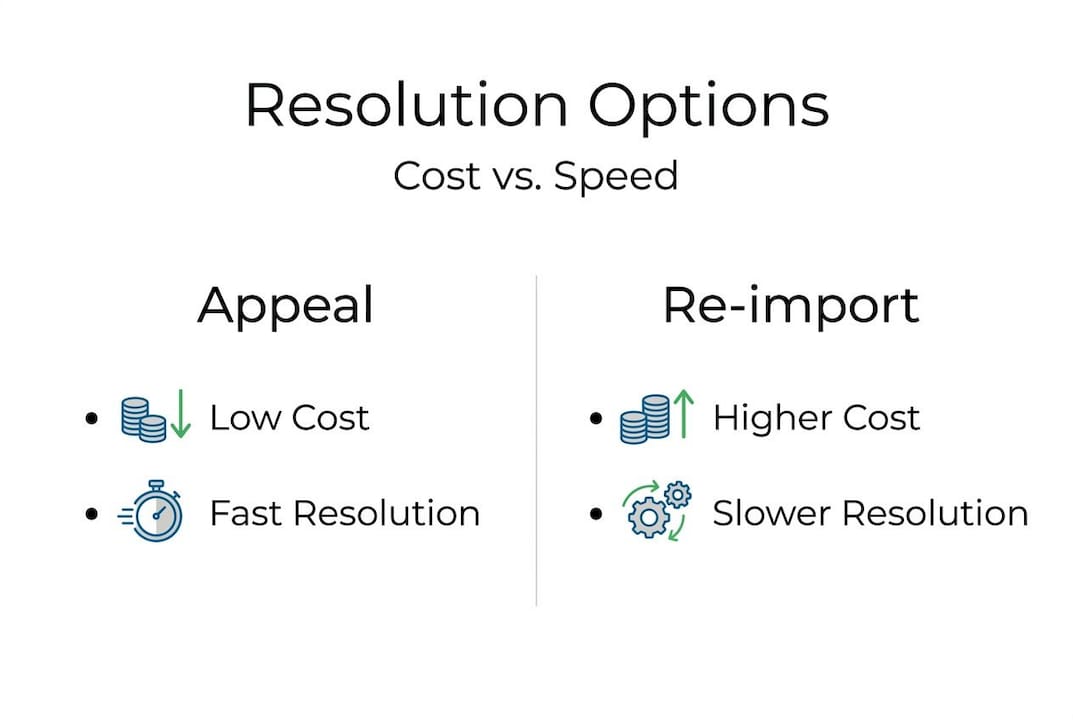
Each option carries financial and operational trade-offs. Appeals are often the best first move when the underlying goods are compliant and the issue is purely administrative. Returns make sense when goods can be reworked or the market of origin can absorb them. Disposal, while painful, is sometimes the only legally permitted path.
Preventing shipment rejections: Compliance strategies
Understanding the process is important, but avoiding rejections entirely is the real goal. Smart compliance is not a box-checking exercise. It’s a business discipline that directly protects revenue and trade relationships.
The foundation of rejection prevention is documentation accuracy. Data and documentation quality, such as product identifiers and certificates, are core to avoiding holds or rejections. That finding from large-scale customs enforcement operations reinforces what experienced trade professionals already know: customs doesn’t just check the box. They check the data inside it.
A practical pre-shipment compliance checklist should include:
- Full and accurate item descriptions that match physical goods, not marketing language
- Correct HS code classification verified against the destination country’s tariff schedule
- Valid certificates of origin, conformity, and any required testing documentation
- Accurate commercial invoice values that reflect true transaction prices
- Complete consignee and shipper details matching those on the import license
- Country-specific labeling requirements including language, warnings, and units of measure
- Updated regulatory status for any products in controlled or restricted categories
Pro Tip: Run a pre-shipment audit before every new product entry or cross-jurisdiction shipment. Assign one team member as the compliance owner for each shipment file, and require sign-off before release. This single operational habit catches a disproportionate number of errors before they become rejections.
Certain scenarios carry significantly higher rejection risk and deserve extra scrutiny:
- Expedited or last-minute shipments where documentation is rushed
- New product lines that haven’t been imported before and lack established compliance history
- Cross-jurisdiction shipments involving free trade zones, multiple transit countries, or blended origin goods
- High-volume e-commerce consignments where item-level data quality is inconsistent
- Seasonal peak periods when customs agencies increase inspection rates
Reducing common importer mistakes requires more than good intentions. It takes systems, training, and periodic audits to make compliance consistent. Following proven compliance best practices is the difference between occasional problems and a genuinely resilient trade operation.
Digital documentation management tools have become indispensable in modern trade. Centralizing records, automating certificate expiration alerts, and maintaining a live compliance checklist per shipment reduces the human error factor dramatically. The investment in these systems pays for itself the first time a high-value shipment avoids rejection because the data was clean and complete.
Why most shipment rejections are preventable: A hard look at logistics reality
Stepping back from the procedural detail, it’s worth challenging a belief that is surprisingly widespread in the industry: that rejected shipments are largely the result of bad luck or overzealous customs enforcement. The data tells a very different story.
Mismatched product identifiers, lack of certificates, and incomplete records are direct drivers of costly rejections. It’s not just the goods that matter, but the data. That insight should reshape how businesses allocate attention and resources in their trade operations.
The uncomfortable truth is that most rejected shipments are not the result of rogue suppliers or impossible regulatory standards. They are the result of operational shortcuts, under-resourced compliance teams, and a cultural tendency to treat documentation as a back-office function rather than a front-line business risk. A single transposed digit in an HS code, one expired certificate, or a commercial invoice that doesn’t match the packing list can freeze an entire container at port for days, triggering storage fees, missed delivery windows, and customer penalties.
What’s particularly revealing is the compounding nature of administrative failures in logistics. A missed document doesn’t just delay one shipment. It can trigger enhanced scrutiny on all future shipments from the same importer. Customs risk-scoring systems flag repeat compliance failures, and businesses that develop a problematic record face higher inspection rates, longer clearance times, and elevated costs over time.
The most operationally disciplined importers treat customs compliance in action as a strategic priority, not a compliance chore. They invest in licensed customs brokers, maintain up-to-date regulatory intelligence, and run pre-shipment audits as standard practice. The ROI on that investment is not theoretical. It shows up in fewer delays, lower inspection rates, preserved supplier relationships, and ultimately in faster, more predictable supply chains.
The companies that get this right don’t see compliance as a cost center. They see it as a competitive advantage.
How expert logistics partners ease the rejected shipments process
Companies don’t have to navigate the complexity of rejected shipments alone, and the right logistics partner can make a measurable difference in both prevention and recovery.
Worldwide Express brings deep expertise in US customs brokerage services and global freight management, helping businesses stay ahead of compliance requirements before shipments ever reach a customs checkpoint. From accurate HS code classification and certificate management to digital documentation tools and real-time tracking, the operational infrastructure is already in place. Understanding the fundamentals of international trade through resources like the freight forwarding guide is a smart starting point for businesses building stronger trade operations. And when it comes to protecting against financial loss from rejected or damaged cargo, exploring cargo insurance basics adds another critical layer of protection. Proactive risk mitigation starts with the right partner.
Frequently asked questions
What is the first step when a shipment is rejected by customs?
Immediate review of the formal rejection notice is the critical first action, as prompt documentation review determines which resolution options remain available and how quickly an appeal or return can be initiated.
How long does it take to resolve a rejected shipment process?
Timelines vary significantly based on the rejection reason. Simple documentation errors may resolve in a few days, while appeals or cross-border returns can take several weeks.
What are the financial risks of rejected international shipments?
Rejected shipments can trigger direct losses including storage and demurrage fees, destruction costs, and lost inventory value. Customs refused an average of 13 items per million in 2024 for non-compliance or serious risks, reflecting how widespread these financial exposures are.
What documentation is critical to avoid shipment rejection?
Accurate item descriptors, correct HS codes, valid conformity certificates, and complete regulatory paperwork are non-negotiable. Data and documentation quality underpins successful customs clearance across all product categories.
What is duty drawback and how does it relate to rejected shipments?
Duty drawback is a refund mechanism for duties paid on goods that are subsequently rejected, exported, or destroyed. All claims must be filed electronically via ABI rather than through the ACE portal or at a CBP office, making licensed broker support essential for this process.
Recommended
- Master International Freight Shipping for Successful Trade – Worldwide Express, Inc.
- Step-by-step guide to exporting goods: compliance to shipment – Worldwide Express, Inc.
- Guide to managing freight claims for smooth international trade – Worldwide Express, Inc.
- Why customs clearance delays happen and how to fix them – Worldwide Express, Inc.
- Proces internationale zending: stapsgewijze aanpak voor e-commerce