CBP Form 5291 is the standard U.S. customs power of attorney, and it’s the document your broker needs before they can legally act on your behalf. Get the official form and confirm who can legally sign it before you submit anything. An equivalent POA is acceptable if it’s executed the same way and grants the same authority, under 19 CFR §141.32.
Before you do anything else:
- Download the official CBP Form 5291 PDF or use the version your broker provides.
- Confirm exactly who at your company has legal authority to sign it.
- Double check that the entity name and EIN on the form match your IRS and ACE records exactly.
That last point matters more than any other single detail. A mismatched name or tax ID is the fastest way to get your power of attorney bounced back.
Key Takeaways
Correctly completing CBP Form 5291 requires matching your entity’s legal name and EIN exactly across IRS, ACE, and broker records, securing the right signer for your entity type, and keeping the signed original on file rather than submitting it routinely to CBP.
| Point | Details |
|---|---|
| Get the official form | Download CBP Form 5291 from the CBP forms page or use your broker’s prefilled version. |
| Match records exactly | Confirm your entity name and EIN match IRS and ACE data before signing anything. |
| Confirm the right signer | Corporations need an officer role; nonstandard signers require a corporate resolution. |
| Keep the original, expect scrutiny | Brokers retain the signed POA and must produce it to CBP on request, not routinely. |
| Work with Worldwide Express | Worldwide Express reviews your POA for common rejection triggers and files entries through ACE for faster processing. |
Table of Contents
- Where to Get Customs Form 5291 and Why It’s the Legal Standard
- Who Can Sign a Customs Power of Attorney by Entity Type
- How to Fill Out Form 5291 Block by Block
- Supporting Documents, Retention, and Broker Practices
- Common Mistakes That Get a POA Rejected
- Delivering the Completed POA to Your Broker
- Expert Tips for a Faster, Smoother POA Process
- Why the Paperwork Deserves More Attention Than It Gets
- How Worldwide Express Handles POA Review and Customs Filing
- Frequently Asked Questions
- Sources
Where to Get Customs Form 5291 and Why It’s the Legal Standard
U.S. Customs and Border Protection maintains an official forms page where you can pull the current CBP Form 5291 PDF directly. Most licensed brokers keep their own prefilled version ready to go, with their business name and address already entered in Block 3, so you’re only completing the sections that identify you as the grantor.
The legal footing here comes from a specific regulation, not just convention.
Statistic callout: Under 19 CFR §141.32, a power of attorney doesn’t have to be Form 5291 word for word. It just has to be executed in the same manner and carry equivalent authority.
A few things to know about how the form actually functions once signed:
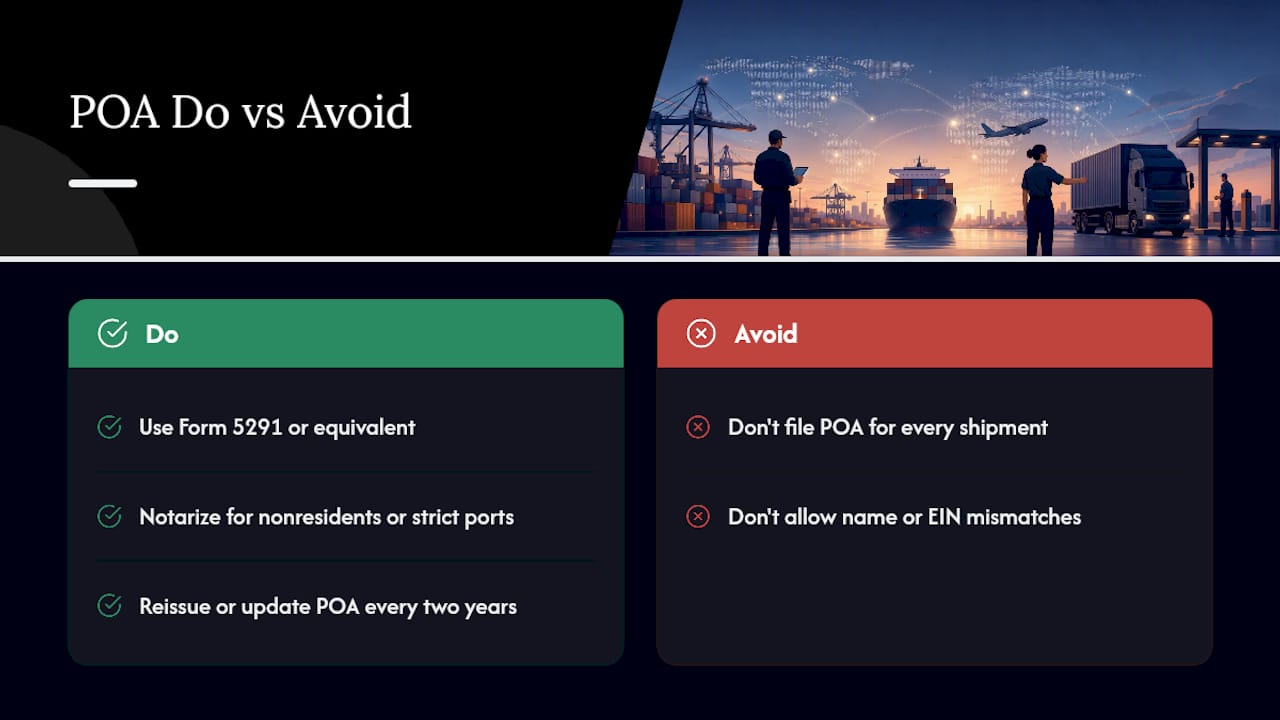
- The broker retains the signed original in their files, not CBP.
- It typically isn’t filed with CBP as a matter of routine.
- CBP can require the broker to produce it on demand, and the broker must be able to hand it over immediately.
Who Can Sign a Customs Power of Attorney by Entity Type
CBP holds brokers to a “reasonable care” standard when accepting a power of attorney, which means they’re required to verify that the person signing actually has the authority to bind your business. That verification typically involves a photo ID, a check of your state business registration, and a comparison against ACE records to confirm your name and EIN line up.
Who qualifies as a valid signer depends entirely on your business structure:
- Individuals and sole proprietors: the individual signs personally.
- Partnerships: any general partner can sign, though many brokers ask that the POA be reissued every two years as a compliance safeguard.
- Corporations: typically the president, vice president, secretary, or treasurer.
- LLCs: an authorized member or manager, depending on how the operating agreement assigns authority.
If someone outside these standard roles needs to sign, expect your broker to ask for a corporate resolution or similar documented proof of authority before they’ll accept the form. Nonresident corporations face an extra layer: they generally need a resident agent and certified corporate documents to satisfy the broker’s verification steps.
Pro Tip: If your company has recently changed officers, update your POA immediately. A signature from someone who left the role six months ago is one of the more common reasons brokers reject a form outright.
How to Fill Out Form 5291 Block by Block
The form runs one page, but each block does specific work, and small errors compound fast. Here’s how to move through it correctly.
- Block 1: Employer Identification Number or Social Security Number. Enter the number exactly as it appears on IRS records and in ACE. Even a single transposed digit will flag a mismatch.
- Block 2: Legal name and address. Use your entity’s full legal name, not a nickname or shortened trade name, and a street address rather than a P.O. box unless your broker confirms otherwise. If you operate under a trade name as well, list it alongside the legal name.
- Block 3: Broker’s name and address. If your broker prefilled this, check it for typos before you sign anything below it. An incorrect broker name here can delay processing just as easily as an error in your own information.
- Blocks 4 and 5: Signature and title. Sign in the capacity that matches your entity type. Corporations sometimes need a second officer’s signature or a corporate seal, particularly when the first signer holds a title outside the standard four officer roles.
- Block 6: Witness and notarization. A witness signature is common practice; notarization isn’t universally required but strengthens the document considerably, especially for nonresident entities or ports known for tighter scrutiny.
Practical walkthroughs of the form consistently flag the same failure point: names and tax numbers that don’t match exactly between the POA, your IRS filings, and ACE.
Supporting Documents, Retention, and Broker Practices
Your signed Form 5291 rarely travels alone; brokers commonly ask for a packet of supporting documents alongside it. Brokers commonly ask for a packet of supporting documents alongside it:
- A government-issued photo ID for the signer.
- A certificate of good standing from your state of incorporation.
- A corporate resolution, when the signer isn’t a standard officer.
- Confirmation of your EIN matching IRS records.
The CBP guide for commercial importers confirms that brokers keep the signed original on file and must produce it to CBP only when requested, not as a routine submission. Notarization and certified corporate documents aren’t always mandatory, but they cut down on friction considerably at ports that scrutinize nonresident entities more closely.
Common Mistakes That Get a POA Rejected
Most rejections trace back to a short list of preventable errors:
- Entity name or EIN on the POA doesn’t match IRS or ACE records.
- The wrong person signed, or a nonstandard signer lacks a corporate resolution.
- A required signature block was left blank.
- The scanned copy is low resolution or partially cut off.
- An outdated POA, particularly for partnerships, wasn’t reissued on schedule.
Run a quick six-point check before submission: correct legal name, matching EIN, valid signer, complete signature blocks, legible scan, and current issue date. If your broker or CBP flags an issue, correct it and resubmit immediately rather than letting an entry sit while paperwork gets sorted out.
Pro Tip: Keep a digital folder with your current POA, corporate resolution, and good-standing certificate together. When a broker asks for backup documentation, you want to send it in one email, not scramble across three drawers.
Delivering the Completed POA to Your Broker
Most brokers prefer a secure scan sent through email or a client portal, while you keep the signed original in your own files. Once received, your broker verifies your identity against the supporting documents, attaches the POA to your client file, and uses it to authorize ACE entry filings going forward.
A clean, error-free POA on file means your broker can move straight to filing without a back-and-forth over documentation. Combined with electronic submission through ACE, Worldwide Express’s internal data shows processing that runs roughly 30% faster compared to manual paperwork handling.
Expert Tips for a Faster, Smoother POA Process
A few habits separate a POA that clears without friction from one that bounces back for corrections:
- File electronically through ACE whenever your broker supports it. It shortens processing time and cuts down on manual rework.
- Draft your corporate resolution in plain terms that name the signer and the scope of authority granted. Skip the legal jargon; clarity matters more than formality here.
- Scan at 300 DPI or higher, save as PDF, and name the file clearly (e.g., “CompanyName_POA_2026.pdf”).
- Include a short cover email noting your EIN, entity name, and the broker contact handling your account.
Pro Tip: A well-labeled file name sounds trivial, but brokers process dozens of client documents a week. Making yours easy to find speeds up everything downstream.
Why the Paperwork Deserves More Attention Than It Gets
Most guidance on customs paperwork treats Form 5291 as a formality, something you sign once and forget. That’s a mistake. The form is the legal hinge that lets your broker act on your behalf for every entry, every duty payment, every classification decision tied to your shipments. Treating it casually is how businesses end up with a broker who technically has no valid authority to file for them, discovered only when CBP asks for proof at the worst possible moment.
The conventional advice, download the form, sign it, send it, undersells the verification work involved. Reasonable care obligations put real scrutiny on your broker to confirm your identity and authority, and that scrutiny should push you to get your corporate documentation in order before you ever pick up a pen. Partnerships in particular tend to let reissuance slide past the two-year mark, which creates exposure nobody notices until an entry gets held.
What should come first, in order: confirm the correct signer for your entity type, match your EIN and legal name across every record CBP might check, and file electronically once the paperwork is clean. Skip straight to signing without those checks, and you’re gambling with entry delays that a little upfront diligence would have prevented entirely.
How Worldwide Express Handles POA Review and Customs Filing
Getting Form 5291 right on the first try saves you the delay of a rejected filing sitting in queue while your shipment waits at port. Worldwide Express reviews your power of attorney for the exact issues that cause rejections, name mismatches, missing corporate resolutions, incomplete signature blocks, before it ever touches an entry filing.
Beyond POA review, Worldwide Express handles ACE e-filing, notarization guidance for entities that need it, and full customs brokerage services from entry through release. If your paperwork has stalled a shipment before, or you’d rather have someone check it before it becomes a problem, request a POA review or a customs brokerage quote and get your next entry filed without the guesswork.
Frequently Asked Questions
Is CBP Form 5291 required, or can I use a different power of attorney?
Form 5291 is the standard instrument, but it isn’t strictly mandatory. Under 19 CFR §141.32, an equivalent POA is acceptable as long as it’s executed the same way and grants comparable authority.
Does Form 5291 need to be notarized?
Not always. Notarization isn’t a blanket requirement, but it strengthens the document and reduces friction, particularly for nonresident entities or at ports with tighter documentation checks.
How long is a customs power of attorney valid?
There’s no fixed universal expiration, but partnerships commonly reissue their POA every two years as a precaution, and any change in signing officers should trigger an update regardless of entity type.
Do I need to file Form 5291 with CBP every time I ship?
No. Your broker keeps the signed original on file and only needs to produce it if CBP specifically requests it, according to CBP’s guide for commercial importers.
What’s the most common reason a POA gets rejected?
A mismatch between the name or EIN on the form and what’s recorded in ACE or with the IRS. It’s the single most frequent, and most preventable, error brokers flag.
Sources
- 19 CFR 141.32 — Form for power of attorney. – eCFR
- How to Fill Out and Submit CBP Form 5291: Power of Attorney – LegalClarity
Recommended
- Complete Guide to Customs Power of Attorney Form PDF – Worldwide Express, Inc.
- How to Complete a Customs POA Form for U.S. Imports – Worldwide Express, Inc.
- How to Use CBP Power of Attorney for Customs Clearance – Worldwide Express, Inc.
- Complete Guide to Using Customs Power of Attorney PDF – Worldwide Express, Inc.