TL;DR:
- Customs pre-clearance can reduce clearance times by up to 40 percent.
- Proper documentation and technology are essential for effective pre-arrival processing.
- Investing in expert broker support enhances speed, compliance, and supply chain resilience.
Pre-arrival processing can cut air freight clearance time by 25%, yet most businesses still treat customs delays as an unavoidable cost of doing business. That assumption is expensive. Every hour a shipment sits at the border waiting for paperwork review is an hour of lost revenue, strained customer relationships, and disrupted supply chains. Customs pre-clearance flips that script entirely. This article breaks down exactly how pre-clearance works, where it delivers the biggest time savings, how country-specific systems differ, and what practical steps businesses can take right now to start benefiting.
Table of Contents
- What is customs pre-clearance?
- How pre-clearance accelerates clearance times
- Global variations: country-specific systems and compliance
- Business impact: logistics efficiency, risks, and investment
- Our take: Why mastering customs pre-clearance is the new logistics edge
- Unlock trade efficiency with expert customs solutions
- Frequently asked questions
Key Takeaways
| Point | Details |
|---|---|
| Boost clearance speed | Pre-clearance methods can reduce customs processing time by up to 40% for shipments. |
| Avoid costly delays | Early documentation and proper digital tools prevent 48-72 hour bottlenecks at border points. |
| Align with local systems | Following country-specific pre-clearance standards ensures maximum benefit and compliance. |
| Plan for investments | Upfront investment in technology and staff training pays off with smoother logistics operations. |
What is customs pre-clearance?
Customs pre-clearance, also called pre-arrival processing (PAP), allows importers to submit all required documentation to customs authorities before the shipment physically arrives at the border or port. According to Malaysian Customs guidelines, this process enables risk assessment and duty calculation to happen in advance, so goods can be released almost immediately upon arrival rather than sitting in a queue.
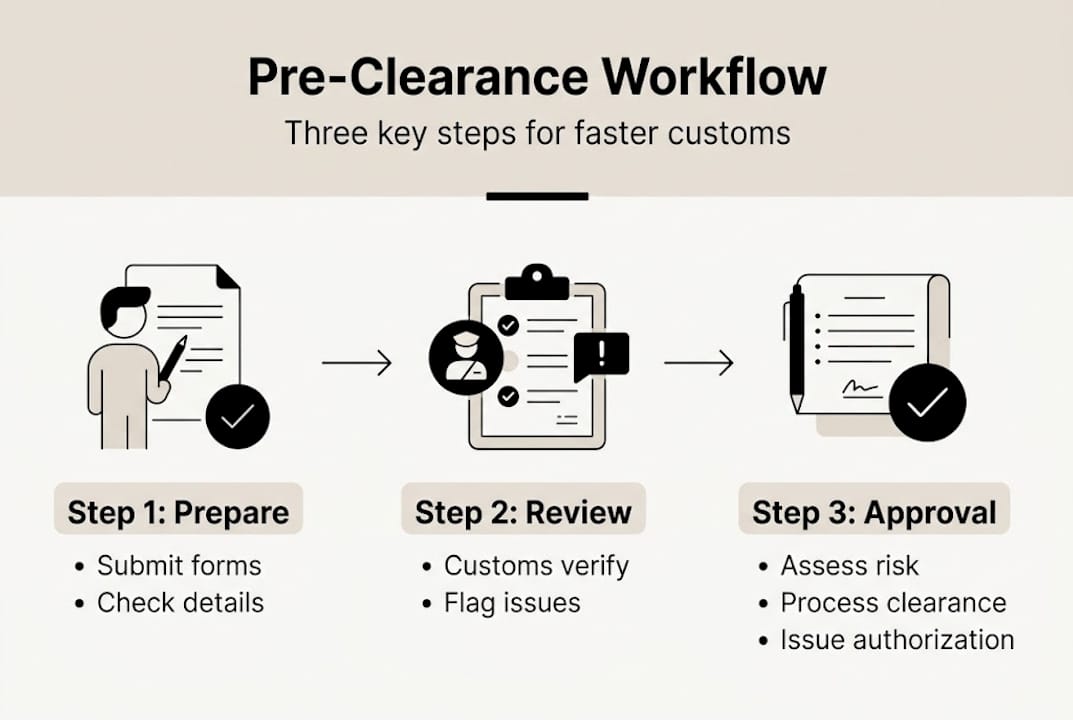
The basic workflow involves three core steps. First, the importer or their customs broker submits the commercial invoice, cargo manifest, and shipment details electronically. Second, customs authorities run a risk assessment, flagging shipments that need physical inspection and clearing low-risk ones automatically. Third, approved shipments receive a release authorization that allows them to move through the port without delay.
The main stakeholders in this process include importers, licensed customs brokers, and the relevant national customs authority. Brokers play a particularly important role because they understand local documentation requirements and can catch errors before submission, which is one of the most common sources of delay.
Timelines vary by transport mode. For air freight, manifest deadlines are typically required four hours before arrival. For sea freight, carriers must submit manifests 24 hours before loading at the origin port in many jurisdictions. Missing these windows means losing the pre-clearance advantage entirely.
Several country-specific systems power this process:
- United States: The Automated Commercial Environment (ACE) handles pre-arrival filings for both air and sea cargo.
- Canada: The Pre-Arrival Review System (PARS) and Pre-Arrival Processing System (PAPS) manage cross-border truck and rail shipments.
- Malaysia: The PAP system allows electronic submission aligned with international data standards set by the World Customs Organization (WCO).
Businesses that align with customs compliance tips early in their logistics planning tend to experience far fewer surprises at the border. Understanding customs clearance for businesses as a proactive discipline rather than a reactive scramble is the first shift that makes pre-clearance genuinely effective.
How pre-clearance accelerates clearance times
Now that we know what pre-clearance is, let’s explore just how much time and disruption it saves for businesses. The numbers are striking. Digital pre-arrival processing cuts air freight customs clearance time by 25%, while ACE automation can make processing up to 40% faster compared to traditional paper-based methods.

| Shipment type | Traditional clearance time | With pre-clearance |
|---|---|---|
| Air freight | 6 to 8 hours | Under 4 hours |
| Sea freight | 48 to 72 hours | 20 to 24 hours |
| Cross-border truck | 2 to 4 hours | Under 1 hour |
Errors in documentation are the single biggest cause of extended delays. A mismatched HS code (Harmonized System code, a standardized numerical classification for traded goods) or an incorrect declared value can trigger a full customs hold lasting 48 to 72 hours. Pre-clearance reduces this risk because documentation is reviewed and corrected before the shipment departs, not after it arrives.
Automation tools like ACE have transformed streamlining airport customs from a manual, paper-heavy process into a data-driven workflow. When systems communicate electronically, customs officers can prioritize inspections based on actual risk signals rather than random checks, which speeds up release for compliant shipments dramatically.
Broker involvement amplifies these gains. A licensed customs broker who submits accurate, complete documentation consistently builds a track record with customs authorities, which can result in even faster processing over time.
Statistic spotlight: Businesses using digital pre-arrival tools report clearance times under four hours for air freight, compared to the six to eight hour industry average without pre-clearance.
Pro Tip: The most common pre-clearance mistakes are misclassified HS codes, missing country-of-origin certificates, and incorrect valuation. Audit your documentation checklist against the specific requirements of your destination country before every shipment. Explore avoiding customs delays for a detailed breakdown of the most costly errors and how to prevent them.
Global variations: country-specific systems and compliance
With time savings established, let’s examine the nuances of pre-clearance systems across major trading nations. The mechanics vary significantly, and local implementation is what drives practical results for businesses on the ground.
| Country | System name | Key requirement | Mode covered |
|---|---|---|---|
| United States | ACE (Automated Commercial Environment) | Electronic filing via ACE portal | Air, sea, truck, rail |
| Canada | PARS / PAPS | Unique shipment control number (SCN) | Truck, rail |
| Malaysia | PAP | Barcode manifest, electronic submission | Air, sea |
| European Union | ICS2 (Import Control System 2) | Entry Summary Declaration (ENS) | All modes |
The WCO guidelines establish a global framework for pre-arrival data exchange, but each country adapts these standards to its own legal and technological infrastructure. This means a process that works smoothly for a US-Canada corridor may require entirely different documentation for an Asia-Pacific route.
Key compliance requirements that appear across most systems include:
- Electronic data interchange (EDI): Most modern customs systems require data submitted through certified software platforms, not fax or paper.
- Barcode manifests: Systems like Malaysia’s PAP require machine-readable manifests to speed up scanning and data matching.
- Unique shipment control numbers (SCN): Canada’s PARS system assigns a unique SCN to each shipment, which carriers and brokers must reference throughout the process.
- Advance cargo information (ACI): Many jurisdictions require cargo details submitted hours or days before arrival, not at the point of entry.
Businesses shipping perishables face an additional layer of urgency. Clearance for perishables demands near-perfect documentation timing, making pre-clearance not just beneficial but essential for temperature-sensitive goods.
Pro Tip: If your business ships to multiple countries, create a country-specific documentation checklist for each major trade lane. Map the exact system, deadline, and required fields for each destination. Pair this with mastering compliance resources to stay current as regulations evolve.
Business impact: logistics efficiency, risks, and investment
Understanding these variations, let’s get practical about how pre-clearance impacts operations and what your business needs to prepare. Pre-clearance genuinely transforms supply chain performance, but it requires upfront investment in both technology and process.
On the efficiency side, the gains are real and measurable. Fewer bottlenecks at the border mean faster transit times, more predictable delivery windows, and lower demurrage (storage fees charged when goods sit at a port beyond the agreed free period) costs. Carriers and freight forwarders can plan more tightly when they know clearance will happen before arrival rather than after.
However, pre-clearance adoption comes with genuine challenges that businesses should not underestimate:
- Technology investment: Connecting to ACE, PARS, or PAP requires certified software and, in some cases, IT integration with existing ERP systems.
- Compliance complexity: Each country’s system has its own rules, deadlines, and data formats. Staying current requires dedicated resources.
- Inconsistent adoption: Not all trading partners, carriers, or freight forwarders have fully embraced digital pre-clearance, which can create gaps in the chain.
Here are the action steps businesses should prioritize:
- Audit your current documentation workflow. Identify where errors or delays most commonly occur and whether pre-clearance submission is already part of your process.
- Invest in streamlining documentation tools that integrate with customs portals and automate data validation before submission.
- Train staff on country-specific requirements for your most active trade lanes, including manifest deadlines and required data fields.
- Partner with a licensed customs broker who has direct experience with the systems used in your target markets.
- Monitor digital freight forwarding trends to stay ahead of regulatory changes that affect pre-clearance requirements.
“Pre-clearance is praised for its efficiency gains, but realizing those gains requires upfront investment in digital tools and well-trained processes.” — Royal Malaysian Customs Department
The businesses that treat pre-clearance as a strategic investment rather than a compliance checkbox are the ones that build real logistics agility over time.
Our take: Why mastering customs pre-clearance is the new logistics edge
Most businesses avoid pre-clearance not because they doubt its value, but because the upfront cost feels daunting. New software, staff training, broker fees, and system integrations all land on the balance sheet before a single shipment moves faster. That hesitation is understandable. It is also short-sighted.
The WCO global frameworks set the standard, but local execution is where businesses either win or lose. A company that invests in understanding Malaysia’s PAP system or Canada’s PARS process gains a concrete operational advantage over competitors who are still faxing manifests or scrambling to correct errors at the border.
The hidden gains go beyond speed. Faster clearance improves customer satisfaction, reduces inventory holding costs, and future-proofs operations against tightening regulatory requirements. Engaging customs broker expertise early in the process is arguably the highest-return investment a trade-active business can make in 2026. Pre-clearance is not a niche tool for large importers. It is quickly becoming the baseline expectation for any business serious about competitive logistics.
Unlock trade efficiency with expert customs solutions
Pre-clearance strategies only deliver their full potential when backed by experienced partners who know the systems, the deadlines, and the documentation requirements inside and out.
Worldwide Express offers US customs brokerage services designed to reduce risk and accelerate clearance across major trade lanes. Whether you are navigating ACE filings for air freight or managing complex multi-country documentation, the customs broker solutions at Worldwide Express are built to keep your shipments moving. For businesses looking to strengthen their broader logistics strategy, the freight forwarding guide is an excellent next step to understanding how pre-clearance fits into a complete international shipping plan.
Frequently asked questions
Does customs pre-clearance reduce shipment delays?
Yes. Pre-clearance cuts processing times by 25 to 40% and significantly reduces delays caused by documentation errors caught before arrival rather than after.
Can all businesses use customs pre-clearance?
Most importers can access pre-clearance programs, but eligibility and specific requirements vary by country and system, as local rules differ considerably across major trading nations.
What documents are needed for pre-clearance?
Core documents include a commercial invoice, cargo manifest, and full shipment details. These must be submitted before arrival to allow risk assessment and duty calculation in advance.
What is the role of digital tools in customs pre-clearance?
Digital tools enable faster data submission and automated risk assessment. Automation speeds processing by up to 40% when properly integrated with national customs portals like ACE or PAP.
Recommended
- Streamline airport customs clearance for faster shipping – Worldwide Express, Inc.
- Airport Customs Clearance 2026: 40% Faster Processing – Worldwide Express, Inc.
- Master customs compliance tips for smoother shipping – Worldwide Express, Inc.
- Trading Bloc Advantages: Improving International Shipping – Worldwide Express, Inc.