TL;DR:
- Freight consolidation minimizes shipping costs, transit times, and product damage by combining shipments into full truckloads. It also enhances sustainability by reducing trips and emissions, while requiring precise data and coordinated scheduling for successful implementation. Large retailers like Walmart exemplify how consolidation programs improve supply chain resilience and operational efficiency at scale.
Freight consolidation is defined as the practice of combining multiple smaller shipments from one or more shippers into a single, fuller truckload for transport. The core freight consolidation benefits are measurable and well-documented: lower per-unit shipping costs, faster transit times, reduced product damage, and a smaller carbon footprint. These advantages apply whether you are managing inbound replenishment for a mid-sized retailer or coordinating outbound flows for a large manufacturer. Walmart’s prepaid consolidation program and third-party logistics providers like C.H. Robinson have demonstrated at scale that consolidation is not just a cost tactic. It is a supply chain discipline that touches inventory availability, dock efficiency, and sustainability performance simultaneously.
What are the freight consolidation benefits for cost and efficiency?
Freight consolidation reduces shipping costs by maximizing trailer utilization, which lowers the per-unit freight charge each shipper pays. When a trailer runs at full capacity, the fixed costs of the driver, fuel, and equipment are spread across more cargo. That math directly cuts what any single shipper pays per pallet-mile compared to a standard less-than-truckload arrangement.
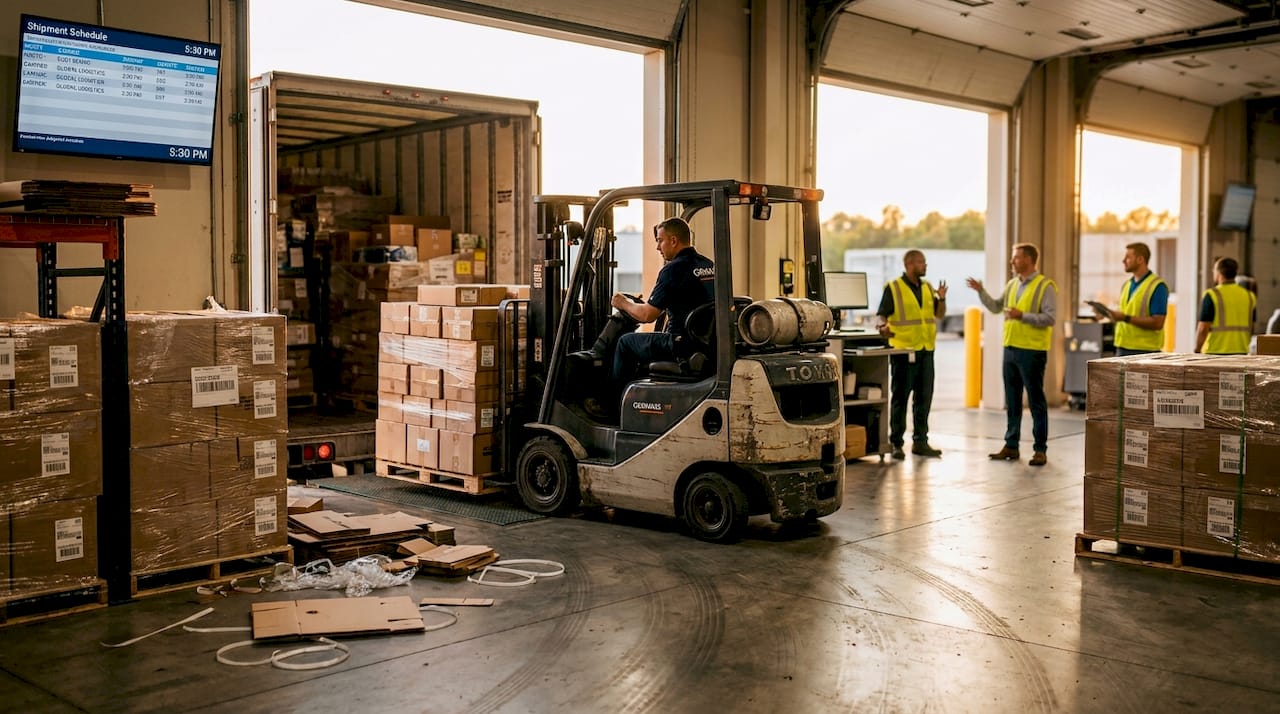
Combining LTL shipments into full truckloads eliminates the premium charges carriers apply to partial loads and reduces the number of handling events at intermediate terminals. Each terminal stop adds cost, time, and damage risk. Fewer stops mean fewer fees and a cleaner freight invoice at the end of the month.
Operational savings extend well beyond the freight bill. Automated consolidation centers reduce administrative burden by allowing suppliers to manage a single national purchase order rather than dozens of individual shipments. That shift cuts dock scheduling complexity, reduces receiving interruptions, and frees warehouse staff for higher-value tasks.
The key cost-saving factors in a well-run consolidation program include:
- Trailer fill rate improvement: Moving from 60% to 95% trailer utilization eliminates the cost of hauling air.
- Reduced carrier accessorial charges: Fewer LTL pickups mean fewer fuel surcharges, liftgate fees, and residential delivery premiums.
- Lower dock labor costs: Consolidating five inbound appointments into one cuts receiving labor by a proportional amount.
- Fewer freight claims: Less handling means fewer damaged goods and lower claims processing overhead.
- Simplified invoicing: One shipment, one bill of lading, one freight invoice to reconcile.
Pro Tip: Align your purchasing calendar with your warehouse receiving schedule before launching a consolidation program. The biggest efficiency gains come when procurement and operations agree on order frequency, not just shipment size.
How does consolidation affect transit times and product integrity?
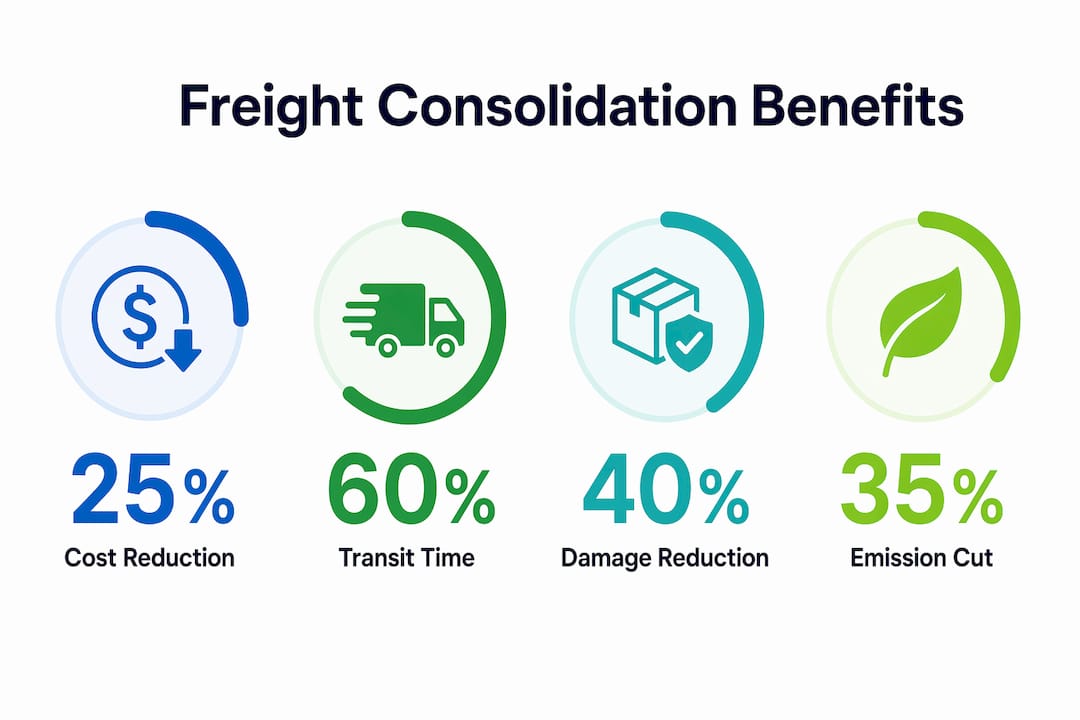
Consolidated shipments cut transit times from the 6 to 10 days typical of fragmented LTL routing down to approximately 2 to 3 days on cross-country routes. That improvement comes from eliminating the multiple sort-and-transfer cycles that LTL freight endures at regional terminals before reaching its destination. A direct consolidated load moves point to point with minimal interference.
Product integrity is a benefit that logistics specialists consistently flag as undervalued. Fewer handling events directly reduce the probability of product damage, because each unloading and re-sorting cycle is an opportunity for goods to be dropped, crushed, or exposed to temperature variation. For food, beverage, and consumer electronics shippers, this translates into lower spoilage costs and fewer insurance claims.
Consider the comparison between standard LTL and consolidated freight on a typical lane:
- Standard LTL: 3 to 5 terminal transfers, 6 to 10 day transit, higher damage exposure at each transfer point, multiple proof-of-delivery documents to manage.
- Consolidated freight: 1 direct or cross-dock transfer, 2 to 3 day transit, damage risk concentrated at a single loading event, one clean bill of lading.
The financial implication of that difference is real. Freight claims processing costs time and money beyond the value of the damaged goods. Reducing claim frequency lowers insurance premiums over time and protects vendor scorecards with retail customers who track fill rates and damage rates as key performance indicators.
Pro Tip: Select consolidation partners with cross-docking capabilities at strategically located facilities. A well-placed cross-dock in the Midwest, for example, can serve both coasts with 2-day transit without requiring a full distribution center footprint.
What are the environmental benefits of freight consolidation?
Freight consolidation reduces the total number of trucks on the road by filling each trailer more completely, which cuts fuel consumption and emissions per unit shipped. Fewer trips and reduced empty miles lower a company’s carbon footprint in a direct, measurable way. For supply chain managers with corporate sustainability targets, this is one of the most credible levers available because the emissions reduction is a byproduct of cost savings, not an added expense.
The emissions comparison between shipping modes matters here. Air freight emits roughly six times more CO₂ per shipment than trucking, which means any shift from air to consolidated ground transport compounds the environmental benefit. Companies that reduce transportation costs through consolidation often find that sustainability metrics improve in parallel without a separate green logistics initiative.
| Shipment type | Relative CO₂ per unit | Handling events | Typical transit (cross-country) |
|---|---|---|---|
| Air freight | Very high (6× trucking) | 2 to 4 | 1 to 2 days |
| Standard LTL | Moderate | 3 to 5 | 6 to 10 days |
| Consolidated FTL | Low | 1 to 2 | 2 to 3 days |
Retailers including Walmart have built sustainability reporting directly into their consolidation programs, tracking emissions reductions alongside freight cost savings. That dual reporting structure makes it easier for suppliers to demonstrate ESG progress to investors and customers using data that already exists in the transportation management system.
Pro Tip: Track carbon metrics alongside freight spend from day one of a consolidation program. The data is already in your TMS. Reporting both together strengthens the business case internally and satisfies sustainability disclosure requirements with minimal additional effort.
Is freight consolidation practical for small and mid-sized businesses?
Mid-sized companies gain real advantages from consolidation, but the benefits depend on tight coordination between procurement and warehouse operations. The non-obvious risk is that prioritizing freight savings over inventory availability can cause replenishment delays. If a consolidation window requires holding a purchase order for three extra days to fill a trailer, and that delay triggers a stockout, the freight savings are erased by lost sales or expedited replenishment costs.
The solution is phased implementation. Start with your highest-volume, most predictable lanes where order frequency is high enough to fill trailers without extending lead times. Avoid consolidating time-sensitive or seasonal inventory in the early stages. Build confidence in the process before applying it to your most critical SKUs.
Experienced third-party logistics providers are the practical entry point for smaller shippers who lack the volume to fill trailers independently. A 3PL with an established consolidation network pools your freight with other shippers on the same lane, giving you FTL economics without requiring FTL volume. The key is selecting a partner whose tech-enabled consolidation services integrate with your order management system so that shipment visibility does not degrade when you hand off control of the load.
Accurate data is the foundation of a functional consolidation program. Purchase order details, vendor readiness dates, pallet counts, and warehouse receiving capacity all need to be current and accessible. When that data is clean, a 3PL can build efficient loads. When it is not, consolidation windows get missed and the cost savings evaporate.
Pro Tip: Align vendor ship windows and your receiving dock schedule before committing to a consolidation program. Vendors who ship late or in inconsistent quantities are the single biggest cause of consolidation failures at the operational level.
How are major retailers using freight consolidation programs in 2026?
Walmart’s prepaid consolidation program is the most visible example of large-scale consolidation in practice. The program combines supplier shipments under a single national purchase order routed through three automated consolidation centers, reducing freight costs, improving inventory flow, and building supply chain resilience across thousands of supplier relationships. Suppliers gain cost control and a simpler inbound logistics process. Walmart gains more predictable inventory availability and lower inbound freight spend.
The program also illustrates how suppliers maintain carrier control while accessing the retailer’s logistics scale, which reduces exposure to spot market volatility. That is a meaningful advantage in a freight market where rates can swing 20 to 30 percent between quarters.
Key benefits suppliers report from participation in retailer-led consolidation programs include:
- Dedicated account management and retail supply chain expertise from 3PL partners embedded in the program.
- Reduced dock congestion at distribution centers from fewer, larger inbound deliveries.
- Improved vendor scorecards due to more consistent on-time and in-full performance.
- Access to automated consolidation center technology without capital investment.
The broader implication for supply chain managers is that consolidation is moving from a tactical freight option to a structural feature of major retail supply chains. Companies that build consolidation capability now, whether through retailer programs or independent 3PL partnerships, are positioning themselves for a logistics environment where full-trailer efficiency is the baseline expectation, not the exception.
Key takeaways
Freight consolidation delivers cost, speed, and sustainability advantages simultaneously, making it one of the highest-return logistics strategies available to supply chain managers in 2026.
| Point | Details |
|---|---|
| Cost reduction mechanism | Maximizing trailer fill rate lowers per-unit freight charges and eliminates LTL accessorial fees. |
| Transit time improvement | Consolidated loads cut cross-country transit from 6 to 10 days down to 2 to 3 days. |
| Product integrity gain | Fewer handling events reduce damage claims and lower insurance costs over time. |
| Sustainability alignment | Fuller trucks mean fewer trips, less fuel, and lower CO₂ emissions per unit shipped. |
| Implementation priority | Clean purchase order data and aligned vendor schedules are prerequisites for consolidation success. |
Why the real value of consolidation is still underestimated
The freight bill savings get the attention in every consolidation conversation. That is understandable. A 15 to 25 percent reduction in transportation spend is a number that shows up clearly in a quarterly review. What gets less attention is the downstream value: fewer freight claims, lower dock labor costs, better vendor scorecards, and improved inventory availability.
From my perspective, the companies that extract the most value from consolidation are the ones that treat it as an operations discipline rather than a procurement tactic. They invest in data accuracy, align purchasing and warehouse scheduling, and choose 3PL partners based on technology integration capability rather than rate alone. The rate matters, but a partner whose system cannot communicate with your WMS will cost you more in exception handling than you saved on the freight.
The sustainability angle is also more financially material than most supply chain managers currently account for. As carbon disclosure requirements expand and customers begin asking for emissions data at the shipment level, the ability to report consolidated freight metrics becomes a competitive differentiator. The data already exists in most transportation management systems. The companies winning on this front are simply the ones who started tracking it early.
The one caution I would offer is on timing. Consolidation requires patience at the purchase order level, and that patience has a cost if your inventory buffers are thin. Build your safety stock before you extend your consolidation windows. The freight savings are real, but a stockout during peak season will erase them and then some. Explore freight transportation modes carefully before committing to a single consolidation structure, because the right mode mix depends on your specific lane profile and inventory velocity.
— Ian
How Worldwideexpress supports your consolidation strategy
Worldwideexpress brings deep expertise in coordinating multi-shipment consolidation across air, ocean, and ground transportation lanes. Whether you are consolidating inbound supplier freight or managing outbound distribution to retail customers, Worldwideexpress provides the freight forwarding infrastructure and account management support to make consolidation work at your scale.
The freight forwarding guide from Worldwideexpress covers the full consolidation process, from load planning and customs documentation to final-mile delivery coordination. For businesses ready to move beyond fragmented LTL shipping, the logistics services portfolio at Worldwideexpress includes consolidation-ready solutions built for importers, exporters, and domestic shippers seeking measurable freight cost reduction. You can also review cost-saving strategies for importers to identify where consolidation fits within your broader shipping budget.
FAQ
What are the main freight consolidation benefits?
Freight consolidation reduces per-unit shipping costs, cuts transit times from 6 to 10 days down to 2 to 3 days, lowers product damage rates, and decreases carbon emissions by filling trailers more completely and reducing total trips.
How does freight consolidation work in practice?
A shipper or 3PL combines multiple smaller shipments heading to the same destination region into a single full truckload, routing them through a consolidation center or cross-dock before final delivery. This eliminates the multiple terminal transfers that standard LTL freight requires.
Is freight consolidation cost-effective for small businesses?
Small and mid-sized businesses access consolidation economics through 3PL providers who pool freight from multiple shippers on the same lane, delivering FTL rates without requiring FTL volume. The key requirement is clean purchase order data and predictable vendor ship windows.
How does consolidation reduce freight damage?
Consolidated loads have fewer unloading and re-sorting events compared to standard LTL shipments, which means fewer opportunities for goods to be damaged in transit. Logistics specialists identify this as one of the most undervalued advantages of the consolidation process.
What role do automated consolidation centers play?
Automated consolidation centers, like those used in Walmart’s prepaid program, process shipments from multiple suppliers under a single national purchase order, reducing dock congestion, cutting administrative overhead, and improving inventory flow to distribution centers.
Recommended
- Top cost-saving tips for importers: reduce shipping expenses – Worldwide Express, Inc.
- Freight marketplace trends shaping logistics in 2025 – Worldwide Express, Inc.
- Freight Consolidation Strategies: Complete Guide – Worldwide Express, Inc.
- How to Optimize Logistics for Efficient Global Shipping – Worldwide Express, Inc.