TL;DR:
- Freight surcharges, which account for 20-40% of shipping costs, include fees for fuel, peak demand, and handling. They are calculated using formulas tied to fuel indices, trade lane risks, and market fluctuations, varying by mode and carrier. Managing surcharges requires proactive monitoring, precise contractual language, and strategic routing to protect margins in volatile markets.
Most businesses spend months negotiating base freight rates, then receive an invoice 40% higher than expected. Surcharges are the reason. According to industry data, surcharges account for 20-40% of total shipping costs, with fuel surcharges alone contributing 21-22% as of January 2026. With this freight surcharge explained guide, logistics managers, trade compliance officers, and importers/exporters will gain a clear picture of what surcharges are, how they are calculated, and what practical steps can protect margins when shipping costs spiral without warning.
Table of Contents
- What are freight surcharges and why do they matter?
- How freight surcharges are calculated: key methods and formulas
- Types of freight surcharges across modes and their impact
- International trade terms and their effect on freight surcharge responsibility
- Managing volatile and emergency surcharges in 2026 shipping markets
- The surcharge line that most businesses overlook
- Manage freight surcharges with confidence alongside Worldwide Express
- Frequently asked questions
Key Takeaways
| Point | Details |
|---|---|
| Freight surcharges size | Surcharges can make up 20-40% of total shipping costs, far exceeding base rate increases. |
| Calculation methods | Fuel surcharges are calculated using formulas tied to diesel price indices, applied per mile or percent of linehaul. |
| Surcharge types | Main categories include fuel, residential delivery, additional handling, peak season, war risk, and currency adjustment factors. |
| Incoterms impact | Trade terms determine which party pays various surcharges and exposure to customs-related fees. |
| Managing volatility | Monitoring market events and clear contract language help mitigate surprise emergency surcharges. |
What are freight surcharges and why do they matter?
Freight surcharges are fees applied on top of the base freight rate to recover costs that fluctuate too frequently or unpredictably to embed in a standard tariff. Think of the base rate as a floor, not the final number. The actual invoice reflects a long list of additional charges that cover fuel volatility, labor costs, geographic complexity, peak demand, and more.
The gap between base rate and total invoice has widened considerably. While carriers advertised only 5.9% base rate increases in 2026, surcharges rose between 6% and 27%, adding 8-12% or more to total shipping costs. That asymmetry is not an accident. Carriers have found that surcharges give them pricing flexibility without the backlash that comes from headline rate hikes.
Common categories covered by surcharges include:
- Fuel surcharges (FSC): Tied to weekly diesel or bunker fuel prices
- Peak season surcharges (PSS): Applied during high-demand windows like Q4 or Chinese New Year
- Residential delivery surcharges: Extra fees for last-mile stops at private homes
- Dimensional weight (DIM) surcharges: Applied when a package is large relative to its actual weight
- Remote area surcharges: Covering deliveries to areas carriers deem hard to reach
- Additional handling fees: Triggered by irregular packaging, heavy items, or non-conveyable cargo
- Emergency surcharges: Reactive fees applied outside normal billing cycles for sudden market disruptions
“Carriers use surcharges to stabilize base rates while passing through variable costs to shippers in real time. Understanding every line item is not optional for anyone managing freight budgets seriously.”
Surcharges vary meaningfully by carrier and shipment type. A parcel going to a rural residential address will attract several layered fees that a full truckload (FTL) shipment to a commercial dock would not. Knowing which surcharges apply to your specific freight profile is essential, and reviewing freight quote factors before booking is a practical first step.
How freight surcharges are calculated: key methods and formulas
Understanding how carriers arrive at surcharge numbers takes some of the mystery out of confusing invoices. The math behind most surcharges follows one of a few repeatable methods.
Fuel surcharge calculation for trucking
The most common method ties the surcharge directly to a weekly diesel price index. Per the EIA diesel index, fuel surcharges adjust weekly using either per-mile or percentage-of-linehaul methods to stabilize base rates over time. Here is a simplified version of the per-mile formula:
Fuel surcharge per mile = (Current EIA price – Baseline price) / Average MPG
If diesel is $4.50, the baseline is $3.00, and the truck averages 6 MPG, the surcharge is $0.25 per mile. On a 1,000-mile lane, that adds $250 to the freight bill before any other fees.
Percentage-of-linehaul method
Some carriers, especially parcel carriers, apply a flat percentage directly to the linehaul charge. This percentage sits in a published table that updates weekly based on which fuel price band the current price falls into. A shipper moving $500 in linehaul charges at a 22% FSC rate adds $110 in fuel costs alone.
Ocean freight surcharge calculation
Ocean carriers use different methods for their key surcharges:
- Bunker Adjustment Factor (BAF): Recalculated monthly or quarterly per trade lane, expressed as a flat dollar amount per TEU (twenty-foot equivalent unit)
- Currency Adjustment Factor (CAF): A percentage applied to the base ocean freight rate to offset foreign exchange fluctuations
- Port congestion surcharges: Set as a flat fee per container, updated when port backlogs worsen
- War risk surcharges: Applied per container, often tiered by how close the routing comes to the affected zone
| Surcharge type | Calculation method | Update frequency |
|---|---|---|
| Fuel (trucking) | Per mile or % of linehaul, EIA index-based | Weekly |
| Fuel (ocean BAF) | Flat rate per TEU by trade lane | Monthly or quarterly |
| Currency (CAF) | % of base ocean rate | Monthly |
| Peak season (PSS) | Flat rate per container | Seasonal |
| Emergency (EBS) | Flat rate per TEU, outside cycle | Event-driven |
Pro Tip: Request the specific index, baseline price, and formula your carrier uses for each surcharge type. Document this in your contract. Without that language, carriers can apply different calculation methods on the same lane from one shipment to the next, and disputing the invoice after the fact is an uphill battle. Reviewing freight contract terms before signing is time well spent.
Types of freight surcharges across modes and their impact
Not all surcharges are created equal, and the mix that applies to your shipment depends heavily on mode, destination, packaging, and timing.
Parcel and small package surcharges
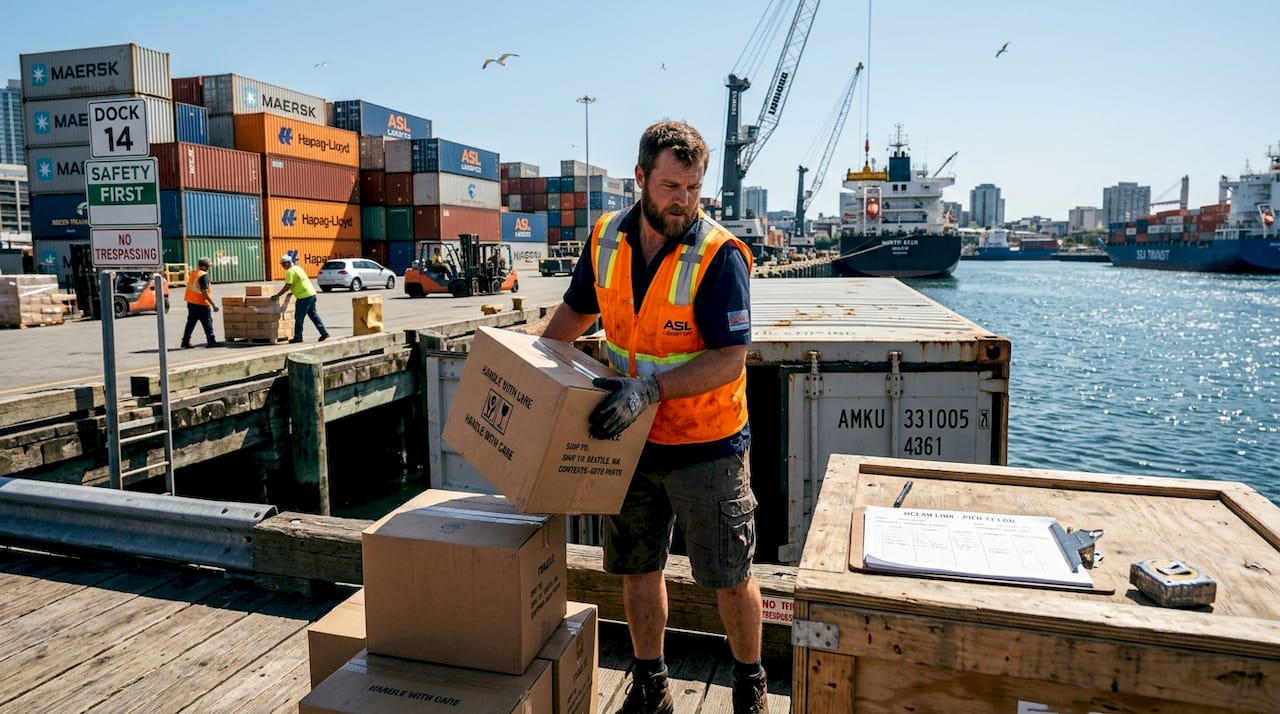
Parcel shipping carries some of the most granular surcharge structures in the industry. In 2026, residential delivery surcharges reached $6.95 per FedEx package and oversize fees climbed to $275. A single large residential delivery can accumulate fuel, residential, oversize, and additional handling fees simultaneously. That stacking effect is one reason shippers focused on B2C logistics feel disproportionate cost pressure compared to B2B shippers.
LTL and FTL trucking surcharges
Less-than-truckload (LTL) shipments attract surcharges for liftgate service, inside delivery, limited access locations, and freight class adjustments. Full truckload shipments are cleaner but still carry fuel and sometimes driver detention fees when loading or unloading exceeds the free time window.
Ocean freight surcharges
Ocean moves carry the longest list of potential surcharges:
- BAF: Compensates for bunker fuel price movements
- CAF: Offsets exchange rate risk on non-USD trade lanes
- Peak season surcharge (PSS): Added during high-volume periods on major lanes
- Port congestion surcharge: Triggered when vessels queue outside congested ports
- War risk surcharge: Applied to routes passing through conflict zones
- Terminal handling charges (THC): Covering loading and unloading at origin and destination ports
For a deeper look at how these ocean-specific fees work, the ocean freight charges breakdown is worth reviewing before pricing a transoceanic shipment.
Pro Tip: When comparing carrier quotes, request a fully accessorialized quote that includes all surcharges for your specific shipment profile. A base rate that looks 10% cheaper may end up 15% more expensive once residential delivery, fuel, and dimensional weight charges are applied.
A quick comparison across modes
| Mode | Primary surcharges | Volatility level |
|---|---|---|
| Parcel | Fuel, residential, DIM, oversize | Medium |
| LTL trucking | Fuel, liftgate, limited access | Medium |
| FTL trucking | Fuel, detention | Low to medium |
| Ocean FCL | BAF, CAF, PSS, THC, war risk | High |
| Air freight | Fuel, security, AWB fee | High |
International trade terms and their effect on freight surcharge responsibility
Incoterms (International Commercial Terms) do more than define who pays the base freight. They determine which party absorbs every surcharge that arises along the shipment’s route, and that distinction has major landed cost and compliance implications.
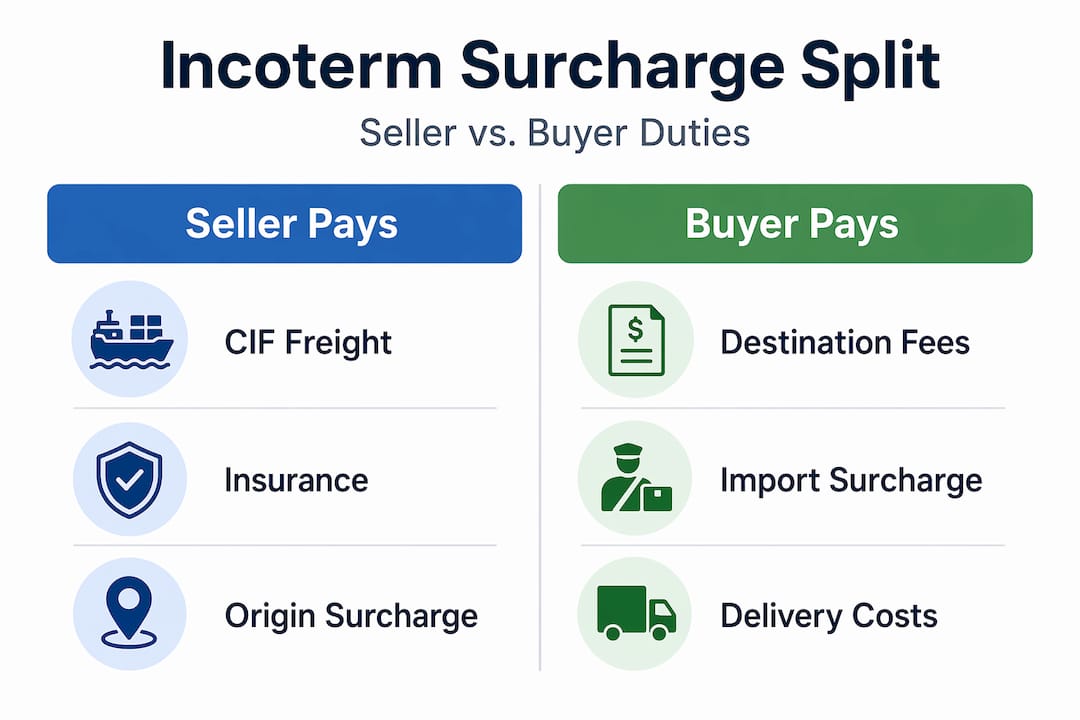
Under CIF (Cost, Insurance, and Freight), the seller covers origin freight, insurance, and related surcharges up to the destination port. However, under CIF, buyers handle destination THC while sellers bear freight and insurance surcharges. That destination terminal handling charge can be surprisingly large, especially at congested ports where THC has risen sharply in recent years.
DDP (Delivered Duty Paid) shifts the full cost burden to the seller, including customs duties, local delivery, and all surcharges at destination. Misassuming “delivered” covers all costs often leads to surprise fees like demurrage and Merchandise Processing Fees (MPF), inflating landed costs and causing clearance delays. A seller pricing DDP without a precise cost model will get hurt by tariff swings, currency shifts, and emergency surcharges they did not budget for.
Key practical implications for compliance officers and logistics managers:
- EXW (Ex Works): Buyer assumes all surcharges from the seller’s door forward, maximizing buyer control but also buyer exposure
- FOB (Free on Board): Seller covers costs to the port of loading; buyer pays all ocean freight and destination surcharges
- CIF: Seller pays ocean freight and insurance; buyer pays destination THC, customs, and local delivery
- DDP: Seller pays everything, including duties and destination surcharges; requires deep knowledge of buyer country cost structure
Pro Tip: When building landed cost models, line out every surcharge by Incoterm responsibility. Customs authorities in some jurisdictions calculate ad valorem duties on CIF value, meaning freight surcharges included in the declared value can directly inflate your duty bill. Keeping surcharges itemized and properly documented is not just good accounting; it is a customs compliance requirement. Monitoring how tariff volatility interacts with Incoterm costs is equally important for accurate forecasting.
Managing volatile and emergency surcharges in 2026 shipping markets
The predictable surcharges are manageable. The unpredictable ones are where freight budgets collapse.
Emergency bunker surcharges (EBS) emerge when fuel prices spike sharply between regular BAF calculation cycles. Unlike the BAF, which adjusts on a published schedule, EBS can appear with as little as 72 hours notice. War risk surcharges are even faster. After the Strait of Hormuz closure in March 2026, war risk surcharges reached $1,500 to $4,000 per container, with emergency fuel surcharges spiking 26% year-over-year.
Surge fees have quietly become a year-round fixture rather than a seasonal anomaly. UPS and FedEx increased international fuel surcharges and added temporary surge fees on both imports and exports in 2026, citing ongoing geopolitical disruptions. For shippers with high international parcel volumes, that combination of fuel and surge fees significantly changed the effective cost per shipment.
“Emergency surcharges are the clearest argument for keeping freight contracts short and flexible, or for building explicit pass-through language that defines how and when emergency fees can be applied.”
Practical steps to manage volatile surcharges:
- Monitor weekly: Track the EIA diesel index, bunker price indices, and geopolitical developments on trade lanes you actively use
- Build contract language: Include surcharge pass-through clauses that cap or pre-define how emergency fees are applied and communicated
- Diversify routing: Having alternative routing options available allows quick pivots when a war risk zone makes a preferred lane uneconomical
- Reforecast regularly: Monthly surcharge reforecasting, not annual, is the only reliable approach in the current market
- Audit invoices systematically: Match every surcharge line to the contractual method and current index before approving payment
Staying ahead of freight marketplace trends is one of the more effective ways to anticipate when emergency surcharges are likely to appear before they hit your invoice.
The surcharge line that most businesses overlook
There is a broader point worth making that most freight cost guides skip. Businesses frequently treat surcharges as a billing problem, something to dispute after the invoice arrives. That framing costs money. The more accurate framing is that surcharges are a market intelligence problem.
The surcharges appearing on your invoice today are lagging indicators of trade lane stress, geopolitical risk, and carrier capacity decisions. A war risk surcharge on an Asia-to-Europe routing is not just a cost event; it is a signal that your supply chain is routed through a zone with active exposure. An oversize surcharge that triples in a single renewal cycle signals that your packaging standards are no longer aligned with carrier handling economics.
Teams that read surcharge data as operational intelligence, rather than accounting noise, make better decisions about packaging, routing, sourcing locations, and contract timing. That shift in perspective is where the real value of understanding freight charges lives. It is not just about avoiding fees; it is about using fee patterns to make smarter supply chain choices before those fees arrive.
Manage freight surcharges with confidence alongside Worldwide Express
Freight surcharge complexity increases every year, and businesses that rely on spreadsheets and carrier portals alone will always be reacting rather than planning. Worldwide Express gives importers, exporters, and logistics teams the tools and expertise to see the full freight charges breakdown before committing to a shipment.
From customs brokerage and ocean freight forwarding to parcel and LTL management, Worldwide Express builds surcharge visibility into every quote and supports clients in structuring contracts that reduce exposure to volatile fees. Whether the concern is war risk on transoceanic routes or residential delivery costs on domestic parcel programs, Worldwide Express brings 30-plus years of freight intelligence to every shipping decision. Contact Worldwide Express to get a freight quote that shows the complete cost picture, not just the base rate.
Frequently asked questions
What are freight surcharges and why do they increase shipping costs?
Freight surcharges are additional fees on top of base rates that cover specific costs like fuel, demand spikes, and special handling, and they account for 20-40% of total shipping expenses, with fuel surcharges alone at 21-22% as of January 2026.
How are fuel surcharges calculated in trucking and parcel shipments?
Carriers calculate fuel surcharges using formulas based on diesel price changes relative to a baseline, and per the EIA diesel index, fuel surcharges adjust weekly via per-mile or percentage-of-linehaul methods to keep base rates stable.
Who is responsible for paying freight surcharges under different Incoterms?
Incoterms assign surcharge responsibility: under CIF, sellers pay freight and insurance while buyers pay destination handling, and under DDP sellers cover all surcharges including customs duties, requiring deep knowledge of destination market costs.
What are emergency surcharges and how can shippers manage them?
Emergency surcharges are sudden fees due to events like fuel price spikes or geopolitical risks; after the Strait of Hormuz closure, war risk fees surged to $4,000 per container, and UPS and FedEx added surge fees on international shipments amid 2026 disruptions. Shippers manage them by monitoring market events daily, reforecasting monthly, and building pass-through clauses into freight contracts.
How can businesses reduce the impact of freight surcharges on total shipping costs?
Requesting fully accessorialized quotes, auditing every invoice against contractual surcharge formulas, and diversifying routing options are the three most effective tactics for controlling surcharge exposure without renegotiating base rates.
Recommended
- Freight contract terms: essential guide for shipping managers – Worldwide Express, Inc.
- International courier vs freight: guide for managers 2026 – Worldwide Express, Inc.
- Ocean freight charges explained 2026: 5% capacity & cost tips – Worldwide Express, Inc.
- What is a Freight Quote? Understanding Its Importance – Worldwide Express, Inc.