TL;DR:
- In 2026, major global shipping regulations include the IMO’s MASS Code, EU waste shipment digitalization, and Iran’s new transit fees. These changes impact operational compliance, requiring accurate documentation, real-time sanctions screening, and technology upgrades for autonomous vessels. Proactive preparation ensures competitiveness, minimizes delays, and leverages digital tools to navigate evolving international maritime standards effectively.
Global shipping regulations update refers to the latest changes in international maritime laws, environmental mandates, and digital compliance standards reshaping cross-border trade in 2026. The International Maritime Organization (IMO), the European Union, and the U.S. Federal Maritime Commission (FMC) have each introduced or activated major policy shifts this year, from autonomous ship safety codes to mandatory digital waste tracking systems. For importers, exporters, and logistics professionals, these changes carry direct financial and operational consequences. Missing a single documentation requirement or overlooking a new fee structure can trigger customs delays, fines, or cargo holds that cost far more than the compliance investment itself.
What are the major global shipping regulations update changes in 2026?
The most significant development in maritime shipping standards this year is the IMO’s MASS Code, formally known as the International Code of Safety for Maritime Autonomous Surface Ships. The IMO adopted this code as non-mandatory effective July 1, 2026, with a mandatory version targeted for January 1, 2032. This means AI-enabled and remotely operated cargo vessels now operate under a defined global framework for the first time, covering everything from Remote Operations Centres (ROCs) to onboard safety protocols.
On the environmental side, the EU activated its revised Waste Shipment Regulation on May 21, 2026, requiring all cross-border waste shipments to use the DIWASS digital platform for electronic Prior Informed Consent (PIC). Paper-based procedures end December 31, 2026. The EU projects €1.4 million in annual administrative savings from this shift, and a ban on plastic waste exports to non-OECD countries takes effect November 21, 2026. These are not optional transitions for businesses handling regulated materials.
The Strait of Hormuz introduced another layer of complexity. Iran launched a multi-tiered transit fee system in May 2026, charging between $150,000 and $2 million per vessel depending on size and cargo type. Proposals include a $1 per barrel fee on oil shipments and the option to pay in digital assets, though the U.S. Treasury has flagged serious risks around cryptocurrency payments in sanctioned corridors. Any vessel transiting this route now faces both financial exposure and compliance scrutiny.
Key regulatory changes to track in 2026:
- IMO MASS Code: Non-mandatory from July 1, 2026; mandatory adoption target July 2030; full mandatory entry January 1, 2032
- EU DIWASS: Electronic PIC required for all cross-border waste shipments from May 21, 2026; paper procedures end December 31, 2026
- Strait of Hormuz fees: $150,000 to $2 million per vessel; cryptocurrency payment risks flagged by U.S. Treasury
- VDES ship tracking: The VHF Data Exchange System replaces AIS by 2028, providing authentication and reducing spoofing risks
- FMC environmental monitoring: The Federal Maritime Commission is shifting enforcement focus toward climate compliance under 46 U.S.C. §§ 42101–42109
Pro Tip: Review your carrier contracts now for clauses covering new transit fees and surcharges. Strait of Hormuz fees may not be absorbed by your freight forwarder unless explicitly negotiated.
How do these regulations affect operational compliance for importers and exporters?
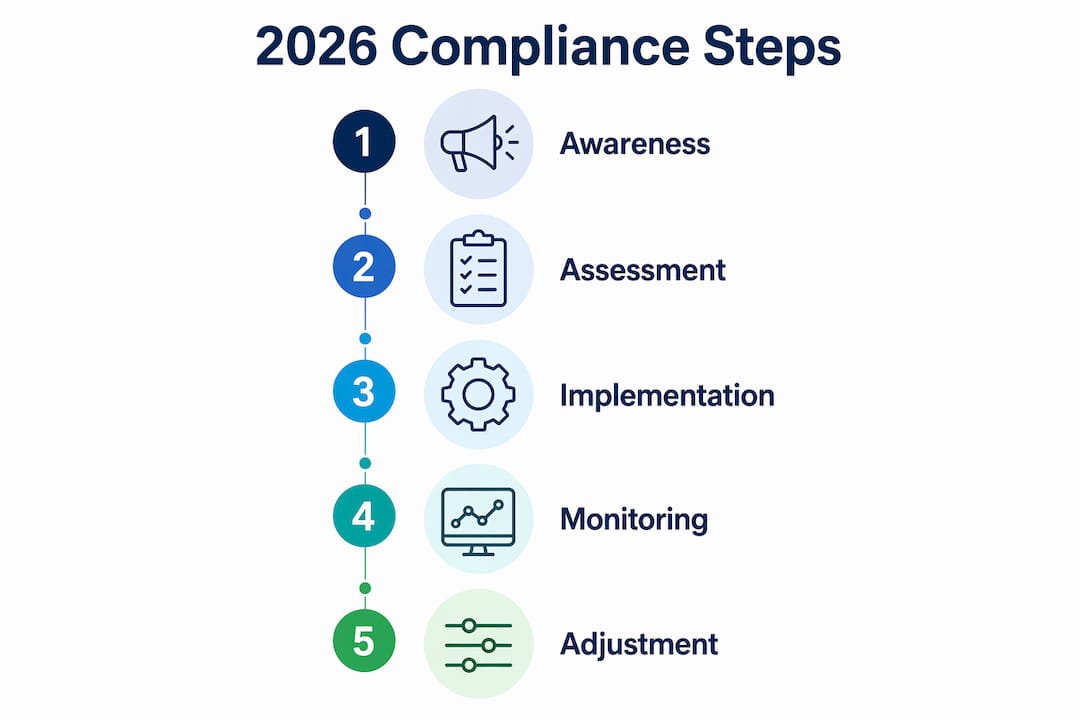
Operational compliance in 2026 is best described as a compliance minefield, where customs authorities cross-reference import entries against maritime fees, sanctions lists, and vessel origin databases simultaneously. A single inaccurate data point in your shipment record can trigger a cascade of inspections, holds, and fines. The days of treating customs documentation as a back-office afterthought are over.
The most immediate operational risk centers on Electronic Advanced Data (EAD). Missing EAD transmission for EU-bound shipments triggers elevated inspection rates and causes 3 to 7 day customs delays. That window can collapse a just-in-time supply chain or breach a delivery contract. Auditing your providers’ customs clearance first-attempt rates is the recommended benchmark, with 94% or higher considered the compliance threshold.
Here is a practical compliance workflow for 2026:
- Audit your HS code library. Missed or inaccurate HS codes cannot be corrected after parcel shipment. Automate classification and schedule quarterly audits to catch drift before it triggers penalties.
- Verify EAD transmission for every EU-bound shipment. Confirm your carrier or freight forwarder transmits EAD before departure, not at the port. FedEx, UPS, and DHL updated their systems for automated EAD transmission early in 2026; regional carriers lag behind, creating risk for budget shippers.
- Screen all parties in real time. Integrate sanctions screening APIs that check against OFAC, EU, and UK restricted party lists before each transaction, not just at onboarding.
- Document environmental fee exposure. Map every trade lane that passes through the Strait of Hormuz or involves EU-regulated waste materials. Assign cost ownership before shipments move.
- Conduct a quarterly compliance review. Quarterly compliance audits are critical given how rapidly international shipping laws evolve and how directly they impact operating margins.
Pro Tip: When evaluating freight forwarders, ask specifically for their EAD first-attempt clearance rate. Any provider below 94% is a liability in the current regulatory environment.
What digital tools and frameworks support compliance today?
Effective cross-border compliance in 2026 requires a layered technology stack combining tax filing automation, customs pre-notification, privacy consent management, and real-time sanctions screening. No single platform covers all four functions, which is why logistics teams are increasingly building integrated compliance stacks rather than relying on standalone tools.

The EU’s DIWASS platform is the most immediate new system to understand. It handles electronic PIC for waste shipments and replaces all paper-based consent procedures by the end of 2026. For businesses involved in supply chain digitalization, DIWASS represents both a compliance obligation and a process efficiency gain, given the projected administrative savings.
| Tool or System | Primary Function | Key Benefit |
|---|---|---|
| DIWASS | Electronic PIC for EU waste shipments | Replaces paper; €1.4M projected annual savings |
| VDES | Secure ship tracking, replaces AIS by 2028 | Authentication, reduced spoofing risk |
| Sanctions screening APIs (Dow Jones Risk & Compliance, ComplyAdvantage, Descartes Visual Compliance) | Real-time restricted party checks | Avoids OFAC, EU, and UK fines |
| HS code auto-classification software | Customs tariff classification | Prevents post-shipment correction failures |
| ROC platforms | Remote operations for autonomous vessels | Supports MASS Code compliance |
For autonomous vessel operations, the MASS Code requires Remote Operations Centres to maintain continuous oversight and communication. The VDES system, expected to replace the Automatic Identification System (AIS) by 2028, provides stronger authentication and significantly reduces the spoofing risks that have plagued maritime tracking in contested waters.
Sanctions screening deserves specific attention. Tools like Dow Jones Risk & Compliance, ComplyAdvantage, and Descartes Visual Compliance integrate directly into logistics platforms via API, enabling pre-transaction checks against multiple global watchlists. The cost of a sanctions violation from OFAC or EU authorities far exceeds the cost of any screening subscription.
How do regional and political factors shape shipping regulation enforcement?
Global freight regulations do not evolve in a vacuum. The current regulatory environment reflects sharp divergence between multilateral IMO frameworks and unilateral national actions, and that divergence creates real compliance complexity for international operators.
Key regional dynamics shaping enforcement in 2026:
- United States: The FMC is actively monitoring foreign environmental regulations that could disadvantage U.S. shipping competitiveness. The U.S. has blocked global shipping emission fee proposals at the IMO level while simultaneously applying port penalties for non-compliant vessels. This creates a split-track environment where U.S. operators face domestic leniency but foreign port restrictions.
- European Union: The EU is the most aggressive enforcer of digital compliance. Its pre-notification customs systems, digital VAT requirements, and the DIWASS mandate collectively mean that any shipment touching EU ports or involving EU-regulated materials requires digital documentation at every stage. The EU’s USPS compliance framework for 2026 reflects this escalating documentation standard.
- Middle East: The Strait of Hormuz fee structure introduces a new category of geopolitical shipping cost. The tiered fee system from Iran, combined with proposals for cryptocurrency payments that the U.S. Treasury has warned against, means that route planning through this corridor now requires legal and compliance review, not just logistics optimization.
- IMO vs. national action: The MASS Code and VDES standards represent IMO’s push for harmonized global maritime shipping standards. However, countries like the U.S. that block emission fee proposals at the IMO level demonstrate that unilateral interests still override multilateral consensus on cost-sensitive issues.
Environmental regulations and carbon pricing are beginning to create direct financial impacts on shipping operations, demanding proactive monitoring by logistics planners. The FMC’s expanded climate role signals that U.S. enforcement will increasingly intersect with environmental compliance, even as the U.S. resists global fee structures. For importers and exporters, the practical implication is clear: compliance strategy must account for both the country of origin and the country of destination, since enforcement priorities differ sharply between them.
Key takeaways
Staying ahead of the 2026 global shipping regulations update requires integrating digital compliance tools, auditing carrier performance, and monitoring regional enforcement divergence on a quarterly basis.
| Point | Details |
|---|---|
| IMO MASS Code is now active | Non-mandatory from July 1, 2026; mandatory entry set for January 1, 2032. Plan technology upgrades now. |
| DIWASS replaces paper PIC | All EU cross-border waste shipments must use electronic PIC via DIWASS; paper ends December 31, 2026. |
| EAD accuracy is non-negotiable | Missing EAD for EU-bound shipments causes 3 to 7 day delays; target providers with 94%+ clearance rates. |
| Sanctions screening must be real-time | Integrate APIs from tools like ComplyAdvantage or Descartes Visual Compliance before each transaction. |
| Regional enforcement diverges sharply | U.S., EU, and Middle East apply different compliance priorities; route-specific legal review is now standard practice. |
The compliance burden is real, but so is the competitive advantage
My experience working with logistics teams navigating major regulatory shifts tells me one thing consistently: the companies that treat compliance as a cost center lose. The companies that treat it as a competitive signal win contracts.
The 2026 wave of shipping laws updates is genuinely demanding. The MASS Code alone requires operators to rethink vessel oversight infrastructure years before the mandatory deadline. The DIWASS transition is straightforward in principle but operationally disruptive for any business still running paper-based consent workflows. And the Strait of Hormuz fee structure is the kind of geopolitical variable that no spreadsheet model adequately captures.
What I have found actually works is building compliance into the procurement and carrier selection process, not bolting it on afterward. When you audit a freight forwarder’s EAD clearance rate before signing a contract, you are not being difficult. You are protecting your supply chain. When you run a customs audit before a major trade lane expansion, you are identifying exposure before it becomes a fine.
The quarterly review cadence matters more than most logistics teams realize. Regulations that were advisory in Q1 become mandatory by Q3. Fee structures that seemed theoretical in January become invoice line items by June. The teams that review their compliance stack every 90 days catch these shifts early. The teams that review annually are always reacting.
The honest truth about the 2026 regulatory environment is that it rewards preparation and punishes complacency. The VDES transition, the MASS Code timeline, and the EU’s digital-first customs posture all point in the same direction: the future of international shipping compliance is automated, documented, and auditable. The sooner your operation reflects that reality, the less painful the next update cycle will be.
— Ian
How Worldwideexpress supports your compliance with evolving regulations
Worldwideexpress specializes in helping importers, exporters, and logistics teams stay ahead of exactly the kind of regulatory complexity described in this article.
From freight forwarding services built around 2026 documentation requirements to U.S. customs brokerage that handles EAD transmission, HS code classification, and sanctions screening, Worldwideexpress provides the operational infrastructure that compliance demands. The team monitors IMO, EU, and FMC regulatory developments continuously, translating policy changes into practical workflow adjustments for clients. Whether you are managing waste shipment documentation under DIWASS, evaluating autonomous carrier partnerships under the MASS Code, or auditing your trade lanes for new fee exposure, Worldwideexpress offers the expertise and tools to keep your shipments moving cleanly. Explore available freight insights and connect with the Worldwideexpress team to discuss your specific compliance needs.
FAQ
What is a global shipping regulations update?
A global shipping regulations update refers to new or revised international maritime laws, environmental mandates, and customs compliance standards issued by bodies like the IMO, EU, or FMC that affect cross-border trade operations.
When does the IMO MASS Code become mandatory?
The IMO MASS Code is non-mandatory from July 1, 2026, with a mandatory adoption target of July 2030 and full mandatory entry into force on January 1, 2032.
What happens if EAD is missing for EU-bound shipments?
Missing Electronic Advanced Data transmission for EU-bound shipments triggers elevated inspection rates and causes customs delays of 3 to 7 days, according to 2026 cross-border commerce compliance data.
Which sanctions screening tools are used in logistics compliance?
Dow Jones Risk & Compliance, ComplyAdvantage, and Descartes Visual Compliance are the leading API-based sanctions screening tools integrated into logistics platforms to check OFAC, EU, and UK restricted party lists.
What is DIWASS and who must use it?
DIWASS is the EU’s Digital Waste Shipment System, mandatory for all cross-border waste shipments requiring electronic Prior Informed Consent as of May 21, 2026. Paper-based procedures are eliminated entirely by December 31, 2026.
Recommended
- USPS International Shipping: Compliance Essentials for 2026 – Worldwide Express, Inc.
- Global Shipping 2026: 72% Face Tariff Volatility – Worldwide Express, Inc.
- Avoid costly international shipping mistakes in 2026 – Worldwide Express, Inc.
- Customs compliance best practices: stay penalty-free in 2026 – Worldwide Express, Inc.