TL;DR:
- Next-gen container tracking uses IoT sensors for real-time location and condition monitoring.
- Industry standards like DCSA and UN/CEFACT ensure interoperability across systems.
- Successful implementation requires operational integration, targeted pilots, and ongoing process alignment.
Most shipping delays are not simply unavoidable acts of fate. That assumption has quietly cost logistics teams millions in demurrage charges, spoiled cargo, and missed delivery windows. Today, next-gen container tracking is changing the equation entirely, giving supply chain professionals the ability to see exactly where cargo is, what condition it’s in, and when something has gone wrong before it becomes a crisis. This guide breaks down the core technologies, the standards that make them work, and the practical steps needed to turn real-time visibility into genuine operational intelligence.
Table of Contents
- What makes next-gen container tracking different?
- Industry standards: The foundation of effective tracking
- Actionable data: Turning tracking into operational intelligence
- ROI and risk reduction: Proving the value of next-gen tracking
- Why most container tracking investments fail—and how to nail yours
- Easily upgrade your container tracking and logistics solutions
- Frequently asked questions
Key Takeaways
| Point | Details |
|---|---|
| Smart container advantage | Next-gen tracking offers real-time location and condition alerts with IoT sensors for complete visibility. |
| Upgrade with standards | Using DCSA and UN/CEFACT standards is critical for interoperability and reliable data exchange. |
| Actionable business intelligence | Transform tracking data into meaningful alerts and operational insight by integrating with TMS/ERP platforms. |
| ROI through risk reduction | Major value comes from demurrage savings, compliance, and preventing silent failures. |
What makes next-gen container tracking different?
Traditional tracking methods rely heavily on milestone events reported at port gates or by carriers, which means logistics teams often learn about problems hours or even days after they occur. Next-gen tracking replaces that reactive model with continuous, real-time data streams flowing from smart containers equipped with IoT (Internet of Things) sensors.
Per findings from the container shipping technology sector, next-gen tracking uses IoT sensors for real-time location and condition monitoring, with hybrid cellular and satellite connectivity ensuring coverage in both port environments and open ocean. That hybrid approach is critical. Cellular networks deliver fast, affordable data transmission near shore, while satellite connectivity picks up where ground infrastructure ends.
These sensors do far more than pinpoint a container’s GPS coordinates. Modern smart containers monitor:
- Temperature and humidity to protect perishable, pharmaceutical, or sensitive cargo
- Door open/close events to flag unauthorized access or accidental openings
- Shock and tilt detection to identify rough handling or potential damage
- Light intrusion as a security indicator inside sealed containers
Edge processing is another leap forward. Instead of sending every raw sensor reading to the cloud, onboard processors filter and package only the meaningful events. This conserves battery life dramatically, which matters when a device must last an entire multi-week ocean voyage without a recharge.
| Feature | Legacy tracking | Next-gen tracking |
|---|---|---|
| Update frequency | Port milestones only | Continuous or near-real-time |
| Condition data | Not available | Temp, humidity, shock, light |
| Connectivity | Carrier EDI messages | Hybrid cellular and satellite |
| Alert capability | Reactive, post-event | Proactive, event-driven |
| Data ownership | Carrier-controlled | Shipper-accessible |
The cargo tracking benefits for organizations making this shift are significant. Teams gain the ability to intervene before cargo is compromised, re-route shipments proactively, and provide customers with accurate, live updates instead of estimated guesses.
Pro Tip: When evaluating smart container devices, ask vendors specifically how edge processing is handled and what the average battery draw per event transmission looks like. Devices that send raw data continuously often die mid-voyage, leaving critical blind spots.
For teams newer to this space, reviewing container shipping basics can help frame how next-gen devices integrate into the broader movement of goods across global lanes.
Industry standards: The foundation of effective tracking
Understanding the technology is the first step, but applying standards is what ensures your solution works in the real world. No matter how sophisticated a tracking device is, its data is only as useful as the systems that can read and act on it.
Interoperability, the ability of different software platforms and carrier systems to exchange data seamlessly, depends on shared standards. Without them, tracking data often gets trapped in proprietary platforms that don’t talk to TMS (Transportation Management System) or ERP (Enterprise Resource Planning) systems. The result is siloed information that creates more confusion than clarity.
The three standards that logistics professionals should know cold are:
- DCSA (Digital Container Shipping Association): Sets the framework for standardized IoT and commercial event reporting across carriers and shippers
- UN/CEFACT: Provides universal data models and messaging formats for trade and transport documentation
- ISO TS 25287: Addresses the technical specifications for container sensor data communication
As noted by DCSA, prioritizing DCSA and UN-CEFACT standards is essential for interoperability and avoiding data silos that quietly undermine supply chain performance.
| Standard | Primary focus | Why it matters |
|---|---|---|
| DCSA | IoT and commercial events | Carrier data uniformity |
| UN/CEFACT | Trade data models | Cross-border document exchange |
| ISO TS 25287 | Sensor communication specs | Device-to-platform compatibility |
One of the most overlooked risks in container tracking deployments is what practitioners call a “silent failure.” A device may appear to be functioning, but due to connectivity gaps or non-standard data formatting, events never reach the operations team. By the time someone notices the missing data, the window for intervention has already closed.
“A tracking solution that cannot exchange data reliably with your existing platforms is not a solution. It is an expensive sensor collecting data no one can use.”
When evaluating vendors, ask directly which standards they align with and whether they hold DCSA tracking standards certifications. Comparing solutions through global freight tracking tools can also help identify which providers genuinely meet interoperability requirements versus those who only claim compliance.
Actionable data: Turning tracking into operational intelligence
Technical standards set the stage, but transforming data into business value is the next competitive advantage. Collecting real-time container data is only half the equation. The other half is building workflows that actually respond to it.
Event-driven reporting is the mechanism that makes data actionable. Rather than generating a constant stream of raw numbers, smart containers flag specific conditions that require attention. Common actionable events include:
- Door opened in transit triggering a security alert to the operations team
- Temperature threshold exceeded sending an immediate notification to the logistics manager and the consignee
- Shock event detected initiating a damage documentation workflow before arrival
- Container idle at port beyond threshold prompting a proactive demurrage avoidance process
- Geofence breach alerting when a container moves outside an expected route or zone
Integration with TMS and ERP platforms is where these alerts go from interesting to indispensable. When a temperature breach alert automatically creates a task in your ERP or triggers a carrier communication in your TMS, the human response time drops dramatically. Per data from the smart containers and real-time tracking sector, focusing on actionable alerts and TMS and ERP integration over raw data, while piloting high-value lanes first, consistently produces the strongest operational outcomes.

A phased rollout strategy is strongly recommended. Start with your highest-value or highest-risk lanes, such as temperature-controlled pharmaceutical shipments or high-theft electronics routes. This concentrates the return on investment where it matters most and gives your team time to build the right alert workflows before scaling.
Pro Tip: Avoid alert fatigue. If every minor sensor fluctuation triggers a notification, teams start ignoring them all. Configure alert thresholds carefully so that only events requiring human action actually generate a notification.
For teams managing warehousing alongside transport, integrating tracking data with smart warehousing solutions creates an end-to-end visibility picture that extends well beyond the port gate.
ROI and risk reduction: Proving the value of next-gen tracking
Once data starts flowing, logistics leaders must focus on demonstrable value to secure buy-in and maximize impact. The business case for next-gen container tracking is strong, but it requires careful measurement to make the numbers visible to finance and executive stakeholders.
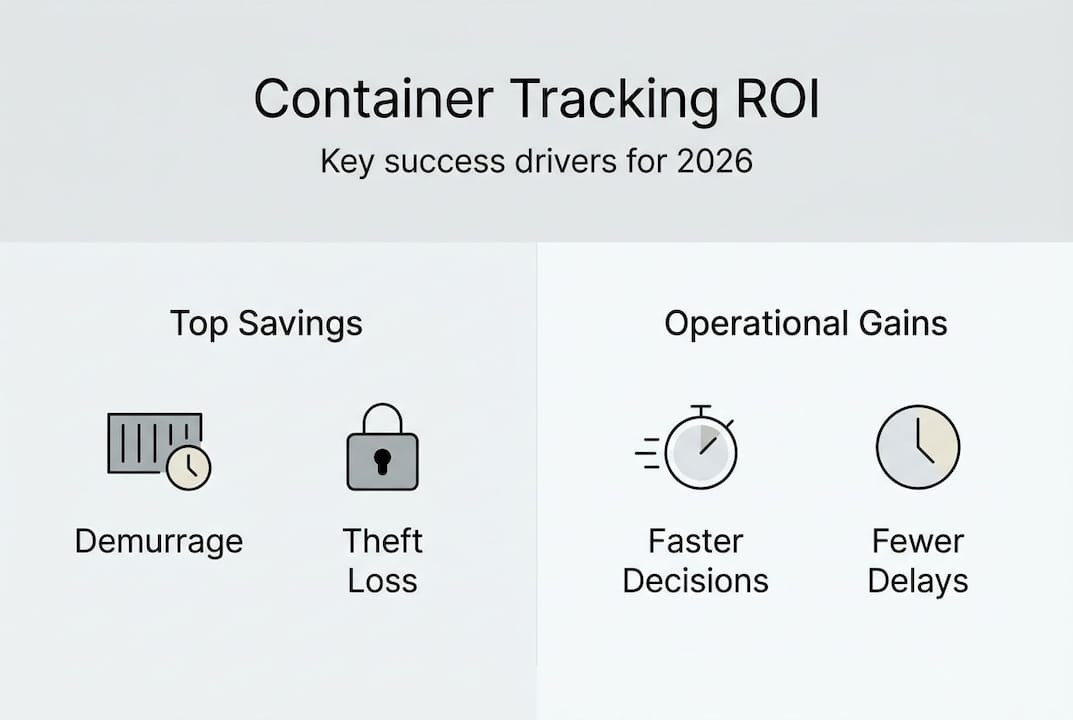
The primary ROI drivers to track include:
- Demurrage savings: Proactive alerts enable faster container retrieval, directly reducing port storage fees
- Cargo damage prevention: Condition monitoring catches temperature or shock events before goods are destroyed
- Theft and loss reduction: Door and geofence alerts flag unauthorized access in real time
- Compliance improvements: Documented condition data supports insurance claims and regulatory reporting
- Carrier accountability: Objective event logs provide evidence when disputes arise with carriers or ports
According to DCSA research, ROI from next-gen tracking is most clearly realized through demurrage savings and the prevention of silent failures that go undetected without active monitoring systems in place.
The benchmark approach matters here. Establish a clear before-and-after measurement framework before deploying on any lane. Record baseline demurrage costs, cargo damage rates, and dispute resolution times. After three to six months of live tracking, compare those numbers against the same metrics.
Pro Tip: Document silent failure incidents explicitly. When a sensor goes dark or an alert fails to fire, log it. These incidents often represent the most compelling ROI case studies because they quantify what active monitoring prevented.
Understanding demurrage costs and compliance in detail helps build a sharper financial model for tracking ROI. Teams also exploring ways to lower international shipping rates will find that improved tracking compliance and carrier accountability often open the door to better contract terms.
Supply chain visibility data, when properly measured and reported, also strengthens the case for procurement teams negotiating service level agreements with carriers.
Why most container tracking investments fail—and how to nail yours
Stepping back from numbers and features, there’s a harder truth worth stating plainly. Most container tracking investments underperform not because the technology is flawed, but because organizations treat it as a plug-and-play solution rather than an operational transformation.
The technology itself is genuinely exciting. IoT sensors, edge computing, and satellite connectivity represent a real leap forward in what’s possible. But buying devices and deploying them without aligning on standards, configuring meaningful alerts, and training operational staff is a recipe for expensive disappointment.
The most common mistake seen across deployments is the “set and forget” approach. A provider installs devices, data starts flowing, and six months later no one is sure what they’re supposed to do with it. The platform collects events no workflow is configured to act on.
The organizations that succeed treat tracking implementation the same way they’d treat any major process change. They start small, measure relentlessly, and build internal expertise before scaling. They also invest in understanding digital freight forwarding trends so their tracking strategy evolves alongside the broader technology landscape. The result is not just better visibility. It is a measurably smarter, more resilient supply chain.
Easily upgrade your container tracking and logistics solutions
The path from real-time data to real operational improvements is clearer than many logistics teams realize. Worldwide Express provides expert resources to help organizations navigate every stage of that journey, from understanding the fundamentals to deploying standards-aligned tracking solutions across complex global lanes.
Explore the freight forwarding guide for a structured approach to modernizing international shipment management. The ocean freight steps guide walks through each phase of a container shipment with practical clarity. For teams ready to go deeper, supply chain visibility solutions from Worldwide Express connect real-time tracking technology to fully integrated logistics management tailored for international trade operations.
Frequently asked questions
What technologies enable next-gen container tracking?
IoT sensors, GPS, cellular connectivity, and satellite networks work together to deliver real-time location and condition monitoring inside modern smart containers. These technologies enable continuous data streams rather than point-in-time milestone reports.
How do industry standards improve container tracking?
Standards like DCSA and UN-CEFACT ensure that tracking data can flow reliably between carriers, shippers, and platform systems without getting trapped in proprietary silos. Interoperability is what turns raw sensor data into supply-chain-wide intelligence.
What are typical ROI drivers for next-gen tracking?
ROI is realized most clearly through demurrage savings, improved compliance documentation, and the active monitoring needed to catch silent failures before they cause financial loss. Cargo damage prevention and carrier dispute resolution are also significant contributors.
How should we start implementing next-gen tracking?
Start by piloting high-value or high-risk lanes first, integrate alerts directly into your TMS or ERP, and configure notifications around actionable events rather than raw sensor readings. This focused approach builds internal competence and delivers measurable results before a broader rollout.
Recommended
- Unlock cargo tracking benefits for efficient logistics – Worldwide Express, Inc.
- How to track a delivery truck effectively in 2026 – Worldwide Express, Inc.
- Supply Chain Visibility: Driving Efficiency in Logistics – Worldwide Express, Inc.
- Container shipping basics: Reliable solutions for global trade – Worldwide Express, Inc.