TL;DR:
- Overseas import customs clearance involves CBP reviewing, classifying, and authorizing goods entering the U.S. to ensure compliance. Proper preparation of documentation, accurate product classification, and timely filings prevent delays and potential penalties. Using a licensed customs broker and establishing compliance routines streamline the process and reduce operational disruptions.
Overseas import customs clearance is the legally required process by which goods entering a country are examined, classified, and authorized for release by the relevant customs authority. In the United States, U.S. Customs and Border Protection (CBP) governs this process under Title 19 of the Code of Federal Regulations. Getting it right determines whether your shipment moves in days or sits in a warehouse accumulating fees. This guide covers every stage of the process, from pre-shipment documentation to post-entry recordkeeping, so you can import with confidence and avoid the compliance traps that catch even experienced shippers off guard.
What documentation and prerequisites does overseas import customs clearance require?
Customs clearance begins long before your shipment reaches the port. The first step is designating an Importer of Record (IOR), the legal entity responsible for ensuring goods comply with all U.S. laws. The IOR must hold an Employer Identification Number (EIN) and, for most commercial entries, access to CBP’s Automated Commercial Environment (ACE) system.

Customs bonds
A customs bond is a financial guarantee that the importer will pay all duties, taxes, and fees owed to CBP. Two types exist: single-entry bonds, which cover one shipment, and continuous bonds, which cover all shipments within a 12-month period. A continuous customs bond costs roughly $250–$500 annually, making it far more cost-effective than stacking single-entry bonds for importers who ship regularly. If you import more than a handful of times per year, a continuous bond is the clear choice.
Core shipment documents
Every customs entry requires a consistent set of import export documentation. The commercial invoice must state the buyer, seller, goods description, quantity, and declared value. The packing list details how goods are packed and weighed. The bill of lading (for ocean freight) or air waybill (for air freight) serves as the contract of carriage and proof of shipment.
HTS classification and tariff stacks
Every product entering the U.S. must be assigned a Harmonized Tariff Schedule (HTS) code, which determines the applicable duty rate. Importers bear full liability for accurate HTS classification. Relying on supplier-provided codes is a known compliance risk. Beyond base duties, Section 301, Section 232, and AD/CVD tariffs create layered cost stacks that can dramatically change your total landed cost. Model the full duty stack before your shipment departs.
Partner Government Agency requirements
Many product categories require clearance from Partner Government Agencies (PGAs) beyond CBP. FDA, USDA, EPA, CPSC, and FCC each impose their own permits, certificates, or prior notice filings for regulated goods. Food products, electronics, agricultural items, and chemicals are the most common categories affected. Missing a PGA requirement is one of the fastest ways to trigger a customs hold.
Pro Tip: Build a PGA checklist specific to your product category before your first shipment. Agencies like the FDA require prior notice for food imports, and missing that filing can result in automatic detention at the port.
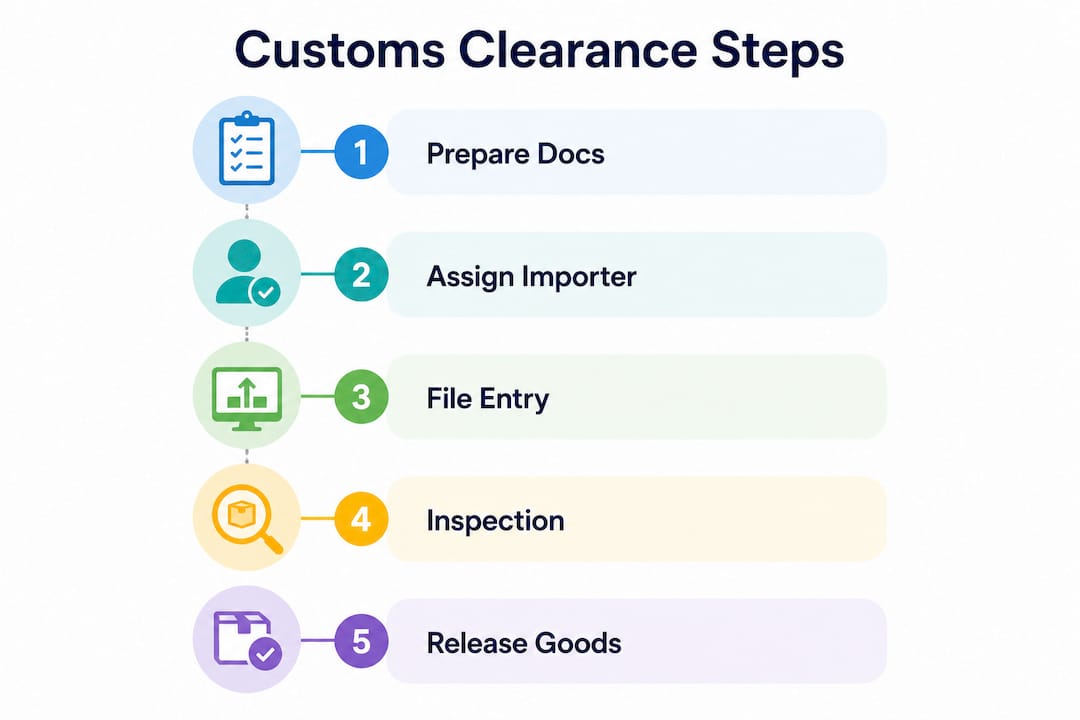
How is the overseas import customs clearance process executed step by step?
The clearance workflow follows a defined sequence. Understanding each stage helps you anticipate timing, prepare the right documents, and respond quickly when CBP needs more information.
-
File the Importer Security Filing (ISF). For ocean shipments, the ISF must be submitted at least 24 hours before vessel loading at the foreign port. Failure to file ISF on time results in fines and potential shipment holds. Air freight does not require ISF, but has its own advance cargo reporting rules.
-
Receive the arrival notice. Your freight forwarder or carrier issues an arrival notice when the vessel or aircraft is near the destination port. This triggers the entry filing window.
-
File the entry via ACE. The customs broker or importer files CBP Form 3461 (Entry/Immediate Delivery) along with the commercial invoice, packing list, and bill of lading through ACE. This is the formal request for release.
-
CBP reviews the entry. CBP assesses the filing for risk, checks HTS classification, verifies declared value, and confirms country of origin. Most low-risk entries receive an automated “line release.” Higher-risk entries may be flagged for document review or physical examination.
-
Goods are released or held. CBP authorizes release, typically within 24–72 hours of filing for compliant entries. If CBP issues a CF-28 (Request for Information) or CF-29 (Notice of Action), you must respond promptly or face extended delays.
-
Pay duties at entry summary. CBP Form 7501 (Entry Summary) must be filed and duties paid within 10 working days of release. The customs bond guarantees this payment.
-
Liquidation period begins. Customs clearance is legally a two-stage process. Entry liquidation can take up to 314 days after arrival, during which CBP can audit the entry and adjust duty liability. This means your final duty bill may differ from what you paid at release.
-
Maintain records. CBP requires importers to retain all entry records for a minimum of five years from the date of entry. This covers invoices, classification decisions, and any correspondence with CBP.
Pro Tip: Work with a licensed customs broker for your first several shipments, even if you plan to self-file later. Broker fees typically run $50–$150 per entry, and the compliance expertise they provide far outweighs that cost.
What common errors cause customs clearance delays and how do you avoid them?
Clearance delays are rarely random. They trace back to a predictable set of errors that importers repeat across industries and shipment types.
-
HTS misclassification. Nearly 42% of all customs penalties arise from HS code misclassification, making it the top compliance risk by a wide margin. Never accept a supplier’s code at face value. Verify independently or request a binding ruling from CBP before your first major shipment.
-
Documentation mismatches. Inconsistencies between the commercial invoice, packing list, and entry summary are the most frequent cause of customs holds. The product description, quantity, and value must match exactly across all three documents. A single discrepancy can trigger a full document review.
-
Late or missing customs bond. Arriving at port without an active bond means your goods cannot be released. Arrange your bond well before the shipment departs.
-
PGA non-compliance. Regulated goods that arrive without the required FDA prior notice, USDA phytosanitary certificate, or FCC authorization face automatic detention. Research PGA requirements for every new product category you import.
-
Ignoring demurrage and storage fees. When goods sit at port due to a customs hold, carriers and terminals charge daily fees. These accumulate fast. Proactive communication with your broker and carrier limits exposure.
“Customs clearance delays are almost always preventable. The importers who avoid them treat documentation as a pre-shipment discipline, not an afterthought. By the time your goods reach the port, every document should already be verified, consistent, and ready to file.”
Responding to CBP’s CF-28 and CF-29 letters quickly is equally critical. A CF-28 requests additional information; a CF-29 proposes a change to classification or value. Both require a timely, well-documented response. Delays in responding extend the hold and can escalate to formal penalties. Partnering with a broker who monitors your shipment status in real time gives you the fastest possible response window.
What best practices help importers clear goods efficiently?
Efficient international freight clearance is the result of preparation, not luck. The importers who move goods fastest are the ones who treat compliance as a standing operational process.
- Set up your EIN and ACE access before your first shipment, not after it arrives.
- Secure a licensed customs broker for complex, high-value, or regulated goods. Broker expertise prevents errors that cost far more than the filing fee.
- Validate HTS codes using official CBP binding rulings for any product you import at scale. Binding rulings eliminate reclassification risk before it becomes a penalty.
- Model your full duty and tariff stack, including Section 301, Section 232, and AD/CVD charges, before committing to a shipment. Surprises at the port destroy margin.
- Prepare complete, consistent documentation packages before the shipment departs. The commercial invoice, packing list, and bill of lading must align on every data point.
- Establish a continuous customs bond if you import more than a few times per year. The annual cost is predictable and lower than repeated single-entry bonds.
- Keep all entry records for at least five years. CBP’s liquidation audit window means your liability does not end at release.
- Monitor tariff and regulatory changes at least annually. The Section 301 and AD/CVD duty lists change, and missing an update can expose you to unexpected costs.
Pro Tip: Subscribe to CBP’s official trade updates and the Federal Register for tariff change notices. Regulatory shifts often take effect with minimal lead time, and staying current is far cheaper than paying retroactive duties.
Key Takeaways
Successful overseas import customs clearance depends on preparation, accurate classification, and consistent documentation from the moment a shipment is planned.
| Point | Details |
|---|---|
| HTS classification is your top priority | Nearly 42% of customs penalties stem from misclassification; verify codes before shipment. |
| Documentation consistency prevents holds | The invoice, packing list, and entry summary must match exactly to avoid CBP review. |
| Continuous bonds save money | At $250–$500 annually, a continuous bond beats stacking single-entry bonds for regular importers. |
| Liquidation extends your liability window | CBP can audit and adjust duties up to 314 days after release, so recordkeeping is non-negotiable. |
| PGA compliance is a separate checklist | FDA, USDA, EPA, CPSC, and FCC each require their own permits for regulated product categories. |
Why customs clearance is really a supply chain discipline
Most importers treat customs clearance as a transaction. Pay the duties, file the forms, move the goods. That framing is what gets companies into trouble.
After working in international logistics for years, I’ve seen the same pattern repeat: a company scales its import volume, skips the compliance infrastructure, and then faces a CBP audit or a major shipment hold at the worst possible moment. The financial hit is real, but the operational disruption is often worse. Production lines stop. Customer commitments get missed. Relationships fray.
The importers who avoid this treat customs clearance as part of their supply chain risk management framework. They classify products before sourcing decisions are finalized. They model tariff stacks as part of cost planning. They maintain broker relationships not just for filing, but for regulatory intelligence.
Technology is changing parts of this process. ACE has made electronic filing faster and more transparent. Binding ruling databases are searchable online. But the underlying compliance logic has not changed. Accurate classification, consistent documentation, and advance preparation remain the three levers that determine whether your goods clear in hours or sit in a warehouse for weeks.
My honest advice: invest in a licensed customs broker before you need one urgently. The logistics and compliance expertise available in this industry is genuinely valuable, and the cost of a broker relationship is trivial compared to the cost of a preventable delay.
— Ian
How Worldwideexpress supports your import clearance operations
Customs clearance is complex, but you do not have to manage it alone. Worldwideexpress brings deep expertise in customs brokerage, import documentation, and international freight to every shipment it handles.
Whether you are importing for the first time or scaling an established supply chain, Worldwideexpress provides licensed customs brokers, real-time shipment tracking, and compliance support across air, ocean, and ground freight. The team handles HTS classification, PGA filings, duty calculations, and entry summary submissions so your goods move without unnecessary delays. Explore Worldwideexpress’s full range of logistics and clearance services to see how the right partner changes the economics of international trade.
FAQ
What is overseas import customs clearance?
Overseas import customs clearance is the formal process by which CBP reviews, classifies, and authorizes imported goods for entry into the United States. It includes document filing, duty payment, and compliance verification with all applicable regulations.
How long does customs clearance take?
CBP typically releases compliant entries within 24–72 hours of filing. However, the formal liquidation period, during which CBP can audit and adjust duties, can extend up to 314 days after the goods arrive.
Do I need a customs broker to clear goods?
A licensed customs broker is not legally required, but is strongly recommended for complex, high-value, or regulated shipments. Broker fees typically run $50–$150 per entry, and their expertise reduces the risk of costly misclassification or documentation errors.
What happens if my HTS code is wrong?
Misclassification triggers penalties, reclassification, and potential shipment holds. Nearly 42% of all customs penalties arise from HS code errors. Obtaining a CBP binding ruling before your first major shipment eliminates this risk.
What is the Importer Security Filing (ISF)?
The ISF is a pre-arrival data filing required for all ocean shipments entering the U.S. It must be submitted at least 24 hours before vessel loading at the foreign port. Late or missing ISF filings result in fines and can cause shipment holds upon arrival.
Recommended
- How to Import Goods: A Step-by-Step Guide for Success – Worldwide Express, Inc.
- Customs clearance for businesses: compliance and smooth trade – Worldwide Express, Inc.
- How to Avoid Customs Penalties: A Step-by-Step Guide – Worldwide Express, Inc.
- Complete Guide to the Customs Inspection Process – Worldwide Express, Inc.